
You send a long apology for a small mistake, and the reply comes back as just two letters: “dw.” Suddenly the knot in your stomach loosens. But what exactly did those two letters say?
Here is the short answer: DW means “Don’t Worry.” It is a quick, warm way to tell someone to relax, to let go of a small worry, or to know that a mistake is not a big deal. People send it after apologies, delays, and awkward moments, and it usually carries real kindness in a very small package.
This guide explains what DW means in text, where it shows up, how it differs from similar short forms, and when a longer reply would serve you better.
What Does DW Mean in Text?
DW stands for Don’t Worry. When someone types it in a text message, a chat app, or a comment, they are telling you not to stress, not to feel bad, and not to overthink something small.
Quick definition: DW means “Don’t Worry.” It is used in texts and online chats to reassure someone, calm them down after a mistake or delay, and signal that nothing is wrong between you.
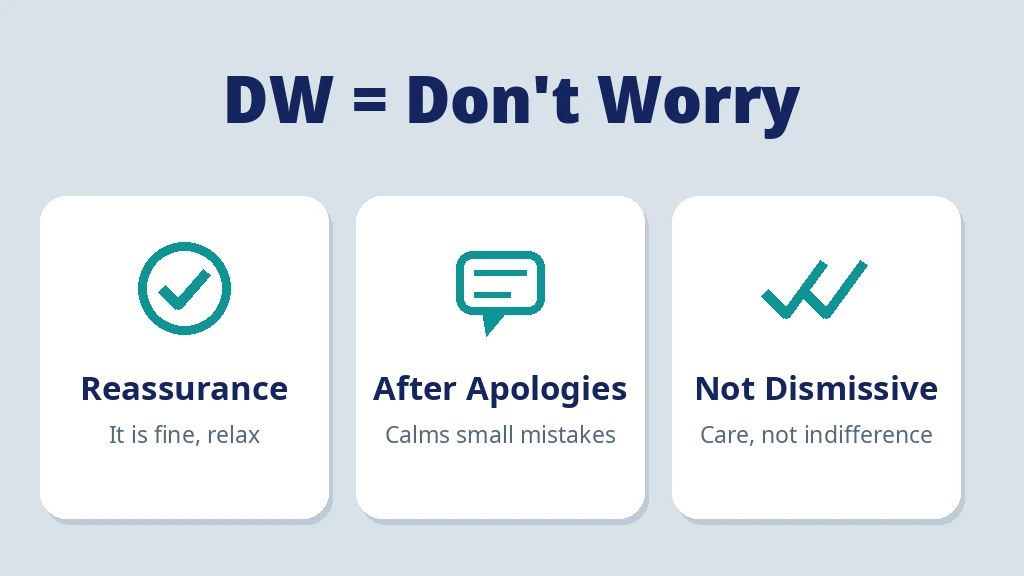
DW is usually written in lowercase as “dw,” though uppercase “DW” means the same thing. You will also see it joined to other words, as in “dw about it” or “dw too much.” The case does not change the meaning. The tone of the conversation does.
Think of DW as a tiny eraser. It wipes away guilt over small things: a late reply, a wrong photo, a missed call. It does not erase real problems, and it was never meant to. It handles the everyday frictions of chatting, not the serious moments of life.
DW Meaning in Easy Words
In plain words, DW usually means one of these: “It is fine, relax.” “No big deal.” “I am not upset.” “You do not need to explain.” “Chill, it is okay.”
If a friend says “dw about it,” they are really saying, “Seriously, let it go, I am not bothered.” If a coworker writes “dw, deadlines shift all the time,” they are saying, “This delay does not change how I see your work.” The words are short, but the message is warm: you are okay, and we are okay.
DW also works as a complete message on its own. A lone “dw” after an apology is a full answer. It says, “Message received, no hard feelings, let’s move on.” That is why it feels so relieving to get. It closes the worry loop in two letters.
Where Is DW Used?
You will see DW in almost every casual digital space: SMS and iMessage, WhatsApp, Instagram DMs and comments, Snapchat, Discord, Twitter/X, TikTok comments, and Reddit threads. Anywhere people type fast and want to keep the tone light, DW fits right in.
It is most common between friends, partners, and close coworkers, especially in group chats when plans change. A friend cancels, and someone replies “dw, we will do it another day.” The plan changes, but nobody carries guilt about it. That guilt-free quality is the whole point.
DW is less common in formal writing, and for good reason. A boss, a teacher, or a client usually deserves a fuller sentence. In relaxed workplace chats like Slack, DW is fine between people who already chat casually. In a formal email, it is not.
Why Do People Use DW?
People use DW because it is fast, soft, and emotionally gentle. Typing two letters beats typing “Please do not worry about it, it really is not a problem.” In a fast chat, that speed keeps the conversation moving instead of stalling on an apology.
It also softens the mood. A tense moment, an awkward slip, or a small mistake can make a chat feel heavy. DW lightens it in one move. It tells the other person, “I am not mad, and I am not keeping score.”
Finally, DW shows reassurance without demanding a long reply. The other person does not have to explain again or apologize again. They can simply accept the reassurance and move on. That is a kindness, especially for someone who tends to over-apologize.
Real-Life Examples of DW
Real chats show the warmth behind DW better than any definition. Read each example, then check the short note underneath it.
Example 1:
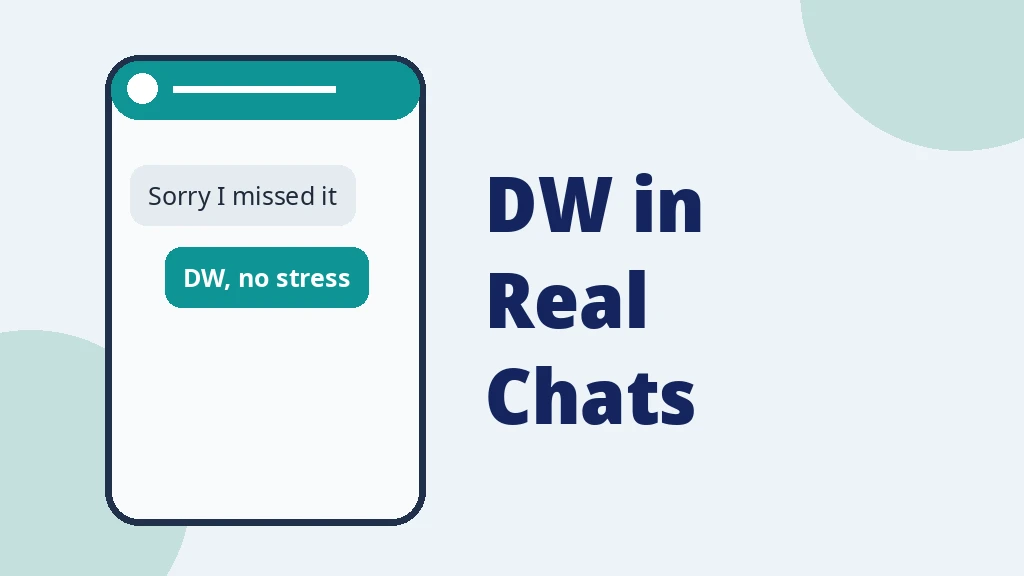
Friend: “I am so sorry I missed your call earlier.”
You: “dw, I was busy anyway.”
Meaning: No hard feelings. The missed call was genuinely not an issue, and the reply proves it.
Example 2:
Coworker: “Sorry, this report is a day late.”
You: “dw about it, deadlines shift all the time.”
Meaning: Reassurance without awkwardness. The delay is treated as normal, not as a failure.
Example 3:
Crush: “I probably said something dumb earlier lol.”
You: “dw, you are fine.”
Meaning: Comfort with a playful tone. The reply calms embarrassment instead of analyzing the moment.
Example 4:
Group chat: “Guys, I can’t make it tonight.”
Reply: “dw, we will do it another day.”
Meaning: No pressure. Plans can change without guilt, and the friendship stays intact.
Example 5:
Friend: “Ugh, I sent that message to the wrong chat.”
You: “dw, happens to everyone.”
Meaning: A shared shrug. The mistake is normalized, so the embarrassment fades fast.
Notice the pattern. In every example, DW removes guilt or stress from the other person. That is the emotional core of the abbreviation, and it is why people reach for it so often.
DW vs Similar Internet Terms
DW has several neighbors that feel similar but do not mean the same thing. NP means “No Problem” and usually answers a thank-you or a small favor. DW answers a worry or an apology. The difference is small, but it matters: NP says “that was easy,” while DW says “do not stress.”
NBD means “No Big Deal” and is close to DW, but slightly more casual and confident. IDC means “I Don’t Care,” which can sound cold or dismissive, the opposite of DW’s warmth. DWAI means “Don’t Worry About It,” which is DW with one extra word, and it is used in almost the same situations, just a touch more complete. You can see how another short chat term changes with context in our guide to BYW meaning in text, and see how quick replies work in our guide to BRB meaning in text.
DW also has context meanings outside everyday texting. In marriage and parenting forums, DW can mean “Dear Wife” or “Darling Wife,” as in “Picking up DW, then we will be on our way.” Fans use DW for the TV show Doctor Who, and gamers use it for Distant Worlds 2. Those readings are real, but they are not the texting default. In a normal chat, DW means “Don’t Worry” unless the conversation is clearly about a spouse, a show, or a game.
When to Use DW (and When to Avoid It)
Use DW when someone apologizes for something small, when plans change at the last minute, when someone feels embarrassed or awkward, or when a mistake genuinely is not a big deal to you. In those moments, DW is the kindest short reply available.
Avoid DW in formal emails and professional documents, where it looks careless. Avoid it when someone is going through something serious, because a two-letter reply can feel like you are not listening. Avoid it when the situation actually needs discussion, because DW can sound like you are brushing the topic aside. And avoid it when you are actually upset: sending DW when you are not okay creates a misunderstanding that surfaces later.
A good test is simple. If a longer sentence would show you actually care, write the longer sentence. DW is for moments when the short answer is also the honest answer.
Common Misunderstandings About DW
The first misunderstanding is that DW means the sender is not listening. Usually the opposite is true. They listened, decided the issue was small, and chose comfort over a lecture. The second is that DW sounds cold. Tone depends on context, and adding a friendly emoji or a short follow-up, as in “dw, I get it,” instantly warms it up.
The third misunderstanding is that DW means “I don’t care.” That is closer to IDC, not DW. DW is reassurance, not indifference. The fourth is that only teenagers use it. Adults use DW too, especially in casual texting and relaxed workplace chats.
The fifth misunderstanding is reading DW as “Dear Wife” in a normal chat. That reading belongs to forum posts and family threads where a spouse is the topic. If nobody is talking about a spouse, DW means “Don’t Worry.”
How to Reply to DW
Replying to DW is easy, because DW itself closes the worry loop. A simple “Thanks, I appreciate it” works. So does a light “Haha, thanks” or an emoji. You do not need to apologize again. In fact, apologizing again restarts the loop DW just closed.
If you sent DW and the other person keeps apologizing, add one warm sentence: “Seriously, dw, it is all good.” The repetition is not nagging. It is proof that you mean it. If the situation turns out to be bigger than you first thought, switch to full words and talk it through properly.
When you receive DW about something that actually still bothers you, say so kindly: “Thanks, I appreciate that. Can we still talk about it for a minute?” That keeps the warmth while opening the real conversation.
Pro Tips for Using DW
Add an emoji to soften DW further. “dw” with a smile feels warmer than a bare “dw.” Pair it with a short explanation when it matters: “dw, I get it” feels more thoughtful than “dw” alone.
Do not overuse DW in serious talks. If someone is really upset, DW alone can feel too short, and a fuller response will serve them better. Match the other person’s energy: playful chats welcome a playful DW, while serious chats deserve serious words.
Finally, use DW to end guilt spirals, not to end conversations. It is perfect for stopping someone from over-apologizing. It is not a substitute for listening when someone truly needs to be heard.
Frequently Asked Questions
What does DW mean in text?
DW means “Don’t Worry.” It is a quick reassurance used to calm someone after a mistake, a delay, or an awkward moment.
Is DW rude?
Not usually. It is casual and friendly. It can feel short only when the situation is serious and needs a fuller explanation.
Can DW mean Dear Wife?
Yes, in marriage and parenting forums DW can mean “Dear Wife” or “Darling Wife.” In everyday texting, though, “Don’t Worry” is the default meaning.
What is the difference between DW and DWAI?
DW means “Don’t Worry” and DWAI means “Don’t Worry About It.” They are used in almost the same situations, with DWAI sounding a touch more complete.
What is the difference between DW and NP?
DW comforts someone after a worry or apology. NP, or “No Problem,” usually answers a thank-you or confirms a small favor was easy.
Can I use DW at work?
Keep it for relaxed workplace chats with coworkers you know well. Avoid it in formal emails and client messages, where full sentences are expected.
Related Texting Slang
Keep exploring the dictionary: what DWAI means in a text, what DWN means in a text, what bet means in a text, cap in chats and texts, FR in chats and texts.
Final Thoughts
DW is one of the simplest and most emotionally useful abbreviations in texting. Two letters say, “You are okay. I am not upset. Let’s move on.” That is a lot of kindness for very little typing.
Now you know the dw meaning in text, when it warms a chat, when it falls flat, and how to reply to it without overthinking. Next time someone sends you a quick “dw,” you will know exactly what they mean, and you can use it just as well yourself.
For the reference side, Dictionary.com lists DW as an abbreviation for “don’t worry”, and CyberDefinitions gives “Don’t Worry” as the most common general-chat definition, with Dear Wife, Doctor Who, and Distant Worlds 2 as context senses, which together confirm why the texting default is so clear.
13 thoughts on “DW Meaning in Text | The Tiny Text That Changes the Mood”