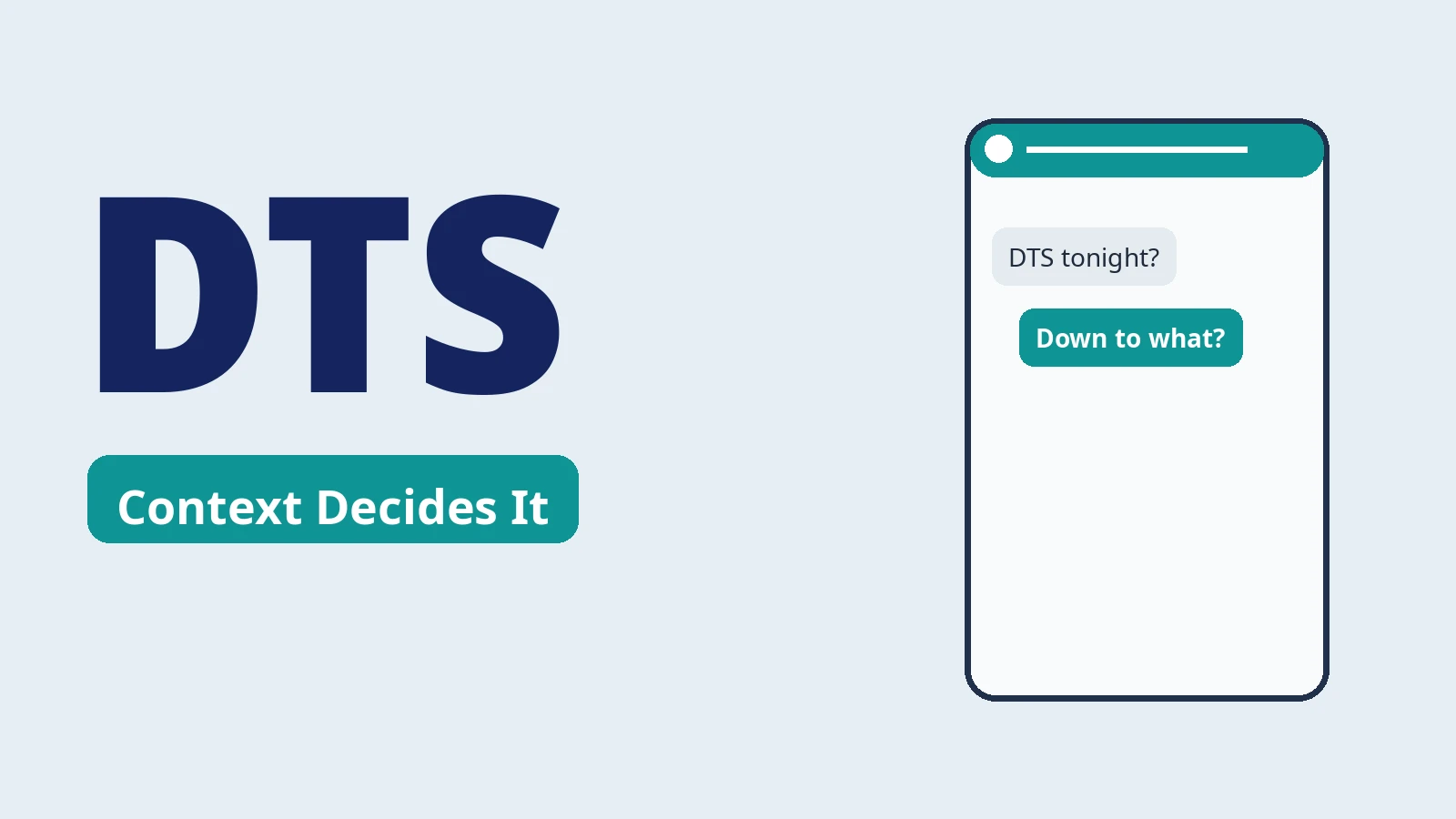
Your phone buzzes and a message says just one thing: “DTS?” No plan, no emoji, no hint about what comes next. Do you say yes? Do you ask what they mean? Do you pretend you understood?
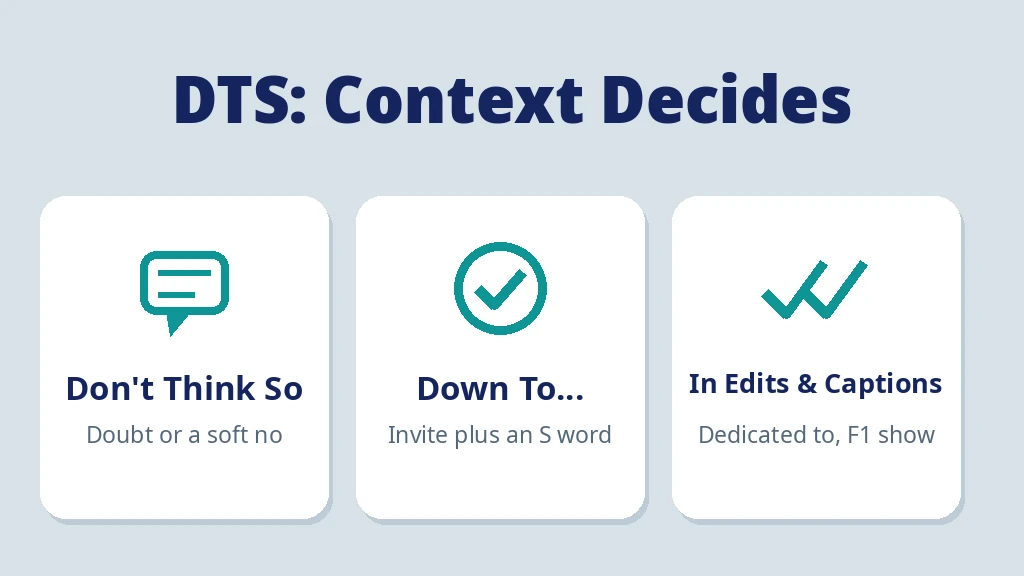
Here is the honest short answer: DTS has no single settled meaning in texting. It belongs to two main families of meaning in chats, and the right one depends on who sent it and what you were already talking about. In most casual chats it means either “Don’t Think So” or “down to” plus a word that starts with S, such as snuggle, smoke, or shore. In social media captions and fan edits, DTS leads a separate life of its own, and this guide covers that too.
This guide explains both readings, the clues that separate them, and the one question that clears up any doubt before you reply.
What Does DTS Mean in Text?
DTS is a three-letter abbreviation with two strong texting lives. The first is a soft disagreement: “Don’t Think So.” The second is a short invitation: “down to” plus an activity. Both are real, both are used by real texters, and neither one covers every chat on its own.
Quick definition: In texting, DTS most often means “Don’t Think So” when it answers a claim or a question, and “down to” plus an S-word when it proposes or accepts a plan. Context, not the letters alone, decides which reading fits.
Why does one abbreviation carry two jobs? Because texting slang grows inside separate groups. One group shortened a polite doubt into three letters. Another group shortened “down to” invites into the same three letters.
That is also why a confident one-line definition for DTS would mislead you. If you assume the doubt meaning in a flirty chat, you will reject an invite you meant to accept. If you assume the invite meaning in a debate, you will agree to something nobody offered.
DTS Meaning in Easy Words
Think of DTS as a coin with two sides. On one side it says, “I doubt that.” On the other side it says, “I am up for that.” You cannot see which side is up until you look at the conversation around it.
As “Don’t Think So,” DTS is a gentle no. It says, “I do not agree,” or, “I am not sure that is right,” without sounding harsh. As a “down to” invite, DTS is a quick yes or a quick question: “Are you up for this?” or, “Yes, I am up for this.”
The grammar gives you a useful clue. The doubt meaning usually stands alone as a reply: “DTS.” The invite meaning often comes with a question mark or follows a plan: “DTS tonight?” If the message reads like an answer, lean toward doubt. If it reads like a plan, lean toward an invite.
Where Is DTS Used?
You will see DTS in private texts, group chats, Snapchat messages, Instagram comments, and gaming chats. The doubt meaning shows up anywhere people react to a claim: a prediction, a rumor, or a suggestion. The invite meaning shows up where people make plans fast: late-night chats, weekend group chats, and gaming lobbies.
Place matters too. In parts of the United States, especially around New Jersey, “down the shore” is everyday talk for a beach trip, so DTS in a summer group chat may simply mean a trip to the shore. In a gaming chat, the S-word may point to summoning, as in joining a match or calling a teammate into play.
On social media, DTS often appears in captions and comments where brevity wins. There, the surrounding post does most of the explaining. A beach photo points to the shore. A cozy evening post points to snuggling. A gaming clip points to playing together. And in fan communities, DTS in a caption often is not chat slang at all, as the next section explains.
DTS on Social Media and in Fan Edits
Meet DTS outside private chats and you will find two more meanings that have nothing to do with doubt or invites.
Drive to Survive. Among Formula 1 fans, DTS is the standard short name for the Netflix series Formula 1: Drive to Survive. Fan accounts, hashtags, and video edits use DTS to talk about the show and the wave of new fans it brought to the sport. A caption like “DTS got me into F1” is about a TV series, not about a plan or an opinion.
Dedicated To. In video and photo editing communities, editors tag their work “dts” followed by a name or account, dedicating the edit to that person, the same way a book carries a dedication page. The shorter form DT is used for “dedicated to” as well. When you see “dts @someone” under an edit, the editor is gifting the edit, not asking or doubting anything.
Example:
- Caption: “new edit is up, dts @maya”
- Reply: “wait, you made this for me? thank you”
Meaning: Dedicated To. The tag names the person the edit was made for.
So the full map is this: in a chat, read DTS as doubt or as an invite. In a caption or an edit tag, read it as the F1 show or as a dedication. The platform, not just the sentence, is part of the context.
Why Do People Use DTS?
People use DTS because it is fast and low pressure. Typing three letters is quicker than writing “I don’t think so” or “Are you down to hang out tonight?” In a fast-moving chat, that speed matters.
It also softens the message. A plain “no” can sound blunt. “DTS” sounds lighter, more like a shrug than a rejection. On the invite side, a short “DTS?” feels easier to send than a long, formal invitation, and easier to decline, because the other person can answer with a simple yes, no, or question.
Finally, slang signals belonging. When friends share shorthand, the shorthand itself says, “We talk like this.” That is part of the appeal, and part of the risk: outsiders to the group may read the wrong meaning entirely.
Real-Life Examples of DTS
Real chats show the split better than any definition list. Read each example, then check the short note underneath it.
Example 1:
Alex: “That new cafe is definitely going to be packed all weekend.”
Sam: “DTS. It was empty last Saturday.”
Meaning: Sam doubts the claim. This is the “Don’t Think So” reading, used as a soft disagreement with a reason attached.
Example 2:
Jordan: “Long day. I am so tired.”
Casey: “DTS tonight?”
Jordan: “Yes please. Bring snacks.”
Meaning: Casey is asking about a cozy evening together. The tired mood and the late hour point to the “down to snuggle” reading.
Example 3:
Riley: “Anyone DTS after dinner?”
Alex: “Give me 30 minutes. I will log on.”
Meaning: Riley is rounding up players. In a gaming chat, the invite reading wins, and logging on is the confirming clue.
Example 4:
Sam: “Heading to the beach house Saturday.”
Chris: “I am DTS. What time?”
Meaning: Chris is up for the trip. With a beach house in the conversation, “down the shore” is the natural reading.
Example 5:
Morgan: “DTS?”
Dev: “DTS what? Snuggle, or something else?”
Meaning: Dev refuses to guess. When a message has no context, asking is smarter than answering the wrong meaning.
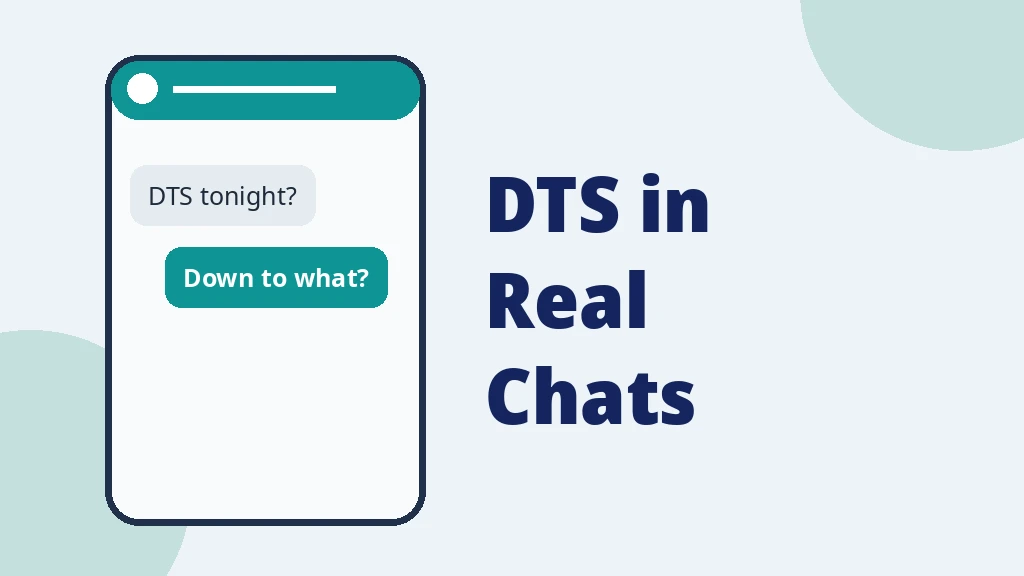
Notice the pattern across all five examples. The meaning never comes from the letters alone. It comes from the sentence before, the relationship, the time of day, and the app you are using.
DTS vs Similar Internet Terms
DTS sits inside a crowded family of short forms, and the neighbors cause most of the confusion. IDTS means “I Don’t Think So,” which is the fuller cousin of the doubt reading of DTS. IDK means “I Don’t Know,” which is about missing information, not doubt. Use IDK when you genuinely lack an answer, and DTS when you lean toward disagreeing.
On the invite side, DTC means “down to cuddle” and DTP means “down to party.” Both name their activity outright, which is why they cause fewer mix-ups than DTS. DT on its own can mean “down to” plus anything, so it is even vaguer than DTS. And DM means “direct message,” which has nothing to do with either DTS family, despite sharing a letter.
One warning matters more than the rest. DTS looks like DTF, but the two are not the same. DTF is far more explicit, and treating DTS as if it meant the same thing can turn a casual chat into a very awkward one. If you are unsure, never upgrade the meaning in your head. Ask instead. You can also compare how a clear reply term works in our guide to BRB meaning in text, where one short form also changes with context, and see how a multi-sense term is handled in our guide to DB meaning in text.
When to Use DTS (and When to Avoid It)
Use the doubt reading with close friends when you want to disagree gently, especially when you can add a short reason, as in “DTS, the last one was empty too.” Use the invite reading only when the activity is obvious from the conversation, or when the other person already uses the same shorthand.
Skip DTS with someone you just met, because they may not know either reading. Skip it at work or school, where a short form can look careless. Skip it when the topic is serious, and skip it whenever a misunderstanding would actually matter, such as plans involving money, travel, or feelings. In those cases, spell it out.
A simple rule covers nearly every case: if guessing wrong would embarrass you or hurt someone, do not guess. Ask one clear question, or write the full words.
Common Misunderstandings About DTS
The biggest misunderstanding is that DTS has only one meaning. It does not. Acronym lists record many senses, and real chats use at least two of them regularly. Anyone who tells you there is one official texting definition is selling certainty the evidence does not support.
The second misunderstanding is that DTS is always romantic. It is not. “Down the shore” is a beach trip. The gaming reading is about playing together. Only the snuggle reading is cozy or romantic, and even that depends on the relationship.
The third misunderstanding is confusing DTS with DTF, covered above. The fourth is trusting every definition page you find. Some auto-generated pages claim rare senses that almost nobody texts, such as “does that sound.” If a definition does not match how real chats work, do not trust it.
Finally, do not confuse DTS with DTs in medical writing. DTs, usually written with a lowercase s, is shorthand for delirium tremens, a serious condition linked to alcohol withdrawal. That is a medical term, not a texting meaning, and it belongs in a completely different conversation.
How to Reply to DTS
Your reply depends on which reading you are facing. If someone sends the doubt reading at you, answer the claim, not the letters: “Fair enough, what makes you think so?” or, “Hmm, I still think it will be busy, but we will see.” Keeping the conversation on the topic avoids a fight about shorthand.
If someone sends an invite and you are interested, say so plainly: “Yes, I am in. What time?” If you are not interested, a kind no works: “Not tonight, but thanks for asking.” If you are unsure what they meant, use the safest reply of all: “Down to what?” or, “Sorry, do you mean you doubt it, or you are up for it?” A one-line question prevents a long misunderstanding.
Never answer an invite you did not understand with a bare yes. A yes to the wrong reading is how a casual chat becomes an awkward one.
Pro Tips for Using DTS
Read the three clues first: who sent it, when they sent it, and where you are chatting. Those three clues solve most DTS mysteries before you reply.
When you use DTS yourself, add one word of context the first time: “DTS tonight?” beats a bare “DTS?” because it tells the reader a plan is involved. When you doubt something, add a reason: “DTS, it rained last time too.” Context is a gift to the reader.
Match the other person’s energy. If they text casually, a casual reply fits. If they seem serious, answer with full words. And remember that slang ages fast. Use DTS when it feels natural to you, not because a list told you it is popular.
Frequently Asked Questions
What does DTS mean in text?
DTS has two main texting readings: “Don’t Think So” as a soft disagreement, and “down to” plus an S-word as an invite. Context decides which one fits.
Is DTS the same as DTF?
No. DTS is usually softer and often about a casual plan or a doubt. DTF is far more explicit. Never treat them as interchangeable.
What does DTS mean on Snapchat?
On Snapchat it usually works as a quick invite or a quick reaction, and the surrounding snap or story gives the clue. A cozy snap points to snuggling, a beach snap points to the shore.
What does DTS mean in gaming?
In gaming chats it usually means an invite to play together, sometimes phrased as down to summon. The lobby or match talk around it is the confirming clue.
What is the difference between DTS and IDTS?
IDTS means “I Don’t Think So” and is only the doubt reading. DTS can also be an invite, which is why DTS causes more confusion than IDTS.
Should I use DTS at work?
No. At work, write the full words. A short form that half your readers may misread is not worth the time it saves.
What does DTS mean in video edits and captions?
Usually one of two things: “dedicated to,” when an editor tags the person the edit was made for, or Drive to Survive, the Netflix Formula 1 series, in F1 fan posts. Neither is the chat slang, so check the platform before the sentence.
Related Texting Slang
Keep exploring the dictionary: when someone texts you emphasize, ERM, explained with real examples, FR in chats and texts, HBU in chats and texts, JK in chats and texts, what NTM means in a text, SMH in chats and texts.
Final Thoughts
DTS is a small abbreviation with an honestly split meaning. The doubt reading and the invite reading both have real support, and pretending one of them is the only answer would mislead you. The skill is not memorizing a definition. It is reading the room: the sender, the timing, the app, and the sentence before it.
Now you know the dts meaning in text in both its main forms, the clues that separate them, and the one question that settles any doubt. Next time DTS lands in your chats, pause, check the context, and reply to the meaning that actually fits.
For the reference side, CyberDefinitions defines the fuller doubt form IDTS as “I Don’t Think So”, which supports the doubt family, and The Free Dictionary lists the DTS acronym senses side by side, including the doubt reading and the down-to readings, which is exactly why context has to do the final deciding.