
You answer a friend’s question, share your own news, and then they reply with three letters: “hbu?” The conversation does not end there. It bounces straight back to you. But what exactly are they asking?
Here is the short answer: HBU means “how about you?” in texts and online chats. It is the quick way to hand a question back to the other person after answering it yourself. It keeps the conversation two-sided, without retyping the whole question.
This guide explains the hbu meaning in text, how it works as a conversation turn, where it shows up, and the few places where a different reading fits.
What Does HBU Mean in Text?
HBU stands for how about you?, often spoken as “how ’bout you?”
CyberDefinitions gives “How About You?” as its quick answer for HBU, and Wiktionary lists hbu as internet slang for “how ’bout you?” The everyday guides line up behind the same reading: hbu is a reciprocal question, not a statement. It only makes sense after someone has already shared something, because its job is to ask for the other side of the same question.
Quick definition: HBU means “how about you?” People use it at the end of their own answer to ask the other person the same question back, keeping the conversation balanced and moving.

In speech, “how about you” is already shortened to “how ’bout you”. HBU simply writes that spoken shortcut down, pronounced letter by letter, and usually written in lowercase, because lowercase feels like the relaxed voice it imitates.
HBU almost always comes with a question mark, or at the end of a sentence that is already a question. “I am good, hbu?” is the classic shape: an answer, then the bounce-back. On its own, without a question before it, hbu still works as a prompt, but it leans on the conversation to supply the question it is returning.
HBU Meaning in Easy Words
Think of hbu as a tennis return.
Imagine a friend serves you a question: “How was your weekend?” You answer, “It was great, I went hiking.” If you stop there, the conversation can stall, because you have answered and offered nothing back. Adding “hbu?” is like hitting the ball back over the net. It says “your turn now, same question”, and the rally continues.
That is why hbu is sometimes called a social ping. It signals interest: you care about their answer, not just your own news. A chat without hbu can feel like two monologues; a chat with hbu feels like a conversation.
The easiest test is to expand it. Replace hbu with “how about you?” and read the message again. If the message still sounds natural, you have read it right. “I am tired, hbu?” becomes “I am tired, how about you?” If the expansion sounds odd, the sender may be using hbu differently, or the question it returns may be further back in the chat than you think.
Where Is HBU Used?
HBU lives in casual, two-way conversations. It is a peer-to-peer word, not a broadcast word, because it needs a conversation partner to bounce the question to.
Common places:
- Private texts and WhatsApp chats between friends
- Instagram and Snapchat DMs
- Group chats, often as “hbu guys” or “hbu all”
- Discord servers and gaming chats
- Dating app conversations and getting-to-know-you chats
Typical situations:
- After answering “how are you?” and asking the same back
- After sharing plans and asking about the other person’s plans
- After giving an opinion and inviting the other person’s opinion
- After a status update, such as “I am home now, hbu?”
- In a group chat, after an announcement, to collect everyone’s side
On Snapchat and Instagram, hbu is a staple of streaks and daily check-ins. A message saying “nm, hbu?” is a low-effort way to keep a conversation alive without a big topic.
Why Do People Use HBU?
It saves retyping the question
Typing “how about you?” takes time, especially on a phone. HBU delivers the same question in three letters, and the reader already knows which question is being returned, because it is the one they just asked.
It shows interest
Answering without asking back can feel self-centred, even when it is not meant that way. HBU fixes that in one move. It turns a report into an exchange.
It keeps conversations alive
Chats die when one side stops asking. HBU is a small engine for continuation: every answer ends with an invitation, so the other person always has a clear next move.
It feels natural and spoken
Because hbu mirrors the spoken “how ’bout you”, it reads like real talk rather than formal writing. That spoken feel is why it survives in an era when most abbreviations come and go.
HBU on Social Media and in Group Chats
On social media, hbu does the same job as in private chats, with two small twists. First, in DMs with someone new, hbu is often part of the getting-to-know-you script: a question, an answer, then hbu, repeated until both people have a picture of each other. It is polite, low-risk, and easy to answer, which is why it appears so early in new conversations.
Second, in group chats, hbu scales up. A single “hbu?” can feel unclear when five people are reading, so people add a plural: “hbu guys”, “hbu all”, or “hbu everyone”. That small addition turns a one-to-one bounce-back into a group invitation, and it avoids the awkward moment where nobody replies because everyone assumed someone else would.
HBU is not flirty on its own. Asking about someone is friendly, and in a dating chat that friendliness can carry a flirty edge, but the feeling comes from the conversation, not the letters.
Real-Life Examples of HBU
Here is how hbu actually appears in everyday chats:
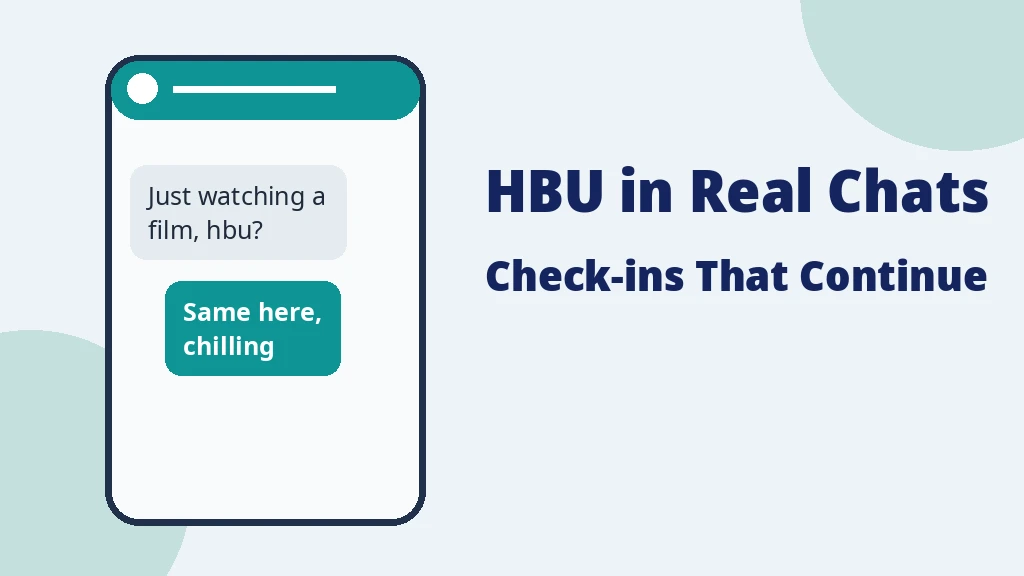
Example 1:
- Friend: “How are you today?”
- You: “I am good, thanks, hbu?”
Meaning: A polite bounce-back. You answered, and now you are asking the same question in return.
Example 2:
- Friend: “What are you doing tonight?”
- You: “Just watching a movie, hbu?”
Meaning: Plans exchanged. Your answer invites their plans, so the evening can be compared or combined.
Example 3:
- Friend: “I loved that new movie, what did you think?”
- You: “I loved it too, the ending was perfect, hbu?”
Meaning: Here hbu is slightly redundant, because you already gave your opinion, but it still works as a friendly nudge: “I have said my side, now tell me more of yours.”
Example 4:
- Group chat: “I am free on Saturday, hbu guys?”
- Members: “Free too”, “Busy, sorry”, “Free after 5”
Meaning: A group bounce-back. One announcement becomes a quick poll of everyone’s plans.
Example 5:
- Friend: “NM, hbu?”
- You: “NM too, just chilling”
Meaning: The classic short exchange. NM means “not much”, and hbu asks for your version of not much. Both sides say little, and the conversation stays warm anyway.
HBU vs Similar Internet Terms
| Term | Meaning | Difference |
|---|---|---|
| HBU | How about you? | Most common, sounds natural spoken aloud |
| WBU | What about you? | Nearly identical, slightly blunter |
| HBY | How ’bout you? | Same meaning, much less common |
| WYD | What are you doing? | Asks a new question, not a return |
| NM | Not much | An answer, often paired with hbu |
Key difference:
- HBU and WBU are interchangeable in practice. HBU sounds a little softer, WBU a little more direct, but nobody will correct you for choosing either.
- HBY spells the spoken form more literally, but it is rare, and most readers will recognise HBU faster.
- WYD starts a question rather than returning one. HBU only works when a question is already on the table.
And if the reply you get is a greeting rather than a question, the reading changes again. Here is what GN means in text, a shortcut that closes a chat instead of bouncing a question back.
HBU Variations You Should Know
HBU vs WBU is a style choice. Both mean the same thing in practice, and both are understood everywhere. HBU is the safer default, because it is the version most guides and dictionaries lead with.
HBU all / hbu guys adapts the question for group chats. Without the plural, a group hbu can hang unanswered, because each reader waits for someone else to go first.
NM HBU is a fixed pair in texting. NM means “not much”, and the hbu that follows asks for the other person’s version. Together they form a complete mini conversation in two abbreviations.
Lowercase hbu vs capital HBU makes little difference. Lowercase is the usual chat form. Capitals can feel slightly more emphatic, but the meaning stays the same.
How to Reply to HBU
Your reply depends on what question hbu is returning.
If hbu follows “how are you?”: answer honestly and briefly. “I am good, thanks” or “Pretty tired today” both work. You do not need to add hbu again, unless you want to keep the rally going.
If hbu follows a plans question: share your plans, or say you have none. “Nothing planned yet, what about you?” is fine, even though it returns the question a second time, because plans change as details emerge.
If hbu follows an opinion question: give your opinion, even a short one. “I liked it too” or “Not my favourite, honestly” keeps the exchange balanced.
If you do not want to answer: you can deflect lightly. “Long story, tell me about yours first” or “I will fill you in later” keeps the tone friendly without forcing an answer.
When to Use HBU (and When to Avoid It)
Good situations:
- Answering a friend’s question and asking it back
- Keeping a casual conversation balanced and friendly
- Checking in with someone in a DM or group chat
- Getting to know someone new in a relaxed chat
- Polling a group chat for everyone’s plans
Avoid using HBU when:
- Writing to a teacher, boss, or anyone formal
- Sending a work email or an official message
- The conversation is serious, and a shortcut could look careless
- No question has been asked yet, so there is nothing to return
- You are writing schoolwork or anything that will be marked
Common Misunderstandings About HBU
HBU is not a greeting on its own. It looks like a conversation opener, but it works best as a return. Opening a chat with a bare “hbu?” can confuse the reader, because there is no question to bounce back yet.
HBU does not mean “how are you” in general. It means “how about you”, which is the return version. The difference is small, but it explains why hbu feels odd as a first message and natural as a second one.
HBU is not rude. Some people worry that a three-letter reply looks lazy, but in casual chats hbu reads as interest, not indifference. It says you want the other person’s side too.
HBU does not always refer to a university. CyberDefinitions also lists Houston Baptist University as a second meaning, and in academic writing HBU can mean a historically Black university. In a casual chat, neither applies. The conversation context settles it.
HBU is not the same as WYD. WYD asks what someone is doing from scratch. HBU returns a question that is already running. Mixing them up can make a reply feel off-topic.
Frequently Asked Questions
What does HBU mean in text?
HBU means “how about you?” in texts and online chats. It is used after answering a question to ask the other person the same question back.
What does “NM HBU” mean?
“NM HBU” means “not much, how about you?” NM means “not much,” and hbu asks for the other person’s update in return. Together they form a short, friendly check-in.
What is the difference between HBU and WBU?
Almost none in practice. HBU means “how about you?” and WBU means “what about you?” Both return a question, and both are understood everywhere. HBU is the more common version.
Can I start a conversation with HBU?
It is not ideal. HBU works best as a return, after someone has shared something or asked a question. As an opener, it can confuse the reader, because there is no question to hand back yet.
What does HBU mean on Snapchat and Instagram?
It means the same thing as in chats: “how about you?” On Snapchat and Instagram it is common in DMs and streak check-ins, often as a quick way to keep a conversation going.
Is HBU formal?
No. HBU is informal chat slang. In formal messages, work emails, and schoolwork, write “how about you?” in full instead.
Related Texting Slang
Keep exploring the dictionary: BTA, the HBY meaning, in plain words, how people actually use ISO, how people actually use Namaste, wyn meaning in text.
Final Thoughts
HBU is one of the most useful shortcuts in texting, precisely because it does social work, not just typing work. It means “how about you?”, and it turns an answer into an invitation, a report into a conversation, and a monologue into an exchange.
Use it whenever you catch yourself answering without asking back. Three letters show interest, and in a chat, interest is often the whole message.
The reference works agree on the reading. Wiktionary lists hbu as internet slang for “how ’bout you?”, and CyberDefinitions gives “How About You?” as its quick answer for HBU, which matches exactly how people use it at the end of their own answers.
5 thoughts on “HBU Meaning in Text | The Question That Bounces Back”