Your friend suggests meeting at six, and you reply with four letters: “IHHT”. They read it as a yes. Or was it a no? Or something else entirely?
Here is the short answer: IHHT usually works as a quick way to say “alright” in texting. It is a clipped, casual spelling of “aight”, the shortened form of alright, used to agree, accept a plan, or acknowledge a message. But IHHT is one of the least settled codes in this batch, and other readings exist, so context has to do more work than usual.
In this guide you will learn the ihht meaning in text, why its readings disagree, where each one shows up, and how to avoid guessing wrong when you see it.
What Does IHHT Mean in Text?
In a chat, IHHT is usually a shrug of agreement written as a spelling, not as an abbreviation.
Most slang codes are initialisms: each letter stands for a word, as in IDK for “I Don’t Know”. IHHT works differently. The letters do not expand into four words. They sound out a word, “aight”, which is itself a casual clipping of “alright”. It is the same family as “ight”, “aight”, and “ite”: spellings that try to capture how “alright” sounds when it is said quickly and casually.
Quick definition: IHHT usually means “alright” in texting. It is an informal spelling used to agree, accept a plan, or acknowledge a message in a casual tone.

The sources split on this term, and the split has to be stated honestly. Texting.io says IHHT is an informal abbreviation that often means “alright” in text messages and online conversations, similar to “aight” or “ite”, and used to show agreement or acceptance in a casual tone. Enlightened Meanings agrees, calling “alright” the meaning of IHHT and a quick way to agree or acknowledge something. Those two guides agree with each other, and they agree with the Day 9 pre-check, which places IHHT in the “alright” family alongside IGH and IHH. CyberDefinitions has no entry for this term at all (its page returns a clean 404), so that layer contributes nothing here. Wiktionary was not found to carry a texting entry for IHHT either, which fits a spelling that lives in chats rather than in dictionaries.
But the agreement ends there. Other guides lead with completely different readings, and this article covers them below instead of pretending they do not exist. The honest position is this: “alright” has two independent guides behind it, which is enough to lead with it, but IHHT is contested, and a bare IHHT in a chat you care about deserves a second look at the sentence around it.
IHHT Meaning in Easy Words
Think of IHHT as typing “alright” the way it sounds when you say it fast.
When someone writes “alright” in full, it sounds considered. When they write “aight”, it sounds relaxed. When they write IHHT, it sounds even more relaxed, almost like a mumble of agreement. The letters are a sound, not a code, and that is why trying to expand them into four words misses the point.
In the simplest words:
IHHT = “Alright, okay, got it.”
That reading fits the way people actually use it. They write IHHT when a friend suggests a time, confirms a plan, or shares news that needs only an acknowledgement. It is not an enthusiastic yes, and it is not a reluctant no. It is a calm, easy acceptance, the kind of reply that keeps a chat moving without adding any new information.
Where Is IHHT Used?
IHHT lives in casual private chats, wherever friends confirm plans quickly.
Common places:
- WhatsApp and iMessage chats, where friends agree on times and meeting points
- Instagram and Snapchat DMs, often as a reply to a plan or a story
- TikTok comments and captions, where IHHT can also carry the “I hate it here” sense
- Discord and gaming chats, where players agree to a plan without stopping the game
- Facebook Messenger chats, often as a short acknowledgement of a message
Why Do People Use IHHT?
It agrees without adding anything new
Sometimes a chat only needs an acknowledgement, not a new sentence. IHHT says “I heard you, and I agree” in four letters, and it does not invite a long reply. That is useful when the plan is already clear and the conversation is nearly done.
It sounds relaxed, not stiff
Writing “alright” in full can feel formal in a fast chat, and writing “okay” can feel flat. IHHT sounds casual and easy, which matches the tone of a friendship chat where everyone is already comfortable with each other.
Real-Life Examples of IHHT
Here is how IHHT actually shows up in chats:
Example 1:
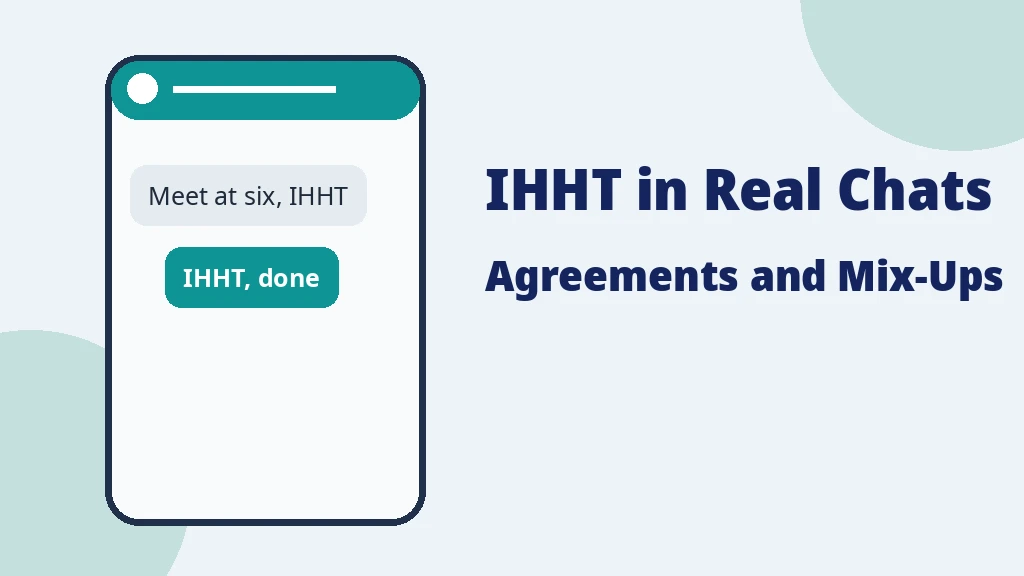
- Chat: “We leave at six, okay?” “IHHT, see you then.”
Meaning: The sender agrees to the time.
Example 2:
- Chat: “I will bring the snacks, you bring the drinks.” “IHHT, done.”
Meaning: The sender accepts the split of jobs.
Example 3:
- Chat: “This queue is endless, IHHT.” “I know, I want to go home.”
Meaning: This is the TikTok sense, “I hate it here”, used as a caption or a complaint.
Example 4:
- Chat: “She was so rude to me again.” “IHHT, she is always like that.”
Meaning: This is the “I hate him/her too” reading, agreeing with a dislike.
Example 5:
- Chat: “Reset your phone, then try again. IHHT.”
Meaning: This is the “I hope that helps” reading, used to close a helpful explanation.
IHHT vs Similar Terms
| Term | Meaning | When to use it |
|---|---|---|
| IHHT | Alright (spelling) | Casual agreement or acknowledgement |
| IGH | Alright (spelling) | Same family, shorter clipped form |
| IHH | Alright or reaction sound | Same family, even shorter, often a squeal |
| OK | Okay | Plain, neutral agreement |
| Bet | Okay, agreed, for sure | Confident, enthusiastic agreement |
Key difference: IHHT, IGH, and IHH all belong to the same “alright” family, and they are easy to confuse, which is why this batch keeps them apart. IHHT is the longest of the three and the most likely to be read as “alright” in a plan. IGH is a shorter clipping of the same word, and IHH is the shortest, often used as a pure reaction sound with no clear expansion at all. OK is the neutral version of all of them, with no slang flavour, while Bet is the confident version, an agreement with energy behind it. Choose IHHT when you want a relaxed yes, OK when you want a neutral one, and Bet when you actually mean it with enthusiasm.
That family resemblance is also the risk. A reader who knows IGH may read IHHT as the same word, which is usually right, but a reader who knows only the “I hate it here” sense may read a plan agreement as a complaint. The letters alone cannot settle it, and only the sentence around them can.
The Other IHHT Meanings You Should Know
“I hate it here” is the TikTok sense. GB Times reports that “ihht” on TikTok is an abbreviation for “I hate it here”, used as a caption or hashtag to express discontent with a situation, a location, or a trend. It is often humorous or self deprecating, and it usually appears under a video that shows the frustrating situation. If IHHT appears as a caption or a hashtag, this is the reading to choose, not “alright”.
“I Hate Him/Her Too” is the complaint sense. Qoutermenia leads with “I Hate Him/Her Too” as the most common meaning of IHHT, used to show agreement with someone’s dislike or frustration towards another person. That guide is a single source for this lead, and it disagrees with the two guides behind “alright”, so it is covered here as a real but contested sense. If the sentence is about disliking a person, this reading fits.
Intermittent Hypoxic-Hyperoxic Training is the medical sense. In health and sports science, IHHT stands for Intermittent Hypoxic-Hyperoxic Training, a therapy that alternates between low oxygen and high oxygen air. Stylist and Neurolaunch both describe it, and it has nothing to do with chats. If the sentence is about therapy, altitude, or training, this is the reading.
How to Reply to IHHT
IHHT is a short, ambiguous reply, so the best response starts with working out which reading you just received.
If IHHT meant “alright”: treat it as a yes and move on. “Great, see you at six” or “Perfect, I will bring the snacks” confirms the plan and closes the exchange cleanly.
If IHHT meant “I hate it here”: reply to the complaint, not the letters. “Same, this queue is the worst” or a laughing emoji matches the humour, while a plain “okay” would miss the joke entirely.
If you cannot tell which reading fits: ask, briefly. “Do you mean alright, or are you fed up?” takes seconds, and it is far better than agreeing to a plan the sender never accepted, or laughing at a complaint the sender never made. For a clearer check-in reply, here is what HBU means in text and when that question fits.
When to Use IHHT (and When to Avoid It)
Good situations:
- Agreeing casually to a small plan with a close friend who knows your slang
- Acknowledging a message when no new information is needed
- Using it as a TikTok caption or hashtag for a frustrating situation, where “I hate it here” is the clear sense
- Closing a short exchange with a relaxed, easy tone
Avoid using IHHT when:
- The agreement matters, such as a time, a payment, or a promise, since IHHT is too vague to confirm details
- Your reader may know a different reading, such as “I hate it here” or “I hate him too”
- You are writing to anyone at work, at school, or in a formal setting, where “alright” or “okay” fits better
- The chat is already tense, because an ambiguous reply can be read as indifference or as a complaint
Common Misunderstandings About IHHT
IHHT does not have one settled meaning. This is the most important thing to know about it. The guides disagree with each other, and this article leads with “alright” because two guides agree on it, not because the other readings are wrong. Treating IHHT as a settled code will misread a large share of its uses.
IHHT is not an abbreviation with four words behind it. Readers often try to expand it letter by letter, and that search produces the competing readings: “I hate him too”, “I hope that helps”, and others. The “alright” reading works differently, as a spelling of a sound, and that is why it sits apart from the expansions.
IHHT is not the same as IGH or IHH. The three terms share a family, but they are not interchangeable. IGH is a shorter clipping, IHH is often a pure reaction sound, and IHHT is the longest form, most likely to be read as “alright” in a plan. Copying an expansion from one into another is how the confusion started, and this article keeps them separate.
Frequently Asked Questions
What does IHHT mean in text?
IHHT usually means “alright” in texting, as a casual spelling of “aight”. It is used to agree, accept a plan, or acknowledge a message, but other readings exist, so context matters.
What does IHHT mean on TikTok?
On TikTok, “ihht” usually means “I hate it here”. It appears as a caption or hashtag under videos that show a frustrating or relatable situation, often with humour.
Does IHHT mean “I Hate Him Too”?
It can. One guide leads with “I Hate Him/Her Too” as the meaning, used to agree with a dislike of a person. That reading is contested, and it only fits when the sentence is about disliking someone.
Is IHHT the same as IGH?
No, but they belong to the same “alright” family. IGH is a shorter clipping of the same word, while IHHT is the longer form. They are not interchangeable, and IHH is a separate, shorter reaction sound.
What does IHHT mean in medicine?
In medicine and sports science, IHHT means Intermittent Hypoxic-Hyperoxic Training, a therapy that alternates low oxygen and high oxygen air. That reading never applies in a chat.
How do you reply to IHHT?
First work out which reading fits, then reply to that. If it meant “alright”, confirm the plan. If it meant “I hate it here”, reply to the complaint. If you cannot tell, ask briefly instead of guessing.
Final Thoughts
IHHT is the least settled code in this batch, and that is its lesson. In most chats it works as a quick way to say “alright”, a casual spelling that agrees, accepts, or acknowledges without adding anything new. Two guides agree on that reading, and the pre-check places it in the same family as IGH and IHH, so it is a fair lead.
The medical sense is described by Stylist, which explains Intermittent Hypoxia-Hyperoxia Therapy as alternating low oxygen and high oxygen air. If short agreements still trip you up, here is what DW means in text, a reply that is far more settled than IHHT.