
Your friend asks what the teacher said about the homework, and your mind goes blank. You know she said something, but the words are gone.
Here is the short answer: ICR usually means “I Can’t Remember” in a text. It is a quick, honest way to admit that a detail has slipped your mind, without turning the moment into a big deal.
In this guide you will learn the icr meaning in text, when it also means something else on social media, how it differs from IDK and IDR, and what to say when someone sends it to you.
What Does ICR Mean in Text?
In a private chat, ICR is a small confession. It says the memory is missing right now, not that the sender never knew it.
Most texting abbreviations save time. ICR saves face as well. Saying “I can’t remember” in full feels heavy, like an apology. Three letters keep it light. The sender admits the gap and the chat keeps moving.
Quick definition: ICR means “I Can’t Remember” in a text. It tells the other person that you cannot recall a name, a time, a detail, or part of a conversation at this moment.

The sources agree on this reading. CyberDefinitions gives “I Can’t Remember” as the definition of ICR in a text, and it notes that the abbreviation usually points to a temporary loss of memory, the kind where the answer may come back soon. The niche guides that rank for this term lead with the same meaning: GrammarSensePro, SlangSphere, and CyberDefinitions all put “I Can’t Remember” first in their guides to ICR in text messages and chats.
That agreement matters, because ICR has a second life on social media. In comments under relatable posts, some people write ICR to mean “I Can Relate”. That sense is real but narrow, and this guide separates it carefully. In a private text or DM, ICR almost always means the memory sense.
ICR Meaning in Easy Words
Think of ICR as a shrug for your memory.
Someone asks you a question. You should know the answer. You probably knew it yesterday. Right now, though, the detail will not come to you, so you say so in the shortest way possible.
In the simplest words:
ICR = “I should know this, but right now I cannot recall it.”
The word “can’t” does a lot of work here. It is not “I don’t know”, which says the information was never there. It is not “I forgot”, which can sound like the detail is gone for good. ICR sits between the two: the memory exists somewhere, it is just out of reach at this moment.
Where Is ICR Used?
ICR lives in fast, casual chats where nobody wants to stop and think hard about a small detail.
Common places:
- Private text messages and WhatsApp chats, when a friend asks about a name, a time, or a plan
- Instagram and Snapchat DMs, usually as a quick reply to a question
- Group chats, when someone asks who said what or what happened earlier
- TikTok and Instagram comments, where the second sense, “I Can Relate”, sometimes appears
- Discord and gaming chats, when a player cannot recall a callout or a rule
Typical situations:
- Forgetting a name: “What was the new teacher called?” “ICR, sorry”
- Forgetting a detail from a conversation: “What did he say about Friday?” “ICR, we spoke about so much”
- Forgetting a small task: “Did you feed the cat?” “ICR, I have been so busy today”
- Reacting to a relatable post: “ICR” under a video about forgetting why you walked into a room
Why Do People Use ICR?
It admits a gap without drama
Forgetting something small is embarrassing enough without a long explanation. ICR lets the sender own the blank honestly and move on. Nobody has to pretend they remember, and nobody has to apologise at length.
It is faster than the full sentence
“I can’t remember” is four syllables and a lot of typing on a phone keyboard. In a fast chat, three letters keep the pace. The meaning survives the shortcut because everyone in the chat already knows the phrase.
It leaves the door open
ICR hints that the memory might return. That is different from a flat “I don’t know”, which closes the question. When someone writes ICR, the other person often waits, or offers a clue, because the answer may still surface.
Real-Life Examples of ICR
Here is how ICR actually shows up in chats and comments:
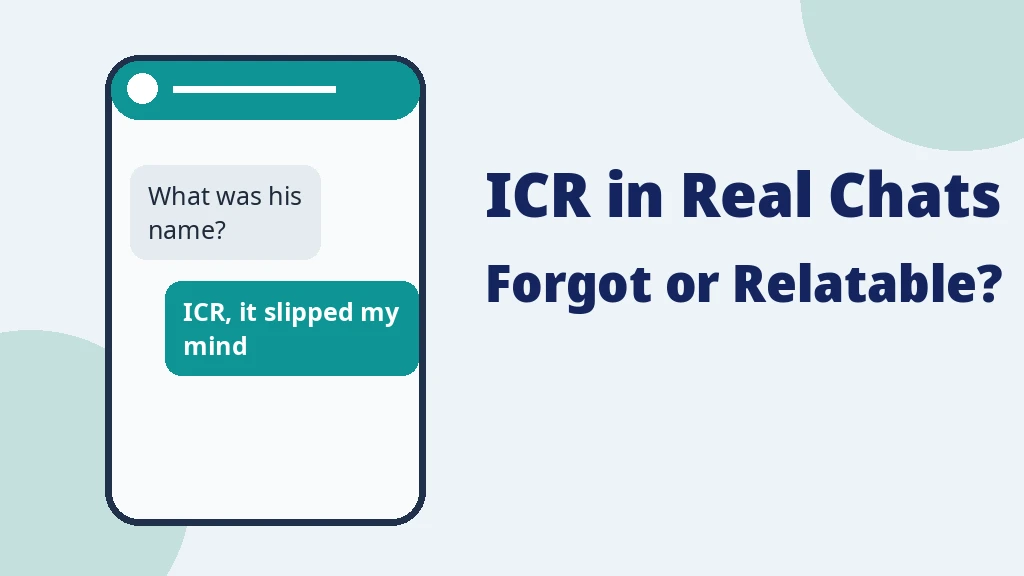
Example 1:
- Chat: “What did you have for lunch last Tuesday?” “ICR. That is a ridiculous question, I can’t remember what I had for dinner last night!”
Meaning: The sender cannot recall a small detail from days ago, and the joke admits how ordinary that is.
Example 2:
- Chat: “Did you feed the cat?” “ICR. I have been so busy today.”
Meaning: The sender is not sure whether the task was done. The honest answer matters here, because the cat still needs feeding.
Example 3:
- Chat: “Did you talk to him about the money?” “ICR, we spoke about so much. If I remember, I will tell you.”
Meaning: The memory is fuzzy, but the sender promises to follow up if it comes back. That promise is the useful part.
Example 4:
- Chat: “What was his name again, the guy from the party?” “ICR, it is on the tip of my tongue.”
Meaning: The classic ICR moment. The name is almost there, just out of reach, and the sender expects it to return.
Example 5:
- Comment: “Me walking into a room and forgetting why I came in” “ICR”
Meaning: This is the social media sense, “I Can Relate”. Nobody is being asked a question. The commenter is saying the post describes their life too.
ICR vs Similar Terms
| Term | Meaning | When to use it |
|---|---|---|
| ICR | I Can’t Remember | When a detail you knew has slipped away for now |
| IDK | I Don’t Know | When you never had the information at all |
| IDR | I Don’t Remember | When the memory is gone, with less hope it returns |
| IDC | I Don’t Care | When the topic does not matter to you, not a memory gap |
| TBH | To Be Honest | When you are about to admit something plainly |
Key difference: ICR and IDK look alike but answer different questions. IDK says the information is missing. ICR says the memory is missing. If someone asks the capital of a country you never learned, IDK is honest. If someone asks what your friend said yesterday and the words have gone, ICR is honest.
IDR is the closest cousin. CyberDefinitions notes that ICR and IDR overlap, but ICR carries a hint that the memory may return soon. IDR sounds slightly more final, as if the detail is gone.
The Other ICR Meanings You Should Know
“I Can Relate” is the real second sense, and it lives in comments. On TikTok, Instagram, and Snapchat, a bare ICR under a relatable post often means the commenter recognises themselves in it. GrammarSensePro notes this directly: on Instagram, ICR can mean “I Can’t Remember” in DMs, but in comments it may sometimes mean “I Can Relate”. The clue is the setting. If nobody asked a question, and the post is about a shared experience, “I Can Relate” is the likely reading. If someone did ask a question, stick with the memory sense.
Intelligent Character Recognition is the tech sense. In document and scanning talk, ICR means software that reads handwriting from scanned forms. It is a completely different world from texting, and the sentence around it always gives it away: forms, scanners, handwriting, documents. Finance talk adds Interest Coverage Ratio, and US government paperwork adds Information Collection Request, but neither appears in a casual chat.
Context rule in one line: a question about a fact plus ICR means “I Can’t Remember”; a relatable post plus a bare ICR in the comments means “I Can Relate”; a sentence about scanners or forms means the tech sense.
How to Reply to ICR
What you send back depends on whether the memory matters.
If the detail matters: help the sender remember. Offer a clue instead of repeating the question. “It was the guy with the red jacket” works better than “come on, think”. A small prompt often unlocks the memory that ICR said was stuck.
If the detail does not matter: let it go with a light reply. “No worries” or “it will come back to you” closes the loop kindly. Pushing someone who already admitted a blank rarely helps.
If it was the “I Can Relate” sense: reply to the shared feeling, not to a question. A comment like “same, every single time” fits the moment. Nobody needs a factual answer, because no question was asked.
If you are the one who forgot something important: say what you will do next. “ICR, let me check my notes and I will tell you” turns a blank into a plan, and the other person can relax.
When to Use ICR (and When to Avoid It)
Good situations:
- Admitting you cannot recall a name, time, or small detail in a casual chat
- Answering a low stakes question honestly instead of guessing
- Reacting to a relatable post in a comment, where “I Can Relate” fits
- Buying time while a memory surfaces, when you expect it to return
Avoid using ICR when:
- The answer matters and you can check it, since guessing or checking beats a shrug
- You actually never knew the information, in which case IDK is the honest word
- You are writing to a teacher, a boss, or a client, where the full sentence sounds more careful
- You are dodging a question on purpose, because repeated ICRs look evasive fast
Common Misunderstandings About ICR
ICR does not mean “I don’t know”. The two overlap in everyday use, but they describe different gaps. IDK is about missing information. ICR is about a missing memory. Using ICR when you never knew the answer is common, but it is not quite accurate.
ICR does not always mean “I Can Relate”. That reading is real, but it belongs to comments under relatable posts. Reading every ICR as “I Can Relate” will confuse a normal chat, where someone is plainly telling you they forgot something.
ICR is not a refusal to answer. It looks like a dead end, but it is actually an invitation to help. A clue, a photo, or a reminder often brings the memory back within seconds.
ICR is not the tech term in a chat. Intelligent Character Recognition never appears in a conversation about lunch or homework. If the chat is casual, the tech sense does not apply. For a term that does carry a reassuring reply when someone forgets, here is what DW means in text and when that reassurance fits.
Frequently Asked Questions
What does ICR mean in text?
In a text, ICR means “I Can’t Remember”. It is a quick way to say a name, a time, or a detail has slipped your mind for the moment.
What does ICR mean on Instagram?
In Instagram DMs, ICR usually means “I Can’t Remember”. In comments under relatable posts, it can mean “I Can Relate” instead, so check whether anyone asked a question.
What is the difference between ICR and IDK?
IDK means you never had the information. ICR means you knew it once, or should have, but cannot recall it right now, and it may come back to you soon.
Does ICR mean “I Can Relate”?
Sometimes, yes, but only in social media comments under relatable posts. In private chats and DMs, ICR almost always means “I Can’t Remember”.
What does ICR mean on Snapchat?
On Snapchat, ICR usually means “I Can’t Remember” in a quick reply. The same comment sense, “I Can Relate”, can appear under stories and posts.
Is ICR rude?
No, ICR is honest and casual, not rude. It only feels dismissive if the forgotten detail was important and the sender makes no effort to check or follow up.
How do you reply to ICR?
Offer a clue if the detail matters, or let it go lightly if it does not. A prompt like “it was the guy with the red jacket” often brings the memory back.
Final Thoughts
ICR is a small, honest abbreviation. In a text it means “I Can’t Remember”, a quick admission that a detail has slipped away for now, with a fair chance it will return. In a comment under a relatable post, it can mean “I Can Relate” instead.
Now you know how to read it at a glance: a question plus ICR means a memory gap, and a relatable post plus a bare ICR means shared feeling. The next time your own memory blanks, use it without shame, and add a follow up when the detail matters.
The memory reading is documented in detail by CyberDefinitions, which defines ICR as “I Can’t Remember” and notes that it usually points to a temporary loss of memory. If you want another short reply that keeps a chat friendly, here is what HBU means in text, a greeting that reopens a conversation instead of closing one.