You are scrolling TikTok, and under a dance video you spot two small letters at the end of the caption: “IB”. Nobody explains them, and the video itself gives no clue.
Here is the short answer: IB usually means “Inspired By” on social media. It is a credit tag. When a creator writes IB, they are saying that someone else’s video, idea, or trend inspired their own post, and they are pointing back to that original creator.
In this guide you will learn the ib meaning in text, where the tag appears, how it differs from similar tags, and what IB means in a school chat.
What Does IB Mean in Text?
On social media, IB is a credit note, not a message to a friend.
Most short forms in chats are replies or reactions: LOL reacts, BRB announces a break, DW reassures. IB works differently. It usually sits in a caption or a comment, next to a name or a trend, and it answers a question nobody asked out loud: where did this idea come from?
Quick definition: IB means “Inspired By” on social media. It credits the creator, trend, or original video that inspired the post you are looking at.
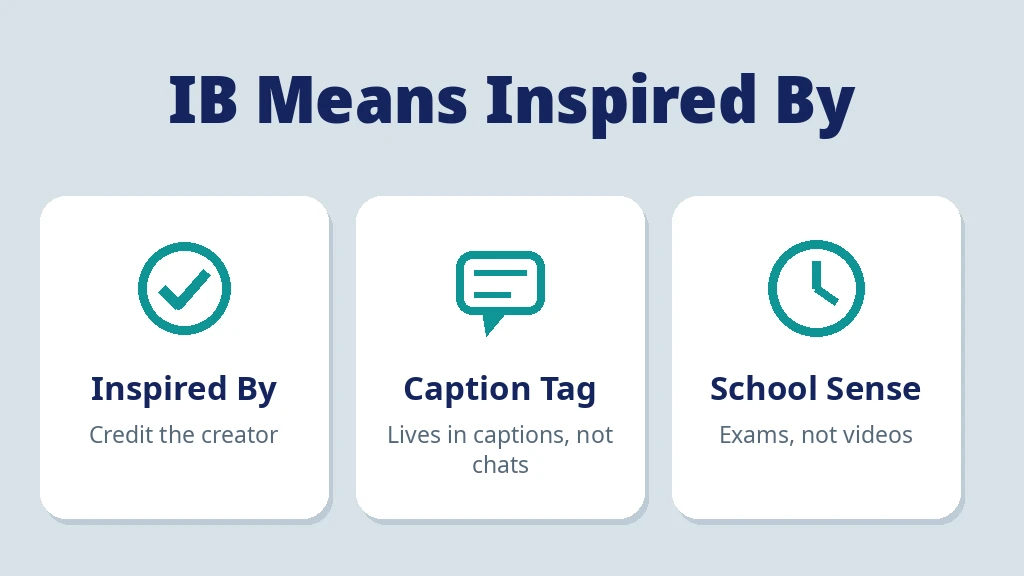
The sources agree on this reading. CyberDefinitions calls “Inspired By” by far the most common meaning for IB in a text, and it describes IB as the tag used to give credit to another user or trend that inspired the poster to make their own video. Wiktionary lists the same sense, labelling it as an internet and art use. The niche guides that rank for this term agree as well: their top results lead with “Inspired By” on TikTok, Instagram, and Twitter, especially where a user recreates a trend.
That agreement matters, because IB has a strong second life outside social media. In school and academic talk, IB means International Baccalaureate, a well known education programme. That sense is real and fully documented, but it belongs to a different kind of sentence, which this guide separates carefully. In a caption under a video, IB is almost always the credit tag.
IB Meaning in Easy Words
Think of IB as a small thank you note pinned to a post.
When a creator sees a dance, a recipe, a joke format, or an editing style they love, they often make their own version. Writing “IB: @username” is their way of saying “I did not invent this, this person did, go and see their version too”. It is polite, it is short, and it takes up almost no space in a caption that is already crowded with hashtags.
In the simplest words:
IB = “This idea came from someone else, and here is the credit.”
Sometimes the credit names a person, as in “IB: @maya”. Sometimes it names a trend or a sound, as in “IB: the viral transition trend”. Either way, the job of the tag is the same: it points backwards to the source, so the new post does not look like it is claiming an idea it borrowed.
Where Is IB Used?
IB lives where creators post, not where friends chat one to one.
Common places:
- TikTok captions and first comments, where a creator credits the trend or the original poster
- Instagram Reels captions, often written as “IB: @username” under a recreated reel
- Video edits and fan edits, where IB credits the editor whose style was copied
- YouTube Shorts descriptions, where a creator notes the inspiration for a short
- Twitter and Threads posts that rework a viral format or joke
Typical situations:
- Recreating a dance, a transition, or a challenge started by someone else
- Copying an editing style, a colour grade, or a caption format
- Remaking a recipe, a routine, or a comedy sketch with your own twist
- Posting a trend entry and crediting the account that started the trend
Notice what is missing: ordinary private chats. Friends rarely write IB to each other, because a private chat usually has no original creator to credit. If you see IB in a DM, check the sentence around it first.
Why Do People Use IB?
It gives credit without a long explanation
Writing a full sentence like “I was inspired by the video that Maya posted last week” takes space and breaks the flow of a caption. IB does the same job in two letters, and everyone who follows trends understands it at a glance.
It protects the creator from looking like a copier
Online trends move fast, and audiences notice when a post looks borrowed. An IB tag shows honesty up front. It says the borrowing was deliberate and acknowledged, which readers usually respect far more than a silent copy.
It helps viewers find the original
When IB names a creator, curious viewers can follow the tag back to the source and watch the original video. That is good for the original creator, who gains views and followers, and good for the viewer, who sees where the trend began.
It is part of creator etiquette
In dance and editing communities, crediting is expected. Leaving IB out when you clearly copied a routine can draw criticism in the comments, while including it is seen as basic good manners. The tag is small, but skipping it can become the whole conversation.
Real-Life Examples of IB
Here is how IB actually shows up in captions and comments:
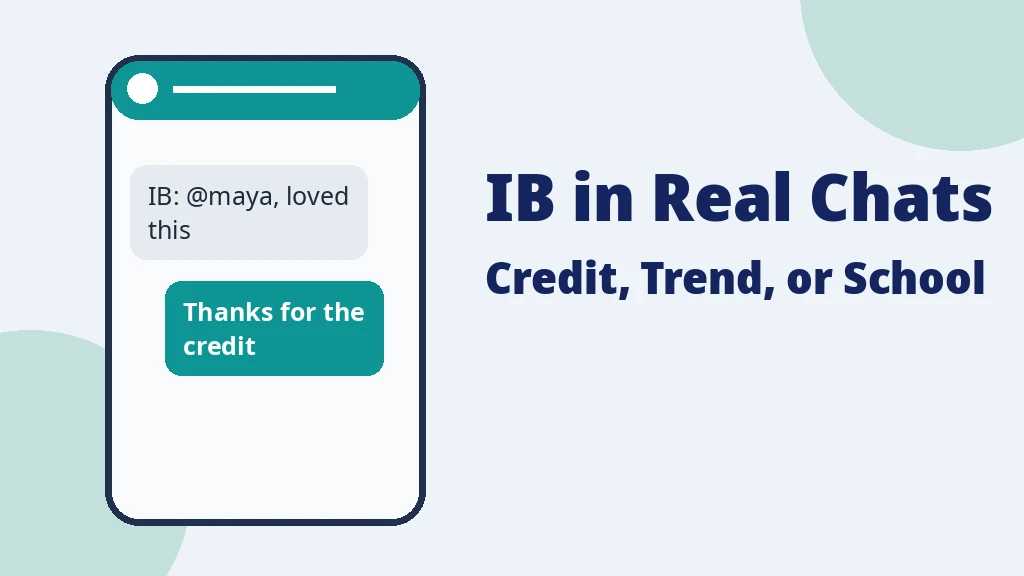
Example 1:
- Caption: “Tried the new transition trend! IB: @maya”
Meaning: The transition idea came from Maya. The poster is crediting her, not claiming the trend as their own.
Example 2:
- Caption: “IB: my mum’s favourite childhood dish that she makes all the time”
Meaning: The recipe was inspired by the poster’s mother. Here IB credits a person who is not even on the app, which shows the tag is about inspiration, not only about tagging an account.
Example 3:
- Comment: “IB @danceking, go watch his version too”
Meaning: The commenter is pointing other viewers to the original dance video. IB works as a recommendation as well as a credit.
Example 4:
- Caption: “New edit, IB: the sunset edits all over my feed”
Meaning: No single creator is named, because the inspiration was a whole style seen across many posts. IB can credit a trend, not just one person.
Example 5:
- Chat: “Are you doing IB next year or A levels?”
Meaning: This is the school sense, International Baccalaureate, not the credit tag. The sentence is about study choices, and no video or trend is involved.
IB vs Similar Terms
| Term | Meaning | When to use it |
|---|---|---|
| IB | Inspired By | Crediting the idea or creator behind your post |
| DC | Dance Credit | Crediting the choreographer of a dance specifically |
| CC | Closed Captions or Credit | Captioning a video, or crediting in some editing circles |
| Inspo | Inspiration | Casual chat word for something that inspired you |
| Recreating | Making your own version | Describing the post itself, not the credit |
Key difference: IB is the broad credit tag, while DC is the narrow one. CyberDefinitions notes that IB is used similarly to DC when DC means dance credit, but the two are not identical. If you copied a dance routine, DC names the choreographer. If you copied an idea, a format, an edit, or a recipe, IB covers all of it. Many creators write both, as in “DC: @choreographer, IB: @trendstarter”, when the dance and the idea came from different people.
CC is the tag to be careful with. In most video contexts CC means closed captions, the on screen text for viewers who watch without sound. In some editing circles it is also used as a credit marker, so “CC: @user” may need a second look. When in doubt, IB is the clearer credit tag.
The Other IB Meanings You Should Know
International Baccalaureate is the major second sense. It is a rigorous education programme for students aged 16 to 19, founded in 1968, offering a two year Diploma Programme with six subjects plus a Theory of Knowledge course and an Extended Essay. Students talk about “doing IB”, “IB exams”, and “IB results” exactly the way other students talk about A levels. If the sentence mentions school, exams, subjects, or university applications, this is the reading, and the credit tag reading does not apply.
“I am back” is a claimed chat sense with weak support. One low quality guide lists “I am back” as the most common texting meaning for IB, with examples like “Dinner done, IB!” That reading is not backed by CyberDefinitions, which does not list it, and it does not appear in Wiktionary’s texting senses either. Treat it as an unverified claim: if a friend writes “IB” after disappearing from a chat, they probably mean something else, or they are using a private shorthand, and the safe move is to ask rather than to assume they announced a return. This guide does not present “I am back” as an established meaning, because the evidence for it is a single weak source against the two stronger layers.
Other context senses include investment banking in finance talk (“working in IB”), ibidem in academic footnotes (Latin for “in the same place”, usually written “ib.”), and Interface Builder in Apple software development. Each is obvious from its field.
Case rule in one line: capital IB in a caption under a video almost always means Inspired By; capital IB in a sentence about school, exams, or university almost always means International Baccalaureate; lowercase “ib.” with a full stop in a footnote means ibidem and has nothing to do with either.
How to Reply to IB
IB rarely needs a reply, because it is usually not addressed to you. It is a note attached to a post, not a question. What you do depends on where you saw it.
If you saw IB in a caption: you do not need to reply to the tag itself. Enjoy the post, and if you liked the idea, follow the credit back to the original creator. A comment like “loved the original too” is welcome, but nobody expects an answer to IB.
If someone credited you with IB: a short, warm reply fits best. “Thank you for the credit!” or “so glad it inspired you” acknowledges the tag and encourages the etiquette. Creators remember who credits properly.
If you are about to post a recreation: add IB yourself, with the name of the creator or the trend. It takes seconds, it avoids criticism in the comments, and it often earns you a share or a comment from the original creator.
If you saw IB in a school sentence: reply to the school topic, not the tag. “Are you doing IB next year?” is a question about study choices, so answer it as one: which subjects, how hard it feels, or what you plan after it.
If IB appears in a private chat with no video and no school context: ask. “Do you mean inspired by, or something else?” clears up the rare cases, including the weak “I am back” claim, faster than guessing.
When to Use IB (and When to Avoid It)
Good situations:
- Posting your own version of someone else’s dance, edit, recipe, or format
- Joining a trend that a specific creator started
- Crediting a style you copied even when no single creator can be named
- Pointing your viewers to an original worth watching
Avoid using IB when:
- The idea is genuinely your own and no credit is owed, since a false IB confuses viewers
- You are writing a private message with no creator or trend involved
- You mean International Baccalaureate and your reader may take IB as a caption tag instead, so spell it out on first use
- You copied a dance and only the choreographer deserves credit, in which case DC is the more precise tag
Common Misunderstandings About IB
IB is not a greeting or a reply. New viewers sometimes read a caption tag as a message to them. It is not. IB points backwards to a source, and it expects no answer from the reader.
IB does not always mean International Baccalaureate. That is the most common misreading outside school. Students and teachers use the school sense daily, but on TikTok and Instagram the credit tag is far more common, and reading a caption as a school reference will miss the point of the post.
IB is not the same as DC. DC credits a dance choreographer specifically. IB credits any inspiration: an idea, a format, an edit, a recipe, or a trend. Using DC for a recipe credit, or IB where only a choreographer should be named, muddles the credit.
IB does not prove the original creator approved. A credit tag is a claim by the poster, not a permission slip. It shows respect, but it does not mean the original creator endorsed the remake.
IB is not proof of “I am back”. That reading circulates in one weak guide and nowhere in the stronger sources. Do not assume a bare IB in a chat announces a return. If the context gives no video and no school topic, ask what the sender meant. For a genuinely reassuring return message, here is what DW means in text and when that reassurance fits.
Frequently Asked Questions
What does IB mean in text?
On social media, IB means “Inspired By”. It credits the creator, trend, or original video that inspired the post you are looking at.
What does IB mean on TikTok?
On TikTok, IB in a caption or first comment means the video was inspired by another creator or trend. It is often written as “IB: @username” so viewers can find the original.
What is the difference between IB and DC?
IB is the broad credit tag for any inspiration, while DC means dance credit and names the choreographer of a dance specifically. A post can carry both when the dance and the idea came from different people.
Does IB mean International Baccalaureate?
Yes, in school and academic talk IB means International Baccalaureate, a two year programme for students aged 16 to 19. In a video caption, though, IB almost always means Inspired By instead.
Does IB mean “I am back” in chats?
That reading appears in one low quality guide but is not backed by CyberDefinitions or Wiktionary, so it should not be assumed. If a friend writes a bare IB in a private chat, ask what they meant.
How do you use IB in a caption?
Write “IB: @username” or “IB: the trend name” at the end of your caption when your post recreates someone else’s idea. It gives credit, avoids criticism, and helps viewers find the original.
Is it rude to leave IB out?
Not always, but in dance and editing communities it is seen as poor manners when a post clearly copies someone. Adding IB takes seconds and is the expected etiquette.
Final Thoughts
IB is small, but it carries good manners in two letters. On social media it means “Inspired By”, a credit tag that points back to the creator or trend behind a post, and in school talk it means International Baccalaureate, a programme that has nothing to do with captions at all.
Now you know how to read the tag at a glance: a caption under a video means credit, a sentence about exams means school, and a bare IB in a private chat with neither context deserves a quick question instead of a guess. The next time you post a recreation of your own, add the tag yourself. It costs nothing, it credits the person who inspired you, and it often brings their audience back to your version too.
The credit reading is documented in detail by CyberDefinitions, which calls “Inspired By” by far the most common meaning for IB in a text, and Wiktionary lists the same internet and art sense alongside the International Baccalaureate expansion. If caption tags still trip you up, here is what GTS means in text, another term whose caption sense differs from its private chat sense.
1 thought on “IB Meaning in Text | Read the Caption Before You Reply”