
A new match opens with a single word: “Hyy.” No question, no sentence, just three letters with an extra y. Is it a typo, a secret code, or a flirt?
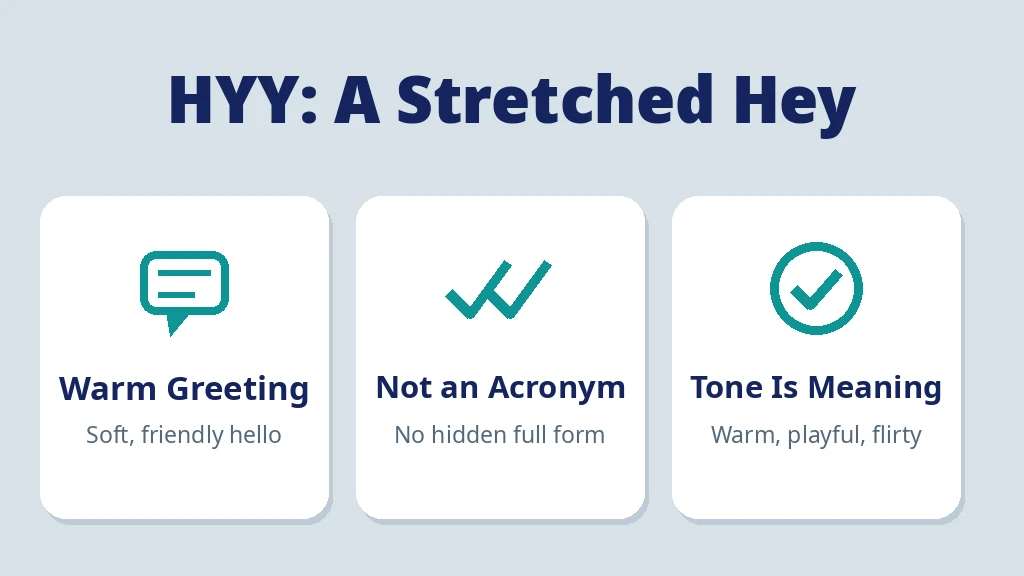
Here is the short answer: HYY is a soft, stretched way of saying hey. It is not an acronym, it has no hidden full form, and it does not stand for a longer phrase. The extra y adds tone, warmth, playfulness, or light interest, and the rest of the message decides which one.
In this guide you will learn the hyy meaning in text, why the extra letter changes the greeting, how HYY differs from hey, heyy, and hai, and how to reply without reading too much, or too little, into it.
What Does HYY Mean in Text?
In everyday chats, HYY is a greeting that works through spelling, not through letters that stand for words.
Most terms in this series are abbreviations: LOL stands for words, BRB stands for words, HBU stands for words. HYY breaks that pattern completely. It is a stylised spelling of hey, stretched by doubling the y, in the same family as hii, heyy, and heyyy. People add letters to greetings to make them sound warmer, softer, or more excited, and the spelling carries the feeling that plain “hi” cannot.
Quick definition: HYY means hey, said softly. It is a casual, playful greeting used to open a conversation, with the extra y adding warmth, friendliness, or light interest depending on who sent it and where.
The sources agree unusually well for an informal spelling. Eight independent niche guides all describe HYY the same way: a casual greeting, a variation of hey, not an acronym, with tone doing the work that a definition cannot. CyberDefinitions has no entry for HYY, and Wiktionary records hyy only as an old Finnish word for slush, which has nothing to do with texting, so there is no dictionary layer to contradict the usage guides. The agreement here comes from consistent real world usage, not from a reference book, and this article says so plainly rather than inventing an authority that does not exist.
That honesty matters, because HYY attracts invented expansions. Pages that claim HYY stands for “Hey You You” or “How You You” are guessing from the letters, not documenting real use. No reliable source supports those expansions, and the guides that address them directly call them mistaken.
HYY Meaning in Easy Words
Think of HYY as a wave instead of a handshake.
A handshake is standard and neutral. A wave is warmer, looser, and more personal, and it suits friends better than strangers. HYY is the wave version of hey: same greeting, softer delivery, and a hint that the sender is glad to be talking to you.
In the simplest words:
HYY = “Hey, I am happy to be chatting with you.”
The extra y is doing all the emotional work. Remove it and you get “hy”, a flat, fast greeting. Stretch it further to “hyyy” and the warmth rises again, sometimes into flirtation.
Where Is HYY Used?
HYY is a private message greeting first, because warmth lands best one to one.
Common places:
- WhatsApp and Messenger chats, as an opening line to friends
- Instagram and Snapchat DMs, where a soft opener suits the medium
- Dating apps, where a light, low pressure greeting starts a conversation
- TikTok comments and replies, where playful spelling is normal
- Group chats, though usually only when the sender knows the group well
Typical situations:
- Opening a chat with a friend after a short gap
- Starting a conversation with a new match or a new contact
- Reopening a chat that went quiet, without a heavy reason
- Signalling light interest on a dating app, without a direct compliment
Why Do People Use HYY?
It softens the opener
A bare “hi” can read as formal or flat, especially to someone new. HYY rounds the edges off, which makes the first message feel friendlier before any real content arrives.
It adds personality in three letters
Texting gives no voice, no smile, no wave. Stretched spellings are one of the few tools that add personality back, and HYY uses that tool efficiently: one extra letter, visibly warmer tone.
It tests the water gently
On dating apps especially, HYY is a low stakes opener. It shows interest without committing to a compliment or a question, and the reply it gets tells the sender how warm the other person wants to be.
Real-Life Examples of HYY
Here is how HYY actually shows up in daily chats, with the tone doing most of the work:

Example 1:
- Friend: “Hyy, you free tonight?”
- You: “Hey, yes, what are we doing?”
Meaning: Warm, casual opener plus a plan. The HYY sets a friendly tone, and the question carries the content.
Example 2:
- Match: “Hyy.”
- You: “Hey, how is your day going?”
Meaning: Light interest on a dating app. A lone HYY with no follow-up is an invitation to talk, and the best reply is a greeting plus an easy question.
Example 3:
- Friend: “Hyy, long time.”
- You: “I know, missed our chats. How have you been?”
Meaning: Soft reconnection after a gap. HYY plus “long time” names the gap gently, without a heavy apology.
Example 4:
- Friend: “Hyy, did you see the photos?”
- You: “Just now, they are brilliant.”
Meaning: Playful opener before a topic. HYY warms the message, and the question about photos is the real point.
Example 5:
- Friend: “Hyyy, guess what happened.”
- You: “Tell me everything.”
Meaning: Extra stretch, extra excitement. Three ys signal news or gossip, and the reply should match that energy with curiosity.
HYY vs Similar Greetings
| Greeting | Tone | Key difference from HYY |
|---|---|---|
| HYY | Soft, warm, playful | Stretched hey, extra y adds warmth |
| HEY | Neutral, standard | Plain greeting, no added tone |
| HEYY | Warmer, more excited | Stretched hey, more common than HYY |
| HAI | Cute, soft, fandom friendly | Stylised hi, often playful or anime adjacent |
| HI | Neutral, safe anywhere | Standard greeting, no tone signal at all |
Key difference: HYY and HEYY are the same trick with different spellings, while HAI is a different trick on a different word. HYY drops the e and doubles the y, which makes it shorter and quirkier than HEYY. HAI stretches hi instead, and it carries a cuter, more fandom flavoured tone. For the closest cousin of HYY, here is what HAI means in text and how its soft tone works in chats and fan communities.
HYY Is Not an Acronym: The Expansions to Ignore
“Hey You You” is the most common invented expansion, and it is wrong. It appears on a few low quality pages, but no reliable source documents it as real usage, and the guides that address it directly say HYY does not stand for it. The letters do not expand, because HYY was never built from words.
“How You You” and “Hi You” are guesses of the same kind. They try to force an acronym shape onto a spelling, and they fail the same test: nobody documents real chats where HYY is used with those meanings. Treat any expansion of HYY with suspicion unless it comes with real examples.
HYY is also not a typo, most of the time. It can be a slip of the finger, and fast typing does produce odd spellings, but when HYY arrives as a deliberate opener, especially from someone who types it regularly, it is a choice, not an accident. The pattern test helps: one HYY could be a typo, repeated HYY is a style.
The flirt question deserves a straight answer. HYY can read as flirty, especially on dating apps or in a late night DM from someone new, because stretched greetings have a documented flirtatious use going back to early chat culture. But HYY is not flirty by itself: between close friends it is simply warm, and the flirt reading needs other signals before it becomes the safe interpretation.
How to Reply to HYY
The best reply matches the warmth without overcommitting.
If it was a friendly opener: greet back with equal warmth and add an easy question. “Hey, good to hear from you. What is new?” keeps the chat moving.
If it was a dating app opener: reply with a greeting plus something to talk about. “Hey, how is your day going?” is better than a lone “hi”, because it gives the sender a thread to pull.
If it was a reconnection: acknowledge the gap lightly. “I know, missed our chats” matches the tone without turning the chat heavy.
If it felt flirty and you are not interested: keep the reply warm but neutral and steer to a topic. A friendly answer about plans or news cools the tone without a confrontation.
If you are unsure: a plain friendly reply is the safe default. HYY is almost always positive, so a warm greeting plus a question will fit in nearly every case.
When to Use HYY (and When to Avoid It)
Good situations:
- Opening a chat with a friend you already know well
- Starting a conversation on a dating app with a light, low pressure greeting
- Reopening a quiet chat without a heavy reason
- Adding warmth to a greeting when a plain hi feels too flat
Avoid using HYY when:
- The message is formal, where a plain hello reads professional and clear
- You are messaging someone for the first time at work, where stretched spellings can look careless
- You want to be clearly flirty or clearly neutral, because HYY sits in between and can be misread either way
- The reader may not know texting slang, because an unusual spelling can confuse more than it warms
Common Misunderstandings About HYY
HYY is not an acronym. That is the central misunderstanding. It does not expand into words, and every expansion you see for it is a guess, not a documented meaning.
HYY is not always flirty. It can carry light interest on dating apps, but between friends it is simply warm. Flirtation needs more signals than one stretched greeting.
HYY is not the same as HEYY. The two are cousins, not twins. HEYY stretches hey with an extra y at the end and is more common; HYY drops the e and doubles the y, which makes it shorter, quirkier, and slightly less familiar to readers.
HYY is not a typo for “hey” in every case. It can be a slip, but repeated use is a style choice, and treating a deliberate greeting as a mistake misses the warmth the sender intended.
Frequently Asked Questions
What does HYY mean in text?
HYY is a soft, stretched way of saying hey. It is a casual, playful greeting used to open a conversation, with the extra y adding warmth, friendliness, or light interest.
Is HYY an acronym?
No. HYY does not stand for a longer phrase. It is a stylised spelling of hey, and expansions like “Hey You You” are guesses, not documented meanings.
What does HYY mean from a girl or a guy?
The meaning is the same either way: a warm, casual greeting. On dating apps it can hint at light interest, but between friends it is simply friendly, whatever the gender of the sender.
Is HYY flirty?
It can be, especially on dating apps or in late night DMs, because stretched greetings have a documented flirtatious use. On its own, though, HYY is warm rather than flirty, and flirtation needs more signals to be the safe reading.
What is the difference between HYY and HEYY?
Both stretch hey for warmth, but HEYY adds a y to hey and is more common, while HYY drops the e and doubles the y, making it shorter and quirkier.
What does HYY mean on Snapchat?
On Snapchat, HYY is the same soft greeting as elsewhere: a warm opener for a DM or a streak chat, with tone carried by the spelling rather than by extra words.
How do you reply to HYY?
Greet back with equal warmth and add an easy question, such as “Hey, how is your day going?” That matches the tone and gives the sender something to answer.
Final Thoughts
HYY is a tiny lesson in how texting works. The letters do not expand, the dictionary does not define the texting sense, and yet millions of readers understand it instantly, because the spelling itself carries the feeling: hey, said a little softer, a little warmer, a little more glad to see you.
Now you know not to hunt for a hidden full form, how to tell a friendly HYY from a flirty one, and how to answer with equal warmth plus an easy question. The next time a lone “Hyy” opens your chat, you will not have to wonder what it stands for. You will know it stands for nothing at all, and that the warmth was the whole message.
The stretched greeting pattern is documented beyond HYY itself. Know Your Meme documents heyy and its variants as internet slang where extra letters turn a plain hey into a warmer or flirtatious greeting, and Wiktionary confirms that hyy has no English texting entry, recording only an old Finnish word for slush, which is why the usage guides, not a dictionary, settle this term.