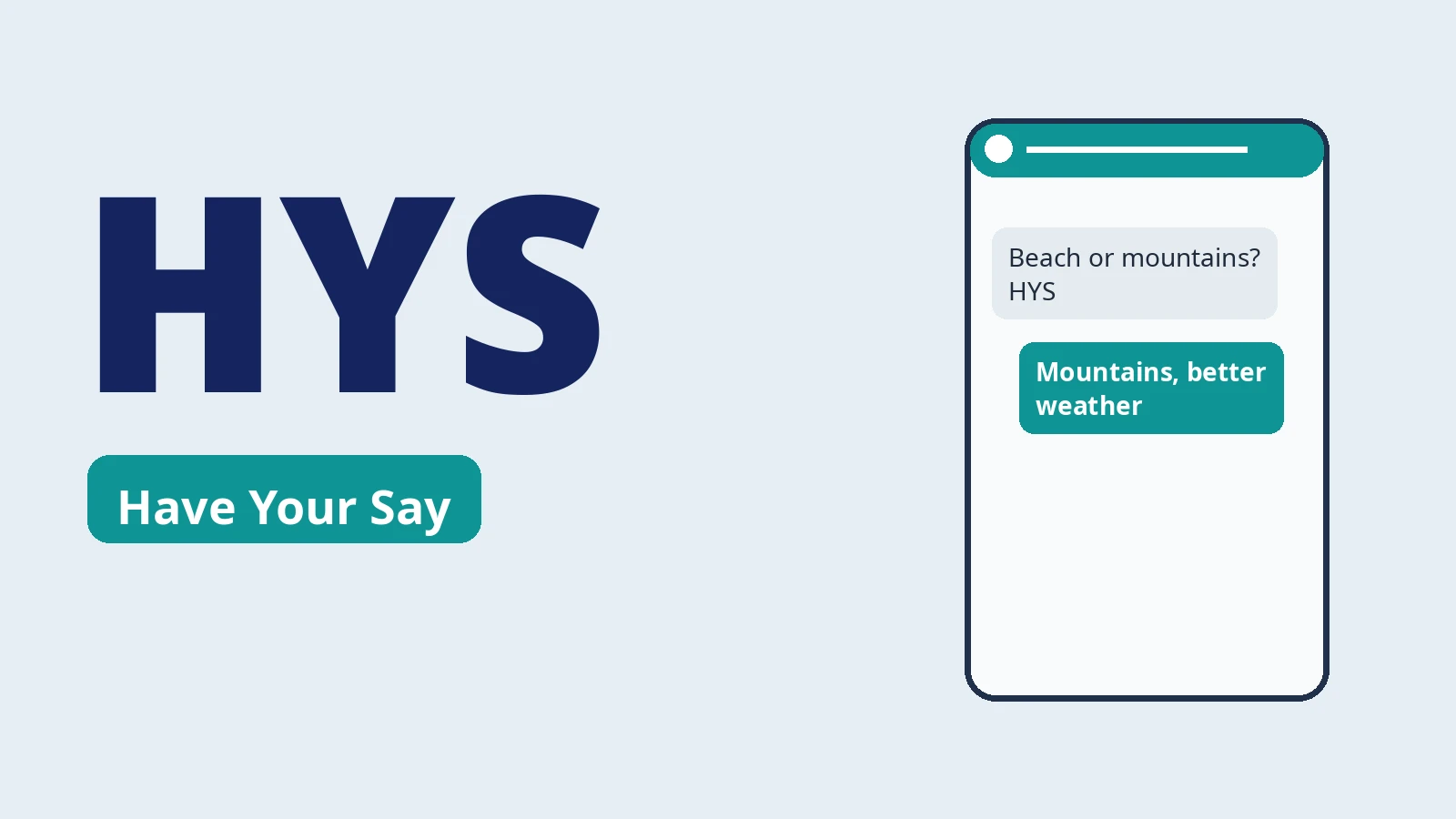
A group chat is arguing about weekend plans, and someone drops a single line: “HYS.” Are they inviting opinions, telling everyone to calm down, or saying something much harsher?
Here is the short answer: HYS usually means “Have Your Say.” It is an invitation to share an opinion, the chat equivalent of handing someone the floor. That is the reading backed by CyberDefinitions and by Cambridge Dictionary, but HYS is a contested term, and two other readings plus one harsh one ride on the same three letters.
In this guide you will learn the hys meaning in text, how to tell the invitation from the warning and from the insult, and how to reply to each version without escalating a chat by mistake.
What Does HYS Mean in Text?
In everyday chats, HYS is an invitation first and a warning second.
Most abbreviations do one job: LOL laughs, BRB leaves, HBU returns a question. HYS is wider. Its lead job is democratic: it opens the floor and asks for opinions, often after a debate or before a decision. Its second jobs are personal: telling someone to hold themselves steady, or asking whether they have seen something. And its darkest job is an insult, used to tell someone to hate themselves, which is why tone matters so much with this term.
Quick definition: HYS means “Have Your Say”, an invitation to share your opinion in a discussion, usually when a decision is being made or a debate needs more voices.
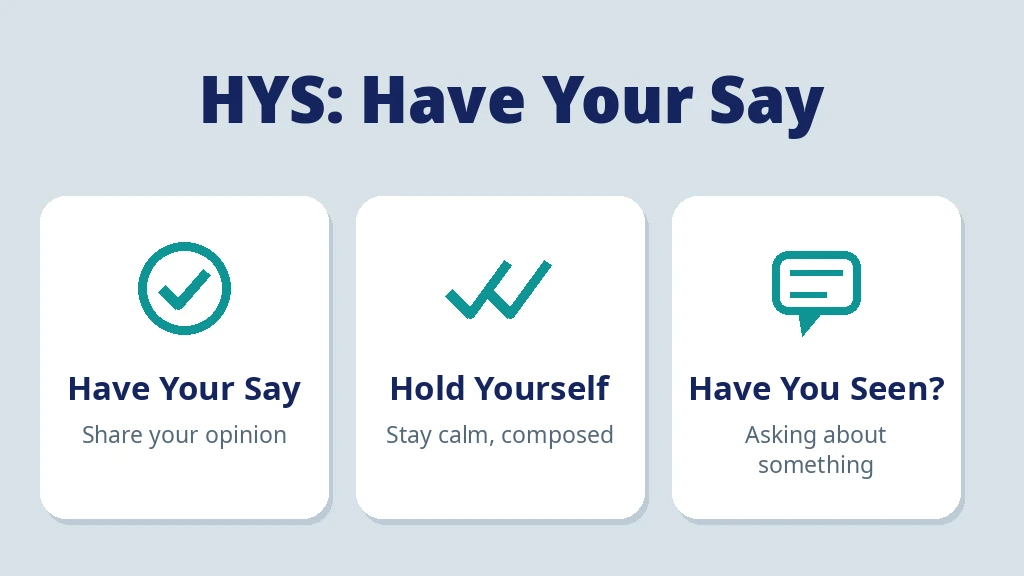
The lead reading has two solid layers behind it. CyberDefinitions gives “Have Your Say” as the texting definition of HYS, while flagging it as a rare term. Cambridge Dictionary also records HYS as the abbreviation of “have your say”, the invitation used on news sites for readers to leave their views. The top niche guide for the term lists “Have Your Say” first as well, before “Hold Yourself” and the harsh reading. That agreement across a slang reference, a general dictionary, and a niche guide is what settles the lead.
The contest is real but it does not overturn the lead. Another source leads with “Have You Seen?” instead, and TheFreeDictionary lists both “Have Your Say” and “Have You Seen?” among its entries. Those conflicts are why this article ranks every reading by evidence instead of pretending HYS has only one meaning.
HYS Meaning in Easy Words
Think of HYS as someone pushing a microphone across the table.
When a group is deciding where to eat, what to watch, or who is right in an argument, one person types “HYS” and the floor opens. Everyone gets a turn, and the decision waits for the opinions to come in. That is the invitation reading, and it is the one to assume unless the sentence says otherwise.
In the simplest words:
HYS = “Your turn to speak, what do you think?”
Notice the difference from a plain question. HYS does not ask for facts, it asks for views. It suits debates, votes, and group decisions far better than it suits a request for information.
Where Is HYS Used?
HYS lives wherever opinions are collected, from comment sections to group chats.
Common places:
- News site comment sections, where “Have Your Say” is the literal invitation to readers
- Group chats and Discord servers, during debates and votes
- Instagram and TikTok comments, where a creator asks followers for their take
- Forums and community threads, where a moderator opens a topic for discussion
- Private chats, where the “Hold Yourself” warning reading appears between friends
Typical situations:
- Opening a decision to the group before anyone commits
- Ending an argument with an invitation instead of a verdict
- Telling a heated friend to stay calm and composed
- Asking whether someone has seen a post, a video, or a piece of news
Why Do People Use HYS?
It shares the floor fairly
In a fast group chat, loud voices dominate. HYS slows the chat down and signals that quieter members are wanted too, which makes the final decision feel shared rather than imposed.
It ends arguments without picking a winner
When two people are going back and forth, “HYS” from a third person changes the shape of the chat: it stops being a duel and becomes a discussion, and everyone else gets to weigh in.
It is shorter than the invitation it replaces
“Everyone, have your say on this” is a sentence. HYS is three letters with the same effect, which suits comment sections and fast chats where brevity wins.
Real-Life Examples of HYS
Here is how HYS actually shows up in daily chats, with each example labelled by the reading it uses:
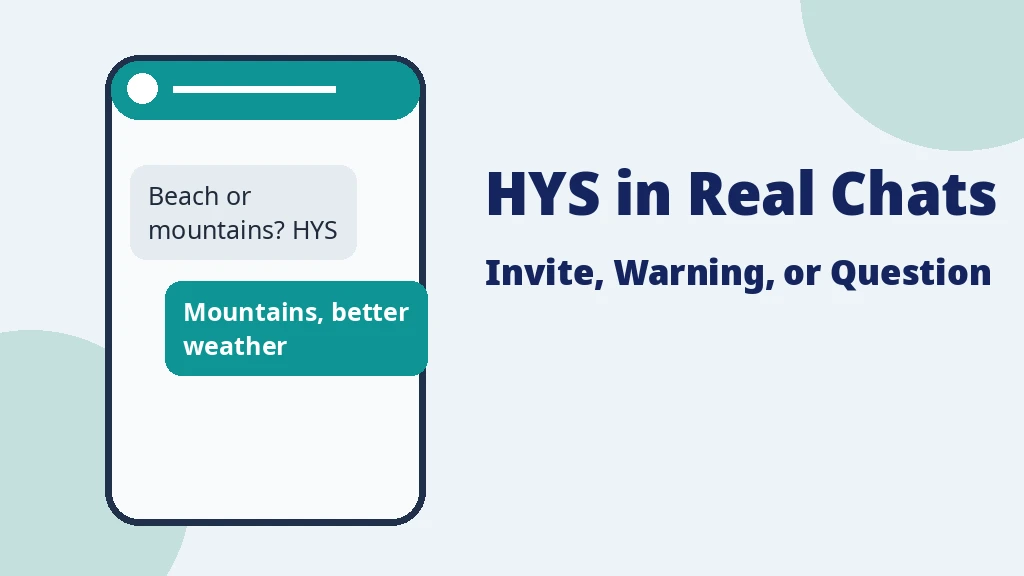
Example 1:
- Friend: “Beach or mountains this weekend? HYS.”
- You: “Mountains, the weather is better there.”
Meaning: “Have Your Say” reading. A decision is open, and the group is invited to vote with opinions.
Example 2:
- Friend: “I have said my piece. HYS now.”
- You: “Fair enough, here is my take.”
Meaning: “Have Your Say” reading again, this time as a handover. One speaker finishes and passes the floor deliberately.
Example 3:
- Friend: “You are getting worked up over nothing. HYS.”
- You: “You are right, I need a minute.”
Meaning: “Hold Yourself” reading. The sentence is about temper, not opinions, so HYS here means stay calm and composed.
Example 4:
- Friend: “HYS the new trailer yet?”
- You: “Not yet, sending me the link?”
Meaning: “Have You Seen?” reading. The sentence asks about a specific thing, and the grammar points to a question about seeing, not speaking.
Example 5:
- Friend: “Nobody asked for your opinion. HYS.”
- You: “That was uncalled for, I am stepping out of this chat.”
Meaning: Harsh “Hate Yourself” reading, used as an insult in an argument. The hostile sentence around it gives it away, and the right reply is to disengage, not to trade insults.
HYS vs Similar Terms
| Term | Meaning | Key difference from HYS |
|---|---|---|
| HYS | Have Your Say | Opens the floor for opinions |
| HBU | How About You? | Returns a personal question, not a debate |
| IMO | In My Opinion | Gives one opinion, does not invite others |
| WDYT | What Do You Think? | Asks one person directly, less of a group call |
| HM | Thinking pause | Shows thought, does not invite speech |
Key difference: HYS invites the whole group, while WDYT asks one person and IMO speaks for one person. HYS is the only term in this set that opens a floor rather than taking a turn. For the thinking pause that often follows an HYS invitation, here is what HM means in text and how a short pause reads before a fuller opinion arrives.
The Other Meanings of HYS
Have You Seen? is the strongest secondary reading. It appears when HYS sits before a specific thing, as in “HYS the trailer?”, and it is documented as entertainment slang. TheFreeDictionary lists it, and at least one source leads with it, which is the direct conflict with the lead reading. Grammar settles most cases: if HYS is followed by a noun or a thing, think “Have You Seen?”; if it stands alone at the end of a debate, think “Have Your Say”.
Hold Yourself is the calming reading. It tells someone to stay calm, composed, and in control, usually when tempers are rising. The top niche guide lists it second, and it fits sentences about behaviour, not about opinions or media. “HYS, you are overreacting” is a warning, not an invitation.
Hate Yourself is the harsh reading, and it must be labelled as such. Used jokingly among close friends it can pass as dark humour, but in an argument it is an insult, designed to sting. The top niche guide documents it as harsh and negative, and it only fits hostile sentences. Never assume this reading from a neutral message, and never use it casually: the gap between a joke and an insult here is entirely about the relationship and the tone.
Other context senses include Healthy Youth Survey in Washington state education and health writing, High Yield Savings in banking, and Houston Youth Symphony in music circles. All of these are formal or field specific uses, obvious from their context, and none of them belongs in a casual chat reading.
How to Reply to HYS
The reply must match the reading, and a wrong match can turn a friendly debate into a fight.
If it was “Have Your Say”: give your opinion, briefly and honestly. That is what was asked for, and silence after an invitation reads as disinterest.
If it was “Hold Yourself”: acknowledge the warning, not the debate. “You are right, I need a minute” calms the chat faster than another argument.
If it was “Have You Seen?”: answer about the thing. “Not yet” or “Yes, loved it” fits, and a link request is natural if you have not seen it.
If it was the harsh reading: do not trade insults. A short boundary, a change of subject, or leaving the chat all beat an escalation, and the harsh reading says more about the sender’s temper than about you.
If you are unsure: treat it as the invitation reading, because it is the lead and the friendliest default, and let the sender correct you if they meant something else.
When to Use HYS (and When to Avoid It)
Good situations:
- Opening a group decision to opinions before anyone commits
- Handing the floor over after you have said your piece
- Inviting quieter members of a chat to speak up
- Asking a friend whether they have seen a specific post or video, where the sentence makes the reading clear
Avoid using HYS when:
- The reader may not know the term, because the harsh reading makes a wrong guess costly
- Tempers are already high, where “Hold Yourself” may be read as an insult instead
- You mean the harsh reading, which is better left unsent in almost every case
- A full sentence would be clearer, such as “What do you all think?” for a group or “Have you seen this?” for one person
Common Misunderstandings About HYS
HYS does not always mean “Have You Seen?” That reading needs a thing after it. A standalone HYS at the end of a debate is an invitation to speak, not a question about media.
HYS is not always friendly. The invitation is warm, but the “Hold Yourself” warning is firm, and the harsh reading is an insult. Friendliness is not built into the letters, it comes from the sentence around them.
HYS is not a vote counter. It invites opinions, but it does not count them or settle the decision. Someone still has to summarise and decide after the opinions arrive.
HYS is not the same as HBU. HBU returns a personal question to the person who asked it. HYS opens a debate to the whole group. One is a bounce back, the other is an open floor.
Frequently Asked Questions
What does HYS mean in text?
HYS usually means “Have Your Say”, an invitation to share your opinion in a discussion, typically when a group decision is being made.
Can HYS mean “Have You Seen?”
Yes, when HYS sits before a specific thing, as in “HYS the trailer?”, it usually means “Have You Seen?” Grammar decides: a thing after HYS points to seeing, a standalone HYS points to speaking.
What does HYS mean when someone is angry?
In a heated chat, HYS often means “Hold Yourself”, telling someone to stay calm, or, harshly, “Hate Yourself” as an insult. The hostility of the sentence around it tells you which one.
Is HYS rude?
The invitation reading is polite and inclusive. The harsh “Hate Yourself” reading is rude by design, so rudeness depends entirely on which reading the sender meant.
What does HYS mean on news sites?
On news sites, HYS is the literal “Have Your Say” invitation for readers to leave comments and share their views on a story.
How do you reply to HYS?
For the invitation, give your opinion briefly. For “Hold Yourself”, acknowledge the warning calmly. For “Have You Seen?”, answer about the thing. For the harsh reading, disengage rather than escalating.
What is the difference between HYS and HBU?
HBU returns a personal question to whoever asked it. HYS opens a debate to the whole group. One bounces a question back, the other opens a floor.
Final Thoughts
HYS is a small invitation with a wide range. Most of the time it means “Have Your Say”, the open floor that lets a group decide together, and the right reply is a short, honest opinion.
Now you know the other readings too: “Have You Seen?” when a thing follows it, “Hold Yourself” when tempers need cooling, and the harsh insult reading that deserves disengagement, not a reply in kind. Read the sentence around HYS first, and the right response usually becomes obvious.
The dictionary evidence backs the lead reading. Cambridge Dictionary records HYS as the abbreviation of “have your say”, used especially where readers are invited to share their views, and CyberDefinitions gives the same texting definition.