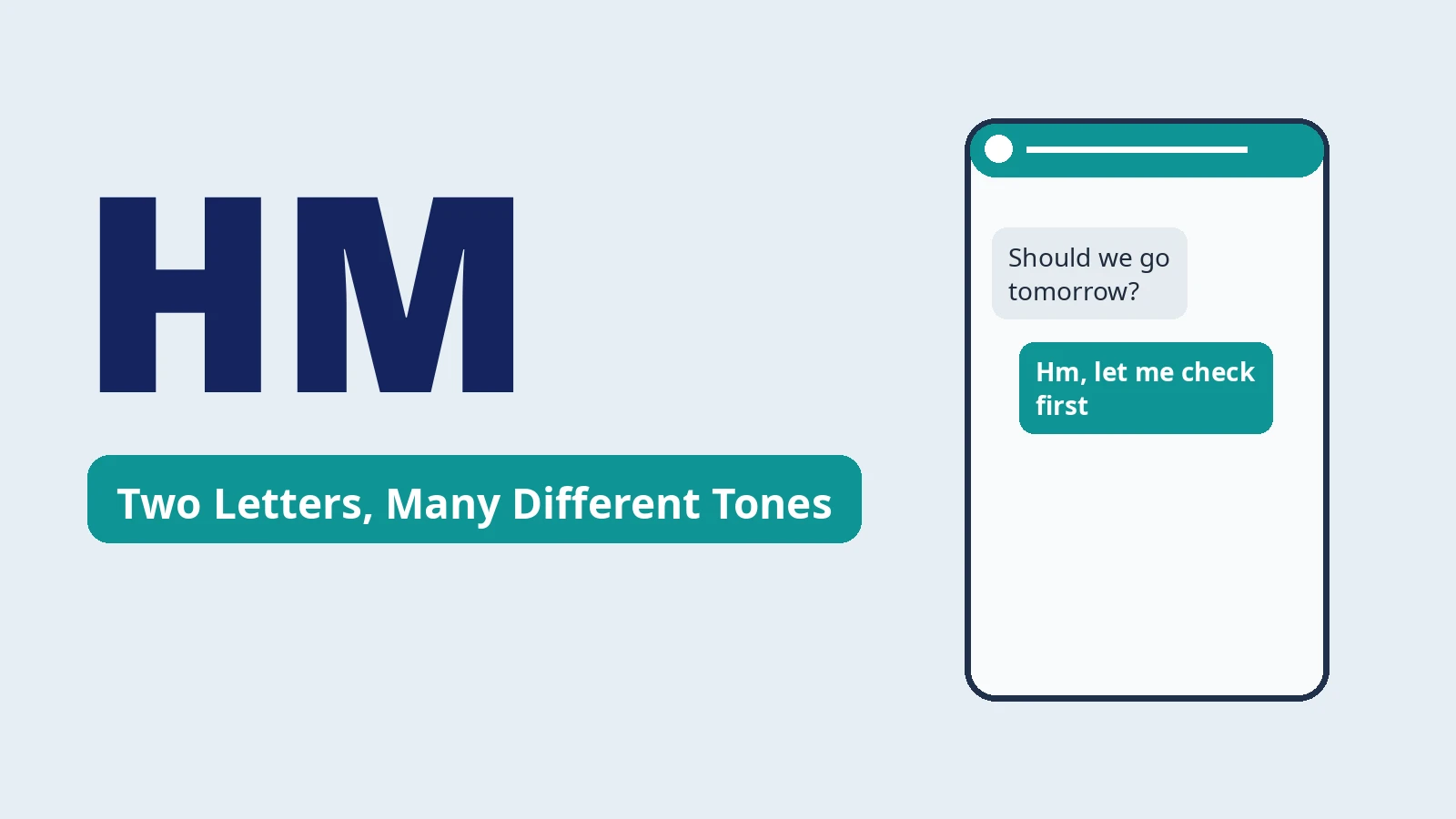
Your message lands, and the reply is just two letters: “hm”. No emoji, no follow-up, no explanation. Are they thinking, doubting, bored, or just busy?
Here is the short answer: HM usually signals a thinking pause, like a typed hmm. It is the written version of the sound people make when they are considering, hesitating, or processing what they just read, and its exact shade depends on punctuation, case, and what comes next.
In this guide you will learn the hm meaning in text, how a full stop or a question mark changes it, when capital HM means something else entirely, and how to reply without overthinking a two letter message.
What Does HM Mean in Text?
In everyday chats, HM is a thinking sound, not a normal abbreviation.
Most abbreviations stand for words: LOL stands for laughing out loud, BRB stands for be right back. HM is different. It stands for a sound, the closed mouth hum people make when they pause to think. Written out, that sound becomes hm, hmm, or hmmm, and HM is the shortest written form of it.
Quick definition: HM means a thinking pause, like a typed hmm. It signals that the sender is considering, hesitating, doubting, or quietly acknowledging what was just said, and the tone depends on punctuation and context.

Dictionaries back this reading directly. Dictionary.com lists hm and hmm as an interjection used typically to express thoughtful absorption, hesitation, doubt, or perplexity. CyberDefinitions also gives “Let Me Think” as one of its HM definitions, describing HM as the thinking sound further abbreviated in text conversations. The niche guides agree even more strongly: their top results all lead with the thinking, hesitation, or processing reading, not with any label sense.
That agreement matters, because HM has a famous competing sense. CyberDefinitions lists High Maintenance first in its summary, and that sense is real, but it belongs to a different kind of sentence, which the next sections separate carefully. In an everyday chat, when someone replies “hm” to your message, they are almost always pausing, not labelling you.
HM Meaning in Easy Words
Think of HM as a pause you can see.
In spoken conversation, people pause all the time: they hum, they say “um”, they go quiet for a second while they think. Texting has no silence, so a bare message can feel like no reply at all. HM fills that gap. It says “I read this, I am thinking about it, hold on”.
In the simplest words:
HM = “Let me think for a second.”
Sometimes that second turns into a full reply a moment later, and sometimes it turns into doubt, as in “hm, I am not sure about that”. Either way, HM is a placeholder for thought, not a finished answer, and it should be read as the start of a response rather than the whole response.
Where Is HM Used?
HM is platform neutral, because a thinking pause is needed everywhere people chat.
Common places:
- WhatsApp and Messenger one to one chats
- Snapchat and Instagram DMs
- Discord and group chats, often as a quick reaction to a plan or a claim
- Comments under posts, where a short reaction is all the reader wants to give
- Work chats, where a cautious pause is safer than a rushed yes or no
Typical situations:
- Considering a plan, a date, or a suggestion
- Reacting to surprising or doubtful news without committing to a view
- Acknowledging a message while still deciding what to say
- Asking, with “hm?”, what someone meant or whether they are serious
Why Do People Use HM?
It buys thinking time without silence
Leaving a message on read can feel cold. HM is a middle step: it shows the message was seen and is being considered, without forcing an instant decision.
It softens doubt
Saying “I disagree” is blunt. Saying “hm, I am not sure” opens the same doubt more gently, and gives the other person room to explain further before any disagreement hardens.
It is honest about uncertainty
Not every message deserves a confident answer. HM admits uncertainty in two letters, which is often more truthful than a quick yes, a quick no, or a fake enthusiasm.
Real-Life Examples of HM
Here is how HM actually shows up in daily chats, with the punctuation doing much of the work:
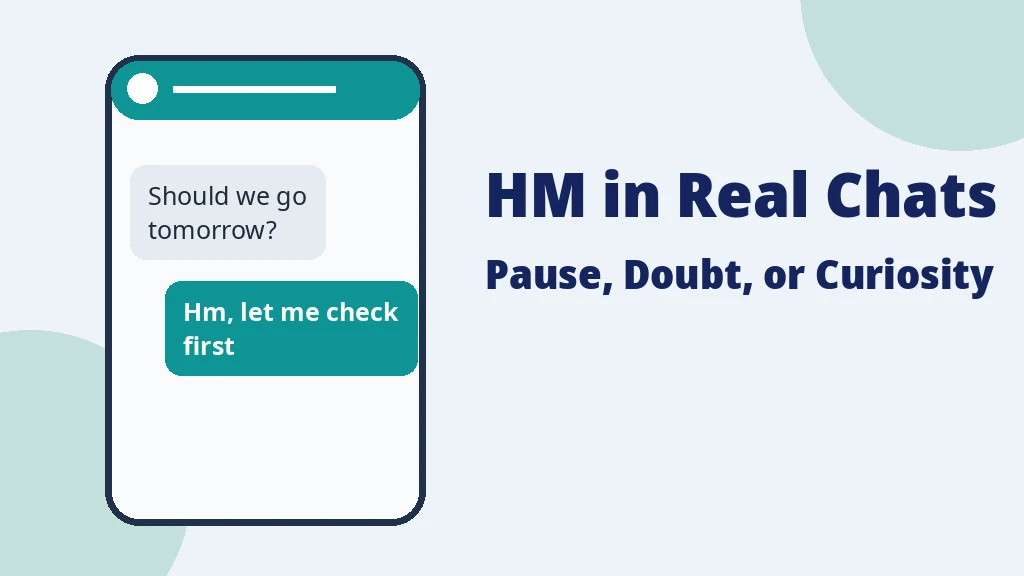
Example 1:
- Friend: “Should we go to the beach tomorrow?”
- You: “Hm, let me check my schedule first.”
Meaning: Genuine thinking. A decision is coming, and HM buys the time to make it.
Example 2:
- Friend: “He said he finished the whole project in one night.”
- You: “Hm, really?”
Meaning: Mild doubt and curiosity. The question mark invites the friend to explain more.
Example 3:
- Friend: “I think we should just tell them the truth.”
- You: “Hm…”
Meaning: Longer, heavier thinking. The ellipsis stretches the pause, and the reply that follows will matter more than the HM itself.
Example 4:
- Friend: “That deal sounds too good to be true.”
- You: “Hm.”
Meaning: Sharper and more final. The full stop closes the pause, and this HM can read as scepticism or quiet disagreement.
Example 5:
- Friend: “I get it. I do all the work and you get all the credit, HM?”
- You: “Fair point, let us talk about it.”
Meaning: The rhetorical “no?” sense documented by CyberDefinitions. Here HM at the end of a sentence seeks agreement, like asking “right?” or “is that not so?”
HM vs Similar Terms
| Term | Meaning | Tone |
|---|---|---|
| HM | Thinking pause (hmm) | Short, neutral, sometimes clipped |
| HMM | Longer thinking pause | More thoughtful, warmer, more engaged |
| HMMM | Drawn out thinking or suspicion | Playful, curious, or suspicious |
| MHM | Yes, agreement sound | Warm agreement, not hesitation |
| ERM | Hesitation sound | Awkward pause, often before a correction |
Key difference: length changes warmth. A bare HM is the shortest pause and therefore the easiest to misread as cold. HMM feels more considered, and HMMM feels more playful or suspicious, because the writer took the time to stretch the sound. MHM is the opposite direction entirely: it agrees, while HM hesitates.
For the closest cousin of HM, the awkward hesitation sound, here is what ERM means in text and how it differs from a thoughtful HM pause.
Capital HM and the Other Senses You Should Know
High Maintenance is the capital HM label sense. In a sentence like “talk about HM” or “she is so HM”, HM describes a person with expensive tastes or high demands on time, money, and attention. This sense is a label about someone, usually in gossip or comment threads, and it is not a reply to your message. If HM appears inside a sentence about a third person, think label. If HM appears alone as a reply, think pause.
Her Majesty / His Majesty is the formal sense. HM precedes a monarch’s name or a British institution, as in HM Government or HM Armed Forces, and it also appears in royal and legal writing. It has nothing to do with casual chats, and it should never be read into a friend’s reply.
No? is the rhetorical sense covered in Example 5 above. HM at the end of a statement seeks agreement, similar to “right?” It is more often spoken than written, but it does appear in text, usually in a frustrated or pointed sentence.
Other context senses include How Much in buying and trading chats (“HM for the tickets?”), Hit Me as a short form of Hit Me Up (“HM when you get home”), Hard Mode in gaming, and Home in property listings. Each of these is obvious from its sentence, and none of them is the general chat lead.
Case rule in one line: lowercase hm as a standalone reply almost always means the pause; capital HM inside a sentence about a person usually means High Maintenance; capital HM before a royal or government name means Her or His Majesty. Case alone does not prove the reading, but combined with position in the sentence, it settles most cases.
How to Reply to HM
Do not overthink HM, but do not ignore it either. The best reply depends on which HM you received.
If it was a thinking pause: give space, then a gentle nudge if needed. “No rush, let me know” works better than demanding an instant answer, and it usually produces a fuller reply.
If it was “hm?” with a question mark: explain or clarify. The sender is asking what you meant, or whether you are serious, so a short explanation is the natural response.
If it was a sharp “hm.”: check the tone before reacting. “Is that a sceptical hm or a thinking hm?” sounds light, and it clears the air faster than assuming the worst.
If HM keeps repeating with no follow-up: that pattern, not a single HM, is the signal. Repeated one word replies with no effort usually mean low interest or distraction, and a direct question (“Are you busy, should we talk later?”) fits better than another message to be met with HM.
If it was the label sense: do not reply as if it were a pause. A High Maintenance comment is a judgement about someone, and it deserves a judgement reply, agreement, disagreement, or a change of subject, depending on your view.
When to Use HM (and When to Avoid It)
Good situations:
- Pausing honestly while you consider a plan or a claim
- Softening doubt before you ask for more detail
- Acknowledging a message when you cannot reply in full yet
- Asking, with “hm?”, for clarification in a light way
Avoid using HM when:
- Someone shared serious, sad, or urgent news and needs a real response
- You have already replied HM several times and the chat is stalling
- The message is formal, where a full sentence reads warmer and clearer
- You mean High Maintenance and the reader may take HM as a simple pause instead
Common Misunderstandings About HM
HM does not always mean High Maintenance. That is the most common misreading of this term. In everyday chats, a standalone hm is a thinking pause, and the label sense needs a sentence about a person to work.
HM does not always mean disinterest. A single HM can be thoughtful, curious, or simply busy. Disinterest is a pattern, repeated short replies with no follow-up, not one pause.
HM is not the same as HMM. The extra letters change the feeling: HMM reads warmer and more engaged, while a bare HM reads shorter and sometimes cooler. Writers who want warmth should use the longer form.
HM is not a yes or a no. It is a pause before an answer, not the answer itself. Treating it as agreement or refusal will create misunderstandings that a short follow-up question would have avoided. If someone answers your HM with a reassurance instead, here is what DW means in text and when that reassurance fits.
Frequently Asked Questions
What does HM mean in text?
HM usually means a thinking pause, like a typed hmm. It signals that the sender is considering, hesitating, or processing what was just said.
Does HM mean High Maintenance?
Sometimes, but only as a label inside a sentence about a person, as in “talk about HM”. A standalone hm reply almost always means a thinking pause, not a label.
What is the difference between HM and HMM?
HMM is a longer, warmer thinking pause, while a bare HM is shorter and can read cooler or more clipped. The meaning is the same family, the warmth differs.
What does “hm?” mean?
“Hm?” usually means curiosity or mild confusion, as in “what do you mean?” or “really?” It invites an explanation.
Is HM rude?
Not on its own. A single HM is neutral, but repeated HM replies with no follow-up can feel distant or dismissive, because the pattern shows low effort.
How do you reply to HM?
Give space for a thinking pause, clarify for “hm?”, and check tone lightly for a sharp “hm.” If HM keeps repeating, ask directly whether it is a good time to talk.
What does capital HM mean?
Capital HM inside a sentence about a person often means High Maintenance, and before a royal or government name it means Her or His Majesty. As a standalone reply, case matters less than punctuation.
Related Texting Slang
Keep exploring the dictionary: bet meaning in text, FR in chats and texts, HBU in chats and texts, when someone texts you HN, the meaning of IONK, JK in chats and texts, SMH in chats and texts.
Final Thoughts
HM is small, but it is not empty. It usually means a thinking pause, a visible moment of consideration in a medium that has no silence, and its shade changes with punctuation, case, and the sentence around it.
Now you know how to read a plain hm, a curious hm?, a stretched hm…, and a sharp hm., plus when capital HM switches to High Maintenance or to Her Majesty. The next time a two letter reply lands, you will not have to stare at it and guess. You will know it is a pause, and you will know what to do next: give it a moment, clarify if asked, and wait for the fuller reply that usually follows.
The dictionaries settle the everyday reading. Dictionary.com defines hm and hmm as an interjection used typically to express thoughtful absorption, hesitation, doubt, or perplexity, which matches exactly how the pause works in real chats.
2 thoughts on “HM Meaning in Text | Two Letters, Many Different Tones”