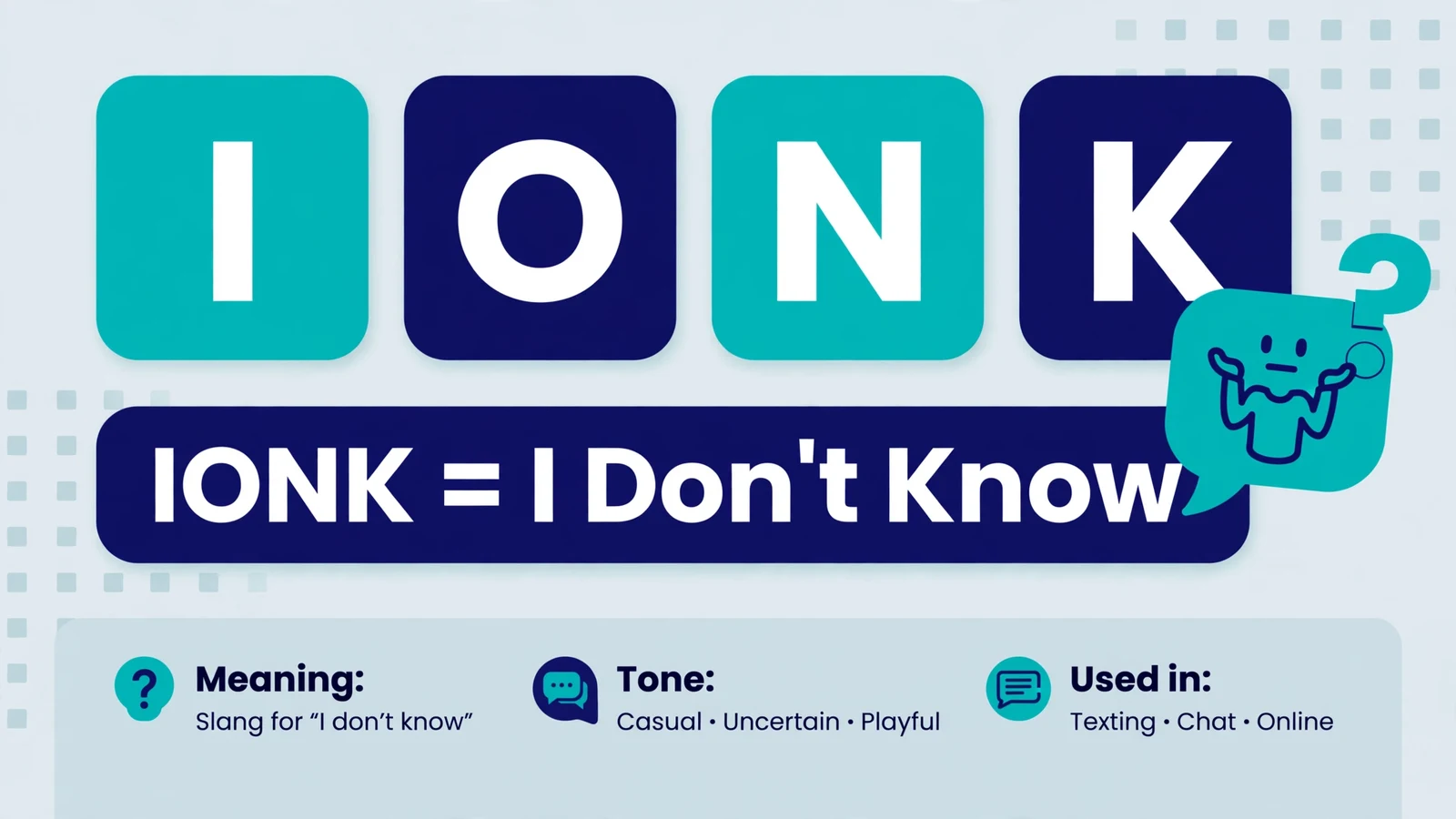
If someone just answered your question with “ionk,” here is the quick answer. IONK means “I don’t know.” It is not an acronym built from initials the way IDK is. Instead, it is a phonetic spelling, a typed version of how “I don’t know” sounds when you say it quickly and casually.
Say the phrase out loud, fast, the way you would to a friend. “I don’t know” blurs into “ion know.” Compress that one step further and you get ionk. The first part, ion, is a slang spelling of “I don’t,” and the k carries the “know” at the end. This guide breaks down the ionk meaning in text slang, how it differs from IDK, how to read its tone, and how to reply when someone sends it to you.
What Does IONK Mean in Text?
IONK simply means “I don’t know.” People use it when they do not have the answer, are not sure about something, or do not have enough information to answer with confidence. It works both as a full reply on its own and inside a sentence, like “ionk why this is trending again.”
The key thing to understand is how the word is built. Most texting abbreviations, such as IDK, LOL, and BRB, take the first letter of each word. IONK does something different. It copies a sound, not a set of initials. That is why it looks like a typo the first time you see it. It is not one. It is a deliberate, written-down version of relaxed speech.
Here is the breakdown:
- ion = “I don’t” (a phonetic spelling of the phrase said quickly)
- k = “know” (the last sound of the phrase)
- ionk = “I don’t know”
Because it copies speech, IONK feels more expressive and personal than IDK. It carries a shrug inside the word itself. That makes it popular in casual conversation with friends, and a poor fit anywhere formal.
How “I Don’t Know” Became IONK
IONK belongs to a family of spellings called phonetic texting, where people type words the way they actually say them. You already know most of its cousins: gonna for “going to,” wanna for “want to,” lemme for “let me,” gimme for “give me,” and dunno for “don’t know.” IONK follows the same pattern, just one generation newer.
The root form is well documented. Dictionary.com describes ion as a spelling based on the colloquial pronunciation of “I don’t,” especially in Black English, and notes that it spread through internet writing in the 2000s. Try their test: say “I don’t know” fast and casually, and it comes out close to “ion-oh.” From there, “ion know” is a short step, and squashing it into one word gives you ionk.
One honest note, because precision matters here. While the root “ion” is documented, IONK itself is a newer, niche form. It has no entry in major dictionaries yet, and nobody can point to a single person or year that created it. It grew out of fast typing, voice-like typing habits, and younger users on TikTok, Snapchat, and Discord who liked how it sounded. Treat any website that gives you an exact birth year for IONK with suspicion. What is certain is the meaning people use it with today: “I don’t know.”
IONK vs IDK and Similar Terms
IONK and IDK mean the same thing, but they do not feel the same, and they are not built the same way. This table shows how IONK compares with the terms it gets mixed up with most often.
| Term | Meaning | How it is formed | Tone and best use |
|---|---|---|---|
| IONK | I don’t know | Phonetic spelling of “ion know” | Playful, relaxed, slang-heavy. Best with friends on TikTok, Snapchat, Discord. |
| IDK | I don’t know | Initials: I + Don’t + Know | Neutral and universal. Understood by almost everyone, safer with mixed audiences. |
| ION | I don’t | Phonetic spelling of “I don’t” | Casual. Used in phrases like “ion care” and “ion wanna.” Also has a separate meaning, “In Other News.” |
| IDC | I don’t care | Initials | Dismissive. Much colder than IONK, so use it carefully. |
| Dunno | Don’t know | Phonetic shortening, older | Casual and spoken. Feels natural in speech, a bit old-school in texts. |
The practical takeaway is simple. If you are chatting with friends who use slang heavily, IONK fits right in. If your audience is mixed, older, or professional, IDK is clearer. Many people simply will not recognize IONK, and an abbreviation that needs explaining has failed at its one job.
IONK in Real Conversations
The meaning stays the same everywhere, but the flavor changes with the situation. Here are four everyday scenarios that show how IONK works in real chats.
1. Genuinely Not Knowing
- Alex: Where did Jake put the car keys?
- Sam: ionk. Check the kitchen counter?
- Alex: Found them. They were in his jacket.
2. Making Plans With Missing Details
- Maya: What time is the party starting on Saturday?
- Jordan: ionk, maybe around 8? Ask Sarah, she is organizing it.
- Maya: Okay, I will ping her.
3. Reacting in a TikTok Comment
- Taylor: ionk why this song is trending again 😭
- Chris: It was in that one show, now it is everywhere.
- Taylor: That explains it lol.
4. Mid-Game on Discord
- Priya: Where did the last player go?
- Leo: ionk, check upstairs, I lost him near the stairs.
- Priya: On it.
Notice the pattern. In each case, IONK answers a question quickly, then the conversation moves on. It is a small word doing a small job, and that speed is exactly why people use it in group chats and gaming chats where replies fly past.
How to Read the Tone of an IONK
Because IONK is so short, the details around it do the talking. The same four letters can feel warm, funny, or a little cold, depending on how they are sent.
- With an emoji: “ionk 🤷” or “ionk 😅” reads friendly and light. The emoji acts as a softener and shows there is no attitude behind it.
- Stretched out: “IONKKKK 😭” is playful disbelief. The sender is laughing at their own confusion, not shutting you down.
- With extra words: “ionk, ask Sarah” or “ionk yet, they have not replied” signals partial knowledge. The person is being helpful, not lazy.
- Bare, with a period: A plain “ionk.” can feel blunt or dismissive, especially on a serious topic. The period does a lot of heavy lifting in texting tone.
A question people ask often is whether IONK means something different from a guy. It does not. The meaning is identical whoever sends it. A guy typing “ionk” is doing the same things anyone else is: admitting he does not know, shrugging off a decision casually (“ionk, whatever works for you”), or keeping the chat playful. Read the context and the punctuation, not the sender.
How to Reply When Someone Says IONK
Your best reply depends on what you actually need. If the chat is casual, match the energy and keep it moving:
- “Haha same 😂”
- “Me neither 😭”
- “We’ll figure it out.”
- “Guess we’ll find out.”
If you genuinely need the answer, stay friendly and redirect:
- “No worries, I’ll ask someone else.”
- “Okay, can you find out when you get a chance?”
- “Let me know if you hear anything.”
And if the reply felt a bit dismissive, do not assume the worst. A short answer usually means a busy person, not a rude one. If it matters, clarify calmly: “Okay, I was just asking because I thought you might know.” That keeps the door open without starting an argument over four letters.
When to Use IONK and When to Skip It
IONK is built for informal spaces: texts with friends, group chats, TikTok and Instagram comments, Snapchat, and Discord servers where slang is the local language. In those settings it sounds natural, quick, and personable.
Skip it anywhere clarity or professionalism matters. Do not use IONK in work emails, school assignments, messages to a teacher or manager, or any chat with someone who may not know current slang. There, write “I’m not sure, but I’ll check” or use IDK at most. Also skip it when the topic is serious. If a friend is sharing bad news or asking something that genuinely matters to them, a slangy “ionk” can land as if you do not care, even when you do.
Common Confusions About IONK
IONK vs ION. These are not the same. ION means “I don’t,” as in “ion care” or “ion wanna go.” The K in IONK is what adds “know.” ION also has a completely separate meaning, “In Other News,” used to change the subject. Context tells you which ION you are looking at.
“I Only Know.” A few websites claim IONK stands for “I Only Know” or “I Only Now Know.” Those expansions do not match how the word is actually used. Their own example sentences only make sense if IONK means “I don’t know.” In real chats, that is what it means, so go with the usage, not the backronym.
“It is just a typo.” IONK does look like a typing mistake, and fast typing probably helped the spelling spread. But people now send it on purpose, with a shared meaning. If it appears right after a question, treat it as an answer, not an error.
The science word. In a textbook, an ion is a charged particle, and that has nothing to do with texting. Likewise, capital-letter IONK shows up in a Finnish human-rights board’s name and in medical writing. Neither has any connection to the slang in your group chat.
Frequently Asked Questions
What does IONK mean in text?
IONK means “I don’t know.” It is a phonetic spelling of “ion know,” which is how “I don’t know” sounds when spoken quickly and casually. People use it in casual chats to say they do not have the answer or are not sure.
Is IONK the same as IDK?
Yes, the meaning is the same, but the words are built differently. IDK is an initialism made from the first letters of “I don’t know,” while IONK copies the sound of the phrase. IDK is neutral and understood by almost everyone; IONK is more playful, niche, and slang-heavy.
What does ION mean in slang?
ION means “I don’t,” as in “ion care” (I don’t care) or “ion know” (I don’t know). It is a phonetic spelling rooted in Black English pronunciation. Separately, ION can also mean “In Other News” when someone changes the topic, so context matters.
Is IONK rude?
Not by itself. IONK has no hidden or offensive meaning. However, a bare “ionk.” with a period, sent during a serious conversation, can come across as blunt or dismissive. Adding an emoji or a few extra words keeps it friendly.
Can I use IONK at work or in school?
No. IONK is very informal slang, and many people will not recognize it. In professional or school settings, write “I’m not sure, but I’ll check” instead. Even IDK is too casual for formal emails and assignments.
Does IONK mean “I Only Know”?
A few websites list “I Only Know” or “I Only Now Know” as expansions, but they do not match real usage. In actual chats, IONK is used to mean “I don’t know,” following the phonetic pattern of “ion” (I don’t) plus “know.”
How do you reply when someone says IONK?
Match the tone of the chat. For casual replies, try “Haha same,” “Me neither,” or “We’ll figure it out.” If you still need the answer, say “No worries, I’ll ask someone else” or “Let me know if you hear anything.”
Related Texting Slang
Keep exploring the dictionary: JFC, explained with real examples, cap in chats and texts, dw meaning in text, FR in chats and texts, JK in chats and texts, what KMS means in a text, SMH in chats and texts.
Conclusion
IONK is one of those terms that makes complete sense the moment you say it out loud. It means “I don’t know,” written the way the phrase actually sounds: ion for “I don’t,” plus the k from “know.” It is playful, fast, and very casual, which is why it thrives in group chats, comments, and gaming lobbies, and why it has no place in a work email. When in doubt between IONK and IDK, pick IDK for clarity and save IONK for friends who speak fluent slang. Either way, you will never stare at those four letters in confusion again.
Sources: Wiktionary: ion, Dictionary.com: IDK
1 thought on “IONK Meaning in Text Slang: What It Stands For”