
Your friend texts “That finale was unreal fr” and another replies to a wild story with just “FR?”
Same letters, different jobs. Here is the short answer: FR means “for real”. It stamps a sentence as sincere, agrees with someone else, or asks in disbelief whether something is really true.
In this guide you will learn the three jobs FR does, how FR? and FR FR change the tone, and how to avoid the only two mix-ups that actually happen: Father and France.
What Does FR Mean in Text?
FR stands for For Real.
This lead is fully backed. CyberDefinitions gives “For Real” as its quick answer for FR, explaining that it emphasises the speaker is being truthful and that it is also used as a question to express surprise or incredulity. The top niche guides for “FR meaning in text” agree unanimously, with Parade citing Dictionary.com for “for real” and other guides giving the same answer for agreement and emphasis. Wiktionary lists FR as internet slang for “for real”, and Dictionary.com lists “for real” among the meanings of FR. Five layers, one answer.
Quick definition: FR means for real. It is used in texts and chats to show sincerity (“I really mean this”), agreement (“I agree completely”), or emphasis, and with a question mark, or even without one, to ask “are you serious?”

The grammar matters more than the definition. FR does three different jobs depending on where it sits, and the rest of this guide is mostly about telling those three jobs apart.
FR Meaning in Easy Words
Think of FR as a sincerity stamp.
When someone adds FR to their own sentence, they are stamping it: “I am not joking, I really mean this.” When someone replies with FR alone, they are stamping your sentence: “Yes, exactly, I agree.” When someone writes FR?, they are questioning the stamp: “Wait, is that actually true?”
FR = “Seriously. I mean it. I agree. Are you serious?”
One abbreviation, four shades, all from the same root idea: realness. If you remember that FR always points at how real or true something is, you will rarely misread it.
Where Is FR Used?
FR shows up wherever people react quickly and honestly. Common places include:
- Text messages and WhatsApp chats between friends
- TikTok and Instagram comments as a one-word agreement reply
- Snapchat captions and stories for emphasis
- Twitter/X replies to surprising or relatable posts
- Discord and gaming chats for quick co-signs
Example situations:
- Agreeing with a friend’s opinion: “FR, exactly what I was thinking”
- Stamping your own sentence: “I am tired fr, long day”
- Reacting to a wild story: “FR? No way that happened”
- Intensifying agreement: “FR FR, I have never agreed more”
- Captioning a relatable post: “Monday mornings fr”
FR went fully mainstream around 2019 as TikTok and Snapchat captions pushed it into millions of feeds, and it has stayed a daily-use word for Gen Z and beyond ever since.
If you searched for FR meaning in texting, the FR for real meaning is the whole story: sincerity, agreement, or a surprised question. FR FR meaning for real for real is the intensifier, FR meaning on TikTok is the one-word agreement reply, and FR meaning in Snapchat comments works the same way. The FR question mark meaning are you serious applies with or without the mark, the FR vs no cap difference is agreement plus honesty versus honesty alone, the FR friend request meaning is secondary, and the FR slang examples agreement sincerity above show all three jobs.
Why Do People Use FR?
It proves sincerity in two letters
Text strips away tone of voice. FR puts some of it back, telling the reader “this is honest, not sarcasm”. That matters in a medium full of jokes.
It agrees without a paragraph
A bare “FR” reply is a co-sign, like “facts” or a nod. It says “I am with you” faster than any sentence could.
It carries emphasis naturally
Adding FR to the end of a sentence turns up the volume on it. “That was good” is mild. “That was good fr” is a real recommendation.
It asks a question without asking
FR? skips the full “are you serious?” and still lands the same disbelief. It is the fastest possible way to say “prove it, because that sounds wild”.
Real-Life Examples of FR
Here is how FR actually looks in real chats, with the meaning spelled out each time:
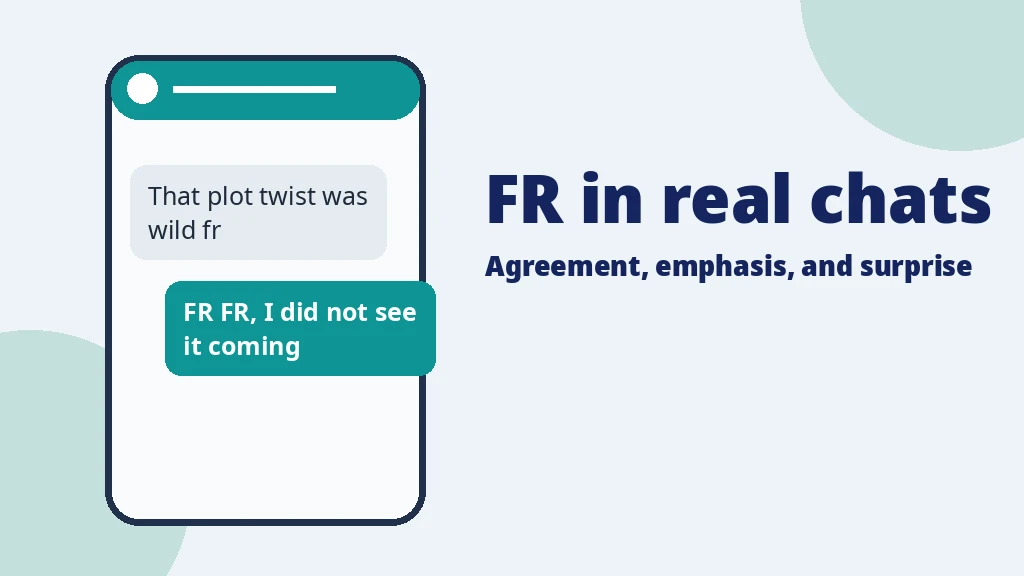
Example 1:
- Friend: “That plot twist was wild fr.”
- You: “FR FR, I did not see it coming.”
Meaning: For real, as a sincerity stamp on the first message, then FR FR as an intensified agreement in the reply.
Example 2:
- Friend: “This pizza is the best fr.”
- You: “FR, I could eat it every day.”
Meaning: The first FR stamps the opinion as genuine. The bare FR reply agrees completely.
Example 3:
- Friend: “I just met a celebrity at the coffee shop.”
- You: “FR? No way, who was it?”
Meaning: For real? as a surprised question, meaning “are you serious?” The question mark makes the job clear.
Example 4:
- Friend: “He said he would pay me back fr this time.”
- You: “Hmm, FR? We will see.”
Meaning: The first FR is the friend quoting a promise sincerely, while the reply’s FR? doubts it. Same letters, opposite trust levels, and the question mark does the work.
Example 5:
- Friend: “I am so tired fr, exams all week.”
- You: “FR, get some rest tonight.”
Meaning: The first FR emphasises real tiredness. The reply agrees and adds advice. Note the lowercase “fr” here: case does not change the meaning in chats.
FR vs Similar Internet Terms
| Term | Meaning | When to use it |
|---|---|---|
| FR | For Real | Sincerity, agreement, or surprised questioning |
| FR FR | For Real, For Real | Stronger sincerity or agreement, the intensifier |
| FRL | For Real Though | Sincerity with a “though” twist, as in “but seriously” |
| No cap | No lie | The same honesty claim, in slang form |
| On God | Swearing truthfulness | Stronger oath-style emphasis |
Key difference: FR is the all-rounder, while no cap and on God only claim honesty. FR can also agree (“FR” as a reply) and question (“FR?”), jobs that no cap cannot do alone. Pairing them is common, as in “FR, no cap”, which stacks two honesty claims for maximum emphasis.
For a reaction that shows disappointment rather than agreement, here is what SMH means in text, and for a quick return message, here is what BRB means in text.
FR Variations You Should Know
FR FR / frfr (the intensifier). Doubling FR means “for real, for real”: completely serious, or the strongest possible agreement. “FR FR, best day ever” leaves no room for doubt. Wiktionary lists frfr as a reduplication of FR.
FRL (for real though). A variant that adds a “though” turn, often used to pivot: “FRL though, we need to talk”. It keeps the sincerity but signals a serious follow-up.
FR? with and without the question mark. CyberDefinitions notes that FR is not always used with a question mark, even when intended as a question. “FR” after a wild claim can still mean “are you serious?” The context, a surprising claim just made, gives it away.
Lowercase “fr” vs capital “FR”. Lowercase is the casual, mid-sentence form (“tired fr”). Capital FR is the standalone reply form (“FR.”). The meaning is identical. Case only changes the energy.
FR as a verb: friend request (secondary, platform-specific). Wiktionary also lists FR as internet slang for friend request, as in “to FR someone” means to send them a friend request. This is real on social platforms but clearly secondary to “for real” in chats. If the message is about adding someone, this reading wins. Otherwise, it is for real.
Father (Fr., formal only). CyberDefinitions lists Father as its second definition, and Dictionary.com agrees: “Fr.” with a period, before a priest’s name, as in “Fr. John”. The period and the religious context separate it instantly from chat FR.
France (geographic only). FR is the country code for France and the .fr domain ending. That is a code, not a chat word, and it never appears as a standalone reply.
Other technical senses (not texting). Federal Reserve, financial reporting, Formula Regional, and family room all use FR in their own documents. None of them belongs in a chat reading.
How to Reply to FR
Your reply depends on which job FR is doing.
If FR stamps someone’s sentence: agree or react to the claim itself. “I know, right?” or “Same here” keeps the conversation on the topic.
If FR is a bare agreement reply to you: accept the co-sign warmly. “Right?” or “Exactly” continues the thread.
If FR? questions your story: back it up. Add a detail, a photo, or a “yes, I swear” and the disbelief turns into fun.
If FR FR intensifies something: match the energy if you agree (“FR FR, no doubt”) or soften it if you do not (“Hmm, maybe, not fully”).
If you are the sender: put FR where it does its job: at the end of your own sentence for sincerity, alone as a reply for agreement, or with a question mark for disbelief.
When to Use FR (and When to Avoid It)
Good situations:
- Agreeing quickly with a friend’s opinion
- Stamping your own honest statement as sincere
- Reacting to a surprising story with FR?
- Comments and captions where short reactions win
Avoid using FR when:
- The message is for work, school, or anyone formal
- You are writing to someone who does not know internet slang
- The claim needs real evidence, not just a sincerity stamp
- You mean Father (Fr.) or France, where the full form or code is clearer
Common Misunderstandings About FR
It does not always need a question mark to be a question. FR after a wild claim can mean “are you serious?” even without “?”. Read the claim, not just the punctuation.
It is not the same as no cap. No cap only claims honesty. FR also agrees and questions, which makes it more flexible.
It does not mean friend request in normal chats. Friend request is a real but secondary platform sense. In a chat about opinions and stories, FR is for real.
It is not Father in chats. Father is “Fr.” with a period, in religious and formal writing. A bare FR in a text is never a priest.
It is not rude. Unlike swear-based abbreviations, FR is clean slang. It is casual, not offensive, which is why it works in comments and captions everywhere.
Frequently Asked Questions
What does FR mean in text?
FR means for real. It shows sincerity, agreement, or emphasis, and as FR? it asks whether something is really true.
What does FR mean in texting?
In texting, FR means for real. Added to your own sentence it stamps it as sincere, sent alone it agrees with the other person, and with a question mark it expresses surprise or disbelief.
What does FR FR mean?
FR FR means for real, for real. It is the intensifier form of FR, used for complete seriousness or the strongest possible agreement.
What does FR mean on TikTok?
On TikTok, FR means for real, used as a one-word agreement reply in comments or tacked onto captions for emphasis. It works the same way as in any chat.
What does FR mean in Snapchat comments?
In Snapchat comments, FR means for real, usually as a quick co-sign agreeing with a post or story. It is the comment-section version of saying facts or exactly.
Does FR mean friend request?
Friend request is a secondary platform sense of FR, as in to FR someone, but in normal chats FR means for real. The message topic decides: adding someone points to friend request, opinions and stories point to for real.
How do you reply when someone sends FR?
If FR agrees with you, accept it with Right? or Exactly. If FR? doubts your story, back it up with a detail. If FR stamps their sentence, react to the claim itself.
Related Texting Slang
Keep exploring the dictionary: what FRL means in a text, how people actually use FSS, chile, the meaning of FS, how people actually use bet.
Final Thoughts
FR earns its place as a daily word because it does three jobs in two letters: it proves you mean it, it agrees in one tap, and it asks “are you serious?” without a speech. Use it at the end of your own sentences for sincerity, alone for agreement, and with a question mark for disbelief, and add the second FR when you want no doubt left at all.
The references settle the meaning cleanly. Dictionary.com lists for real among the meanings of FR, and Wiktionary defines FR as internet slang for for real, including the friend request verb sense that this article keeps clearly secondary. With CyberDefinitions and the top guides agreeing too, FR is one of the safest leads in texting slang.
16 thoughts on “FR Meaning in Text | Are They Serious or Agreeing?”