Your friend asks whether you want the beach or the mountains, and you like both. You could write a paragraph about your feelings. Instead you send three letters, and the plan moves forward.
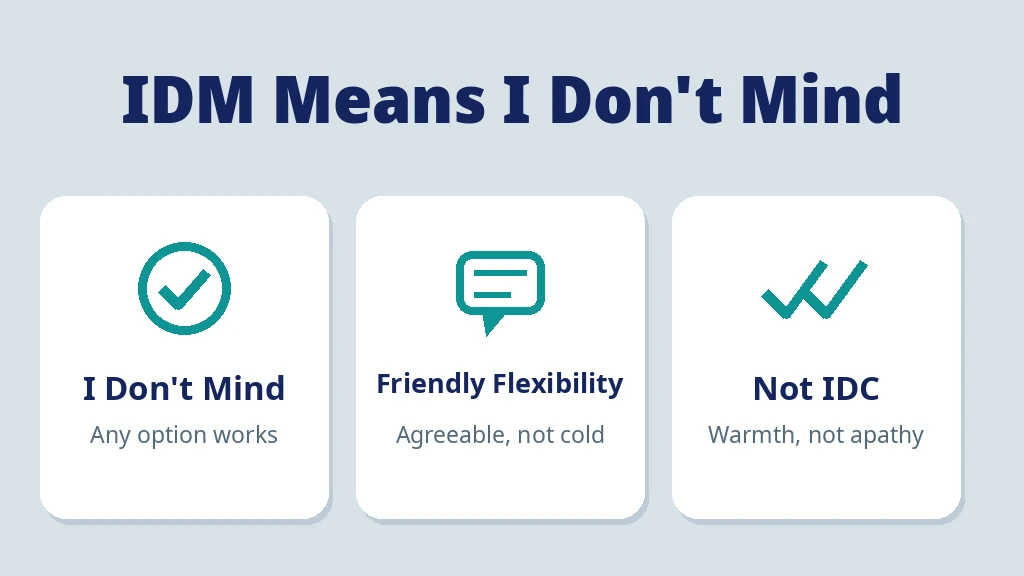
Here is the short answer: IDM usually means “I Don’t Mind” in a text. It is a friendly, flexible way to say any option works for you.
In this guide you will learn the idm meaning in text, how it differs from IDC, when it sounds warm and when it sounds flat, what its tech and music senses mean, and what to send back when someone drops it on you.
What Does IDM Mean in Text?
In a chat, IDM is a green light. It says the sender is fine with the suggestion, the plan, or the outcome, and has no strong preference either way.
That makes it one of the kindest abbreviations in texting. Where IDC shrugs a topic away, IDM welcomes it in. The sender is not saying the topic does not matter. They are saying the choice does not matter, because they are happy with whatever happens.
Quick definition: IDM means “I Don’t Mind” in a text. It tells the other person that you are okay with a suggestion or a choice, and that any option works for you.
The sources agree on this reading completely. CyberDefinitions lists “I Don’t Mind” as the first definition of IDM in a text, with “It Doesn’t Matter” as the second. Dictionary.com notes that IDM may be used in texting to mean “I don’t mind”, similar to IDC, and gives a texting example of exactly that use. Wiktionary lists IDM as internet slang and text messaging for “I don’t mind”. The niche guides that rank for this term are unanimous too: QuoetHint, BlessSpark, Pikupsline, and MeaningPulse all lead with “I Don’t Mind”, and Grammarscoope calls it the relaxed, informal way of expressing a lack of strong preference.
That unanimity matters, because IDM has strong second lives in music and tech. In music circles it means Intelligent Dance Music, and in software talk it means Internet Download Manager. Both senses are real and fully documented, but neither of them belongs in a casual chat, and this guide fences them off carefully.
IDM Meaning in Easy Words
Think of IDM as a friendly nod.
Somebody offers you two options, or asks whether a plan suits you. Instead of picking one, or writing a long reply, you nod in three letters. The nod says “I am happy with that”, and the other person can carry on.
In the simplest words:
IDM = “Either way is fine with me, go ahead.”
Notice the warmth in that sentence. IDM is not enthusiasm: it does not say “I would love that”. It is not apathy either: it does not say “I do not care”. It sits in the middle, a comfortable, agreeable yes.
Where Is IDM Used?
Common places:
- Private text messages and WhatsApp chats, when a friend offers two options or a plan
- Instagram and Snapchat DMs, as a quick reply to a suggestion or an invitation
- TikTok comments and replies, where someone reacts to a story or a joke with easy agreement
- Group chats, when the group is choosing a place, a time, or a film
- Discord and gaming chats, when a player accepts a plan or a lobby change
Typical situations:
- Choosing between options: “Pizza or burgers?” “IDM, both sound good”
- Accepting a plan: “Shall we meet at six?” “IDM, six works for me”
- Accepting a change: “We moved it to Friday, is that okay?” “IDM, Friday is fine”
- Reacting to a story: a friend tells a joke and you reply “IDM, that is funny either way”
- Staying flexible: “Do you want to stay in or go out?” “IDM, whatever you prefer”
Why Do People Use IDM?
It keeps a decision moving
Group chats stall when everyone waits for someone else to choose. IDM breaks the stall: one person says any option works, and the next person can decide. It is a small act of cooperation, and groups that use it plan faster.
Real-Life Examples of IDM
Here is how IDM actually shows up in chats and comments:
Example 1:
- Chat: “Do you want pizza or burgers?” “IDM, both sound good”
Meaning: The classic IDM moment. The sender has no preference and is happily handing the choice over.
Example 2:
- Chat: “I would rather not go tonight. You?” “IDM, staying home sounds good to me!”
Meaning: The Dictionary.com example. The sender agrees with staying home.
Example 3:
- Chat: “We moved the meeting to Friday, is that okay?” “IDM, Friday works for me”
Meaning: Accepting a change without fuss. The sender is flexible, and the plan can go ahead.
Example 4:
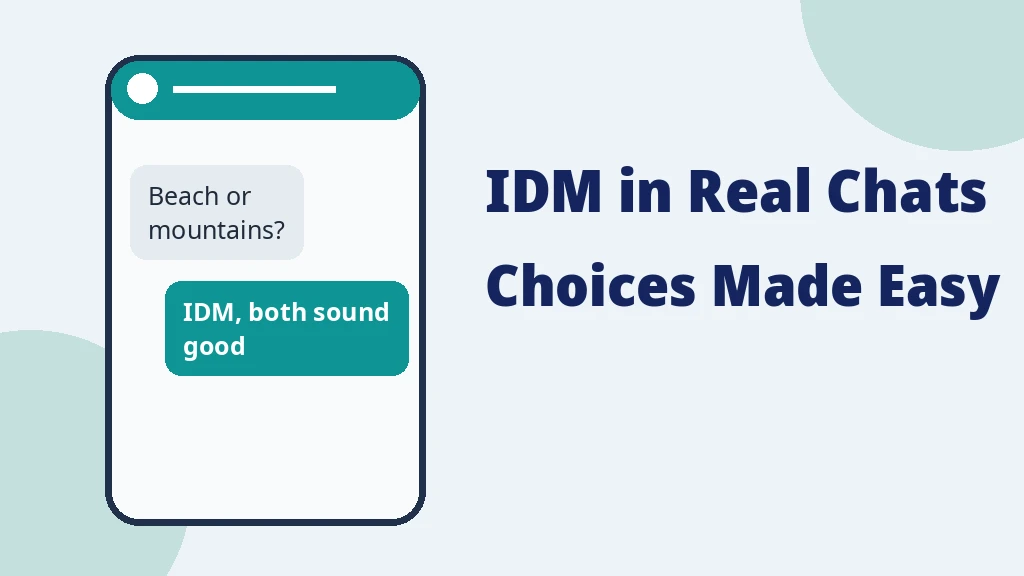
- Chat: “Beach or mountains this weekend?” “IDM, I like both, you choose”
Meaning: A warm handover. The sender likes both options, so the choice is a gift to the other person.
Example 5:
- Chat: “Can I borrow your charger?” “IDM, take it, I am not using it”
Meaning: Permission granted lightly. The sender is saying yes to a small favour.
IDM vs Similar Terms
| Term | Meaning | When to use it |
|---|---|---|
| IDM | I Don’t Mind | When any option works and you are happy to go along |
| IDC | I Don’t Care | When a topic does not matter to you, which can sound cold |
| IDK | I Don’t Know | When you lack the information, not the preference |
| Whatever | Anything goes | When you want the same shrug in a full word, with more risk |
| Sure | Yes, agreed | When you want a clear yes with no ambiguity |
Key difference: IDM and IDC are the pair to get right. EnglishGroom states it plainly: mistaking IDM as “I don’t care” is the common error, and the two are not the same. IDC usually shows apathy, while IDM leans neutral but agreeable. If you mean “either is fine with me”, IDM says it warmly. If you send IDC instead, the other person may hear “this does not matter to me at all”, and a friendly chat turns cold for no reason.
IDK is the other confusion. “I don’t know” is about information, “I don’t mind” is about preference. If a friend asks which film to watch and you answer IDK, you have not helped them choose.
“Sure” is the clearer cousin. When a bare IDM might sound flat, “sure” or “IDM, sounds good” removes the doubt. Use the longer reply when the decision matters to the other person.
The Other IDM Meanings You Should Know
“It Doesn’t Matter” is the close second sense. CyberDefinitions lists it as the second definition of IDM, and several niche guides treat it as a near synonym. In practice the two overlap: “IDM, it does not matter to me” and “I don’t mind” say almost the same thing in a chat. The difference is tiny. “I don’t mind” is about willingness, “it doesn’t matter” is about importance. Most readers will not notice which one you meant, and either reading fits a casual chat.
Intelligent Dance Music is the music sense. In music circles, IDM is a genre of experimental electronic music, named in the early 1990s, associated with artists like Aphex Twin and Autechre. If the sentence is about music, playlists, or artists, this is the reading. If the sentence is a reply to “pizza or burgers?”, it is not.
Internet Download Manager is the tech sense. In software talk, IDM is a popular download tool. If the sentence is about downloads, speeds, or software, this is the reading. In a casual chat, it never applies.
“I Do Mind” is a rare sarcastic reading, not a real sense. Some guides note it as a possible sarcastic use, but it has thin support and no dictionary entry. Do not lead with it, and do not assume it: in a normal chat, IDM means “I Don’t Mind”, full stop.
Context rule in one line: a choice or a plan plus IDM means “I Don’t Mind”; a sentence about music means the genre; a sentence about downloads means the software.
How to Reply to IDM
Someone who sends IDM has given you the choice, so the best reply is a decision, not another question.
If they handed you the choice: just decide. “Great, pizza it is” is the perfect reply. Asking “are you sure?” a second time wastes the gift they just gave you.
If the IDM sounded flat: check gently, once. “Okay, but do you actually want to come?” tells the difference between a warm IDM and a tired one. A bare IDM in a long chat can mean the sender is checked out, not agreeable.
If you are the one choosing: pick the option you like, and say so plainly. “Perfect, let us do the beach then” closes the loop and lets the sender relax.
If someone uses IDM for everything: notice the pattern before you judge it. Some people are genuinely easygoing. Others use IDM to avoid stating a preference they are afraid will cause a disagreement. If every plan gets an IDM, try asking directly: “forget being polite, what do you actually want?”
When to Use IDM (and When to Avoid It)
Good situations:
- Accepting a choice between two options you like equally
- Agreeing to a plan or a change of plan without fuss
- Granting a small favour casually, like lending a charger
- Keeping a group chat moving when a decision needs a yes
Avoid using IDM when:
- You actually have a strong preference, since hiding it leads to a plan nobody enjoys
- Someone is upset and needs comfort, where IDM can sound like you are not listening
- You are writing to a boss, a teacher, or a client, where the full sentence sounds more careful
- The decision matters a lot to the other person, who may need a real answer instead of a shrug
Common Misunderstandings About IDM
IDM does not mean “I don’t care”. This is the most common mix up, and it matters. IDC can sound cold and dismissive. IDM sounds agreeable and warm. They are neighbours in the dictionary, not twins.
IDM does not mean “I do mind”. The sarcastic reading circulates in some guides, but it has no dictionary support, and reading a normal IDM as “I do mind” will turn a friendly reply into a fight. Assume “I Don’t Mind” unless the sarcasm is unmistakable.
IDM is not the music genre in a chat. Intelligent Dance Music is a real and documented sense, but it lives in music writing, not in a reply to “pizza or burgers?”. The sentence around the letters always gives it away. For a term that shows the opposite, colder shrug, here is what FR means in text, a short reply whose warmth depends entirely on context.
Frequently Asked Questions
What does IDM mean in text?
In a text, IDM means “I Don’t Mind”. It is a friendly way to say you are okay with a suggestion or a choice, and any option works for you.
What is the difference between IDM and IDC?
IDM means “I Don’t Mind” and sounds agreeable: any option works. IDC means “I Don’t Care” and can sound cold or dismissive. If you mean “either is fine”, IDM is the safer word.
Can IDM mean “It Doesn’t Matter”?
Yes, CyberDefinitions lists “It Doesn’t Matter” as the second definition of IDM. In a casual chat the two readings overlap, and either fits when the sender has no strong preference.
What does IDM mean in music?
In music, IDM means Intelligent Dance Music, a genre of experimental electronic music from the early 1990s, associated with artists like Aphex Twin and Autechre.
What does IDM mean in texting on Snapchat?
On Snapchat, IDM usually means “I Don’t Mind” in a quick reply to a suggestion or a plan. The music and software senses do not apply in a casual chat.
Does IDM mean “I Do Mind”?
Almost never. That sarcastic reading has thin support and no dictionary entry. In a normal chat, IDM means “I Don’t Mind”, and assuming otherwise will cause confusion.
How do you reply to IDM?
Just decide. The sender gave you the choice, so pick an option and say so plainly, as in “Great, pizza it is”. Asking again wastes the gift.
Final Thoughts
IDM is the friendly member of the not caring family. In a text it means “I Don’t Mind”, a warm and flexible way to say any option works for you.
Now you know how to read it at a glance: a choice plus IDM means go ahead, I am happy either way; a sentence about music means the genre; a sentence about downloads means the software. Use it when you are genuinely flexible, and say what you really want when you have a preference worth naming.
The texting sense is documented by Dictionary.com, which notes that IDM may be used in texting to mean “I don’t mind”, and Wiktionary lists the same internet slang sense alongside the music and identity management expansions. If agreeable replies keep blurring together, here is what HBU means in text, a greeting that reopens a chat instead of settling a choice.
6 thoughts on “IDM Meaning in Text | Do Not Mix It Up With IDC”