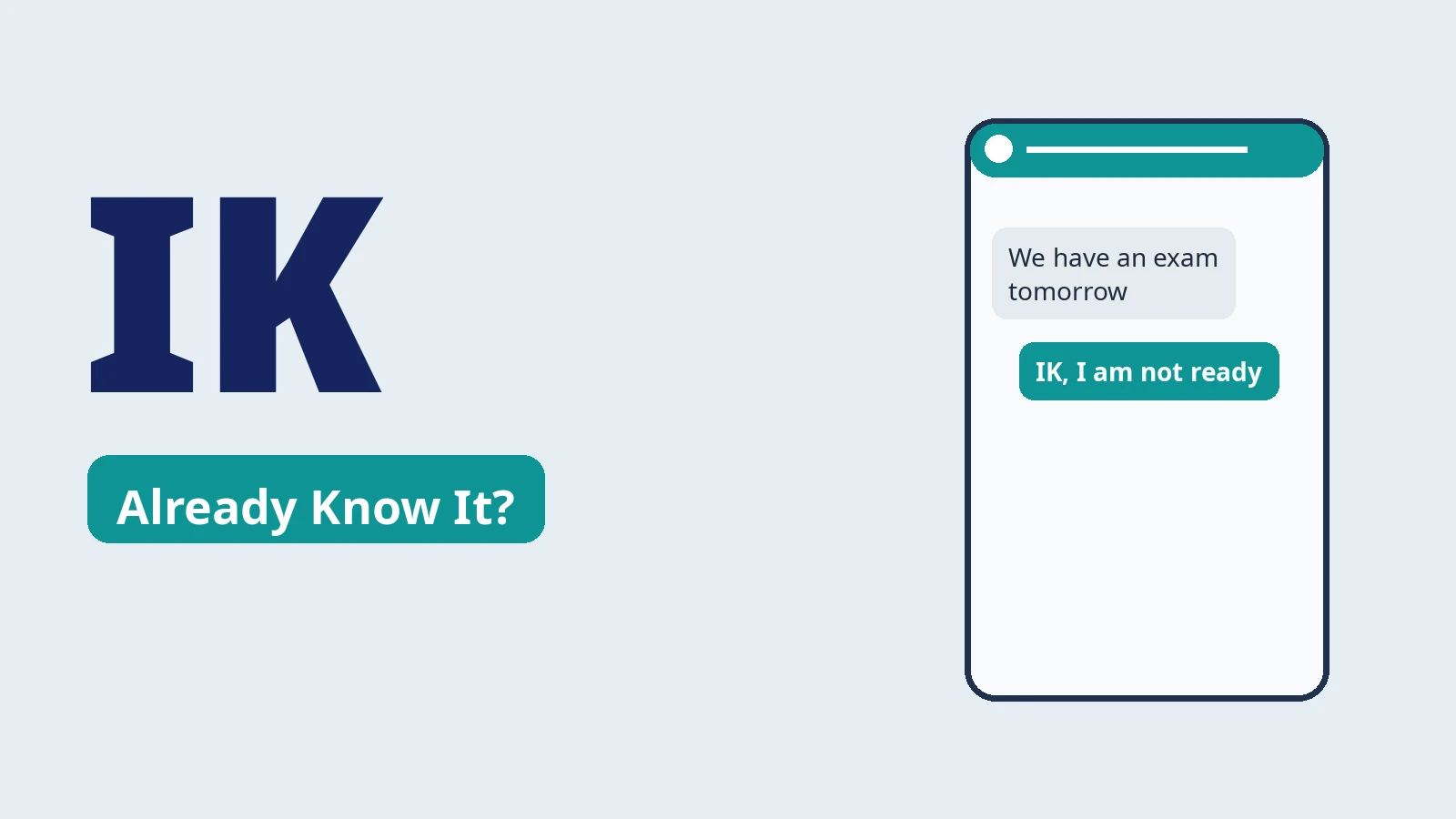
Your friend texts you the exam date, the one you already circled on your calendar last week. You type two letters back: “ik”. They laugh. Nobody explains anything twice.
Here is the short answer: IK means “I Know”. It is the shortest way to say you already have the information, you understand what was said, or you agree with it. It is plain, fast, and casual, and it lives in chats where nobody has time for full sentences.
In this guide you will learn the ik meaning in text, how tone turns those two letters warm or sharp, where IK shows up, why people reach for it instead of typing the full phrase, and what to send back when someone sends it to you.
What Does IK Mean in Text?
IK is a tiny acknowledgement with a big job. It tells the other person that the message landed, that nothing in it was news, and that no further explanation is needed.
When a friend says “the show is out tonight” and you reply “ik”, you are saying three things at once: I already knew that, I agree it matters, and we can move on to the next part of the conversation. The letters do the work of a whole sentence, and that is why they survive in fast chats.
Quick definition: IK means “I Know”. In texting and social media it confirms that you already know something, understand a situation, or agree with what someone just said. The tone around it decides whether it sounds warm, guilty, or dismissive.
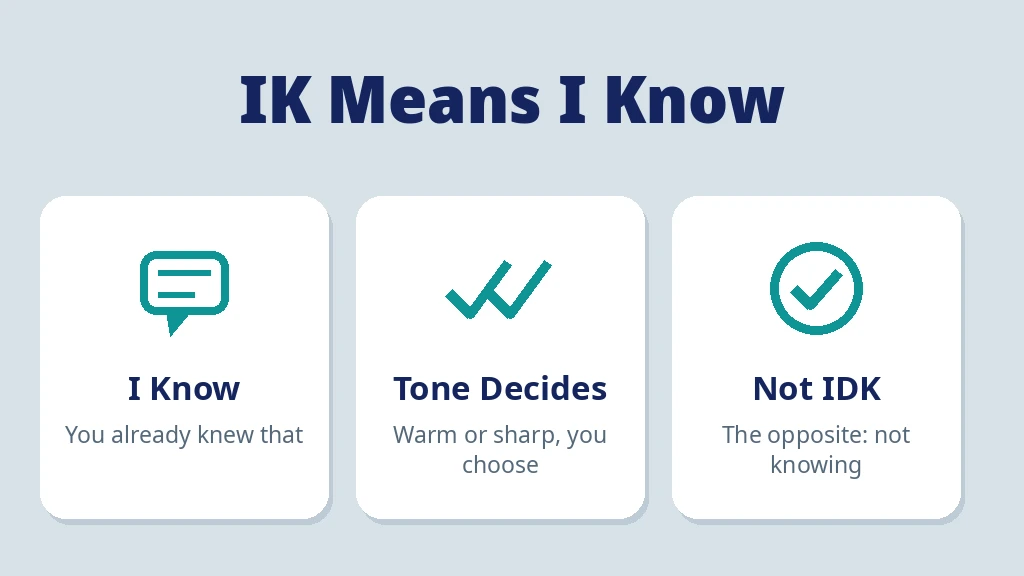
The sources agree on the expansion, and they agree on the tone split. CyberDefinitions says IK means “I Know”, and adds that it indicates the sender is already in possession of certain information or understands a situation. Wiktionary lists “ik” as internet slang and text messaging shorthand for “I know”, and gives IDK, “I don’t know”, as its opposite. The niche guides that rank for this term say the same thing in different words: all three of the top three lead with “I know”, and each one stresses that the tone ranges from warm agreement to a slightly dismissive brush off. The first widely cited definition appeared on Urban Dictionary in October 2004, and it read simply “Used in IM. Means I Know.”
IK Meaning in Easy Words
Think of IK as a nod. That is the ik meaning in one image.
When someone tells you something in person and you nod, you are not starting a speech. You are saying “I hear you, I already knew that, carry on”. IK is the typed version of that nod. It keeps the conversation moving without adding a new idea of its own.
In the simplest words:
IK = “I already knew that, and I agree with you.”
Where Is IK Used?
As ik slang, IK lives in casual chats between people who already share some context, and it almost never leaves that world.
Common places:
- Private texts and DMs, as a quick acknowledgement of news or a reminder
- Group chats, where one “ik” closes a point without starting a debate
- Snapchat chats, where short reactions are the norm
- Instagram and TikTok comments, answering a relatable post with a nod
- Discord DMs and gaming chats, where speed matters more than full sentences
Typical situations:
- A friend reminds you of a deadline you already know about
- Someone states an obvious fact and you agree with it
- A friend confesses something you already suspected
- A relatable post says what you were already thinking
- Someone asks if you knew a piece of news, and you did
Why Do People Use IK?
It saves time and typing
IK is two letters instead of six, and in a fast chat that difference matters. People use it for the same reason they use any shortcut: the full phrase adds nothing, so they cut it. The meaning survives the cut, and the conversation moves faster.
It shows agreement without a speech
Sometimes you agree with someone and there is nothing useful to add. Typing a full paragraph of agreement would slow the chat down and sound strange. IK says “I am with you” in the smallest possible space, and lets the other person keep talking.
It closes a loop
A reminder only needs one answer: I already knew that. IK closes that loop cleanly. The other person knows the message landed, knows no further explanation is needed, and can move on to something else.
Real-Life Examples of IK
Here is how IK actually shows up in chats and comments:
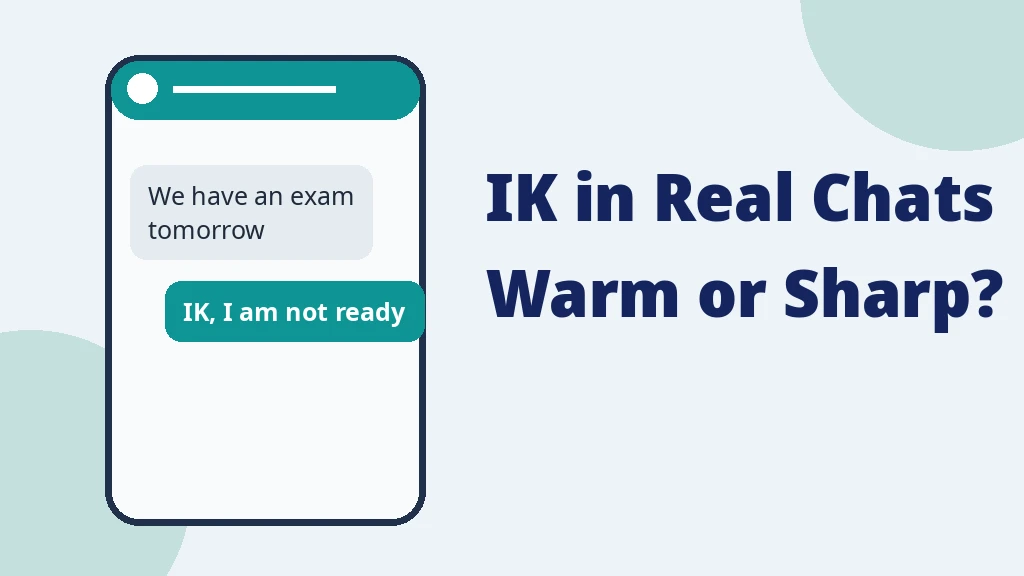
Example 1:
- Chat: “We have an exam tomorrow.” “IK, I am not ready at all!”
Meaning: Guilty agreement, the sender already knew about the exam.
Example 2:
- Chat: “The new episode is out tonight.” “IK, watching it the second I get home.”
Meaning: Warm acknowledgement, the sender already knew and is excited.
Example 3:
- Chat: “Do not forget to bring your charger.” “IK.”
Meaning: Sharp and short, the sender is tired of being reminded.
Example 4:
- Comment: “This movie is so good!” “IK, right? It is amazing!”
Meaning: Enthusiastic agreement with a stranger’s post, the plain IK doing the agreeing.
Example 5:
- Chat: “Did you know Sara got the job?” “IK, she told me yesterday.”
Meaning: Plain confirmation, the sender already had the news.
IK vs Similar Terms
| Term | Meaning | When to use it |
|---|---|---|
| IK | I Know | Plain acknowledgement or agreement |
| IDK | I Don’t Know | The opposite, when you do not know |
| IKR | I Know, Right? | Warm, enthusiastic shared agreement |
| IKK | I Know, Know, Know | Stretched, emphatic agreement |
| IFK | I F***ing Know | Emphatic agreement with heat and a swear word |
Key difference: IK is the calm, plain version of the whole family. IDK is its opposite, the admission that you do not know. IKR adds warmth and shared feeling, the “right?” inviting the other person to agree with you. IKK stretches the same agreement louder by repeating the K, and IFK adds a swear word that turns the agreement hot. If you want to sound calm, use IK. If you want to sound warm, use IKR. If you want to sound emphatic without swearing, IKK is the safer stretch. For the warm opposite of a shrug, here is what IDM means in text, the “I don’t mind” that keeps any choice friendly.
Keep IK apart from IKK as well. IKK is not a typo of IK. The extra K is deliberate, and it changes the volume of the agreement. IK says “I know”. IKK says “I really know, I completely agree”. Use IK when the feeling is ordinary, and save the stretched form for the moments when ordinary is not enough.
The Other IK Meanings You Should Know
“I Know” is the only texting meaning. In chats, DMs, and comments, IK means “I Know” and nothing else. Every source that covers texting agrees on that, and there is no rival texting reading with real support.
Outside texting, IK has formal meanings. In robotics, IK stands for inverse kinematics, the maths of working out how a robot arm should move to reach a target. In Swedish, IK is short for idrottsklubb, a sports or athletic club, which is why you see it in Swedish club names. In Esperanto, IK is an abbreviation for intelligence quotient, the same idea as IQ. As a language code, “ik” is the ISO code for Inupiaq. None of these will appear in a chat about an exam.
Tone rule in one line: an emoji or an exclamation mark means the warm reading, a full stop and no emoji means the sharp reading, and the sentence around it tells you which one you are looking at. When in doubt, read the message it answers before you decide how it sounded.
How to Reply to IK
Your reply depends on which IK you received, because the same two letters can open a chat or close one.
If it was sharp or dismissive: do not push the same point again. “Got it, sorry” or simply moving on to a new topic is the safest reply. Repeating the reminder will only make the sharpness worse.
If you want to use IK yourself: use it when you genuinely already know the thing being said. Add an emoji or a few extra words when the chat is warm, so it does not read as a brush off. “IK, thank you for telling me” is friendly. A bare “IK.” to a person who was trying to help can sound rude, even when you did not mean it that way. For a reply that is warm in any chat, here is what IDC means in text, the shrug that is honest about not caring either way.
When to Use IK (and When to Avoid It)
Good situations:
- Acknowledging news or a reminder you already had
- Agreeing with a friend in a fast-moving chat
- Answering a relatable post in a comment
- Closing a loop so the conversation can move on
Avoid using IK when:
- You are talking to a teacher, a boss, or anyone formal
- Someone is sharing serious news and needs a real response
- You actually do not know, since that is what IDK is for
- The other person was trying to help and a bare “IK.” would sound rude
Common Misunderstandings About IK
IK does not always sound dismissive. This is the biggest misunderstanding, and it comes from reading the letters without the context. Most of the time IK is a friendly nod, not a brush off. The sharp reading is real, but it is the exception, and the punctuation and the emoji are the clues that tell you which one you are reading.
IK does not mean “I don’t know”. That is IDK, the opposite term, and mixing the two up flips the meaning completely. IK says you already knew. IDK says you did not. One letter changes everything, so read the letters as written.
IK is not a full answer to a real question. If someone asks you a genuine question, “IK” does not answer it. It only says you already knew the thing they told you. When a question needs an answer, give the answer, and save IK for the moments when acknowledgement is all that is needed.
IK is not rude on its own. The rudeness, when it appears, comes from the situation: a reminder the sender is tired of, a helper being brushed aside, or a bare full stop where a warmer reply was expected. The letters themselves are neutral, and a little warmth around them keeps them friendly.
Frequently Asked Questions
What does IK mean in text?
IK means “I Know”. It is a short way to say you already have the information, understand a situation, or agree with what someone just said.
Is IK rude?
It can be, but usually it is not. With an emoji or extra words it sounds warm and friendly. A bare “IK.” with a full stop can sound sharp or dismissive, so add warmth when you mean it kindly.
What does IK mean on TikTok?
On TikTok, IK usually means “I Know” in comments, often as agreement with a relatable video. A stretched “ikkk” in a comment signals strong agreement.
What is the difference between IK and IDK?
IK means “I Know” and IDK means “I Don’t Know”. They are opposites. IK says you already knew something, IDK says you did not.
What is the difference between IK and IKR?
IK is plain acknowledgement, while IKR means “I Know, Right?” and adds warm, enthusiastic shared agreement. IK is calm, IKR is the warmer version that invites the other person in.
What does IKKK mean?
IKKK is a stretched form of IK, meaning strong agreement or “I really know”. The extra Ks add emphasis, like stretching the word out loud.
Should I use IK at work?
No. It is informal and can read as dismissive in a work chat. Write “I know, thank you” in full instead.
Final Thoughts
IK is the smallest acknowledgement in texting, and one of the most useful. It means “I know”, and it does the work of a nod: I already knew that, I agree with you, and we can move on. The letters are neutral, and the feeling comes from everything around them, the emoji, the punctuation, and the message they answer.
Now you can read it at a glance: an emoji and an exclamation mark mean the warm reading, a full stop and no emoji mean the sharp reading, and the sentence around it settles any doubt. The next time a friend reminds you of something you already knew, you can answer in two letters, and add a little warmth so it lands the way you mean it.
The lead is documented by CyberDefinitions, which says IK means “I Know” and indicates that the sender already has the information or understands the situation. Wiktionary lists “ik” as internet slang and text messaging shorthand for “I know”, with IDK as its opposite. For the warmest way to accept any option, here is what IDM means in text, the friendly “I don’t mind” that never sounds dismissive.
8 thoughts on “IK Meaning in Text | Do You Already Know This?”