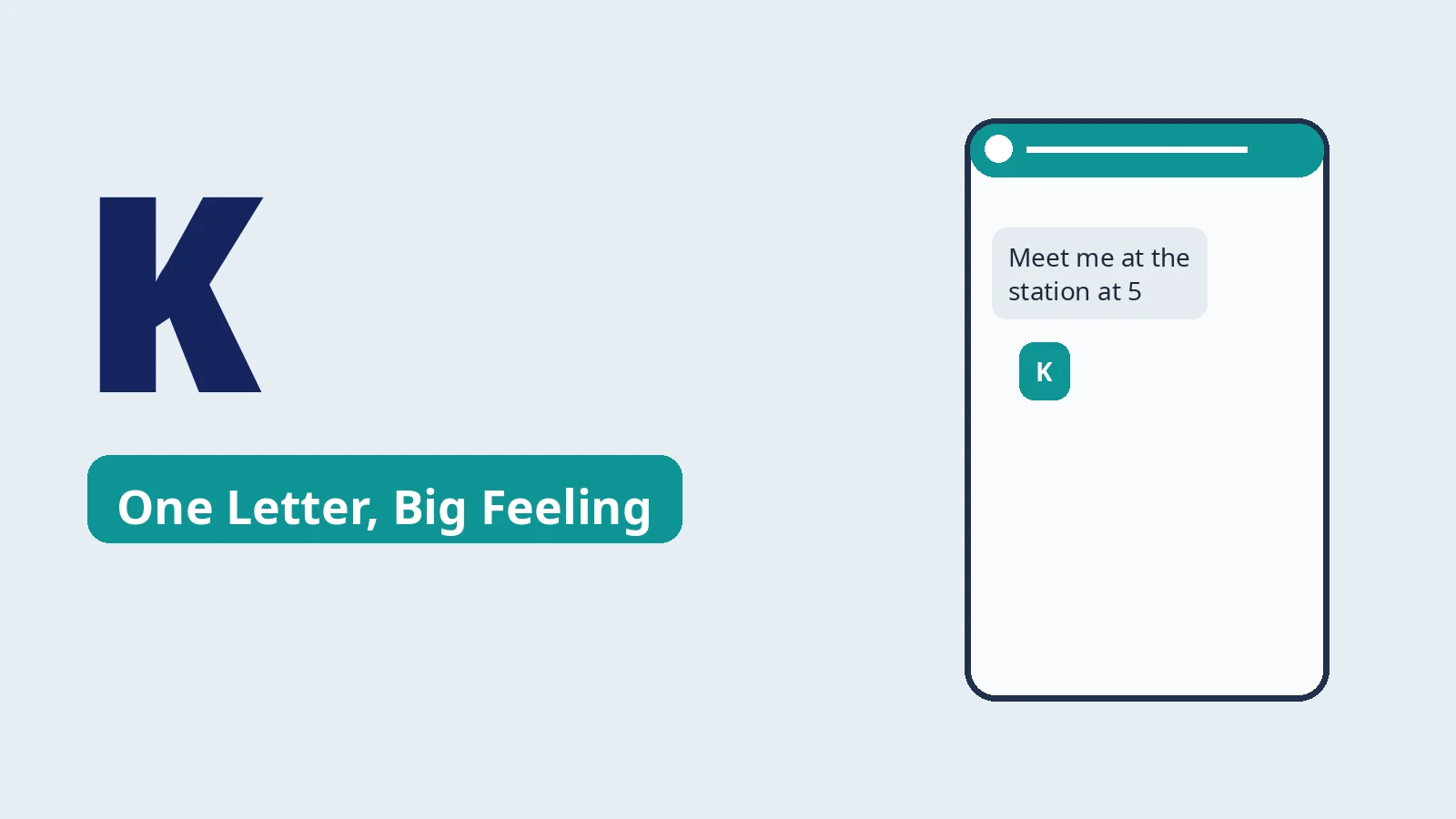
You send a long message. You planned the weekend, you asked three questions, you waited for an answer. Your phone buzzes. One letter comes back: “k”. Nothing else. Now you are staring at the screen, wondering if that means yes, no, or “please stop talking to me”.
Here is the short answer: K means “Okay”. It is the shortest possible way to say you got the message, you agree, or you accept the plan. It is fast, it is casual, and it is also the most misunderstood single letter in texting, because the meaning is simple and the feeling behind it is not.
In this guide you will learn the k meaning in text, why one letter can sound warm, cold, or annoyed, where K shows up, why people reach for it instead of typing the full word, and what to send back when someone sends it to you.
What Does K Mean in Text?
K is an acknowledgement with nothing attached to it. It tells the other person that the message arrived and that you have nothing to add, no question to ask, and no feeling to share. That emptiness is the whole point, and it is also the whole problem.
When a friend says “meet at 5” and you reply “k”, you are saying “got it, see you then”. When a friend pours out a long story about a bad day and you reply “k”, you are saying the same two things, “got it”, but the second one lands very differently. The letter did not change. The message it answered did.
Quick definition: K means “Okay”. In texting and social media it is a minimal way to confirm that you received a message, accept a plan, or agree with what someone just said. The tone around it decides whether it sounds neutral, friendly, or cold.
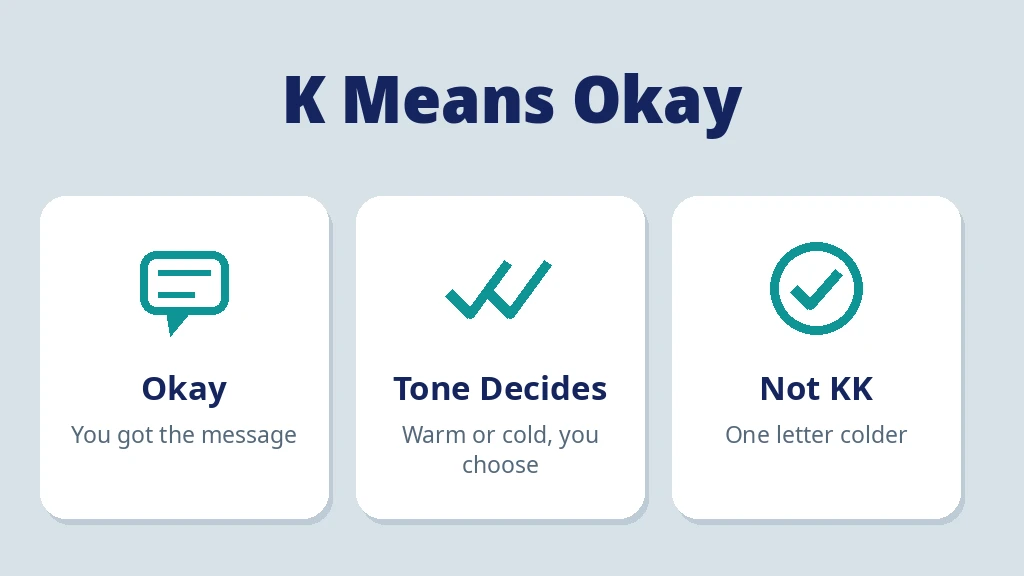
The sources agree on the expansion, and they agree on the tone split. CyberDefinitions says the letter k means “okay” in texting and online, and adds that it indicates acceptance, agreement, approval, or acknowledgment, but may sometimes be interpreted as lacking enthusiasm. Merriam-Webster lists “K” as a common texting abbreviation for “okay”. The niche guides that rank for this term say the same thing in different words: all three of the top three lead with “Okay”, and each one stresses that a single “k” often reads as cold, dismissive, or passive-aggressive. The first documented use of “K” as shorthand for “OK” dates to 1993, on an early internet message board, and it grew through the SMS era of the late 1990s and early 2000s, when phones charged per character and every letter cost something.
K Meaning in Easy Words
Think of K as a nod from someone who is already walking away. That is the k meaning in one image.
When someone tells you something in person and you nod once without a word, you are saying “I heard you”. You are not starting a conversation, and you are not ending one rudely. You are just confirming. K is the typed version of that single nod, and like a nod, it works best when the other person already knows you are listening.
In the simplest words:
K = “Okay, got it, nothing more to add.”
Where Is K Used?
As k slang, K lives in fast, informal chats between people who already know each other, and it almost never leaves that world.
Common places:
- Private texts and DMs, as a quick confirmation of a time, a place, or a plan
- Group chats, where one “k” closes a small point without starting a debate
- Snapchat chats, where short reactions are the norm
- Instagram and TikTok comments, answering a post with a dry, minimal reply
- WhatsApp chats, where a single “k” often ends a round of planning
Typical situations:
- A friend confirms a meeting time and you have nothing to add
- Someone sends an address or a link and you only need to confirm receipt
- A plan is settled and the chat is winding down
- You are busy, your hands are full, and a full reply would take too long
Why Do People Use K?
It saves time and typing
K is one letter instead of four, and in a fast chat that difference matters. People use it for the same reason they use any shortcut: the full word adds nothing to a simple confirmation, so they cut it. The meaning survives the cut, and the conversation moves faster.
It closes a loop with no effort
A confirmation only needs one answer: I got it. K closes that loop cleanly. The other person knows the message landed, knows no further reply is coming, and can move on to something else. When the loop is small, like a meeting time, that is exactly the right amount of effort.
Real-Life Examples of K
Here is how K actually shows up in chats and comments:
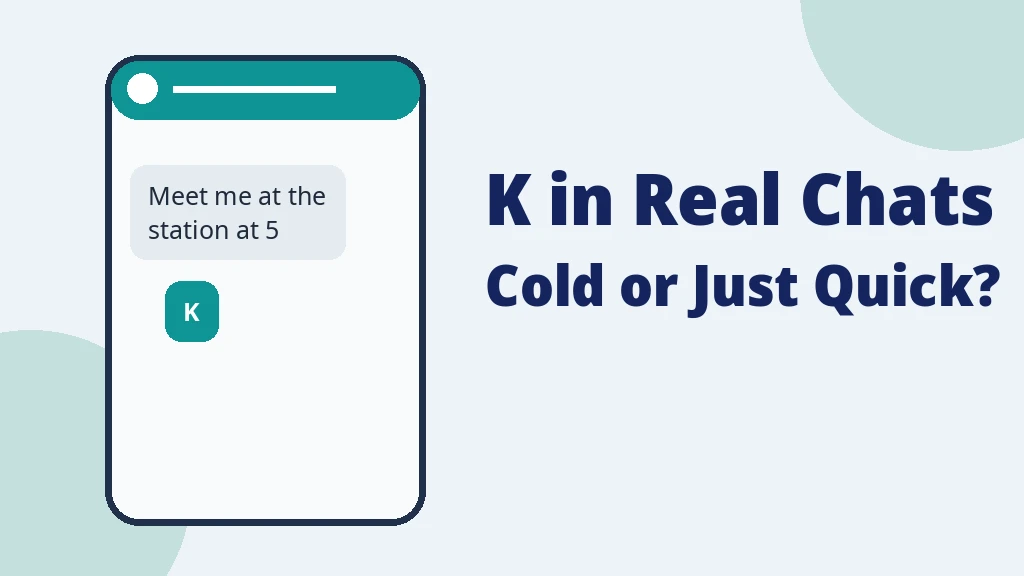
Example 1:
- Chat: “Meet me at the station at 5.” “K.”
Meaning: Plain confirmation, the sender got the time and will be there.
Example 2:
- Chat: “I have been thinking about this all week and I am really upset.” “K.”
Meaning: Cold and dismissive, the sender is brushing off a message that needed a real reply.
Example 3:
- Chat: “Can you pick up milk on your way home?” “K, on it.”
Meaning: Warm and practical, the extra words turn a bare “k” into a friendly yes.
Example 4:
- Comment: “This song is stuck in my head now.” “K.”
Meaning: Dry humour in a comment, the sender agrees but adds nothing.
Example 5:
- Chat: “Do not forget, the exam is tomorrow at 9.” “K, I know.”
Meaning: Mildly annoyed agreement, the sender already knew and is tired of the reminder.
K vs Similar Terms
| Term | Meaning | When to use it |
|---|---|---|
| K | Okay | Minimal confirmation, close friends only |
| KK | Okay | Warm, friendly confirmation |
| OK | Okay | Neutral, safe in most chats |
| Okay | Okay | Fully polite, works almost anywhere |
| Got it | Understood | When you want to sound engaged |
Key difference: K is the coldest member of the okay family, and KK is the warmest short form. OK sits in the middle, neutral and safe. “Okay” written out is the most polite of the lot, because it shows you took the time to type the whole word. “Got it” does a different job: it says you understood, and it sounds engaged, which K never does. If you want to sound calm, use OK. If you want to sound warm, use KK. If you want to sound polite, write “okay” in full. For the calm, plain version of agreement, here is what IK means in text, the “I know” that agrees without sounding cold.
Keep K apart from KK as well. KK is not a typo of K. The extra K is deliberate, and it changes the temperature of the whole reply. K says “noted”. KK says “got it, sounds good”.
The Other K Meanings You Should Know
“Okay” is the only general texting meaning. In chats, DMs, and comments, K means “Okay” and nothing else. Every source that covers texting agrees on that, and there is no rival texting reading with real support.
On dating apps, K can mean “kids”. CyberDefinitions lists “Kids” as a second definition, used on dating sites, as in “Do you like k?” That reading lives only in dating chats.
After a number, K means “thousand”. In money, followers, and statistics, 5K means 5,000 and 10K means 10,000, from the metric prefix kilo. That is a number sense, not a reply, and the number in front of it is the clue.
Outside texting, K has formal meanings. In physics, K is the symbol for Kelvin, the unit of temperature. In chemistry, K is the symbol for potassium. In baseball scorekeeping, K means a strikeout. None of these will appear in a chat about meeting at 5.
How to Reply to K
Your reply depends on which K you received, because the same letter can close a plan or close a person out.
If it was a plain confirmation: you do not need to reply at all. The loop is closed, and the plan is set. A thumbs up or a “see you then” is enough if you want to be sure.
If it felt cold or dismissive: do not answer with a “k” of your own, because that only turns the coldness into a contest. Ask a real question, like “are we good?”, or move on to a new topic and let the tone reset. For a reply that is warm in any chat, here is what IDM means in text, the “I don’t mind” that keeps any choice friendly.
When to Use K (and When to Avoid It)
Good situations:
- Confirming a time, a place, or a small plan with a close friend
- Acknowledging an address, a link, or a photo you only needed to receive
- Closing a practical loop in a fast-moving chat
- Replying when you are genuinely busy and a full sentence would wait too long
Avoid using K when:
- Someone has shared feelings, bad news, or a long message that deserves a real reply
- You are talking to a teacher, a boss, or anyone formal
- The conversation is tense, since a bare “k” will read as passive-aggressive
- You actually disagree, since “k” pretends to agree while saying nothing
Common Misunderstandings About K
K is not always rude. This is the biggest misunderstanding, and it comes from reading the letter without the context. In a fast chat about a meeting time, K is simply efficient. The rude reading is real, but it belongs to the situation, not to the letter itself.
K does not mean “I don’t care”. It can look that way, and a study summarised by Fast Company found that single-letter replies like “k” rank among the most negatively received responses in digital conversations. But the letter itself only says “okay”.
K is not the same as KK. One letter changes everything. K is minimal and can sound cold. KK is doubled and sounds friendly. Mixing the two up flips the feeling of the reply, so read the letters as written and count them.
K is not a full answer to a real question. If someone asks you a genuine question, “K” does not answer it. It only says you received the message. When a question needs an answer, give the answer, and save K for the moments when confirmation is all that is needed.
Frequently Asked Questions
What does K mean in text?
K means “Okay”. It is the shortest way to say you received a message, accept a plan, or agree with what someone just said.
Is K rude in texting?
It can be, but it is not always rude. As a quick confirmation of a time or a plan it is fine. A bare “K.” after a long or emotional message usually reads as cold or dismissive, so add a word or two when the chat matters.
What does K mean from a girl?
It usually means “Okay”, but the tone can vary a lot. As a quick confirmation it is neutral. After a long message it can mean she is annoyed, busy, or wants the conversation to end.
What is the difference between K and KK?
K is a single letter and often reads cold or minimal, while KK is a doubled letter and reads warm and friendly. Both mean “Okay”, but the extra K changes the feeling completely.
What does K mean on TikTok?
On TikTok, K usually means “Okay” in comments, often as a dry or minimal reply. A lone “k” under a video is usually read as unimpressed or dismissive.
What does 5K mean?
After a number, K means thousand, so 5K means 5,000. That comes from the metric prefix kilo, and it is a number sense, not the texting reply.
Should I use K at work?
No. It is informal and can read as dismissive in a work chat. Write “Okay, got it” in full instead.
Final Thoughts
K is the smallest reply in texting, and one of the most loaded. It means “okay”, and it does the work of a nod: I got it, I agree, and we can move on. The letter is neutral, and the feeling comes from everything around it, the message it answers, the full stop after it, and the words you did not add.
Now you can read it at a glance: a “k” after a time or an address means the plan is set, and a “k” with a few extra words means a friendly yes. The next time you are tempted to send a bare “k”, add one small word, and it will land the way you mean it.
The lead is documented by CyberDefinitions, which says the letter k means “okay” in texting and online, and notes that it indicates acceptance, agreement, approval, or acknowledgment, though it may sometimes be interpreted as lacking enthusiasm. For the warmer version of the same reply, here is what IK means in text, the calm “I know” that never sounds cold.