Your friend posts the most relatable video you have seen all week, the one that describes your life exactly. You do not type “ik”. You type “ikkk”. The extra letters are the whole point.
Here is the short answer: IKK means “I Know, Know, Know”. It is a stretched, emphatic form of IK, the typed version of saying “I knoooow” out loud. It means you already know, and you agree strongly.
In this guide you will learn the ikk meaning in text, why the extra K matters, how it differs from plain IK and warm IKR, why it is not the ick, and what to send back when someone sends it to you.
What Does IKK Mean in Text?
IKK is IK with the volume turned up. The extra K does not add a new word. It adds feeling, the way stretching a word out loud adds feeling in speech.
When someone says “this WiFi is terrible today” and you reply “ikkk”, you are not just saying you know. You are saying you know very well, you feel the same frustration, and you could not agree more. The letters are longer because the feeling is bigger.
Quick definition: IKK means “I Know, Know, Know”, a stretched and emphatic way to say you already know something or agree with it strongly. It is casual, expressive, and always informal.
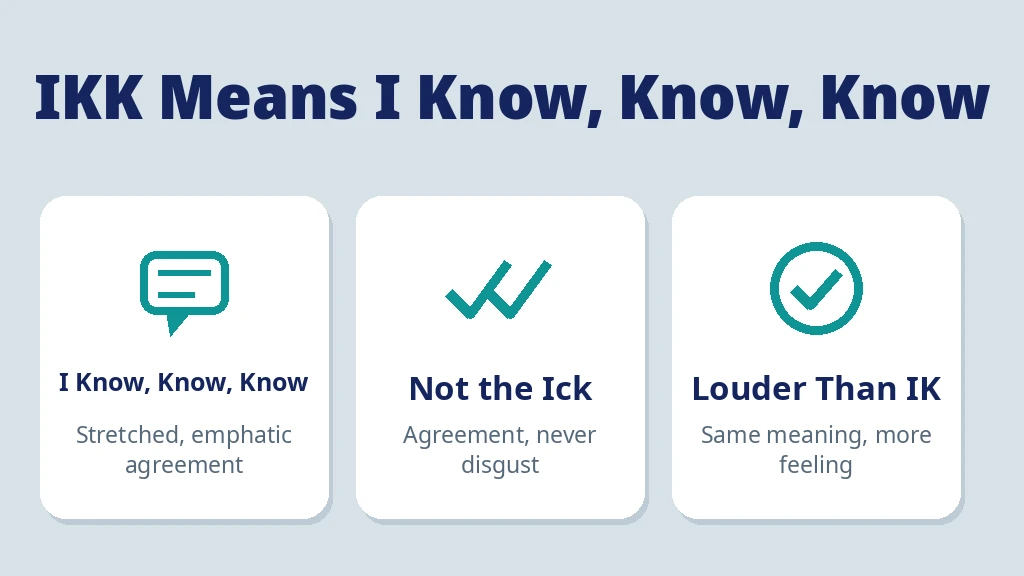
The sources agree on the core reading, and they agree on the emphasis. Texting.io says the slang “ikk” usually stands for “I know, know, know” or an extended “I knoooow”, and that it is a way to tell someone you already know what they are saying, or to show strong agreement. Streetslang says IKK means “I know” or “I know, right” in casual texting, usually as a quick agreement or a tiny “yeah, same” reply. Further guides repeat the same lead: one notes that “ikkk is text slang for I know, know, know”, and another notes that the stretched form is expressed “in a more emphasized manner”. CyberDefinitions has no entry for IKK at all, its page returns a clean 404, and no dictionary lists a texting sense for it, so the lead rests on those independent niche guides agreeing on the same emphatic “I know”.
IKK Meaning in Easy Words
Think of IKK as IK said with a big nod and a laugh. That is the ikk meaning in one image.
A plain nod says “I know”. A big nod, with wide eyes and a laugh, says “I know, I know, I know, do not even start”. IKK is the typed version of that big nod. The extra K is the wide eyes. The reader hears the stretch even though nothing was spoken out loud.
In the simplest words:
IKK = “I already know this, and I completely agree with you.”
Where Is IKK Used?
As ikk slang, IKK lives in the most casual corners of the internet, where typed feeling matters more than correct spelling.
Common places:
- Private texts and DMs, as an emphatic agreement with a friend
- Group chats, where one “ikkk” can end a relatable rant with a laugh
- Instagram comments, answering a relatable post with a stretched nod
- TikTok comments, under videos that describe a shared experience
- Snapchat chats and Discord DMs, where expressive spelling is normal
Typical situations:
- A friend complains about something you also hate, like bad WiFi
- Someone states an obvious truth and you agree completely
- A relatable meme describes your exact life
- A friend reminds you of something you already know very well
- A fandom post or an edit captures a feeling you share
Why Do People Use IKK?
It adds feeling without adding words
Saying “I completely agree with you and I already knew that” takes a whole sentence. Typing one extra letter takes a keystroke. IKK gives the reader the feeling of the long sentence at the cost of a single letter, and in a fast chat that trade is worth making.
It sounds like a voice, not a code
Plain abbreviations can feel flat, like a code. Stretched spellings feel like a voice, because people stretch words out loud when they feel strongly. IKK sounds like someone saying “I knoooow” with a laugh, and that voice makes the agreement feel warmer and more human.
It signals that the feeling is shared
IKK rarely answers a fact. It answers a feeling: frustration, excitement, embarrassment, or relief. The extra K tells the other person that the feeling is not theirs alone. You feel it too, and you feel it just as strongly.
Real-Life Examples of IKK
Here is how IKK actually shows up in chats and comments:
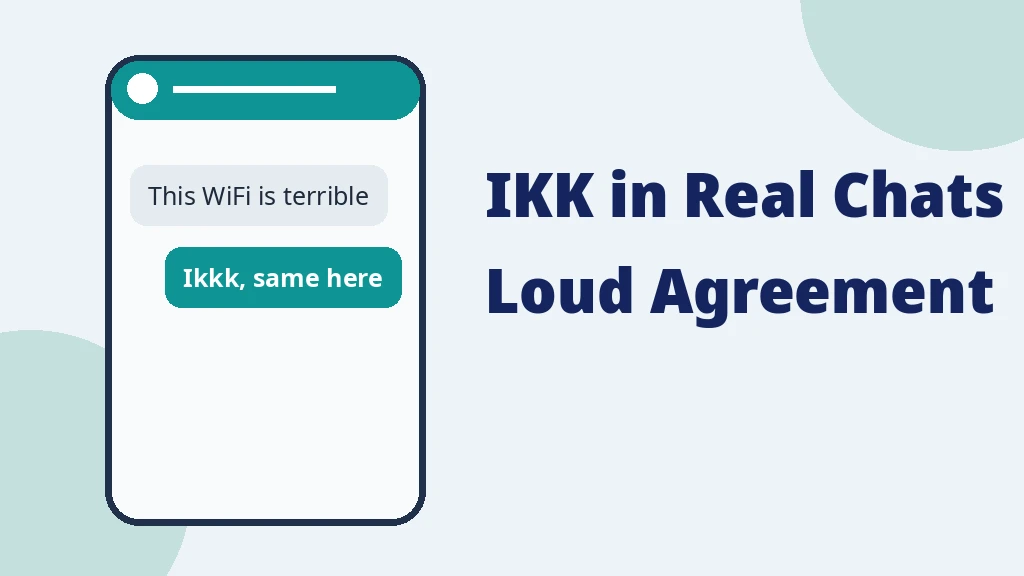
Example 1:
- Chat: “This WiFi is terrible today.” “Ikkk, it keeps cutting out on me too.”
Meaning: Strong agreement, the sender shares the same frustration.
Example 2:
- Comment: “That exam was the hardest one yet.” “Ikk, I barely finished.”
Meaning: Emphatic agreement with a relatable complaint.
Example 3:
- Chat: “You already told me about the party three times.” “Ikk, I know, I am just excited.”
Meaning: The sender already knows, and the stretch softens the admission with humour.
Example 4:
- Chat: “That concert was unreal.” “Ikkk, best night of the year.”
Meaning: Excited agreement, the sender felt the same joy.
Example 5:
- Comment: “Nobody understands how tired I am.” “Ikk, same, I slept four hours.”
Meaning: Shared feeling, the sender is saying “me too, completely”.
IKK vs Similar Terms
| Term | Meaning | When to use it |
|---|---|---|
| IKK | I Know, Know, Know | Stretched, emphatic agreement |
| IK | I Know | Plain, calm acknowledgement |
| IKR | I Know, Right? | Warm, shared agreement with a question |
| IFK | I F***ing Know | Emphatic agreement with heat and a swear word |
| Ick | Disgust | Reacting to something gross, never agreement |
Key difference: IKK and IK share the same meaning, and only the volume differs. IK is calm and plain. IKK is the same agreement stretched louder. IKR adds a “right?” that invites the other person in, so it feels warmer and more social than IKK. IFK is emphatic too, but it adds a swear word and heat, so it can sound annoyed where IKK sounds playful. The ick is not in the same family at all: it means disgust, and it reacts to something gross, while IKK agrees with something true. If the message answers a statement with agreement, it is IKK. If it reacts to something gross, it is the ick. For the calm version of the same family, here is what IDC means in text, the shrug that is honest about not caring either way.
The Other IKK Meanings You Should Know
“I Know, K?” is a single-source reading with no corroboration. One guide reads IKK as “I Know, K?”, a casual way of saying “I understand, right?” or “I get it, okay?” No other independent source agrees with that expansion, and its examples do not match the stretched-agreement use everywhere else. Treat it as an unverified claim. If someone writes “ikk” after a relatable complaint, they mean emphatic agreement, not “I know, K?”
IKK is not the ick. This is the confusion that matters most. “Ick” is a word for disgust, first recorded in the late 1960s, and one guide reads “ikkk” as a variation of it. That reading conflicts with the examples everywhere else, where IKK answers a statement with agreement, not a reaction to something gross. If someone wanted disgust, they would write “ick” or “eww”. The letters look alike, and the sound is close, but the meanings are opposites: one agrees, the other recoils.
Outside texting, IKK is a science term. In biology, IKK stands for IkappaB kinase, an enzyme complex involved in the cellular response to inflammation. That is why a search for uppercase IKK returns science papers instead of slang guides. It is not a texting meaning, and it will never appear in a chat about bad WiFi.
Tone rule in one line: more Ks mean more feeling, and the sentence it answers tells you which feeling. Agreement with a complaint means shared frustration, agreement with good news means shared excitement, and a gross photo with no agreement in sight means you are reading the ick, not IKK.
How to Reply to IKK
Your reply depends on what the IKK was agreeing with, because the stretch only tells you the feeling is strong, not what the feeling is.
If it admitted they already knew: be kind about it. “Ha, sorry, I got excited” or “Fair, I will stop repeating it” takes the pressure off. The writer already knew, so they do not need the point made again.
If you want to use IKK yourself: use it when the agreement is genuinely strong, and save it for casual chats with friends. Stretching the K once in a while keeps it fun. Stretching it in every message makes it lose its power. Never use it in a formal chat, and never use it to answer something gross, since that is the ick’s job, not yours. For a reply that is warm without any risk of sounding loud, here is what IHY means in text, the playful teasing that only works between close friends.
When to Use IKK (and When to Avoid It)
Good situations:
- Agreeing strongly with a friend in a casual chat
- Answering a relatable post or meme in a comment
- Sharing frustration or excitement you genuinely feel
- Admitting you already know something, with humour
Avoid using IKK when:
- You are talking to a teacher, a boss, or anyone formal
- The agreement is mild, since a plain IK fits better
- Someone is sharing serious news and needs a real response
- You mean disgust, since that is the ick, not IKK
Common Misunderstandings About IKK
IKK does not mean disgust. This is the biggest misunderstanding, and it comes from the letters looking like “ick”. The ick reacts to something gross. IKK agrees with something true. If the message answers a statement, it is agreement. If it reacts to a gross photo, it is the ick. The context decides, and the context is almost always agreement.
IKK is not a typo. The extra K is deliberate, and removing it changes the meaning. “IK” is calm. “IKK” is emphatic. Treating the extra letter as a mistake misses the whole point of the term, which is that the spelling is the feeling.
IKK is not the same as IKR. Both agree strongly, but IKR adds a “right?” that invites the other person in, while IKK simply turns the volume up on “I know”. They are cousins, not twins, and the difference is the warmth of the invitation versus the loudness of the agreement.
Frequently Asked Questions
What does IKK mean in text?
IKK means “I Know, Know, Know”, a stretched, emphatic way to say you already know something or agree with it strongly. It is the typed version of saying “I knoooow” out loud.
Is IKK the same as IK?
Almost. Both mean “I know”, but IKK is louder and more emphatic. IK is calm and plain, IKK is the same agreement with the volume turned up.
Does IKK mean disgust?
No. Disgust is “ick”. IKK means emphatic agreement. The letters look alike, but the meanings are opposites, so check the context before you decide.
What does IKK mean on TikTok?
On TikTok, IKK usually means “I Know, Know, Know” in comments, as strong agreement with a relatable video. It is the stretched nod under a post that describes the commenter’s life.
What is the difference between IKK and IKR?
IKK stretches “I know” louder, while IKR means “I Know, Right?” and adds a warm invitation to agree together. IKK emphasises, IKR bonds.
What does IKKK mean?
IKKK is the same term with one more K, meaning even stronger agreement. The extra letters only add emphasis, they never create a new meaning.
Should I use IKK at work?
No. It is informal and expressive, and in a work chat it will look careless. Write “I know, I completely agree” in full instead.
Final Thoughts
IKK is IK with feeling. It means “I know, know, know”, and the extra K is the whole message: I already knew this, I agree completely, and I feel it strongly. The spelling is the voice, and the voice is what makes a short reply feel human instead of flat.
Now you can read it at a glance: a relatable post with “ikkk” underneath means strong agreement, a gross photo with “ick” underneath means disgust, and the two are never the same word. The next time a post describes your life exactly, you can answer with the stretched letters, and the reader will hear your voice in them.
No dictionary or CyberDefinitions page defines IKK, so this article links no external source for the lead. The lead rests on independent slang guides agreeing on the same emphatic “I know” reading, and the dissenting readings are recorded in the article above rather than hidden. For the calm version of the same family, here is what IDC means in text, the shrug that is honest about not caring either way.