
Your friend posts a photo from a beach holiday, sun, sea, and a cocktail in hand, while you are stuck at your desk on a grey afternoon. You type three letters in the comments: “ihy”. Everyone laughs. Nobody calls the police.
Here is the short answer: IHY means “I Hate You”. In most chats it is a joke, not real hate. It is playful teasing, fake outrage, or good natured jealousy, usually aimed at a friend who has just done something lucky, funny, or mildly annoying. The words sound harsh. The feeling behind them is usually warm.
In this guide you will learn the ihy meaning in text, how to tell the joke from the real thing, where it shows up, why it became the playful opposite of ILY, and what to say back when someone sends it to you.
What Does IHY Mean in Text?
IHY is a short sentence with a long history of not meaning what it says.
“I hate you” is one of the harshest things you can say to a person, and that is exactly why it works as a joke. When friends use it, they are borrowing the strongest possible words to describe the smallest possible annoyance: you ate my fries, you finished the show without me, you got the last ticket. The exaggeration is the joke. Everyone in the chat knows the hate is fake, and that shared knowledge is what makes it funny instead of hurtful.
Quick definition: IHY means “I Hate You”. In most texting and social media use it is playful or teasing, expressing mock annoyance, jealousy, or affection. In a serious argument it can be literal, so tone and context decide which one you are reading.

The sources agree on the expansion, and they agree on the tone split. CyberDefinitions says IHY means “I Hate You”, and adds that it can be used ironically, often in response to someone’s good fortune, expressing good natured jealousy rather than actual dislike. The niche guides that rank for this term say the same thing in different words: two of the top three lead with “I hate you” and stress that most of the time it is playful or joking among friends. One dissenting guide reads the lowercase form as “I have” or “I have to”, but that reading appears in no other independent source, and it does not match the examples, where IHY stands alone as a reaction rather than starting a sentence about having something.
IHY Meaning in Easy Words
Think of IHY as a playful punch on the arm. That is the ihy playful reading in one image.
Friends punch each other lightly on the arm when something is funny or annoying, and nobody calls it violence. The gesture only works because both people know it is not real. IHY is the typed version of that punch. It says “I am annoyed with you” in the strongest possible words, while the friendship underneath says “and I am joking”.
In the simplest words:
IHY = “I am pretending to be mad at you because you did something lucky or annoying, and we both know I am joking.”
Where Is IHY Used?
As ihy slang, IHY lives in casual chats between people who know each other well, and it almost never leaves that world.
Common places:
- Private texts and DMs, as a reaction to a friend’s lucky or annoying news
- Group chats, where one “IHY” gets a round of laughing reactions
- Snapchat chats and comments, where short reactions are the norm
- Instagram and TikTok comments, under photos of holidays, food, or good news
- Discord DMs and gaming chats, where friends trade fake outrage for laughs
Typical situations:
- Someone posts a perfect holiday photo while you are at work
Why Do People Use IHY?
It turns jealousy into a joke
Real jealousy is uncomfortable to admit. “I am jealous of your holiday” sounds heavy. “IHY” says the same thing with a laugh built in, and it lets the other person enjoy their good news without feeling guilty about it.
It expresses annoyance without a fight
Small annoyances do not deserve a serious conversation, but they still deserve a reaction. IHY gives the annoyance a voice without starting an argument. The exaggeration signals that the feeling is small, and the friendship absorbs it easily.
Real-Life Examples of IHY
Here is how IHY actually shows up in chats and comments:
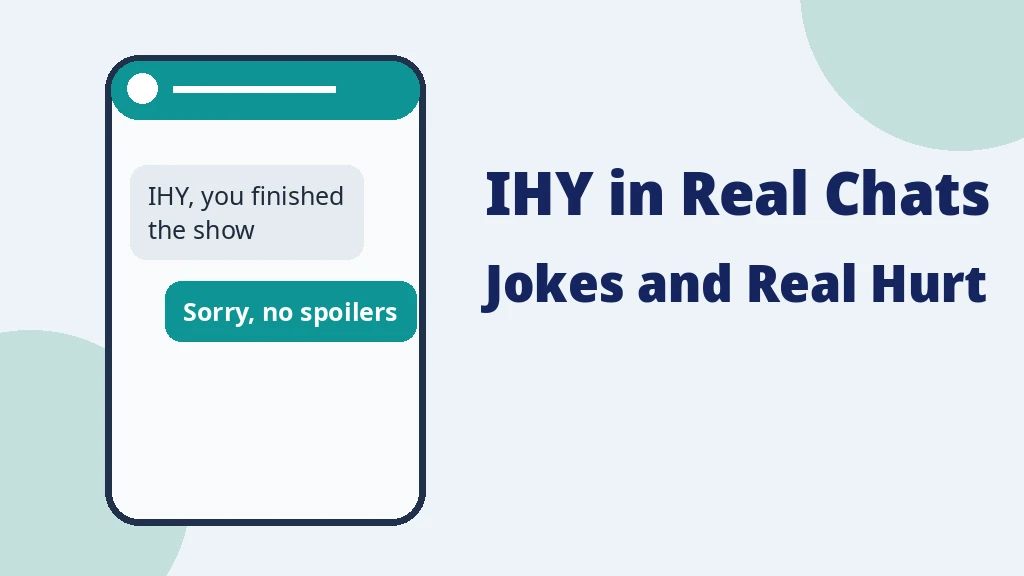
Example 1:
- Chat: “You ate the last slice of pizza. IHY!”
Meaning: Playful fake anger about a small theft.
Example 2:
- Comment: “You are on a beach and I am at my desk. IHY.”
Meaning: Good natured jealousy about a holiday photo.
Example 3:
- Chat: “You finished the show without me. IHYSM!”
Meaning: “I hate you so much”, the stretched version, still playful.
Example 4:
- Chat: “You lied to me. IHY. I never want to see you again.”
Meaning: This one may be literal.
Example 5:
- Chat: “Dave: I am meeting Jen for a drink tonight. Tony: IHY! She is gorgeous.”
Meaning: Good natured jealousy between friends, the classic ironic use.
IHY vs Similar Terms
| Term | Meaning | When to use it |
|---|---|---|
| IHY | I Hate You | Playful fake anger or jealousy between friends |
| ILY | I Love You | Real affection, the warm opposite |
| IHYSM | I Hate You So Much | A bigger, still usually playful, version |
| SMH | Shaking My Head | Disbelief or disappointment, no fake hate |
| Ugh | Frustration sound | Any small annoyance, aimed at nothing in particular |
Key difference: IHY and ILY are a pair, and the ihy vs ily contrast is the joke: ILY says the affection plainly. ILY says the affection plainly. IHY borrows the language of hate to joke about affection. IHYSM is the same joke turned up louder: more letters, more drama, still usually a joke. SMH is the honest cousin: it shows disbelief without pretending to hate anyone, which is why it is safer with people you do not know well. If the head shake fits your moment better than a fake insult, here is what SMH means in text, the reaction that needs no trust to land safely.
Keep IHY apart from IH as well. IH is sometimes used to start “I hate” phrases, as in “IH Mondays”, but IH is not a settled term and it has many competing readings. IHY is the settled form for the full “I hate you”, and it is clearer than IH precisely because it spells out the whole phrase.
The Other IHY Meanings You Should Know
“I Have” is a dissenting reading with weak support. One guide reads the lowercase form as “I have” or “I have to”, as in “ihy go soon” meaning “I have to go soon”. That reading appears in no other independent source, and it conflicts with the examples everywhere else, where IHY stands alone as a reaction. Treat it as an unverified claim. If someone writes “ihy” at the start of a sentence about having to do something, the context will make it clear, but a bare “IHY” is almost always “I hate you”.
Outside texting, IHY has formal meanings. In medicine, IHY can stand for intrahepatic cholestasis of pregnancy. In science, IHY was the International Heliophysical Year, a project studying the sun and the earth. Neither is a texting meaning, and neither will appear in a chat about pizza.
Tone rule in one line: laughing emoji, exclamation mark, or a lucky event means the joke; a serious argument, no emoji, and a sentence about lying or betrayal means it may be real. When in doubt, ask before you laugh it off.
How to Reply to IHY
Your reply depends on whether the IHY was a joke, because the wrong reply to either version makes things worse.
If it was clearly a joke: play along. “Ha, sorry, the pizza was worth it” or “I know, I am the worst” keeps the joke going. A laughing emoji works too. The writer wanted a laugh, so give them one.
If it was real anger: do not laugh it off. “I hear you, can we talk about what happened?” takes the message seriously and opens a real conversation. If the chat is a serious argument, the letters deserve a serious reply.
If you want to use IHY yourself: use it only with close friends, only about small things, and pair it with a laugh or an emoji the first few times. “IHY” to a stranger, a colleague, or a new friend can land as a real insult, and no explanation afterwards will fully undo the first impression. For a reassuring reply that never risks that confusion, here is what DW means in text, the “do not worry” that is warm in any chat.
When to Use IHY (and When to Avoid It)
Good situations:
- Teasing a close friend about a small annoyance, like stolen food
- Joking about good natured jealousy, like a holiday photo
- Trading fake outrage in a group chat where everyone knows the joke
- Answering a sibling or partner who teased you first
Avoid using IHY when:
- You are talking to a stranger, a colleague, or someone new
- The argument is real and feelings are already hurt
- The other person has told you they do not like harsh jokes
- You actually mean “I have” or “I have to”, since nobody will read that sense
Common Misunderstandings About IHY
IHY does not always mean real hate. This is the biggest misunderstanding, and it is the whole point of the term. Most of the time, IHY is a joke between friends, and the hate is fake. Reading every IHY literally would make the internet look far angrier than it is. The emoji, the exclamation mark, and the lucky event are the clues that it is a joke.
IHY does not mean “I have”. That reading comes from a single guide, and it does not match how the term is used anywhere else. If you write “ihy go soon” expecting people to read “I have to go soon”, most of them will read “I hate you, go soon” instead, and the confusion will be entirely avoidable. Write “I have to go” in full.
IHY is not safe with everyone. The joke needs trust, and trust takes time. With a new friend, a colleague, or anyone who has not heard the joke before, the letters can land as a real insult. The safe rule is simple: use it only with people who have already joked with you this way, and never use it to win an argument.
Frequently Asked Questions
What does IHY mean in text?
IHY means “I Hate You”. In most chats it is playful or teasing, expressing mock annoyance or good natured jealousy, not real hate.
Is IHY serious?
Usually not. Between friends it is almost always a joke. In a serious argument, though, it can be literal, so check the tone and the sentence around it.
What does IHY mean on TikTok?
On TikTok, IHY usually means “I Hate You” in comments, and it is usually playful, as in joking jealousy under a holiday or good news video.
What is IHYSM?
IHYSM means “I Hate You So Much”. It is a bigger, more dramatic version of IHY, and it is still usually playful, as in “you finished the show without me, IHYSM”.
What is the difference between IHY and ILY?
ILY means “I Love You” and says affection plainly. IHY means “I Hate You” and is usually a playful opposite, a fake insult that only works between people who like each other.
Does IHY mean “I have”?
One guide says so, but no other independent source agrees, and real examples show IHY standing alone as a reaction. Do not use it for “I have”; write the words in full.
Should I use IHY at work?
No. It is informal, it needs trust to work as a joke, and in a work chat it will read as a real insult. Keep it for close friends outside work.
Final Thoughts
IHY is a joke that borrows the harshest words in the language and turns them into affection. It means “I hate you”, and in most chats it means the opposite of what it says: I like you, I am jealous of your good luck in a friendly way, and I trust you enough to joke about it. The words are strong, the feeling is warm, and the trust between the people is what makes the difference.
Now you can read it at a glance: a laughing emoji and a lucky event mean the joke, a serious argument and a sentence about betrayal mean it may be real, and a bare “IHY” from a stranger deserves a question before a laugh. The next time a friend writes it after you ate their fries, play along.
The lead is documented by CyberDefinitions, which says IHY means “I Hate You” and notes that it is often used ironically, expressing good natured jealousy rather than actual dislike. For a reply that is warm without any risk of sounding harsh, here is what DW means in text, the “do not worry” that fits any chat.
4 thoughts on “IHY Meaning in Text | Hate or Joke? How to Tell the Difference”