It is Monday morning. The alarm went off too early, the weekend feels like it ended five minutes ago, and your friend sends you a message with three letters you have never seen before: “ihm”. No emoji, no explanation, just three letters and a Monday.
Here is the short answer: IHM means “I Hate Mondays”. It is a short, joking groan about the first day of the working week, the texting version of sighing at the alarm clock. It is a rare term, so most people will not know it on sight, but the meaning is simple once you have seen it.
In this guide you will learn the ihm meaning in text, why it is rare, where it shows up, how it differs from the German word it looks like, and what to say back when someone drops it into your Monday chat.
What Does IHM Mean in Text?
IHM is a complaint in miniature. It packs a whole Monday mood into three letters.
Monday has a reputation in every language: the weekend is over, the alarm is early, the inbox is full, and the next weekend feels far away. “I hate Mondays” is the sentence people have said about that feeling for generations. IHM is simply that sentence shortened for a text, the way LOL shortened a laugh and IDK shortened not knowing.
Quick definition: IHM means “I Hate Mondays”. It is used on Mondays, or when talking about Mondays, to express dislike, tiredness, or playful frustration about the start of the week.
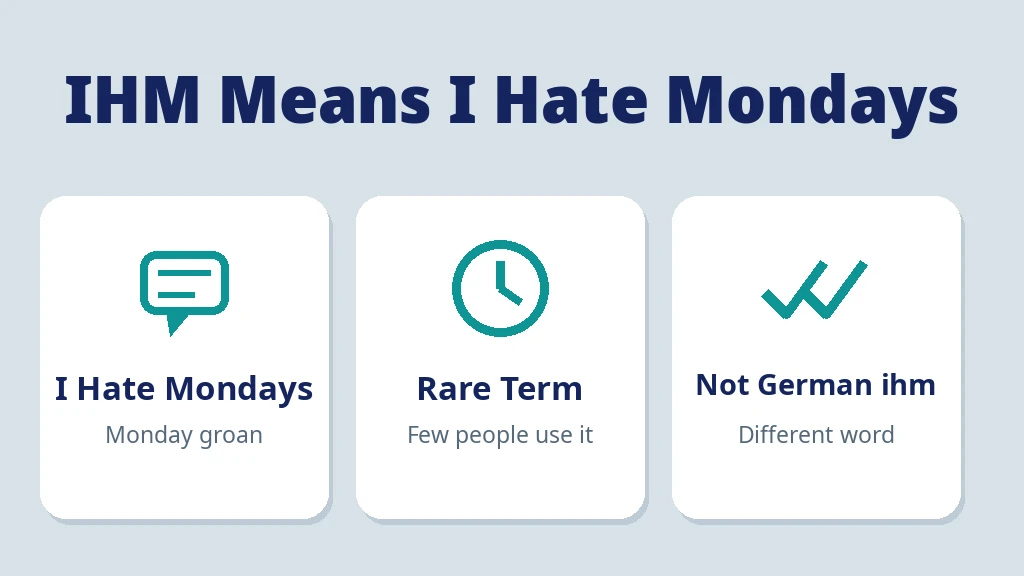
The sources agree on the expansion, and they agree that it is rare. CyberDefinitions says IHM means “I Hate Mondays” when used in a text, calls it the most common meaning in texting, and warns that it is a rare term. The Free Dictionary’s acronym list includes “I Hate Mondays” among the IHM definitions, and abbreviation lists give the same expansion. What you will not find is a flood of guides about it: a plain search for “ihm meaning in text” mostly returns German pages about the word “ihm”, which is a different word entirely, and that scarcity is part of the story. IHM exists, it is documented, and almost nobody uses it.
IHM Meaning in Easy Words
Think of IHM as a Monday groan typed out.
You know the sound: the alarm goes off, you look at the clock, and a small unhappy noise comes out before you are even awake. IHM is that noise in letters. It is not real hatred. Nobody who writes “ihm” actually hates an entire day of the week in a serious way. It is a joke about a shared feeling, and the joke works because almost everyone has felt it.
In the simplest words:
IHM = “It is Monday again, and I am not ready for it.”
Where Is IHM Used?
IHM is rare, so as ihm slang it does not have a busy home anywhere. When it appears, it appears in the same places other small complaints appear.
Common places:
- Private texts and DMs on Monday mornings, as a greeting or a complaint
- Group chats, where one “ihm” starts a round of Monday jokes
- Social media captions and comments on Mondays, under posts about alarms and commutes
- Work chats, as a light joke between colleagues who know each other well
Typical situations:
- Waking up early after a good weekend
- Facing a long meeting list on a Monday
- Going back to school or work after a holiday
- Captioning a Monday post without writing a full sentence
Why Do People Use IHM?
It turns a groan into a joke
“I hate Mondays” said out loud can sound negative. Typed as “ihm” between friends, it becomes a shared joke. The shortcut signals that the complaint is playful, not serious, and that the writer expects a laugh or a matching groan rather than sympathy.
It is faster than the full sentence
Monday mornings are busy, and nobody wants to type a full complaint before coffee. Three letters carry the whole feeling, and in a fast chat that speed is the appeal.
It finds people who feel the same
Monday dislike is one of the most shared feelings online. Posting “ihm” is a small signal that says “I feel this, do you?” and the replies are usually a flood of agreement, coffee emojis, and matching complaints. The term works as a tiny flag for a shared mood.
Real-Life Examples of IHM
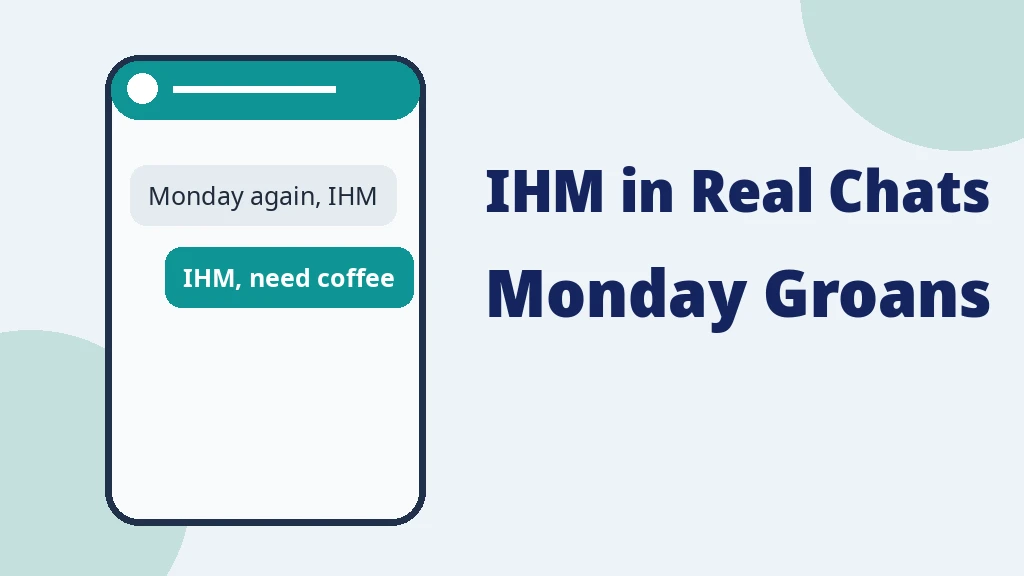
Here is how the ihm monday groan actually shows up in chats and captions:
Example 1:
- Chat: “Alarm went off at 6, IHM, I need coffee.”
Meaning: “I hate Mondays” as a morning groan.
Example 2:
- Chat: “Monday again, IHM. Three meetings before lunch.”
Meaning: A complaint about the shape of the day.
Example 3:
- Caption: “Back to the office. IHM.”
Meaning: A Monday caption.
Example 4:
- Chat: “Weekend was too short, IHM.”
Meaning: The weekend ending too soon is the complaint.
Example 5:
- Chat: “You up? IHM, I have been awake since 5.”
Meaning: An early Monday check in.
IHM vs Similar Terms
| Term | Meaning | When to use it |
|---|---|---|
| IHM | I Hate Mondays | Monday groans, rare and playful |
| IHY | I Hate You | Playful teasing, usually a joke |
| SMH | Shaking My Head | Disbelief or disappointment, any day |
| Ugh | Frustration sound | Any small annoyance, no day attached |
| TGIF | Thank God It Is Friday | Friday relief, the opposite end of the week |
Key difference: IHM is tied to one day, while the others are not. SMH works on any day and reacts to something specific. “Ugh” works on any annoyance. TGIF is the mirror image: Friday relief instead of Monday dread. IHY is the closest cousin in shape, since it is also an “I hate” shortcut, but it aims at a person as a joke, while IHM aims at a day. And for the head shake that fits any day of the week, here is what SMH means in text.
The “I hate” family is worth keeping straight. IH on its own is sometimes used to start “I hate” phrases, as in “IH Mondays”, but IH is not a settled term and it has many competing readings, so it is a risky shortcut. IHM is the settled form for Mondays specifically, and it is clearer than IH precisely because it names the day.
The Other IHM Meanings You Should Know
“Ihm” in German is not IHM. The ihm german confusion is the most likely mix up, and it is worth a full paragraph. In German, “ihm” is the dative form of “er”, meaning “him” or “to him”, as in “ich gebe ihm das Buch”, meaning “I give him the book”. A search for “ihm” returns German grammar pages first, and a reader who lands on a German sentence should not read it as a Monday complaint. The difference is the language of the chat: English chat plus Monday equals “I hate Mondays”, German sentence equals a pronoun.
IHM has formal meanings in other fields. In medicine, IHM can be the immune health metric, a measure of immune function. In science, IHM is the interacting heads motif in muscle research. In religion, IHM can stand for the Immaculate Heart of Mary. In computing, IHM is a modelling format for structures. None of these is a texting meaning, and none of them will appear in a Monday morning chat.
Day rule in one line: IHM belongs to Mondays and to English chats about Mondays. In a German sentence it is a pronoun, and in a science paper it is something else entirely. The day and the language decide.
How to Reply to IHM
Replying to IHM is easy, because the writer is inviting agreement, not asking for help.
If a friend writes “ihm” on a Monday: agree and add your own groan. “Same, coffee first” or “tell me about it, my alarm went off twice” both work. Matching the mood is the whole reply.
If you see “ihm” in a German sentence: do not reply to a Monday complaint at all. Read it as the pronoun “him” and answer the German sentence on its own terms.
If you want to use IHM yourself: use it on Mondays, with people who know you, and pair it with the reason. “IHM, three meetings before lunch” is clear. A bare “ihm” with no context may confuse people who have never seen the term, since it is rare.
When to Use IHM (and When to Avoid It)
Good situations:
- Joking about a Monday morning with close friends
- Captioning a Monday post about alarms, commutes, or coffee
- Starting a round of Monday jokes in a group chat
- Lightening a work chat on a Monday, with colleagues you know well
Avoid using IHM when:
- It is not Monday and the joke will not land
- You are talking to someone who does not know the term, since it is rare and easily misread
- The chat is in German or with German speakers, where “ihm” is a pronoun
- The complaint is serious, since a joke shortcut will make a real problem sound small
Common Misunderstandings About IHM
IHM does not mean the writer truly hates Mondays. Real hatred is a strong feeling, and a three letter joke is not how people express it. IHM is a playful groan about a shared feeling, closer to a sigh than to a serious complaint. Treat it as a joke and you will read it correctly.
IHM is not a common term. This is the misunderstanding that causes the most confusion. People assume every three letter shortcut is widely known, but CyberDefinitions rates IHM as extremely difficult to guess, and most searches for it return German grammar instead. If you use it, expect some readers to ask what it means, and be ready to explain it in one line.
IHM is not the German word “ihm”. The two look identical in lowercase, and that is exactly why they get mixed up. The German word is a pronoun that has existed for centuries. The texting term is a recent English abbreviation. Same letters, different languages, different meanings, and the chat around them tells you which one you are reading.
IHM is not the same as IHY. Both start with “I hate”, but one hates a day and the other teases a person. Mixing them up turns a Monday joke into a personal jab, so keep the last letter straight: M is for Mondays, Y is for you. For a question that often follows a Monday groan, HBU means “how about you”, the reply that keeps a Monday chat going.
Frequently Asked Questions
What does IHM mean in text?
The ihm meaning in texting is “I Hate Mondays”, a short, playful groan about the first day of the working week, used on Mondays or when talking about Mondays.
Is IHM a common abbreviation?
No, it is rare. CyberDefinitions calls it a rare term and rates it extremely difficult to guess, so many readers will not know it on sight.
Does IHM mean “him” in German?
Not as a texting term. In German, “ihm” is the dative form of “er”, meaning “him” or “to him”. The English texting term and the German pronoun share the same letters but are different words.
Can I use IHM on other days?
Yes, when the topic is Mondays, as in dreading next Monday. As a general complaint on a Wednesday, it will confuse people, so save it for Monday talk.
Is IHM rude?
No. It is a light joke about a shared feeling, not an insult. It only sounds negative if it is used in a serious work chat where a joke does not fit.
What is the difference between IHM and IHY?
IHM means “I Hate Mondays” and complains about a day. IHY means “I Hate You” and teases a person, usually as a joke. The last letter tells you which one it is.
Final Thoughts
IHM is a small joke about a big shared feeling. It means “I hate Mondays”, and it is used the way a sigh is used: briefly, playfully, and with the expectation that everyone nearby feels the same. It is rare, it is easy to confuse with the German pronoun that shares its letters, and it only really works when Mondays are the topic.
Now you know how to read it: an English chat on a Monday morning is a groan about the week, a German sentence is a pronoun, and a science paper is something else entirely. The next time “ihm” lands in your chat on a Monday, answer it with a groan of your own.
The texting lead is documented by CyberDefinitions, which says IHM means “I Hate Mondays” in a text while noting that it is a rare term, and The Free Dictionary lists “I Hate Mondays” among the definitions of IHM. For a Monday check in that often follows the groan, here is what HBU means in text, the “how about you” that keeps the conversation going.