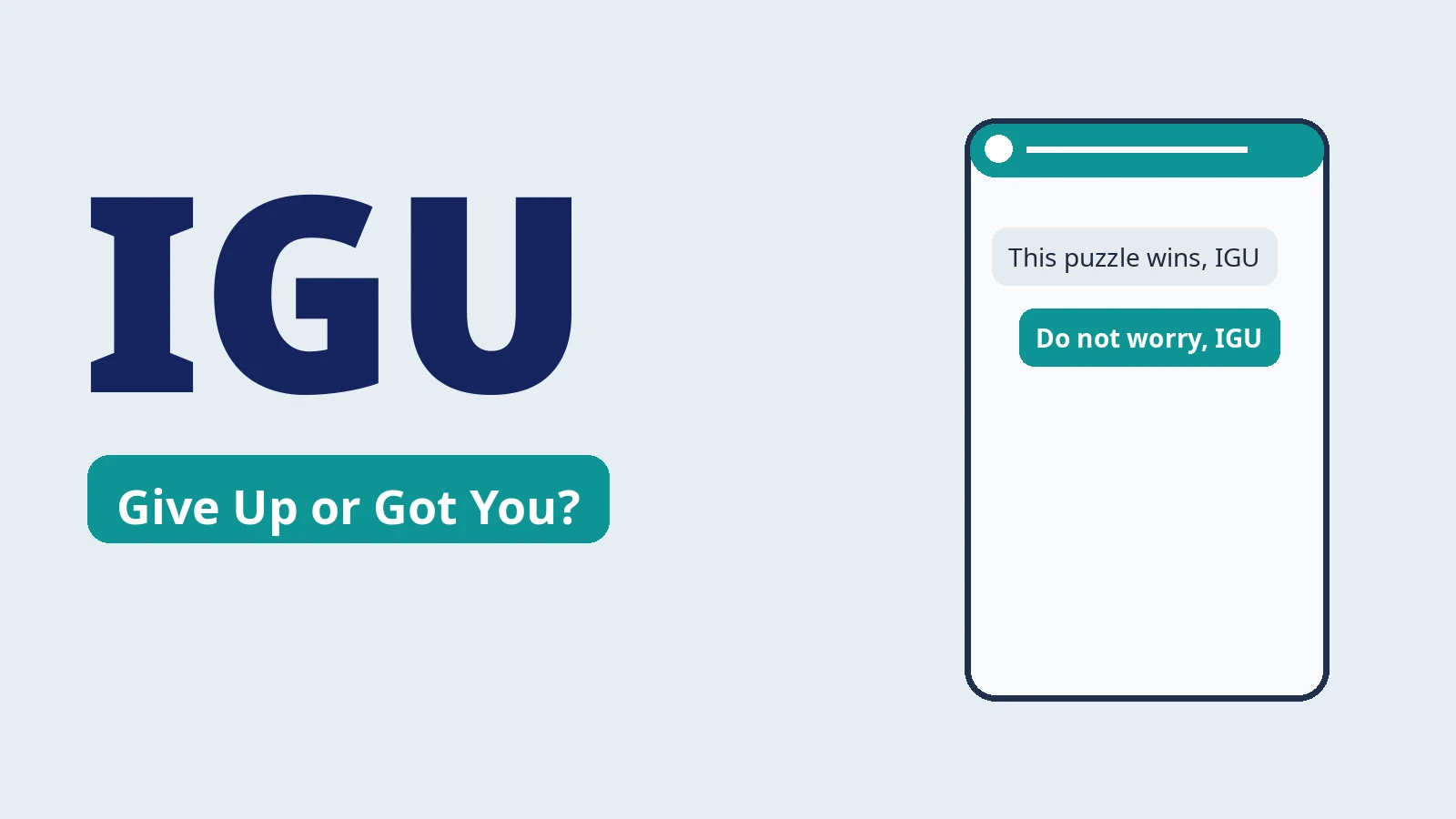
You have tried the same puzzle ten times, the pieces still do not fit, and your friend is watching you fail with a grin. You type three letters, put the phone down, and walk away: “igu”. Everyone in the chat knows exactly what just happened.
Here is the short answer: in plain texting, IGU usually means “I Give Up”. It is a small white flag, a playful or frustrated surrender when a puzzle, an argument, or a game has beaten you. On TikTok, though, the same letters often mean “I Got You” or “I Get You”, which is almost the opposite: support instead of surrender. The platform and the sentence decide which one you are reading.
In this guide you will learn the igu meaning in text, how to tell surrender from support, where each reading lives, why the same letters can mean two opposite things, and how to answer without making a joke worse or a real frustration feel ignored.
What Does IGU Mean in Text?
IGU is a tone word. The letters stay the same, but the feeling behind them changes with the chat.
In a private text or a gaming chat, IGU is usually a surrender. Someone has tried, failed, and decided to stop. It can be dramatic, with extra letters or an emoji, or it can be flat and tired. Either way, the message is “I am done with this”. In a TikTok comment, IGU is more often support: “I got you” or “I get you”, a quick way to say “I understand” or “I have got your back” under a video.
Quick definition: in texting, IGU usually means “I Give Up”. It signals surrender, frustration, or playful defeat. On TikTok and in some comments, IGU can also mean “I Got You” or “I Get You”, showing understanding or support.
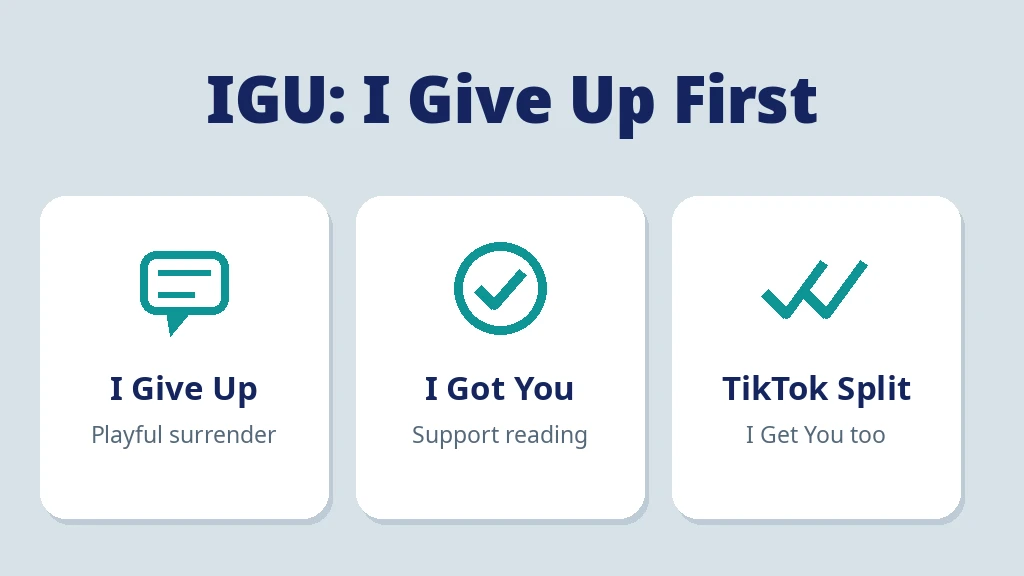
The sources agree on the texting lead, and they split openly on the rest. CyberDefinitions says IGU means “I Give Up” when used in a text, calls it the most common meaning in texting, and adds that it is a rare term. The niche guides that rank for this term agree: two of the top three lead with “I Give Up”, describing it as frustration, playful defeat, or mental exhaustion. The dissenting guide leads with “I Got You” instead, and TikTok guides lean the same way, with “I Get You” and “I Got You” as the comment readings and “I Guess You” as a sarcastic shrug reading. Nobody pretends the letters have one meaning everywhere, and this guide does not either.
IGU Meaning in Easy Words
Think of IGU as a hand going up in two different ways.
In a game or an argument, the hand goes up in surrender: “I quit, you win, I am done”. In a comment under a video, the hand goes up in support: “I have got you, I understand, I am with you”. Same hand, same letters, opposite messages. The only way to tell them apart is to look at what is happening around them.
In the simplest words:
IGU = “I am done trying” in a chat, and “I have got you” in a TikTok comment.
Where Is IGU Used?
As igu slang, IGU is rare compared with giants like LOL or IDK, and CyberDefinitions says so plainly. When it does appear, it appears in two different places.
The “I Give Up” reading appears in:
- Private texts and group chats, after a failed attempt at something
- Gaming chats, when a level, puzzle, or opponent proves too much
- Arguments that have gone in circles and nobody is winning
- Playful chats between friends, where giving up is a joke rather than a real defeat
The “I Got You” and “I Get You” readings appear in:
- TikTok comments, under videos about feelings, struggles, or relatable moments
- Instagram comments and DMs, as a quick show of support
- Reassurance chats, where the igu i got you reading promises help, as in “do not worry about the notes, IGU”
Why Do People Use IGU?
It ends a struggle without a speech
Explaining that you are stuck takes a paragraph. “IGU” takes a second, and everyone understands it. In a game or a puzzle chat, that speed keeps the conversation moving instead of stalling on a failure.
It makes defeat funny instead of heavy
Most IGU messages are not real despair. They are playful: the puzzle won, the joke won, the argument is not worth another hour. Typing “I give up” in three letters turns a small loss into a joke, and the joke is often the point.
Real-Life Examples of IGU
Here is how IGU actually shows up in chats and comments:
Example 1:
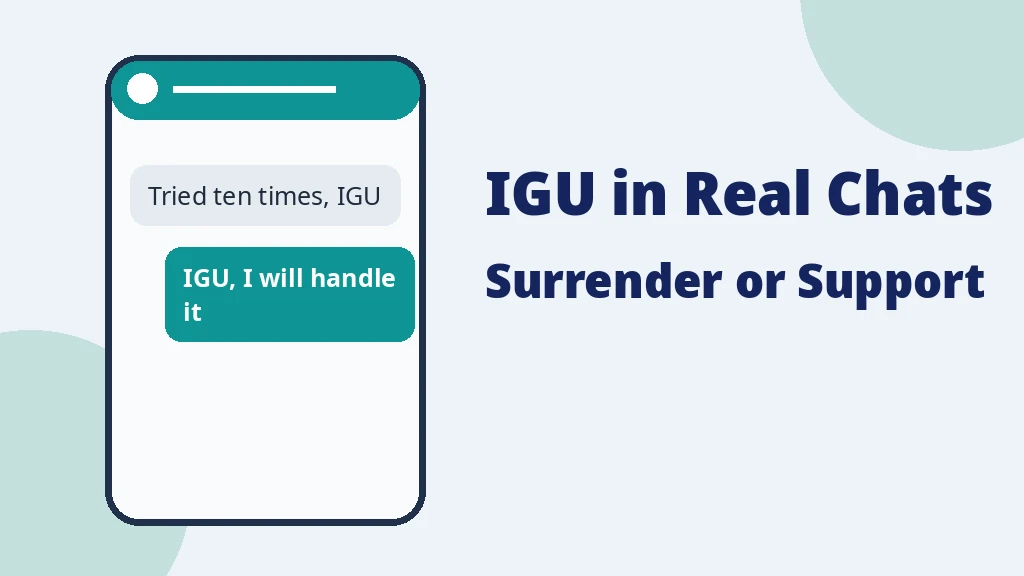
- Chat: “Tried this level ten times, IGU, you try.”
Meaning: “I give up” after repeated failure in a game.
Example 2:
- Chat: “I have read this question five times and I still do not get it. IGU.”
Meaning: Playful surrender to a hard problem.
Example 3:
- Comment: “This video is exactly how my week went, IGU.”
Meaning: “I get you” on TikTok.
Example 4:
- Chat: “Do not worry about the notes, IGU, I will send them tonight.”
Meaning: “I got you” as reassurance.
Example 5:
- Chat: “Fine, you win, IGU. Let us order pizza instead.”
Meaning: “I give up” in an argument, used to end the debate and move on to something better.
IGU vs Similar Terms
| Term | Meaning | When to use it |
|---|---|---|
| IGU | I Give Up / I Got You | Surrender in chats, support in comments |
| IDK | I Don’t Know | When you have no answer, not when you quit |
| IDC | I Don’t Care | When you have no preference, not when you stop trying |
| IG | I Guess | Reluctant agreement, not surrender |
| I Got You | Reassurance | The full phrase, always clear, never ambiguous |
Key difference: IGU and IDK both appear when someone is stuck, but they are not the same. IDK means you do not know the answer. IGU means you know you are stopping. One is a blank, the other is a decision. IG is the reluctant cousin: it agrees while doubting, while IGU stops trying altogether. And if the support reading is the one you want, typing “I got you” in full is always safer than IGU, because the full phrase cannot be read as surrender. If the shrug reading interests you, IG means “I guess” in text, the reluctant agreement that sits one step before giving up.
The TikTok “I Guess You” reading deserves a note too. It is a sarcastic shrug, as in a comment that means “I guess you are right, whatever”. It is the rarest of the four readings, and it only works when the sarcasm is obvious from the video. Do not lead with it, and do not use IGU when you mean a sarcastic “I guess you”, since most readers will hear surrender or support first.
The Other IGU Meanings You Should Know
“I Get You” is the TikTok understanding reading. Under videos about feelings, struggles, or relatable moments, the igu i get you reading means “I understand exactly what you mean”. It is close to “I got you”, and in comments the two blend together. Both are warm. Both are the opposite of surrender. The video decides which one fits, and either way the commenter is agreeing, not quitting.
“I Guess You” is the sarcastic reading. On TikTok, IGU has also been used for “I guess you”, a shrug that means “I suppose you are right” without enthusiasm. It is documented in TikTok guides, but it is the weakest of the readings, and it needs obvious sarcasm to work. In a plain chat it will be read as “I give up” first.
Outside texting, IGU has formal meanings. In geography, IGU is the International Geographical Union. In windows, an IGU is an insulated glass unit, the sealed double pane in a window. In Denmark, IGU is a training programme for refugees. None of these is a texting meaning, and the sentence around them always gives them away.
Platform rule in one line: plain texting leans “I give up”, TikTok comments lean “I get you” or “I got you”, and a sarcastic video leans “I guess you”. The platform is the first clue, and the sentence before it is the second.
How to Reply to IGU
Your reply depends on which IGU you just received, because surrender and support want opposite answers.
If someone gave up on a puzzle or a game: laugh with them or offer a fresh try. “Same, that level is impossible” or “one more try, I will help” both fit. Do not treat a playful surrender as a crisis.
If you are not sure which reading it is: ask, and name both. “Do you mean you give up, or you have got me?” takes one second and prevents a wrong reply in either direction.
When to Use IGU (and When to Avoid It)
Good situations:
- Ending a playful struggle with a joke, as in a game or a puzzle
- Closing an argument that is going nowhere, as a peace offering
- Showing support in a TikTok or Instagram comment, where “I get you” fits
- Reassuring a friend that you will handle something, when the context makes “I got you” obvious
Avoid using IGU when:
- The other person needs clear support, since they may read it as surrender
- You are genuinely upset and need help, since a joke reading will miss the seriousness
- The chat is formal or with someone who does not know the shortcut, since IGU is rare and easily misread
- You mean “I guess you” sarcastically, since almost nobody will read that sense without heavy context
Common Misunderstandings About IGU
IGU does not always mean “I Give Up”. That is the texting lead, but it is not the whole story. In comments, the support readings are common, and reading a supportive “IGU” as surrender turns encouragement into defeat. The platform matters, and this guide says so plainly instead of pretending one meaning wins everywhere.
IGU is not a common term. CyberDefinitions calls it rare, and it is right. Most people will understand it from context, but some will not know it at all. If you use it with someone new, be ready for a “what does that mean?” reply, and do not be surprised if they read the support sense when you meant surrender, or the other way round. For a frustration reaction that everyone knows instantly, here is what SMH means in text, the head shake that needs no explanation.
IGU is not proof someone is angry with you. In the surrender reading, the frustration is usually aimed at the puzzle, the game, or the problem, not at you. In the support reading, the feeling is warm. Either way, the letters are about the situation, not an attack on the reader.
Frequently Asked Questions
What does IGU mean in text?
In texting, IGU usually means “I Give Up”. It signals surrender, frustration, or playful defeat after trying something that did not work.
What does IGU mean on TikTok?
The igu tiktok reading is usually “I Get You” or “I Got You” in comments, showing understanding or support. It can also mean “I Guess You” as a sarcastic shrug.
Does IGU mean “I Got You”?
Sometimes, in comments and reassurance chats. In plain texting, though, “I Give Up” is the more common reading, so the context has to make “I Got You” clear.
Is IGU rude?
No. The surrender reading is usually playful, and the support reading is warm. It can sound blunt in a serious chat, but it is not an insult.
What is the difference between IGU and IDK?
IDK means you do not know the answer. IGU means you are stopping trying. One is a blank, the other is a decision to quit for now.
Should I use IGU at work?
No. It is informal, rare, and ambiguous, so a work chat is the wrong place for it. Write “I will come back to this later” or “I have got this” in full instead.
Final Thoughts
IGU is a small term with two opposite jobs. In a text it usually means “I give up”, a playful white flag after a struggle. In a TikTok comment it often means “I got you” or “I get you”, a quick show of understanding. Both readings are real, both are documented, and the platform plus the sentence before it will almost always tell you which one you are reading.
Now you know how to read it without guessing: effort means surrender, feelings mean support, and a sarcastic video is the one place where “I guess you” enters the picture. The next time IGU lands in your chat, check the world it came from before you reply.
The texting lead is documented by CyberDefinitions, which says IGU means “I Give Up” in a text and calls it the most common meaning in texting, while noting that it is a rare term. For a term that pairs naturally with giving up after a long day, here is what FR means in text, a short reply that often follows a frustrating moment.
1 thought on “IGU Meaning in Text | Giving Up or Got You? Decide Fast”