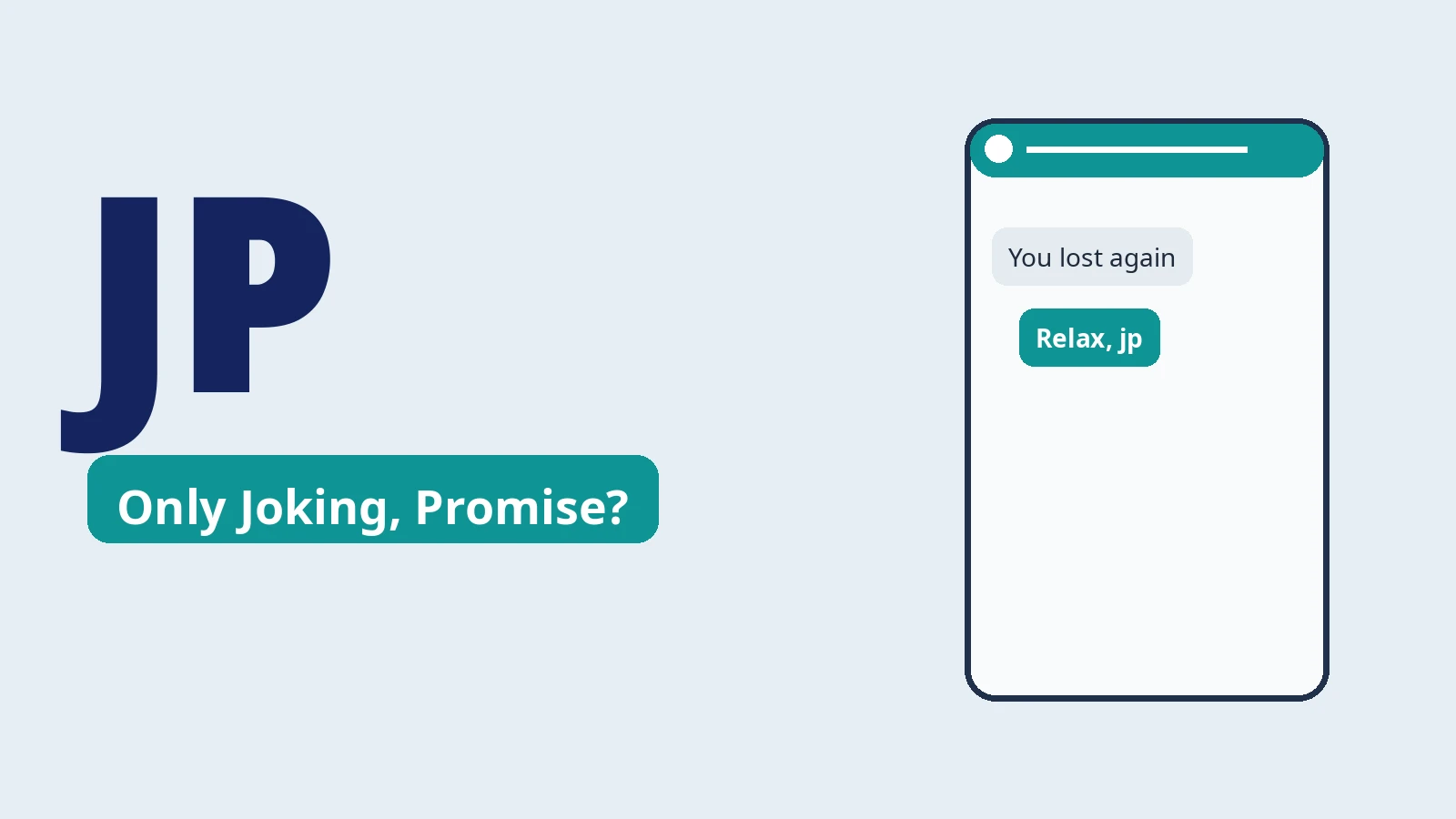
Your friend texts you after losing the game for the third time in a row: “You lost again, you are hopeless at this… jp.” You laugh instead of getting annoyed. Two letters turned a roast into a joke, and you both know it.
Here is the short answer: JP means “Just Playing”. It is a light tone softener that sits after a tease or a joke to signal that the sender was not serious. It is the younger sibling of JK, and it does one job very well: it takes the sting out of a message.
In this guide you will learn the jp meaning in text, how it differs from JK, where it shows up, why people reach for it instead of typing the full phrase, and what to send back when someone sends it to you.
What Does JP Mean in Text?
JP is a safety valve for jokes. It goes right after a line that could sound harsh on its own, and it tells the reader to take the line lightly. “You lost again, jp” means the tease was playful, not a real insult. Without the JP, the same sentence could start an argument. With it, the sentence is clearly a joke.
JP works because text has no tone of voice. In person, a smile tells the other person you are joking. In a chat, there is no smile to see, so JP does the smiling for you: “do not take this seriously, I am only playing around”.
Quick definition: JP means “Just Playing”. In texting and social media it signals that the message before it was a joke or a tease, not a serious statement, and it softens the tone so the reader takes it lightly.
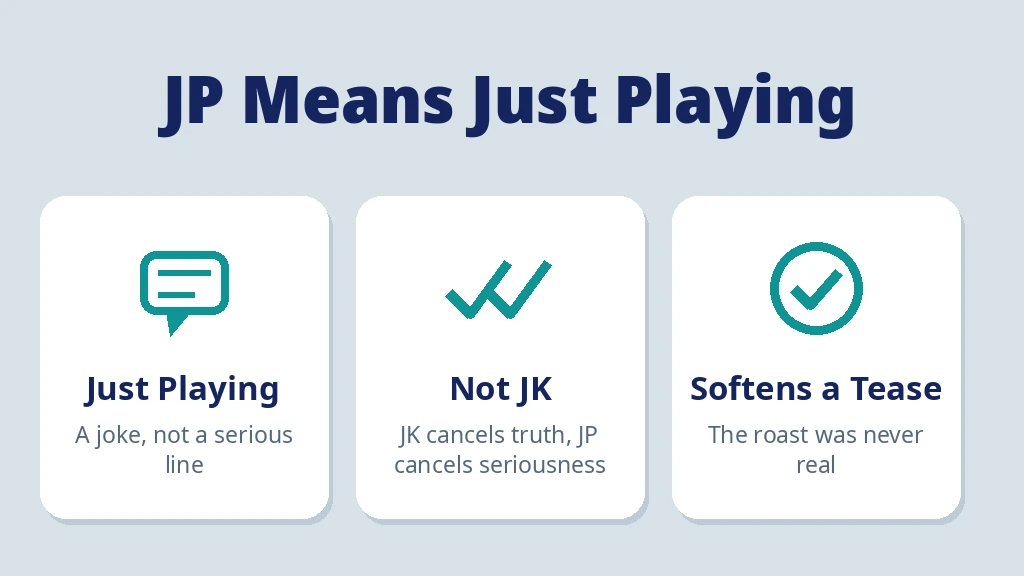
The sources agree on the expansion, and they agree on the tone job. CyberDefinitions says JP means “Just Playing” when used in a text, calls it the most common meaning in texting, and adds that it is a rare term with a guessability score of 4, which means it is difficult to guess. The niche guides that rank for this term lead with the same reading, all three of the top three: one calls JP a joking tone softener tacked onto a teasing message to signal it was not serious, and says it works exactly like JK, defusing a roast before it lands; one calls it short for “Just Playing”, used to show that a previous message was meant as a joke; and one says it softens a comment, signalling that the speaker is teasing in good fun.
JP Meaning in Easy Words
Think of JP as a wink at the end of a sentence.
When someone winks after saying something cheeky, you know they are joking, even if the words alone sounded serious. JP is the typed version of that wink. It does not change what the sentence said, only how you are supposed to take it: lightly, and without offence.
In the simplest words:
JP = “I was only joking, do not take that seriously.”
Where Is JP Used?
JP lives in casual chats between friends who tease each other, and it almost never leaves that world. It shows up wherever jokes need a safety net, and it is typed in lowercase as often as in capitals.
Common places:
- Private texts and DMs, softening a tease between friends
- Group chats, where a roast needs a clear “I am joking” flag
- TikTok and Instagram comments, after a teasing comment or a joke caption
- Snapchat chats, where quick jokes land without a tone of voice
- Discord and gaming chats, softening trash talk between teammates and rivals
Typical situations:
- Teasing a friend about losing a game
- Softening a fake threat, like “I am going to steal your fries, jp”
- Adding a playful edge to a sarcastic compliment
- Posting a joke caption that could read as serious without the flag
- Walking back a roast that landed a little too hard
Why Do People Use JP?
It defuses a roast before it lands
A roast without a flag can hurt. The same roast with “jp” at the end is clearly a joke, and the reader can laugh instead of getting defensive.
It replaces the missing tone of voice
In person, a grin tells the other person you are joking. In a chat, there is no grin, so a joke can read as an insult. JP fills that gap. It is the typed version of a playful tone, and it works even when the reader cannot see your face or hear your voice.
It keeps friendships light
Friends tease each other, and that teasing only works when both sides know it is play. JP keeps the play visible, and that shared understanding is what keeps a tease friendly instead of turning it into a real argument.
Real-Life Examples of JP
Here is how JP actually shows up in chats and comments:
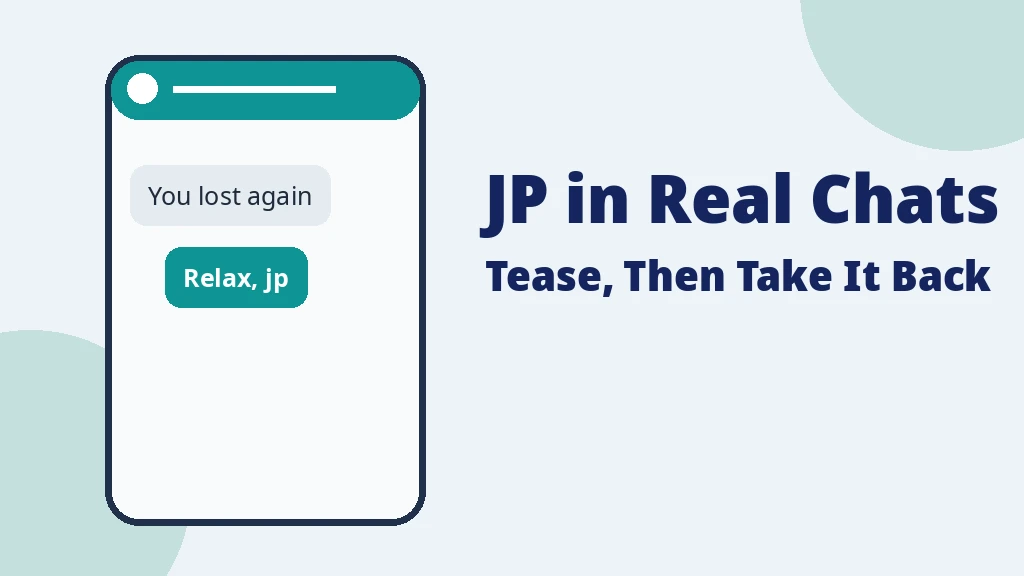
Example 1:
- Chat: “You lost again, you are hopeless at this… jp”
Meaning: Playful roast, the sender is teasing, not insulting.
Example 2:
- Chat: “I am going to eat all your fries. JP, relax.”
Meaning: Fake threat, the sender was never going to do it.
Example 3:
- Chat: “Wow, nice haircut… jp, it actually looks great.”
Meaning: Sarcastic compliment softened, the sender likes the haircut.
Example 4:
- Comment: “This is the worst song ever, jp, I have it on repeat.”
Meaning: Joke caption in a comment, the sender loves the song.
Example 5:
- Chat: “I am never talking to you again, jp, you know I love you.”
Meaning: Dramatic joke, the sender is not angry at all.
JP vs Similar Terms
| Term | Meaning | When to use it |
|---|---|---|
| JP | Just Playing | Softening a tease or joke |
| JK | Just Kidding | Cancelling a statement that was not true |
| LOL | Laughing Out Loud | Showing you found something funny |
| /s | Sarcasm | Marking a sentence as sarcastic |
| TBH | To Be Honest | Flagging a sincere opinion |
Key difference: JK cancels a statement’s truth, while JP cancels its seriousness. “I lost your phone, jk” means the phone is not lost, the statement was false. “You lost again, jp” means the loss really happened, but the tease about it was a joke, not a serious insult. One says “that was not true”, the other says “that was not serious”. If the sentence was false, use JK. If the sentence was true but the tone was playful, use JP. For another short reply whose meaning depends on tone, here is what IKR means in text, the warm agreement that says you feel exactly the same.
Keep JP apart from LOL as well. LOL says you laughed, but it does not say the message before it was a joke. JP says the message before it was a joke, whether you laughed or not. And keep JP apart from /s. The /s tag marks sarcasm, where the words mean the opposite of what they say. JP marks playfulness, where the words mean what they say, only lightly.
The Other JP Meanings You Should Know
“Just Playing” is the only texting meaning. In chats, DMs, and comments, JP means “Just Playing” and nothing else. Every texting source that covers JP agrees on that, and there is no rival texting reading with real support.
Outside texting, JP has formal meanings. As a country code, JP stands for Japan, which is the only sense Wiktionary lists alongside Justice of the Peace. In gaming, JP can stand for Job Points, a stat in role playing games like Final Fantasy XI. In law, JP stands for Justice of the Peace, and in work settings it can stand for Job Posting. None of these will appear in a chat about losing a game.
JP versus JSP in one line: JSP also claims “Just Playing” in some guides, but JP is the settled two letter form, and JSP is the contested three letter one with several competing readings, so JP is the form to use when you mean “just playing”.
How to Reply to JP
Your reply depends on what the JP was softening, because the two letters only tell you the message was a joke, not what to do next.
If it was a playful roast: laugh and play along. “Ha, very funny” or a roast back of your own keeps the game going, because the sender was inviting you to joke, not to argue.
If it was a fake threat or a dramatic joke: show you knew it was a joke. “I knew it” or “nice try” tells the sender the flag worked, and that you were never fooled.
If the joke still stung: say so honestly, even with the JP in place. “I know you were joking, but that one hurt a little” is fair, because JP softens a tease, it does not erase it. For a reply that is warm in any chat, here is what IGU means in text, the small white flag that says you give up, playfully or not.
When to Use JP (and When to Avoid It)
Good situations:
- Teasing a close friend who knows you are joking
- Softening a roast in a group chat
- Adding a playful flag to a joke caption or comment
- Walking back a tease that landed a little too hard
Avoid using JP when:
- The joke was genuinely hurtful, since “jp” does not undo real hurt
- You are talking to a teacher, a boss, or anyone formal
- The other person is upset and needs a real apology, not a joke flag
- You are using it to say something mean and hide behind it afterwards
Common Misunderstandings About JP
JP does not mean the statement was false. This is the biggest misunderstanding, and it comes from mixing JP up with JK. JK cancels the truth of a statement. JP only cancels its seriousness. “You lost again, jp” still means you lost. The loss is real, only the teasing tone was play.
JP does not make a mean comment okay. Adding “jp” to a cruel remark does not turn it into a kind one. It only tells the reader you meant it as a joke, and a joke can still hurt, so a real apology is the honest reply.
JP is not the same as JK. They are siblings, not twins. JK says “I was kidding, that was not true”. JP says “I was playing, that was not serious”. Use JK when the facts were invented, and JP when the facts were real but the tone was light.
JP is not the same as JSP. JSP is a three letter abbreviation with several competing readings, including “Just Playing”, “Just Saying, Period” and a French texting sense. JP is the settled two letter form for “Just Playing”, and it is clearer than JSP precisely because it has only one texting job.
Frequently Asked Questions
What does JP mean in text?
JP means “Just Playing”. It is a tone softener that sits after a tease or a joke to signal the sender was not serious, as in “you lost again, jp”.
What is the difference between JP and JK?
JK cancels a statement’s truth, while JP cancels its seriousness. “I lost your phone, jk” means the phone is not lost. “You lost again, jp” means the loss really happened, but the tease was a joke.
What does JP mean on TikTok?
On TikTok, JP in a comment usually means “Just Playing”, softening a teasing comment or marking a joke caption as playful. It tells readers not to take the comment seriously.
What does JP mean in gaming?
In a gaming chat, JP usually means “Just Playing”, softening trash talk between friends. In some role playing games it can also mean Job Points, a stat, but that reading never appears in a casual tease.
Does JP mean Japan?
Outside texting, JP is the country code for Japan. In a chat, though, JP means “Just Playing”, and the Japan reading only applies when the conversation is about countries, travel, or servers.
Is JP rude?
No, JP itself is not rude, it is a friendly flag that a message was a joke. But adding “jp” to a genuinely mean comment does not make it kind, and a hurtful joke still needs a real apology.
How do you reply to JP?
Laugh and play along, as in “ha, very funny” or a roast back of your own. If the joke stung anyway, say so honestly, because JP softens a tease but does not erase it.
Final Thoughts
JP is the smallest safety valve in texting, and one of the most useful. It means “just playing”, and it does the work of a wink: the message before it was a joke, not a serious statement, and you are supposed to take it lightly.
The lead is documented by CyberDefinitions, which says JP means “Just Playing” in a text and calls it the most common meaning in texting, while noting that it is a rare term. For the reply that says you feel exactly the same, here is what IKR means in text, the warm agreement that turns a shared joke into a shared feeling.