Your friend shows you their new haircut and asks what you think. You think it is a brave choice, and not a good one. You type your honest opinion, then you add two letters at the end: “js”. Suddenly the same opinion sounds like a shrug instead of a verdict.
Here is the short answer: JS means “Just Saying”. It is a soft tag you stick onto the end of a statement to show you are sharing an opinion or an observation, not starting an argument. It is casual, fast, and everywhere in chats where people want to be honest without sounding harsh.
In this guide you will learn the js meaning in text, its second job as the plain word “just”, where JS shows up, and what to send back.
What Does JS Mean in Text?
JS is a tone softener with a very small job. It tells the other person that the words before it were an opinion, an observation, or a piece of advice, and that you are not looking for a fight about it.
When a friend says “that jacket is a lot” and you reply “the blue one suited you better, js”, you are saying two things at once: here is what I honestly think, and I am only pointing it out.
Quick definition: JS means “Just Saying”. In texting and social media it is added to the end of a statement to soften a blunt opinion or share an observation without forcing a debate. The same letters do a second job mid-sentence, where lowercase “js” is the plain word “just” in fast typing.
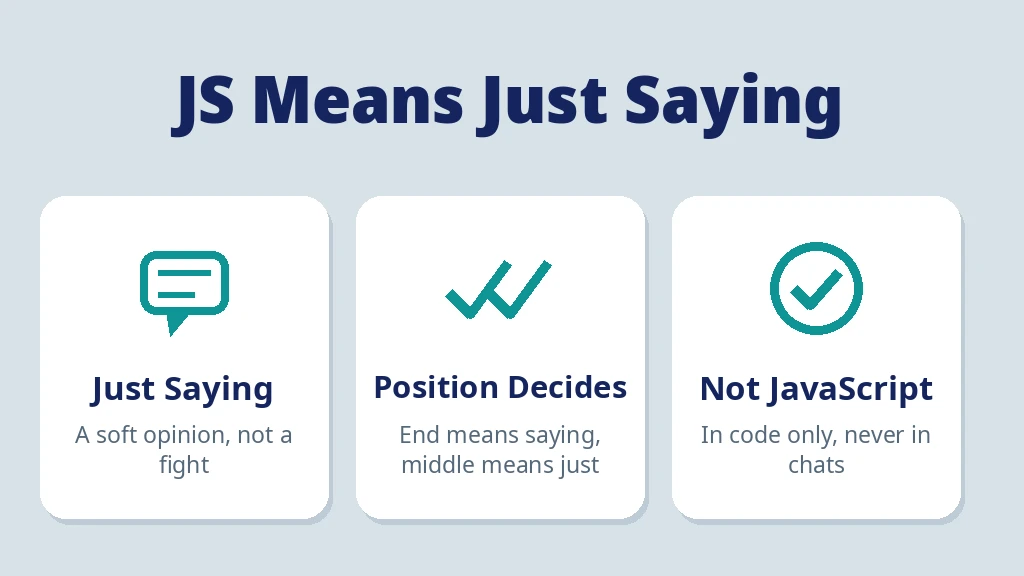
The sources agree on the expansion, and they agree on the softening job. CyberDefinitions says JS means “Just Saying”, and adds that it is typically used to soften an insult or a piece of advice that may not be well received. Wiktionary lists lowercase “js” as a text messaging acronym of “just saying” and as an abbreviation of “just”. Dictionary.com added “js” to its acronym guide in 2018. The top three niche guides all lead with “just saying”, and each one stresses that it sits at the end of a statement and softens it.
JS Meaning in Easy Words
Think of JS as a shrug at the end of a sentence. That is the js meaning in one image.
When someone says something out loud and then shrugs, they are saying “that is only my view, take it or leave it”. JS is the typed version of that shrug.
In the simplest words:
JS = “That is only my opinion, I am not trying to argue.”
Where Is JS Used?
As js slang, JS lives in casual chats between people who already share some context, and it almost never leaves that world.
Common places:
- Private texts and DMs, as a softener after an honest opinion
- Group chats, where one “js” keeps a hot take from starting a debate
- Snapchat chats, where short tags are the norm
- Instagram and TikTok comments, answering a post with a gentle observation
- Discord and gaming chats, where it softens blunt opinions
Typical situations:
- A friend asks for your honest opinion and you give it gently
- You point out something awkward that nobody else wants to say
- You share a mild roast and want it to land as a joke
- You offer advice that might not be welcome
Why Do People Use JS?
It softens a blunt opinion
Honest opinions can sting, and JS is the cheapest way to take the sting out. The same sentence without JS sounds like a verdict. With JS at the end, it sounds like a passing thought.
It closes a point without inviting a debate
Sometimes you want to say your piece and stop there. JS signals that you are done, and that no long reply is needed.
It saves time and typing
JS is two letters instead of eleven, and in a fast chat that difference matters. The full phrase adds nothing, so people cut it. The meaning survives the cut, and the conversation moves faster.
Real-Life Examples of JS
Here is how JS actually shows up in chats and comments:
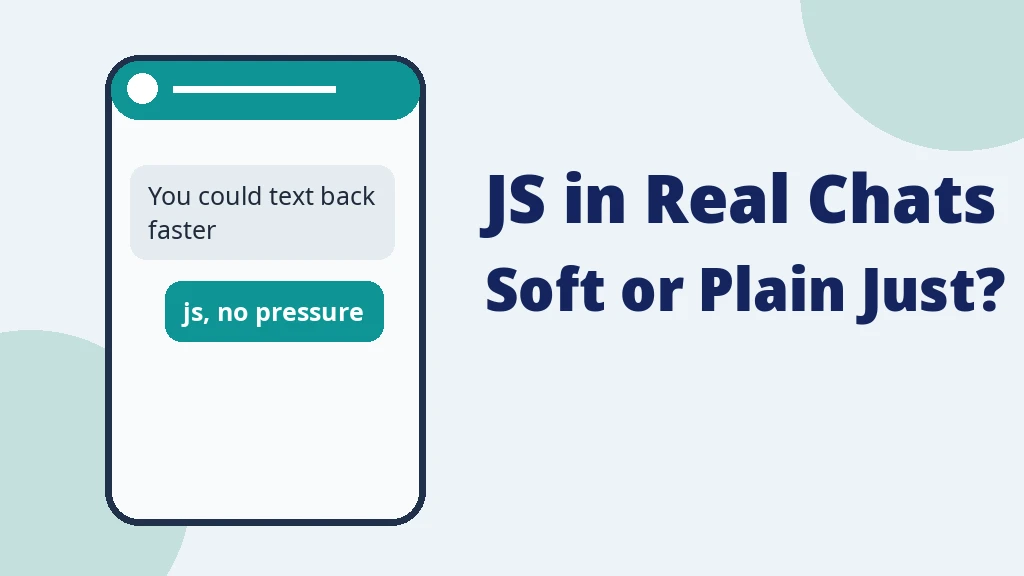
Example 1:
- Chat: “You could text back faster, js.”
Meaning: A gentle complaint about slow replies.
Example 2:
- Chat: “That movie was pretty boring, js.”
Meaning: A casual opinion, shared without asking anyone to agree.
Example 3:
- Chat: “I js got home, give me ten minutes.”
Meaning: The second job, lowercase “js” here is the plain word “just”.
Example 4:
- Comment: “This filter makes everyone look tired, js.”
Meaning: A light observation under a post, kept friendly instead of rude.
Example 5:
- Chat: “You always pick the same place. JS.”
Meaning: A teasing nudge with a playful edge.
JS vs Similar Terms
| Term | Meaning | When to use it |
|---|---|---|
| JS | Just Saying | Softening an opinion at the end of a sentence |
| IJS | I Am Just Saying | The longer form of JS, same softening job |
| JK | Just Kidding | Cancelling the truth of what you just said |
| JP | Just Playing | Cancelling the seriousness of a joke or tease |
| IMO | In My Opinion | Flagging a view as personal, usually at the start |
Key difference: JS softens what you said, JK cancels whether it was true, and JP cancels whether it was serious. IJS is the same tag as JS with the “I am” spelled out, so the two are interchangeable. IMO sits at the start and flags the view as personal, while JS sits at the end and shrugs after the fact. If you want to soften a blunt opinion, use JS. If you want to take a joke back, use JK or JP. For the warmest way to agree with someone, here is what IKR means in text, the “I know, right?” that invites the other person to agree with you.
Keep JS apart from JK as well. JK says “I did not mean that”, and it takes the whole statement back. JS says “I did mean that, I am only pointing it out”, and it leaves the statement standing.
The Other JS Meanings You Should Know
“Just Saying” is the only texting meaning at the end of a sentence. In chats, DMs, and comments, JS at the end means “Just Saying” and nothing else. Every source that covers texting agrees on that, and there is no rival texting reading with real support for that position.
Mid-sentence, lowercase “js” means the plain word “just”. This is the second texting job, and position is the clue. “I js got home” and “js checking in” are fast lowercase typing, not the softener. If JS sits at the start or in the middle of a sentence, read it as “just”. If it sits at the end, read it as “just saying”. The case helps too: the “just” job is almost always lowercase.
Outside texting, JS has formal meanings. In programming, JS is the standard short name for JavaScript, the language that powers most websites, and it has nothing to do with the texting tag. None of these will appear in a chat about a slow reply.
Position rule in one line: JS at the end of a message means “just saying”, lowercase js in the middle means “just”, and JS next to words like code, files, or functions means JavaScript. When in doubt, look at where the letters sit in the sentence before you decide what they mean.
How to Reply to JS
Your reply depends on which JS you received, because the same two letters can soften an opinion or simply fill in the word “just”.
If it was an opinion softener: you do not need a long answer. “Fair enough” or “noted” accepts the point without starting a debate. If you disagree, answer the opinion itself, not the JS: “I see it differently, but fair point” keeps the chat friendly. For a reply that flags your own view as personal, here is what IMO means in text, the “in my opinion” that marks a take as yours and nobody else’s.
If you want to use JS yourself: use it when you genuinely want to soften an opinion, not when you want to hide a harsh one. Add it after the statement, not before it. A bare “JS.” after a sharp insult does not make the insult kind, it only makes it sound passive aggressive, so save it for opinions you would still stand behind without the tag.
When to Use JS (and When to Avoid It)
Good situations:
- Sharing an honest opinion with a friend who asked for it
- Pointing out something awkward without starting a debate
- Dropping a mild roast that should land as a joke
- Offering advice that might not be welcome
- Typing the plain word “just” faster in a casual chat
Avoid using JS when:
- You are talking to a teacher, a boss, or anyone formal
- Someone is sharing serious news and needs a real response
- You actually mean the opposite of what you typed, since that is what JK is for
- You are writing code or talking tech, where JS means JavaScript
Common Misunderstandings About JS
JS does not always mean JavaScript. This is the biggest misunderstanding, and it comes from reading the letters without the context. In a code chat, JS is JavaScript. In a normal text or comment, JS is “just saying”. The chat around it tells you which one you are reading.
JS does not cancel what you said. That is JK, and mixing the two up flips the meaning completely. JS leaves your opinion standing and only softens how it lands. JK takes the whole statement back. One letter changes everything, so read the letters as written.
JS is not a full argument. If someone asks you a genuine question, “JS” does not answer it. It only softens the statement it follows. When a question needs an answer, give the answer, and save JS for the moments when a softener is all that is needed.
JS is not rude on its own. The rudeness, when it appears, comes from the situation: a blunt opinion dressed up with a tag, or a passive aggressive jab hiding behind two letters. The letters themselves are neutral.
Frequently Asked Questions
What does JS mean in text?
JS means “Just Saying”. It is a soft tag added to the end of a statement to share an opinion or observation without sounding harsh or starting an argument.
What does JS mean on TikTok?
On TikTok, JS usually means “Just Saying” in comments, often as a soft opinion on a video. Lowercase “js” mid-sentence usually means the plain word “just”, as in “i js got home”.
What does “js” mean as the word “just”?
In fast lowercase typing, “js” is a shortcut for the plain word “just”. It sits at the start or in the middle of a sentence, like “i js got home” or “js checking in”. Position is the clue: end of sentence means “just saying”, middle means “just”.
What is the difference between JS and JK?
JS means “Just Saying” and leaves your opinion standing while softening it. JK means “Just Kidding” and takes the whole statement back. JS softens a real opinion, JK cancels it.
What is the difference between JS and IMO?
JS sits at the end of a sentence and softens an opinion after the fact. IMO sits at the start and flags the whole view as personal before you say it. JS shrugs after the opinion, IMO warns before it.
Does JS mean JavaScript?
In programming and tech chats, yes, JS is the standard short name for JavaScript. In a normal text or comment, JS means “Just Saying”. The conversation around it tells you which one fits.
Is JS rude?
Usually it is not. JS softens an opinion and signals that you are not looking for a fight. It can sound passive aggressive when it follows a sharp insult, so use it for opinions you would stand behind without the tag.
Final Thoughts
JS is the smallest softener in texting, and one of the most useful. It means “just saying”, and it does the work of a shrug: here is what I honestly think, and I am not trying to argue about it. The letters are neutral, and the feeling comes from everything around them, the opinion they follow, the punctuation, and the message they answer.
Now you can read it at a glance: JS at the end of a message means “just saying”, lowercase js in the middle means the plain word “just”, and JS in a code chat means JavaScript. The next time a friend drops a blunt opinion with two letters at the end, you will know it was meant to land softly.
The lead is documented by CyberDefinitions, which says JS means “Just Saying” and is typically used to soften an insult or a piece of advice that may not be well received. Wiktionary lists lowercase “js” as a text messaging acronym of “just saying” and as an abbreviation of “just”. For the warmest way to agree with someone, here is what IKR means in text, the friendly “I know, right?” that never sounds dismissive.