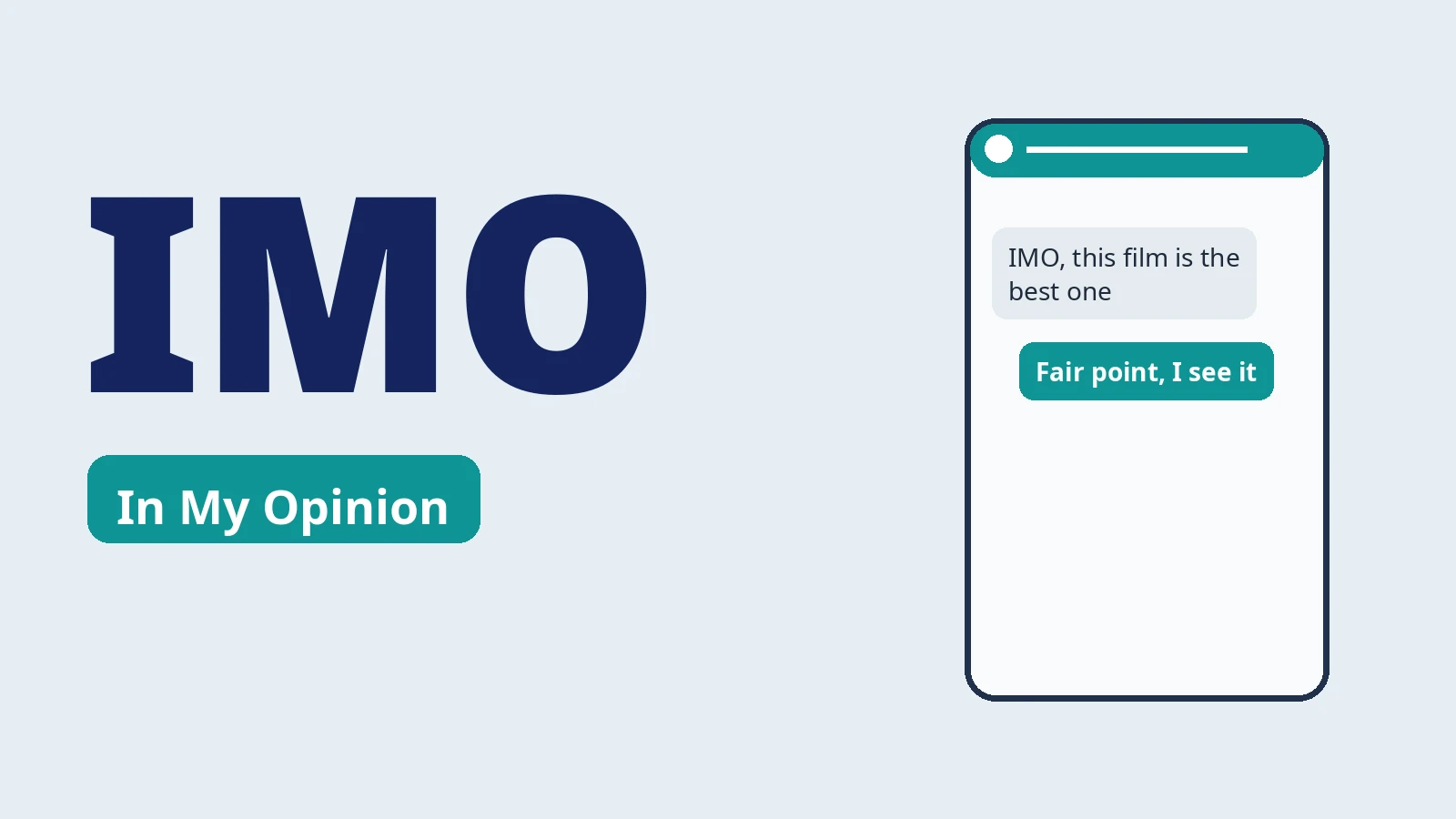
You are in a group chat and someone writes, “IMO, the new season is the best one yet.” Nobody asks what IMO means. Everyone just knows it is an opinion, not a fact, and the chat moves on.
Here is the short answer: IMO means “In My Opinion”. It is a small flag you put before or after a take to say, this is how I see it, and you are free to see it differently. It softens a statement without weakening it, and it invites disagreement instead of shutting it down.
In this guide you will learn the imo meaning in text, where to place it in a sentence, how it changes the tone of a message, how it differs from IMHO, and what to send back when someone opens with it.
What Does IMO Mean in Text?
IMO is one of the oldest shortcuts on the internet, and it has survived because it does a job nothing else does quite as neatly.
“In My Opinion” is a full phrase, and typing it out every time would slow a chat down. IMO keeps the meaning and drops the weight. It tells the reader, before they even finish the sentence, that what follows is a personal view.
Quick definition: IMO means “In My Opinion”. In texting and social media it marks a statement as a personal view, not a fact. It usually sits before the opinion, as in “IMO, the sequel was better”, or after it, as in “The sequel was better, IMO”.
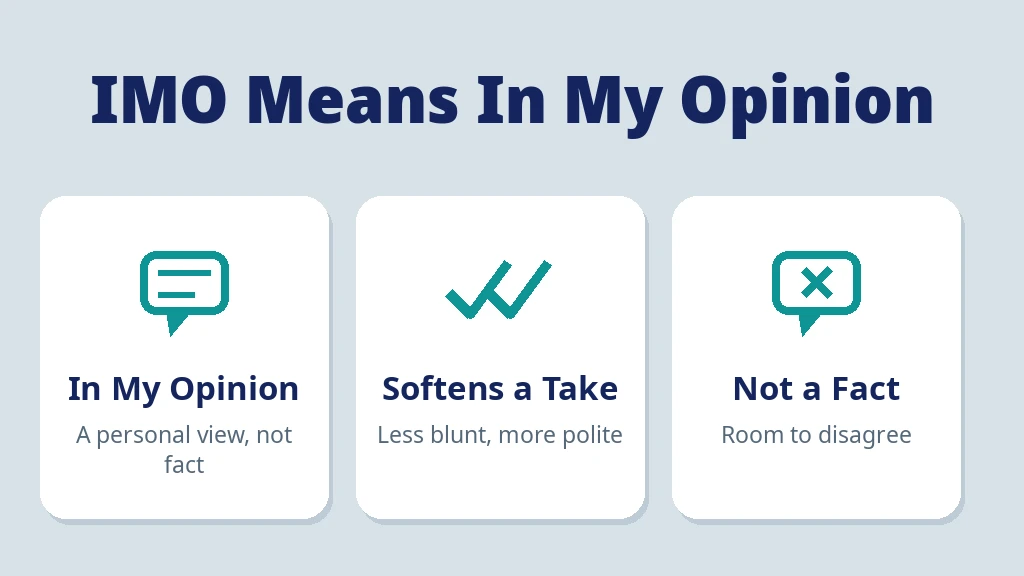
The sources agree on the expansion, and they agree on the job it does. CyberDefinitions says IMO means “In My Opinion”, and adds that it is typically used to preface a comment to make the speaker appear less forthright and authoritative, which is another way of saying it softens the take. Dictionary.com lists the texting sense as “in my opinion”. The niche guides that rank for this term say the same thing: all three of the top three lead with “In My Opinion” and stress that it signals a personal view rather than a fact.
IMO Meaning in Easy Words
Think of IMO as a small cushion you put under a strong statement. That is the imo meaning in easy words in one image.
A cushion does not change what you are sitting on. It just makes the landing softer. IMO does the same for an opinion. “This film is the best of the year” lands like a verdict. “IMO, this film is the best of the year” lands like a conversation starter.
In the simplest words:
IMO = “This is just what I think, and I know you might think differently.”
Where Is IMO Used?
As imo slang, IMO lives anywhere people share takes quickly, and it almost never leaves casual conversation.
Common places:
- Private texts and DMs, before or after an opinion about a film, a song, or a plan
- Group chats, where it keeps a hot take from starting a fight
- Reddit threads and forum posts, where opinions are the whole point
- Instagram, TikTok, and X comments, often at the end of a take about a post
- Discord servers, where short opinions fly fast and tone is hard to read
- Casual work chats, where it softens a suggestion to a teammate
Typical situations:
- Reviewing a film, a show, or a song with friends
- Disagreeing politely with someone you do not want to offend
- Posting a take in a comment thread where strangers will read it
Why Do People Use IMO?
It softens a strong take
A bare opinion can sound like a ruling. “The new album is bad” sounds final, and it puts the reader on the defensive. Add IMO and the same sentence becomes a personal report, which invites a reply instead of an argument.
It saves time without losing meaning
Three letters replace a whole phrase, and every reader in a chat already knows what they mean. IMO is fast to type, fast to read, and it carries its full meaning in a space smaller than a single word. That efficiency is why it has lasted since the early days of chat rooms.
Real-Life Examples of IMO
Here is how IMO actually shows up in chats and comments:
Example 1:
- Chat: “IMO, the new season is the best one yet.”
Meaning: A personal take on a show, flagged as opinion before the sentence starts.
Example 2:
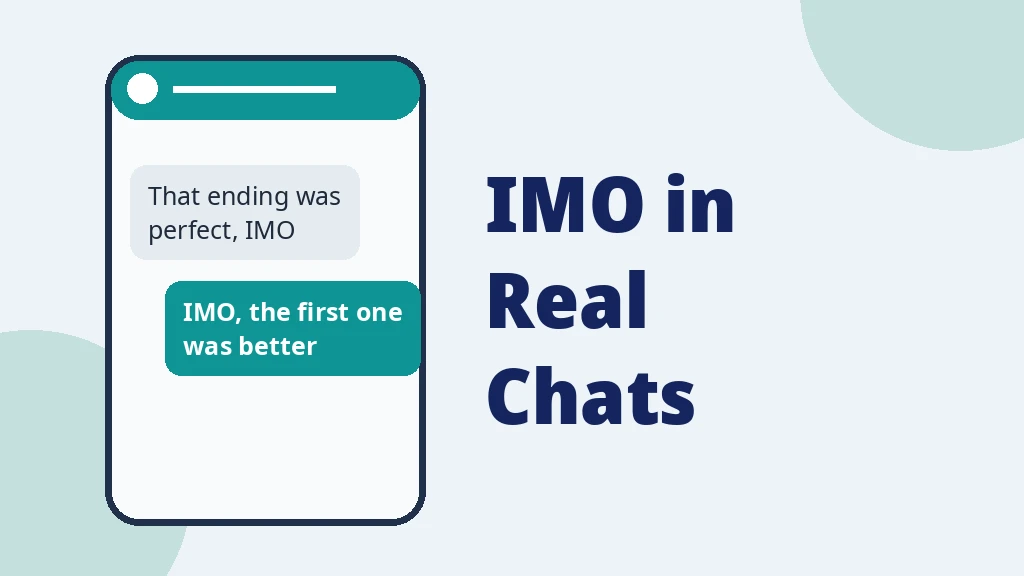
- Chat: “That ending was perfect, IMO.”
Meaning: The same flag, placed after the opinion, with the same softening effect.
Example 3:
- Comment: “IMO we should leave early to beat the traffic.”
Meaning: A suggestion framed as one person’s view, so the group can push back easily.
Example 4:
- Chat: “IMO, homemade food tastes better than takeout.”
Meaning: A taste preference, stated as opinion, not as a fact about food.
Example 5:
- Chat: “A: The sequel was a letdown. B: IMO, it was better than the first one.”
Meaning: A polite disagreement, where IMO keeps the reply friendly instead of combative.
IMO vs Similar Terms
| Term | Meaning | When to use it |
|---|---|---|
| IMO | In My Opinion | Flagging any personal take, neutral and direct |
| IMHO | In My Humble Opinion | The same flag, softer and more modest |
| IMHO (honest) | In My Honest Opinion | A frank take, sometimes with a teasing edge |
| TBH | To Be Honest | Adding honesty to a take, often a confession |
| FWIW | For What It Is Worth | Offering a take you are not sure about |
| IDK | I Don’t Know | Admitting you have no view, the opposite of a take |
Key difference: IMO and IMHO are cousins, and the imo vs imho contrast is all about tone. IMO is neutral and direct: here is my view. IMHO adds humility, which can sound more polite, more careful, or even slightly ironic, as if the writer is pretending to be modest about a view they hold strongly. TBH is different again: it stresses honesty rather than opinion, and it often introduces a confession or an unpopular view. If you want to admit you have no view at all instead of sharing one, here is what IDRK means in text, the softer “I don’t really know” that needs no flag.
Keep IMO apart from IMHO in one more way. Some people write IMHO when they mean “In My Honest Opinion”, and that version can carry a teasing or sarcastic edge, as if the honesty is the point. IMO never carries that edge. If you want a clean, neutral flag, IMO is the safer choice.
The Other IMO Meanings You Should Know
“In My Humble Opinion” belongs to IMHO, not IMO. Dictionary.com lists “in my (honest/humble) opinion” under IMO as well, because the two terms share a history, but in everyday chats the humble and honest readings belong to IMHO, the four letter form. If you write IMO, readers will read “In My Opinion”, plain and simple, and that is the reading to use.
Outside texting, IMO has formal meanings. In shipping and maritime work, IMO is the International Maritime Organization, a United Nations agency based in London that regulates shipping safety. In the United States insurance industry, IMO is an Independent Marketing Organization. In tribute posts, “in memory of” is sometimes shortened to IMO. None of these is a texting meaning, and the context will always make the right one clear.
Tone rule in one line: IMO before the opinion sounds like a calm opening, IMO after the opinion sounds like a friendly shrug, and IMO in a heated argument still softens the sentence, but it will not save a take that is meant to hurt.
How to Reply to IMO
Your reply depends on whether you agree, because IMO is an invitation to talk, not a question that needs an answer.
If you agree: say so plainly. “Agreed, IMO the first half was the best part” or “Same, I thought so too” keeps the conversation warm. You can add your own IMO to match their tone.
If you disagree: keep it friendly, because they already made room for you. “Fair point, but IMO the ending saved it” disagrees without turning the chat into a debate. The IMO they used was a peace offering, so answer in the same spirit.
If you want to use IMO yourself: put it before the opinion when you want to open gently, and after the opinion when you want to land a take and then soften it. Both positions work, and switching between them keeps your messages from sounding repetitive. For a reply that shuts a choice down instead of opening one up, here is what IDC means in text, the “I don’t care” that needs a very different tone.
When to Use IMO (and When to Avoid It)
Good situations:
- Sharing a take about a film, a song, a game, or a meal
- Disagreeing politely in a group chat or a comment thread
- Softening a suggestion at work in a casual chat
- Posting an opinion where strangers will read it and judge the tone
Avoid using IMO when:
- You are stating a fact, like a time, a price, or a date, since opinions and facts are different things
- The message is formal, like a report, a legal note, or an academic paper
- You are apologising or giving condolences, where a plain, sincere sentence fits better
- You want to sound certain, since IMO deliberately sounds uncertain
Common Misunderstandings About IMO
IMO does not mean you are unsure. This is the biggest misunderstanding, and it is worth clearing up. Using IMO does not mean you doubt your own view. CyberDefinitions even notes that IMO is often used when the speaker is sure they are right. The flag is about politeness, not confidence.
IMO does not mean IMHO. The two look alike and share a history, but they are not interchangeable. IMO is the plain version, and IMHO is the humble or honest version. Mixing them up will not confuse most readers, but using IMHO when you want a neutral flag can make you sound mock modest, and using IMO when you want humility can make you sound blunter than you meant to be.
IMO is not rude. Some people worry that flagging an opinion sounds dismissive, as if the writer is saying “that is just my opinion, so do not argue”. In practice it does the opposite: it tells the reader that their view is welcome.
IMO does not belong only at the start of a sentence. Many guides show it only before the opinion, but the after position is just as common in real chats. “That ending was perfect, IMO” is natural, and it lets the opinion land first and the softening arrive second.
Frequently Asked Questions
What does IMO mean in text?
IMO means “In My Opinion”. It flags a statement as a personal view, not a fact, so the reader knows disagreement is welcome.
Where do you put IMO in a sentence?
Before the opinion, as in “IMO, the sequel was better”, or after it, as in “The sequel was better, IMO”. Both positions are common and correct.
What is the difference between IMO and IMHO?
IMO means “In My Opinion” and is neutral and direct. IMHO means “In My Humble Opinion”, or sometimes “In My Honest Opinion”, and sounds softer, more modest, or sometimes teasing.
What does IMO mean on TikTok?
On TikTok, IMO means “In My Opinion” in comments, usually at the end of a take about a video, as in “That ending was perfect, IMO”.
Is IMO rude?
No. IMO is polite, because it marks a take as personal and invites a different view. A bare statement of the same opinion sounds more forceful than one with IMO in it.
Can I use IMO at work?
In a casual work chat, yes, it softens a suggestion nicely. In a formal email, a report, or a legal document, no, write the opinion out in full instead.
Does IMO mean “In My Humble Opinion”?
Not usually. That reading belongs to IMHO. Dictionary.com lists it under IMO because of their shared history, but in everyday chats IMO means “In My Opinion” and IMHO carries the humble or honest sense.
Final Thoughts
IMO is a small flag with a big job. It means “In My Opinion”, and it turns a verdict into a conversation by telling the reader that what follows is one person’s view, not a fact about the world.
Now you can read it at a glance: before the opinion it opens gently, after the opinion it lands softly, and in a disagreement it keeps the chat friendly.
The lead is documented by CyberDefinitions, which says IMO means “In My Opinion” and notes that it is typically used to preface a comment to make the speaker appear less forthright and authoritative. Dictionary.com gives the same texting sense, listing it as “in my opinion” and tracing it to early digital communications. For the reply that admits you have no take at all, here is what IDRK means in text, the softer “I don’t really know” that pairs well with any IMO.
2 thoughts on “IMO Meaning in Text | How to Reply Without Sounding Rude”