
Your friend asks what time the film starts, and you reply with four letters: “IDRK”. They read it, they pause, and the chat moves on. But what did you actually say?
Here is the short answer: IDRK usually means “I Don’t Really Know” in texting. It is a softer, less blunt version of IDK. It says you do not have the answer, but you thought about the question first instead of brushing it off.
In this guide you will learn the idrk meaning in text, how it differs from IDK, where it shows up, and when it can sound evasive instead of honest.
What Does IDRK Mean in Text?
In a chat, IDRK is a small admission of uncertainty with a polite edge.
Most people already know IDK, which means “I Don’t Know”. IDRK adds one word, “really”, and that word changes the tone. It tells the reader that you gave the question a moment of thought, that you are not sure, and that you are not hiding an answer on purpose. It is the difference between a shrug and a shrug with an apology built in.
Quick definition: IDRK means “I Don’t Really Know” in texting. It expresses mild uncertainty, softer than IDK, and it usually appears when the sender has considered the question but still has no answer.

The sources agree on this reading. CyberDefinitions gives “I Don’t Really Know” as the meaning of IDRK in a text, and it calls IDRK a rare term, which is worth remembering: you will see it far less often than IDK, and some readers may need a second to work it out. Wiktionary lists the same sense, labelling it as internet slang and text messaging, with a quoted example from 2018 in which a writer says “IDRK what to call it, but I want it”. The niche guides that rank for this term agree as well: their top results lead with “I Don’t Really Know” and describe it as a casual shorthand that softens a reply compared with blunt IDK.
That agreement matters, because the extra word is the whole point of the term. Without it, IDRK would just be IDK with a typo. With it, the sender signals effort. They looked, they thought, they checked, and they still do not know. In a friendship chat, that small signal often matters more than the answer itself.
IDRK Meaning in Easy Words
Think of IDRK as IDK with a little more care in it.
When someone writes IDK, the message can land as a closed door. It can sound like “I do not know, and I am not going to find out”. When someone writes IDRK, the door stays half open. It sounds like “I do not really know, I thought about it, and I am still not sure”. The meaning is almost the same, but the feeling is warmer.
In the simplest words:
IDRK = “I am not sure, even after thinking about it.”
That reading fits the way people actually use it. They write IDRK when a friend asks for an opinion they have not formed yet, when a plan is still undecided, or when a fact is just out of reach. It is not a claim of knowledge. It is an honest report that the answer is missing, offered in a friendly tone.
Where Is IDRK Used?
IDRK lives in casual private chats and on social media, wherever friends trade quick, low stakes questions.
Common places:
- WhatsApp and iMessage chats between friends, where plans and opinions are still forming
- Instagram and Snapchat DMs, often as a reply to a story question or a poll
- TikTok comments, where a viewer admits they do not know a song, a name, or a reference
- Discord and gaming chats, where a player is asked about a strategy or a score they did not track
- Group chats, where several people are guessing and nobody wants to sound certain
Why Do People Use IDRK?
It softens a reply that could sound blunt
IDK can feel like a wall, especially in text, where tone is invisible. IDRK adds a cushion. The word “really” tells the other person that you paused before answering, which makes the same lack of knowledge feel less dismissive and more considered.
It buys time without ending the chat
Sometimes the honest answer is that you have not decided yet. IDRK says exactly that, and it keeps the conversation open. The other person can suggest an option, share what they think, or wait for you to check, and nobody has to pretend the question is settled.
Real-Life Examples of IDRK
Here is how IDRK actually shows up in chats:
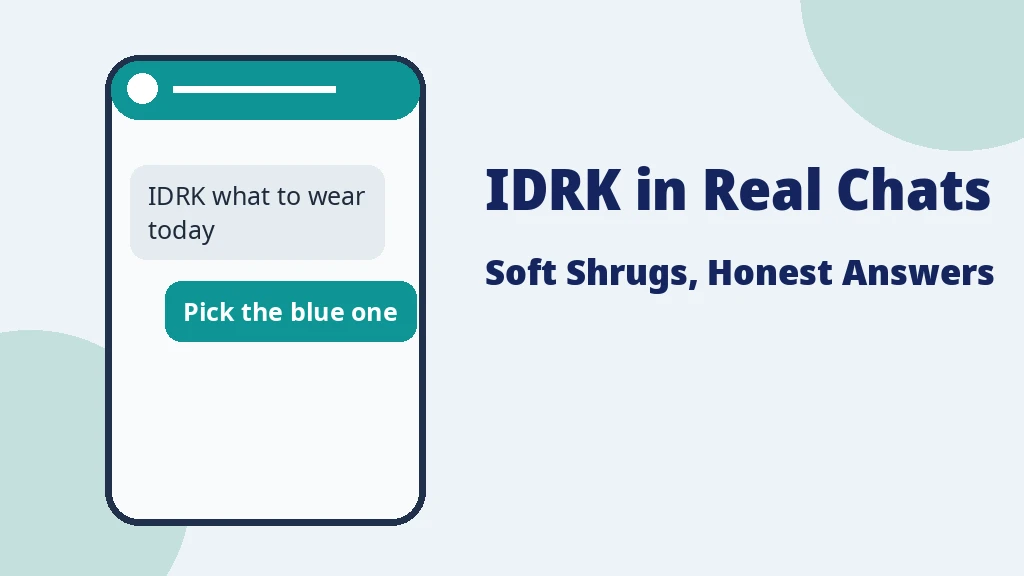
Example 1:
- Chat: “What time does the film start?” “IDRK, maybe 7? Let me check.”
Meaning: The sender is not sure about the time, but they are offering a rough guess and a promise to check.
Example 2:
- Chat: “Should I wear the blue jacket or the black one?” “IDRK, both look good on you.”
Meaning: The sender has no strong opinion, and they say so gently instead of picking at random.
Example 3:
- Chat: “Do you think she will come tonight?” “IDRK, she seemed unsure earlier.”
Meaning: The sender is reporting real uncertainty, with a small piece of evidence behind it.
Example 4:
- Chat: “What should we watch?” “IDRK, I am happy with anything.”
Meaning: The sender is flexible, not uninterested.
Example 5:
- Chat: “Why did the teacher cancel class?” “IDRK, nobody told us.”
Meaning: The sender has no inside information, and they are saying so plainly.
IDRK vs Similar Terms
| Term | Meaning | When to use it |
|---|---|---|
| IDRK | I Don’t Really Know | Uncertain after thinking, soft and friendly |
| IDK | I Don’t Know | Plain lack of knowledge, can sound blunt |
| IDEK | I Don’t Even Know | Stronger confusion or disbelief |
| IDT | I Don’t Think | Doubt or gentle disagreement, an opinion |
| IDM | I Don’t Mind | Flexible and agreeable, happy either way |
Key difference: IDRK and IDK share a meaning, but they do not share a tone. IDK states a fact: the knowledge is missing. IDRK states a process: you thought about it, and the knowledge is still missing. IDEK goes further in the other direction, adding surprise or frustration, as in “IDEK what just happened”. IDT is different again, because it is an opinion rather than a gap in knowledge: “IDT that will work” is a judgement, while “IDRK if that will work” is an admission that you cannot judge yet.
Choosing between them is a matter of tone. Use IDRK when you want to sound thoughtful. Use IDK when a short, plain answer is enough. Use IDEK only when you are genuinely baffled, and use IDT when you actually have a view and want to share it gently.
The Other IDRK Meanings You Should Know
There is no strong second texting sense. Unlike terms that split across fields, IDRK has one clear life in chats, and that life is “I Don’t Really Know”. The dictionaries and guides agree, and no competing chat expansion has real support. That makes IDRK easier to read than most of its neighbours, but it also means a bare IDRK gives the reader very little to work with beyond the shrug itself.
The main risk is confusion with IDK. Because IDRK is rare, some readers will read it as a typo of IDK, or will not recognise it at all. CyberDefinitions warns that it is a rare term, and that warning is practical advice: if your reader is older, or new to texting slang, they may stare at IDRK for a moment before they work it out. In a chat with someone like that, spelling the words out is kinder than sending the abbreviation.
How to Reply to IDRK
IDRK is not a question, so it does not demand an answer. It is a pause, and the best reply depends on what the chat needs next.
If you asked the question: accept the shrug and move the chat forward. “No worries, I will check” or “Okay, let me ask someone else” keeps things friendly. Pressing for an answer the sender does not have will only produce a second, less patient IDRK.
If you can supply the answer yourself: share it without making a point of the gap. “I just checked, it starts at 7” is helpful. “See, you should have known that” is not, and it turns a small admission into a small argument.
If you are the one writing IDRK: add a little help when you can. “IDRK, let me check” or “IDRK, what do you think?” shows you are still engaged, while a bare IDRK on its own can read as a closed door.
When to Use IDRK (and When to Avoid It)
Good situations:
- Answering a casual question you have thought about but cannot settle
- Softening a reply so it does not sound dismissive in a friendly chat
- Handing a low stakes choice back to the other person, such as what to watch
- Admitting you missed a detail without making a drama of it
Avoid using IDRK when:
- The question needs a real answer, such as a time, a place, or a safety detail, and you could find it out
- You are writing to a teacher, a manager, or anyone in a formal setting, where full sentences fit better
- You actually know the answer but do not want to say it, since IDRK then becomes a dodge rather than an honest shrug
- Your reader may not know the abbreviation, in which case spelling it out avoids confusion
Common Misunderstandings About IDRK
IDRK is not the same as IDK. The meanings overlap, but the tone does not. IDRK says you thought about it first. IDK says nothing about thought at all. Treating them as identical misses the politeness that IDRK was built to carry.
IDRK does not mean the sender does not care. It is easy to read a shrug as indifference, especially in text, where there is no voice or face to soften it. Most of the time, IDRK means the opposite: the sender cared enough to think before admitting they did not know. For a genuinely reassuring reply in the other direction, here is what DW means in text and when that reassurance fits.
IDRK is not a typo. New readers sometimes assume the R slipped in by accident. It did not. The R is the point: “really” is the word that separates IDRK from IDK, and removing it changes the message.
Frequently Asked Questions
What does IDRK mean in text?
IDRK means “I Don’t Really Know” in texting. It is a softer version of IDK that says you thought about the question but still do not have the answer.
What is the difference between IDRK and IDK?
IDK means “I Don’t Know” and can sound blunt, while IDRK means “I Don’t Really Know” and sounds softer, because it signals that you considered the question before admitting you are unsure.
Is IDRK rude?
No, IDRK is not rude. It is usually polite, because the word “really” shows you thought about the question. It only feels dismissive when it is repeated without any effort to help.
When should I use IDRK instead of IDK?
Use IDRK in friendly chats when you want your uncertainty to sound thoughtful rather than blunt, especially when the other person might take a bare IDK the wrong way.
Does IDRK mean the same in lowercase?
Yes, lowercase “idrk” means the same as capital IDRK. Lowercase usually feels a little softer and more casual, while capitals can sound firmer.
How do you reply to IDRK?
Accept the shrug and move on, or supply the answer yourself if you have it. “No worries, I will check” keeps the chat friendly, and pressing for an answer rarely helps.
Is IDRK common?
No, IDRK is much rarer than IDK. CyberDefinitions calls it a rare term, so some readers may not recognise it at first, and spelling it out is safer with people who are new to texting slang.
Final Thoughts
IDRK is a small kindness in four letters. It means “I Don’t Really Know”, and it carries a little more care than IDK, because it tells the reader you thought before you admitted you were unsure. In friendly chats it softens a shrug, keeps a conversation open, and hands a choice back without sounding dismissive.
The trick is to use it honestly. Save it for questions you genuinely cannot settle, add a little help when you can, and spell it out when your reader may not know the code. Used that way, IDRK does exactly what it was built to do: it says “I do not know” in the friendliest way possible.
The meaning is documented by CyberDefinitions, which gives “I Don’t Really Know” as the meaning of IDRK in a text and notes that it is a rare term, and Wiktionary lists the same internet slang and text messaging sense with a quoted example. If soft replies still trip you up, here is what HBU means in text, another short reply that keeps a chat moving.
1 thought on “IDRK Meaning in Text | The Soft Shrug, Explained Simply”