Someone accuses you of eating the last slice of pizza, and your friend fires back three letters: “IDS, I didn’t touch it!” The chat goes quiet. Was that a joke, a promise, or a warning?
Here is the short answer: IDS usually means “I’m Dead Serious” in texting. It is a firm promise that the sender is not joking, not exaggerating, and not playing around. When those three letters appear, the sentence before them is meant to be believed.
In this guide you will learn the ids meaning in text, how it differs from a plain “I’m serious”, where it shows up, and when the same three letters mean something completely different.
What Does IDS Mean in Text?
In a chat, IDS is an honesty stamp.
People use it when they know their words might sound unbelievable, funny, or too good to be true. A claim on its own can be doubted, laughed off, or read as a joke. Add IDS, and the sender is saying “I know how this sounds, and I mean every word of it”. It turns a casual sentence into a statement the reader is asked to trust.
Quick definition: IDS means “I’m Dead Serious” in texting. It emphasises honesty and sincerity, and it tells the reader that the sender is not joking about the statement it follows or introduces.
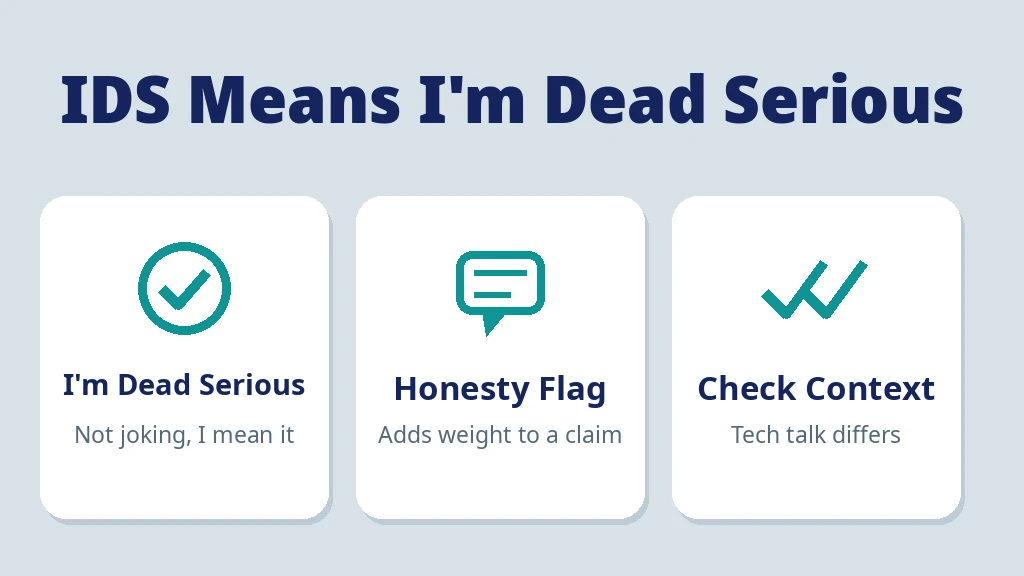
The niche guides that rank for this term agree on the texting lead. Texting.io calls “I’m Dead Serious” the common texting meaning of IDS, used to emphasise honesty and sincerity, and it notes that IDS appears across Snapchat, Instagram, WhatsApp, Facebook, and TikTok. Slangify leads with the same reading, calling it a popular interpretation in casual texting, and it gives the example “I told you I didn’t eat your food, IDS!” The phrase itself is well documented too: the Free Dictionary’s idiom entry defines “dead serious” as completely serious and not joking in any way, used to implore the listener to believe the speaker.
Two honest caveats belong here. CyberDefinitions has no entry for this term at all (its page returns a clean 404), so the lead rests on the two niche guides and the idiom dictionary rather than on that layer. Wiktionary lists no texting sense for IDS at all: its entries cover computing, linguistics, and medicine, which tells you that IDS as a texting code is newer and less formal than the dictionary senses. Even so, the texting sources agree with each other, and the phrase they expand is a real, documented idiom, so the lead is sound within chats even while the dictionaries stay silent.
IDS Meaning in Easy Words
Think of IDS as underlining a sentence twice and then saying “trust me”.
When a friend writes “I am serious”, you might still wonder whether they are playing. When they write “IDS”, the doubt is meant to stop. The word “dead” works as an intensifier, the way it does in the full phrase “dead serious”: it does not mean anything about death, it means completely, absolutely, no room for doubt.
In the simplest words:
IDS = “I am not joking, believe this.”
That reading fits every normal use. A friend denies a prank with IDS. A friend confesses a crush with IDS. A friend warns you about a strict teacher with IDS. In each case, the sender expects the first reaction to be disbelief, and IDS is their answer to that disbelief before it even arrives.
It also helps to see what IDS is not. It is not an apology, and it is not a threat on its own. It adds weight to whatever sentence it sits beside, so its feeling comes from that sentence. Beside a denial it sounds defensive. Beside a confession it sounds brave. Beside a warning it sounds urgent.
Where Is IDS Used?
IDS lives in fast, emotional chats, wherever a claim needs extra weight to be believed.
Common places:
- Snapchat and Instagram DMs, where friends deny pranks, defend themselves, or confess feelings
- WhatsApp and iMessage group chats, where a surprising story needs a credibility boost
- TikTok comments, where a viewer insists a wild story is true
- Facebook Messenger chats, often after a joke that landed too close to the truth
- Gaming chats, where a player insists they really did pull off an unlikely play
Why Do People Use IDS?
It stops a joke reading before it starts
Text has no tone of voice, so a surprising sentence can easily be read as a joke. IDS closes that gap in three letters. It tells the reader, before they can laugh it off, that the sender means it.
It adds weight without a long explanation
Proving you are serious usually takes a paragraph: reasons, evidence, backstory. IDS skips all of that and borrows the weight of a familiar phrase instead. The reader already knows what “dead serious” feels like, so the abbreviation carries the whole feeling at once.
Real-Life Examples of IDS
Here is how IDS actually shows up in chats:
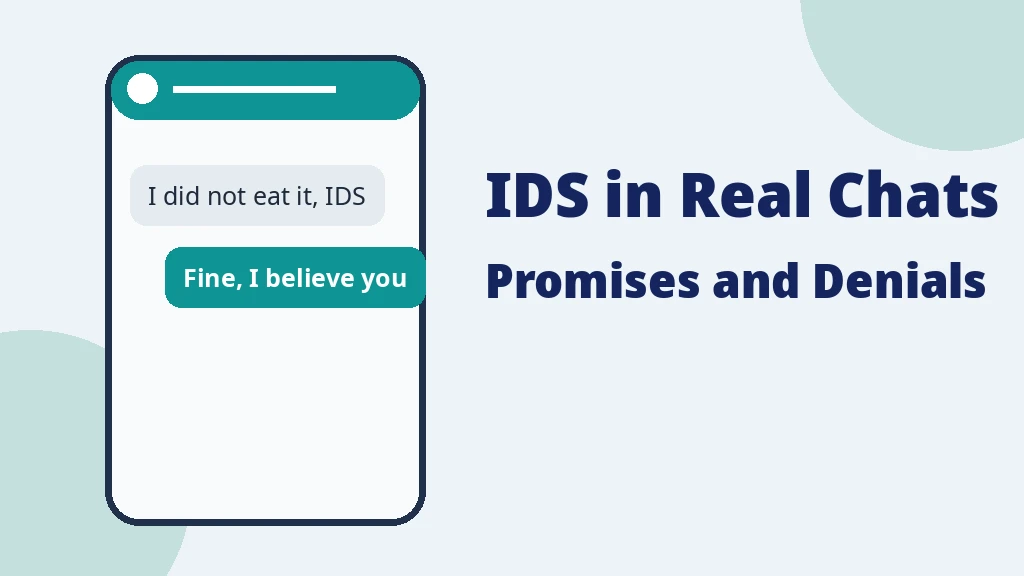
Example 1:
- Chat: “I did not eat your chips, IDS!” “Okay okay, I believe you.”
Meaning: The sender is denying the accusation and insisting the denial is honest.
Example 2:
- Chat: “IDS, I am actually going to quit my job this month.”
Meaning: The sender knows this sounds sudden, and they are warning the reader not to treat it as a joke or a passing thought.
Example 3:
- Chat: “He really said that to the teacher?!” “Yes, IDS, everyone heard it.”
Meaning: The sender is backing up a surprising story.
Example 4:
- Chat: “IDS, if you do that again there will be consequences.”
Meaning: The sender is giving a warning, not making a joke.
Example 5:
- Chat: “I think I like her, IDS.”
Meaning: The sender is confessing something vulnerable, and IDS shows they are not hiding behind humour.
IDS vs Similar Terms
| Term | Meaning | When to use it |
|---|---|---|
| IDS | I’m Dead Serious | Insisting a surprising claim is true |
| FR | For Real | Agreeing that something is true or real |
| TBH | To Be Honest | Sharing an honest opinion, often soft |
| NGL | Not Gonna Lie | Admitting something awkward honestly |
| ISTG | I Swear to God | Strongest promise, often emotional |
Key difference: IDS and FR both deal with truth, but they point in opposite directions. FR usually agrees with someone else, as in “FR, that film was amazing”, while IDS defends your own statement, as in “I really saw it, IDS”. TBH is softer and more reflective, often used before an opinion the sender knows might sting. ISTG is the strongest of the group, a near oath, and it can sound dramatic where IDS sounds firm. Choose IDS when you need to be believed, FR when you need to agree, and ISTG only when the moment truly deserves an oath.
The Other IDS Meanings You Should Know
Intrusion Detection System is the dominant meaning outside texting. In cybersecurity, IDS stands for Intrusion Detection System, a system that monitors network traffic for suspicious activity and security breaches. Wiktionary lists this as a computing sense, and the niche guides list it as the main technical meaning. If the sentence mentions networks, servers, firewalls, or security alerts, the writer means the system, not the chat code, and reading it as “I’m Dead Serious” would miss the point entirely.
“I Don’t See” is a minor chat reading. Slangify notes “I Don’t See” as another possible reading of IDS in messages, as in a reply to “Did you see my message?” That use exists, but it is far less common than “I’m Dead Serious”, and it usually needs a question about seeing something to make sense. If the sentence is about sight or a missing message, consider it. Otherwise, the serious reading wins.
How to Reply to IDS
IDS is a claim about sincerity, so the right reply is usually about belief, not about the letters themselves.
If you believe the sender: say so, briefly. “Okay, I believe you” or “Fair enough, I trust you” closes the loop and rewards the honesty. Arguing after someone has stamped their claim with IDS will feel like calling them a liar.
If you still doubt the claim: ask for the detail, not for a repeat of the stamp. “What exactly happened then?” gives the sender a chance to prove the story, while “Are you sure?” just invites another IDS and a longer argument.
If you are the one writing IDS: use it once, and let it stand. Repeating IDS in every message weakens it, because a stamp that appears everywhere stops looking like proof and starts looking like a habit.
When to Use IDS (and When to Avoid It)
Good situations:
- Denying something you are accused of when a plain denial sounds too weak
- Confessing a real feeling or a real plan that might be mistaken for a joke
- Backing up a surprising story that your friends are laughing at
- Warning someone that a rule, a deadline, or a consequence is genuinely real
Avoid using IDS when:
- The statement is ordinary and nobody doubts it, since IDS then sounds dramatic for no reason
- You are writing in a work, school, or technical chat, where IDS may be read as Intrusion Detection System
- You are actually joking, because stamping a joke with IDS teaches your friends not to trust the stamp
- You need to prove something, since IDS is a claim of honesty, not evidence, and evidence will convince people faster
Common Misunderstandings About IDS
IDS does not prove the claim is true. It only proves the sender wants you to believe it. Honest people use IDS, and so do people who are wrong or lying, which is why the smart reply is to ask for the detail behind the stamp rather than to accept the stamp as proof.
IDS is not always about an argument. New readers sometimes assume IDS only appears in fights, because it sounds intense. It also appears in confessions, warnings, and happy surprises, anywhere a sender needs the reader to know they mean it. For a softer sincerity marker, here is what FR means in text and when that agreement fits better.
IDS does not mean the sender is angry. The word “dead” makes the phrase sound harsh, but the feeling usually comes from the sentence around it. A friend can write “IDS, I love this song” with excitement, not anger, and the abbreviation carries no anger of its own.
Frequently Asked Questions
What does IDS mean in text?
IDS means “I’m Dead Serious” in texting. It tells the reader that the sender is not joking and means the statement honestly.
What does IDS mean on Snapchat?
On Snapchat, IDS means “I’m Dead Serious”. Friends use it in DMs and stories to insist a claim, a denial, or a confession is genuine and not a joke.
Does IDS mean Intrusion Detection System?
Yes, in cybersecurity IDS means Intrusion Detection System, a system that monitors network traffic for suspicious activity. In a private chat, though, IDS almost always means “I’m Dead Serious” instead.
Is IDS rude?
No, IDS is not rude on its own. It adds emphasis to a statement, so it can sound firm or defensive, but the tone comes from the sentence around it, not from the letters.
What is the difference between IDS and FR?
IDS defends your own statement and asks the reader to believe you, while FR usually agrees with someone else that something is true or real. Use IDS to insist, and FR to agree.
Can IDS mean “I Don’t See”?
It can, but that reading is minor and needs a question about seeing something to make sense. Without that context, “I’m Dead Serious” is the reading to choose.
How do you reply to IDS?
Reply to the claim, not the letters. If you believe the sender, say so briefly. If you doubt it, ask for the detail behind the claim instead of asking them to repeat the stamp.
Final Thoughts
IDS is a small stamp with a big job. In chats it means “I’m Dead Serious”, a promise that the sentence beside it is honest, not a joke and not an exaggeration. It appears when belief is in doubt: denials, confessions, surprising stories, and warnings all borrow its weight.
Read it with the sentence around it, and remember its other life. In a security document, the same three letters mean Intrusion Detection System, and that reading has nothing to do with chats at all. Context is the whole trick: a DM means sincerity, a network report means software, and a bare IDS with no context deserves a quick question.
The texting reading is led by Wiktionary, which lists the computing sense for IDS, and the idiom behind the expansion is defined by The Free Dictionary, which calls “dead serious” completely serious and not joking in any way. If sincerity markers still trip you up, here is what GN means in text, a short sign off that needs its own context check.
1 thought on “IDS Meaning in Text | How to Tell a Promise From a Warning”