Your friend swears they did not eat the last slice of pizza, and the message starts with four capital letters: ISTG. You believe them a little more than you did a second ago, and that is exactly the point.
Here is the short answer: ISTG means “I Swear To God”. It is a short way to say you are serious, you are frustrated, or you cannot believe what you just heard. It adds feeling to a sentence the way an exclamation mark adds volume, and it almost never works as a literal oath.
In this guide you will learn the istg meaning in text, the four tones it carries, where it shows up, why people reach for it, and what to send back when someone sends it to you.
What Does ISTG Mean in Text?
ISTG is an emphasis acronym. It adds no new information to a sentence, only weight. When someone writes “ISTG I did not touch your phone”, the facts are the same as “I did not touch your phone”. The feeling is different. The first version asks you to believe it. The second version just states it.
That weight is the whole job. ISTG usually does one of four things: it backs a promise, it vents frustration, it shows disbelief, or it insists on sincerity. The sentence around it tells you which one you are reading.
Quick definition: ISTG means “I Swear To God”. In texting and social media it adds strong emphasis to a statement, usually a promise, a denial, or a reaction, and it signals frustration, disbelief, sincerity, or exaggeration rather than a literal oath.
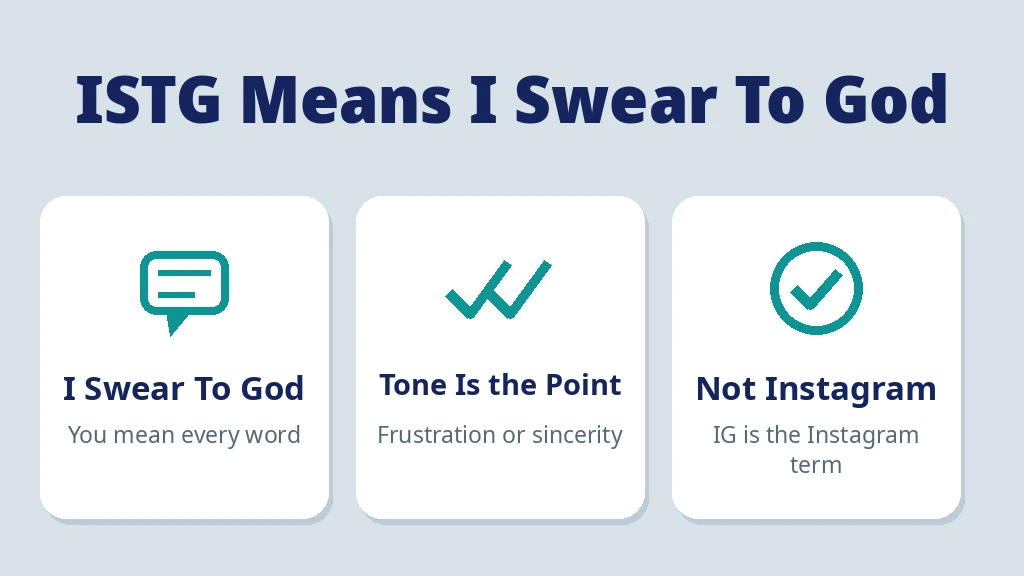
The sources agree on the expansion, and they agree that the tone does the work. CyberDefinitions says ISTG means “I Swear To God”, and adds that it adds emphasis to a statement, usually a promise, threat, excuse or apology, or works as an interjection expressing surprise, skepticism or exasperation. Dictionary.com calls it an acronym for “I swear to God”, used to convey extreme seriousness, exasperation, or surprise, in an entry dated April 27, 2018. Wiktionary lists ISTG as internet slang and an initialism of “I swear to God”, with a cited use from a Usenet post in July 2003. The niche guides that rank for this term say the same thing: all three of the top three lead with “I swear to God”, and each one calls ISTG a tone booster, not a literal oath. The first widely cited definition appeared on Urban Dictionary in January 2008, and it read simply “I swear to God. Promising.”
ISTG Meaning in Easy Words
Think of ISTG as an underline. That is the istg meaning in one image.
When you underline a word on paper, you are telling the reader to pay more attention to it, not changing what it means. ISTG does the same thing in a chat. It underlines the sentence it sits in and tells the reader that the sender means it, feels it, or cannot believe it.
In the simplest words:
ISTG = “I really mean this, and I want you to believe me.”
Where Is ISTG Used?
As istg slang, ISTG lives in casual chats and comment sections, anywhere feelings run high and messages stay short.
Common places:
- Private texts and DMs, as an emphatic promise or denial
- Group chats, where one ISTG can turn a joke into a debate
- Snapchat chats and stories, where short reactions are the norm
- TikTok comments and captions, answering wild claims with disbelief
- Instagram DMs, comments, and the hashtag #istg
Typical situations:
- A friend denies something and wants to be believed
- Someone reacts to news that sounds impossible
- A promise needs to sound stronger than a plain “I will”
- A vent about a bad day reaches its breaking point
- A joke lands and the reply needs to sound dramatic
Why Do People Use ISTG?
It turns up the volume
Some sentences are flat on their own. “I did not do it” sounds calm, even when the sender is not calm at all. Adding ISTG at the front turns the volume up without adding a single new fact. It is the fastest way to make a sentence sound urgent.
It makes a promise sound real
A plain “I will be on time” is easy to doubt, especially if you have been late before. “ISTG I will be on time” puts the sender’s word on the line. The oath is not literal, but the extra weight tells the reader that this promise matters more than the last one.
It vents without a long rant
Frustration is hard to type, and a long rant can sound worse than the feeling behind it. ISTG lets the sender release the pressure in four letters and then move on. “ISTG this week needs to end” says everything about the mood, and it leaves the chat open for the other person to agree or change the subject.
Real-Life Examples of ISTG
Here is how ISTG actually shows up in chats and comments:
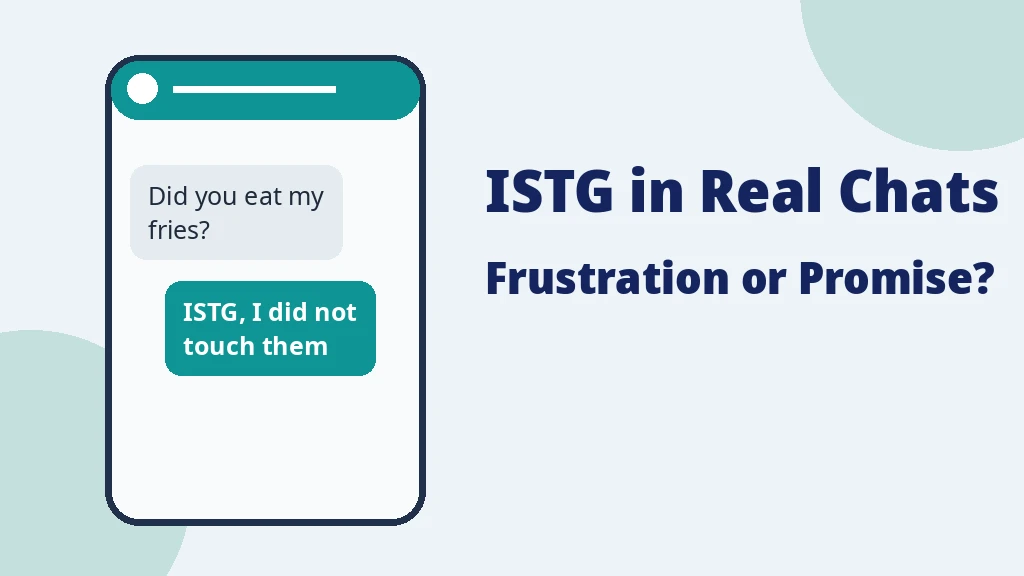
Example 1:
- Chat: “Did you eat my fries?” “ISTG, I did not touch them.”
Meaning: A firm denial.
Example 2:
- Chat: “ISTG if the bus is late again I am walking home.”
Meaning: Frustration at the breaking point, a vent more than a real threat.
Example 3:
- Chat: “He got the job? ISTG, I cannot believe it!”
Meaning: Happy disbelief, the sender is shocked in a good way.
Example 4:
- Comment: “This traffic is unreal.” “ISTG, I sat in it for two hours.”
Meaning: Shared frustration with a stranger’s post.
Example 5:
- Chat: “ISTG I will finish the assignment tonight, no more excuses.”
Meaning: A sincere promise, the sender is putting their word on it.
ISTG vs Similar Terms
| Term | Meaning | When to use it |
|---|---|---|
| ISTG | I Swear To God | Strong emphasis, a promise or a heated reaction |
| OMG | Oh My God | Surprise or shock, with no promise attached |
| FR | For Real | Calm agreement or confirmation |
| IDS | I Am Dead Serious | Firm sincerity, defending your own statement |
| S2G | Swear To God | The same meaning as ISTG, in fewer letters |
Key difference: ISTG is the loudest promise of the group. OMG reacts with surprise but promises nothing, and FR agrees or confirms in a much calmer voice. IDS defends your own statement and sounds firm rather than heated, so it fits when you need to be believed without sounding angry. S2G is simply ISTG shortened, the same meaning with fewer letters. If you want to sound serious without the heat, IDS is the safer choice, and here is what IDS means in text, the firm promise that never sounds like a rant. Use ISTG only when the moment truly deserves an oath.
The Other ISTG Meanings You Should Know
“I Swear To God” is the only texting meaning. In chats, DMs, and comments, ISTG means “I Swear To God” and nothing else. Every source that covers texting agrees on that.
ISTG has a shorter form and a stronger sibling. S2G, and sometimes IS2G, is the same meaning with fewer letters. ISTFG adds a swear word in the middle and means “I swear to f***ing God”. It is the louder, rougher version, best left to close friends and private chats.
Tone rule in one line: the sentence around ISTG tells you the tone, and the punctuation tells you the volume. All caps with exclamation marks means the loudest reading, and lowercase istg mid-sentence usually means the softer one.
How to Reply to ISTG
Your reply depends on which ISTG you received, because the same four letters can ask for trust, vent anger, or show shock.
If it was a promise: accept it and move on. “Okay, I believe you” or “Deal, I am holding you to it” both work. Doubting a sincere ISTG right after it was sent will start an argument the sender did not want.
If it was frustration: stay calm and do not match the heat. “That sounds rough, what happened?” gives the sender room to vent without turning the chat into a fight.
If it was disbelief: send proof or laugh along. A screenshot, a link, or a simple “I know, right?” all fit. If you made the wild claim, ISTG from the other person means your proof is now expected.
When to Use ISTG (and When to Avoid It)
Good situations:
- Making a promise you truly mean to keep
- Denying something firmly when someone doubts you
- Reacting to news that sounds impossible
- Venting to a close friend in a private chat
- Adding drama to a joke everyone already knows is a joke
Avoid using ISTG when:
- You are talking to a teacher, a boss, or anyone formal
- You are writing a work email or a message to a client
- Someone is sharing serious news and needs a real response
- The reader may find the religious wording offensive
- You do not actually mean it, since a hollow oath is worse than no oath
Common Misunderstandings About ISTG
ISTG is not a literal oath. This is the biggest misunderstanding, and it comes from reading the words instead of the chat. Almost nobody who types ISTG is making a real vow before God. It is an emphasis tool, a way to say “I mean this” in four letters. Treat it as feeling, not as a legal promise, and you will read it correctly almost every time.
ISTG does not mean Instagram. The letters “IG” sit inside ISTG, and that trips people up, but ISTG has nothing to do with Instagram. IG is the Instagram term, and ISTG is the oath. For the platform name people actually confuse it with, here is what IMSG means in text, the iMessage shorthand that is a real app name, not an oath.
ISTG is not a swear word. It is not profanity, and it is not a curse. It does contain a religious reference, and some readers find that irreverent, so it can still offend. The stronger sibling ISTFG is the one that crosses the line into swearing. If the chat needs to stay clean, a plain “I promise” does the same job without the risk.
ISTG is not always angry. Frustration is the most common tone, but it is not the only one. ISTG shows up in happy disbelief, sincere promises, jokes between friends, and captions that are pure exaggeration for laughs. The anger reading is real, but it is only one of four tones.
Frequently Asked Questions
What does ISTG mean in text?
ISTG means “I Swear To God”. It is a short way to say you are serious, frustrated, or cannot believe something, and it adds strong feeling to the sentence around it.
Is ISTG rude?
It is not a swear word, but it can sound heated or irreverent. It abbreviates an oath with a religious reference, so some readers find it offensive. Use it with close friends, not in formal chats.
What does ISTG mean on TikTok?
On TikTok, ISTG usually means “I Swear To God” in comments and captions, often as disbelief or frustration about a wild claim or a relatable vent. It works the same way as in a text message.
What is the difference between ISTG and OMG?
OMG means “Oh My God” and reacts with surprise, while ISTG means “I Swear To God” and adds a promise or a guarantee. OMG asks the world a question, ISTG answers it and dares you to doubt it.
What does ISTFG mean?
ISTFG means “I swear to f***ing God”. It is a stronger, rougher version of ISTG with a swear word in the middle. Save it for close friends and private chats.
Does ISTG mean Instagram?
No. ISTG means “I Swear To God” and has nothing to do with Instagram. IG is the Instagram term, and the “IG” inside ISTG is only a coincidence of letters.
Should I use ISTG at work?
No. It is informal, emotional, and carries a religious reference, so it reads as unprofessional in a work chat. Write “I promise” or “I am certain” in full instead.
Final Thoughts
ISTG is the loudest little promise in texting. It means “I swear to God”, and it does the work of an underline: I mean this, I feel this, and I want you to believe me. The feeling comes from everything around the letters, the sentence, the punctuation, and the message they answer.
Now you can read it at a glance: a promise means trust me, a vent means the sender has reached the edge, and disbelief means the news sounded impossible. The next time a friend opens a message with ISTG, you will know whether to believe them, calm them down, or send the proof.
The lead is documented by CyberDefinitions, which says ISTG means “I Swear To God” and is used to add emphasis to a statement or as an interjection expressing surprise, skepticism or exasperation. Wiktionary lists ISTG as internet slang and an initialism of “I swear to God”, with a cited use from a Usenet post in July 2003. For the calmer promise that never sounds heated, here is what IDS means in text, the firm “I am dead serious” that fits almost any chat.