Your friend asks you a question about a show you both watch, and your answer comes back as three letters: “isk”. Did you just say you should know the answer, or did you just say you do not know it at all?
Here is the honest answer: ISK has two competing readings in text, and neither one has won. It can mean “I Should Know”, and it can also mean “I don’t know”, as a typo of IDK that stuck around as a joke. The sentence around it picks the winner, so you have to read the chat before you decide which one you are looking at.
In this guide you will learn the isk meaning in text for both readings, where the typo story comes from, where ISK shows up online, and what to send back.
What Does ISK Mean in Text?
ISK is a short texting abbreviation with two readings, and the guides split on which one comes first. That split is real.
Reading 1, “I Should Know”, has the majority of the niche guides behind it. The top three results for this term all lead with it. Here the sender is saying they ought to know the answer, or knew it once and forgot it. It is an admission with a little pride in it.
Reading 2, “I don’t know”, is the typo reading, and it has serious support too. S and D sit next to each other on a keyboard, so people typing IDK kept hitting ISK by mistake, and the mistake stuck. Two well known guides lead with this reading and list “I Should Know” second.
Quick definition: ISK means “I Should Know” or “I don’t know” in texting, and the context decides. Use “I Should Know” when the sender ought to have the answer, and “I don’t know” when the message reads like a shrug.
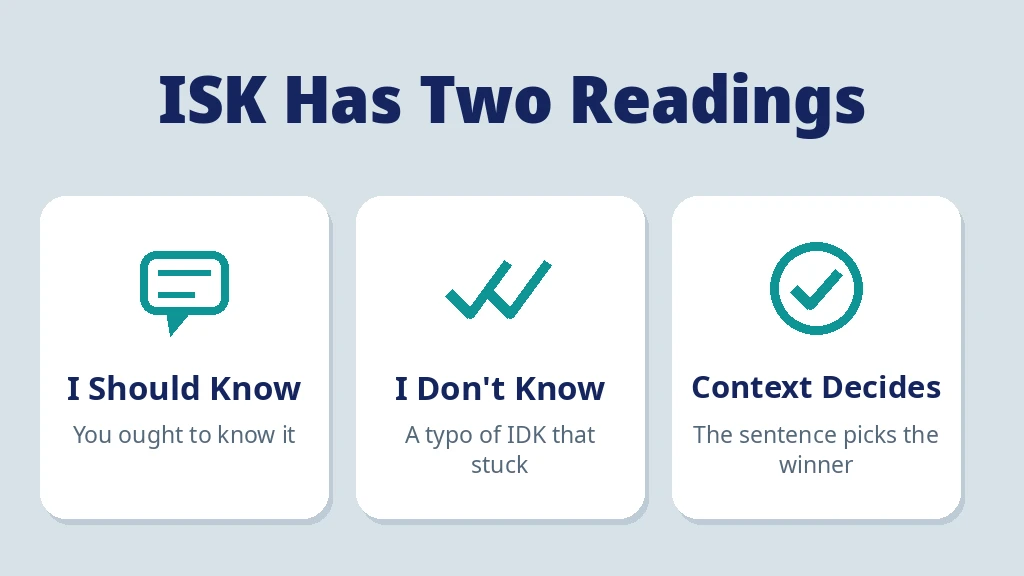
The evidence is labelled honestly, because no single source settles this term. “I Should Know” has strong guide support: the top three niche guides lead with it. “I don’t know” also has strong guide support: two established guides lead with it and explain the keyboard typo. No dictionary settles the texting question. CyberDefinitions has no entry for ISK at all, its page returns a clean 404. Dictionary.com covers ISK only as the Icelandic currency and the EVE Online game currency, and Wiktionary lists it only as the ISO currency code for the Icelandic krona.
ISK Meaning in Easy Words
Think of ISK as a shrug with two possible faces. That is the isk meaning in one image.
One face says “I should know this”, the face of someone who forgot an answer they once had. The other says “I don’t know”, the face of someone who never had the answer. Both look the same in three letters.
In the simplest words:
ISK = “I should know this, but I cannot remember it right now” OR “I don’t know”.
A quick test works most of the time. A question about something expected, like their own schedule, means “I Should Know”. A question nobody could answer means “I don’t know”. When the test fails, ask.
Where Is ISK Used?
As isk slang, ISK lives in casual chats between people who type fast and forgive typos, and it almost never leaves that world.
Common places:
- Private texts and DMs, as a quick reply when an answer is missing
- Group chats, where one “isk” closes a question without a long excuse
- Snapchat chats, where both readings are claimed
- Instagram DMs and comments, usually as “I Should Know”
- TikTok comments, usually as “I Should Know” under trivia and quiz videos
Typical situations: a fact you should remember but cannot recall, a question you simply cannot answer, a quiz video that reminds you of something obvious you forgot, or a friend asking who started a trend.
Platform senses line: no platform owns one reading. Snapchat is the only platform where both readings are claimed with equal confidence. TikTok and Instagram lean toward “I Should Know”, but that is a lean, not a rule. The hashtag #isk is not a texting sense: it is mostly used for EVE Online currency talk, Icelandic money, and posts about the rapper ISK.
Why Do People Use ISK?
It saves time and typing
ISK is three letters instead of a whole sentence, and in a fast chat that difference matters. The full phrase adds nothing, so people cut it.
It admits a gap without a long excuse
Saying “I should know this but I have forgotten” sounds like an apology. ISK says the same thing in three letters, and the tone stays light.
It keeps a joke alive
Once people noticed that ISK was a mistyped IDK, some kept typing it on purpose, because the mistake itself became the joke.
Real-Life Examples of ISK
Here is how ISK actually shows up in chats and comments, with both readings in play:
Example 1:
- Chat: “What time is the class tomorrow?” “ISK, I think it is at nine but I am not sure.”
Meaning: “I Should Know”, the sender ought to know their class time but forgot it.
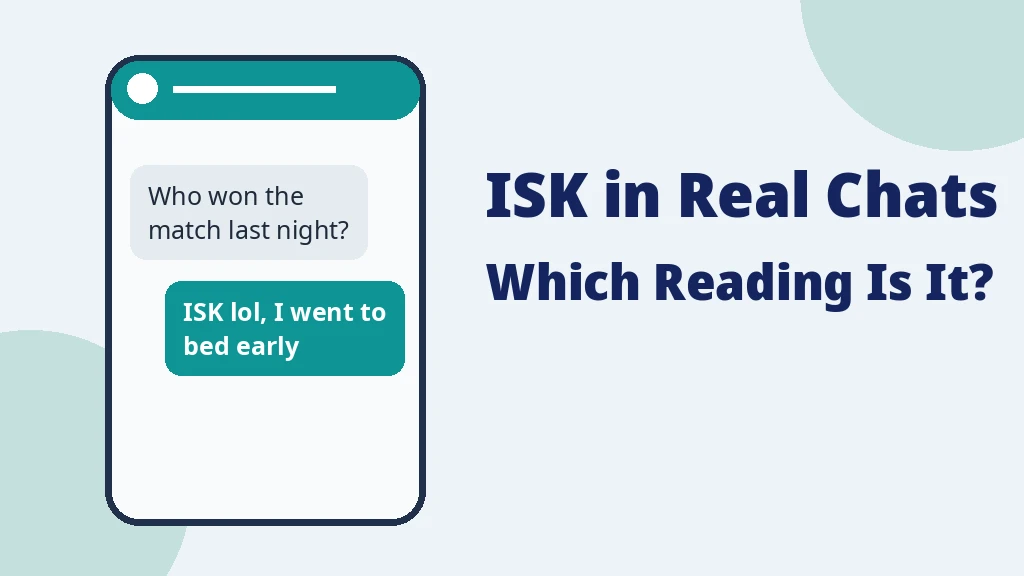
Example 2:
- Chat: “Who won the match last night?” “ISK lol, I went to bed early.”
Meaning: “I don’t know”, the sender never saw the match.
Example 3:
- Comment: “This quiz question is so easy!” “ISK, I stared at it for five minutes.”
Meaning: “I Should Know”, the sender admits they should have known an easy answer.
Example 4:
- Chat: “Did Sara tell you about the plan?” “ISK, she has not said anything to me.”
Meaning: “I don’t know”, the sender has no information at all.
Example 5:
- Chat: “You knew all the answers in that round!” “ISK, I seriously know this stuff.”
Meaning: “I Seriously Know”, used as a boast, not an admission.
ISK vs Similar Terms
| Term | Meaning | When to use it |
|---|---|---|
| ISK | I Should Know / I Don’t Know | When the reading depends on context |
| IDK | I Don’t Know | The settled way to say you do not know |
| IK | I Know | Plain acknowledgement, the opposite of IDK |
| IKR | I Know, Right? | Warm, enthusiastic shared agreement |
| IMK | In My Knowledge | Sharing what you believe is true, with a hedge |
Key difference: ISK is the only term in this family with two live readings, and that is what makes it tricky. IDK always means “I Don’t Know”. IK is the opposite of IDK: it says you already knew, while ISK says you should have known or did not know at all. IKR adds warmth to an agreement, which ISK never does. IMK hedges a fact you believe is true, while ISK admits a gap in what you know. For the plain version of knowing, here is what IK means in text, the calm “I know” with no second reading to untangle.
Keep ISK apart from IMK as well. IMK offers information with a safety net: this is what I believe, correct me if I am wrong. ISK withholds information: either I should know this and I do not, or I simply do not know.
The Other ISK Meanings You Should Know
The two texting readings are “I Should Know” and “I don’t know”. In chats, DMs, and comments, ISK means one of those two. Everything else below is a minor reading with thin support, or a meaning from outside texting.
Minor texting readings, labelled by evidence: “I Seriously Know” has support from two guides, and it turns the admission into a boast, as in Example 5. “I Suck” has support from one established guide and appears after a bad game. “I am So Kidding” appears in one guide only. “I See” appears in a single outlier source, so treat it as a weak reading. “Iskiskisk” is a keyboard mash for excitement, listed by one established guide. None of these is the main meaning.
Outside texting, ISK has formal meanings. ISK is the ISO currency code for the Icelandic krona, the official currency of Iceland since 1874. In gaming, ISK stands for InterStellar Kredits, the in-game currency of EVE Online, launched in 2003. Neither will appear in a chat about a quiz question.
Tone rule in one line: a question about something expected means “I Should Know”, a question nobody could know means “I don’t know”, and when the test fails, ask.
How to Reply to ISK
Your reply depends on which ISK you received.
If it meant “I Should Know”: help them remember, or move on lightly. “No worries, it is at nine” or “Same, I forgot it too” both work.
If it meant “I don’t know”: treat it exactly like IDK. Give the answer yourself if you have it, or shrug along. “Fair enough, I will check” keeps the chat moving.
If you cannot tell which one it was: ask one short question: “Do you mean you forgot, or you never knew?” It settles it in a second. For a reply that shares what you believe without claiming certainty, here is what IMK means in text, the careful “in my knowledge” that leaves room to be corrected.
If you want to use ISK yourself: use it only in a casual chat where the ambiguity will not cause a problem. Add a few words so the reader can tell which reading you mean, like “ISK, I forgot the time” or “ISK, no idea at all”.
When to Use ISK (and When to Avoid It)
Good situations:
- Admitting you forgot something you should have remembered, with friends
- Shrugging at a question nobody could be expected to answer
- Replying to a trivia or quiz post where the answer slipped your mind
- Keeping a fast Snapchat or TikTok exchange moving with a short reply
Avoid using ISK when:
- You are talking to a teacher, a boss, or anyone formal
- The answer actually matters and a wrong guess would cause a problem
- Someone is sharing serious news and needs a real response
- You are giving instructions or anything that must be exact
Common Misunderstandings About ISK
ISK does not have one settled meaning. This is the biggest misunderstanding, and it comes from guides that present their own favourite reading as the only one. The majority favour “I Should Know”, but two established guides lead with “I don’t know”.
ISK is not always a typo. The typo story explains the “I don’t know” reading well, but not the “I Should Know” reading, which most guides treat as a deliberate abbreviation. Some type ISK by mistake, and some type it on purpose.
ISK does not mean the Icelandic currency in a chat. The currency code and the texting abbreviation share the same three letters, and nothing else.
ISK is not the same as IDK. The two overlap only in the typo reading. IDK always means “I Don’t Know” and nothing else. ISK can mean that, but it can also mean the opposite admission: I should know this and I do not.
Frequently Asked Questions
What does ISK mean in text?
ISK has two readings: “I Should Know” and “I don’t know”. Most guides lead with “I Should Know”; two established guides lead with “I don’t know” as a typo of IDK. Context decides.
Does ISK mean I should know or I don’t know?
Both. “I Should Know” fits a forgotten answer the sender ought to have; “I don’t know” fits a sender with no answer at all.
Why do people say ISK instead of IDK?
A keyboard typo that stuck. S and D sit next to each other, so people typing IDK kept hitting ISK by mistake. Some now type it on purpose as a joke.
What does ISK mean on Snapchat?
On Snapchat, ISK can mean either “I Should Know” or “I don’t know”, and the guides disagree about which comes first. Read the message it answers first.
What does ISK mean on TikTok?
On TikTok, ISK usually means “I Should Know” in comments, often under trivia or quiz videos. The “I don’t know” reading still appears, but the guides lean toward “I Should Know” there.
Is ISK the Icelandic currency?
ISK is the currency code for the Icelandic krona, but that is a finance sense, not a texting sense. In a chat, ISK means “I Should Know” or “I don’t know”.
Should I use ISK at work?
No. It is informal, and its two readings make it a poor choice anywhere the answer matters. Write the full phrase instead.
Final Thoughts
ISK is a small term with an honest split at its centre. It can mean “I Should Know”, the admission of someone who forgot an answer they once had, and it can mean “I don’t know”, the shrug of someone who never had the answer. The majority of guides favour the first, and two established guides lead with the second.
A question about something expected means “I Should Know”; a question nobody could know means “I don’t know”; and when the test fails, one short question settles it.
The non texting senses are documented by Dictionary.com, which defines ISK as InterStellar Kredits, the in-game currency of EVE Online, and as the code for the Icelandic currency, the krona.