
Your friend suggests a restaurant you tried last month and did not enjoy. You do not want to say no outright, and you do not want to lie. Three letters solve the problem: “IDT”.
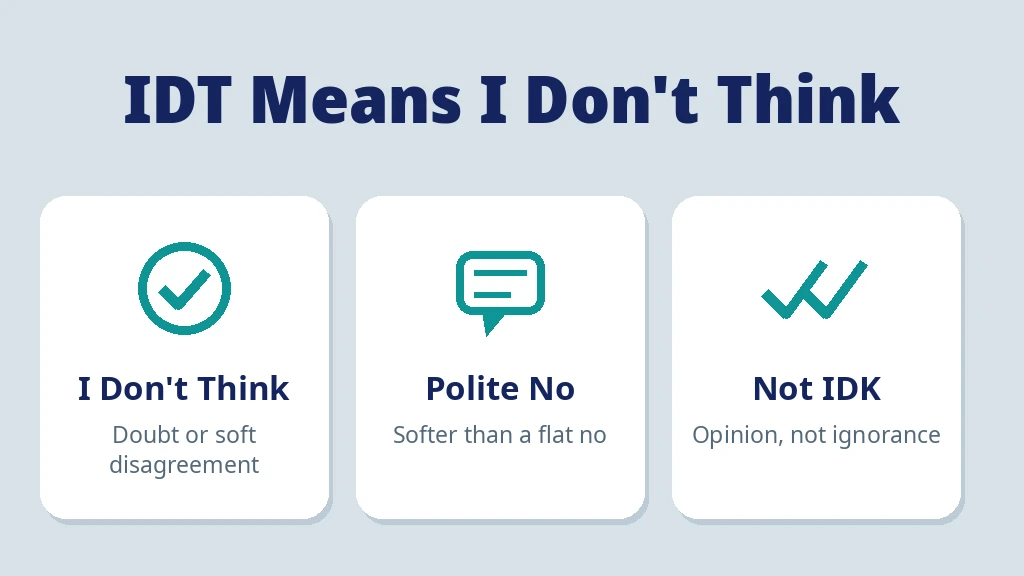
Here is the short answer: IDT usually means “I Don’t Think” in texting. It is a gentle way to disagree, or to admit doubt, without sounding blunt. It says you have a view, but you are holding it lightly.
In this guide you will learn the idt meaning in text, how it differs from IDK, where it shows up, and when a soft IDT can cause more confusion than a clear answer.
What Does IDT Mean in Text?
In a chat, IDT is a polite doubt.
People use it when they want to push back on an idea without starting an argument. A flat “no” can sound cold in text, where there is no voice to soften it. IDT wraps the same refusal in uncertainty: it says “I do not think so”, which leaves room for the other person to persuade you, and room for you to be wrong.
Quick definition: IDT means “I Don’t Think” in texting. It expresses doubt, disagreement, or a lack of certainty, usually in a soft, friendly tone.
The sources agree on this reading, and the agreement is unusually strong. CyberDefinitions gives “I Don’t Think” as the meaning of IDT in a text, and it explains that IDT is used to express disagreement or a lack of certainty, with examples such as “IDT that’s right” and “IDT it does”. The niche guides that rank for this term agree as well: the Word Counter calls “I don’t think” the most commonly used texting meaning, Meanary leads with the same expansion, Rizzline Love, ScoopEvalle, Slangify, and Texthints all lead with it too, and Slangify notes that IDT is softer than saying no directly. Wiktionary lists no texting sense for IDT, only technical and military expansions, which is a gap in that dictionary rather than a disagreement: the texting use is documented by the specialist source and by every niche guide that ranks for the term.
That agreement matters, because IDT has a quiet second job. It is not only a disagreement, it is also a report of uncertainty. “IDT he is coming” can mean “I doubt he is coming”, or it can mean “I am not sure whether he is coming”. The two readings overlap, and in most chats the difference does not matter, because both point the same way: towards no, but gently.
IDT Meaning in Easy Words
Think of IDT as a soft no with the door left open.
When someone writes “I don’t think so” in full, it sounds considered and calm. When they write IDT, they are sending the same message in shorthand, for a fast chat where full sentences feel heavy. The meaning stays the same, and so does the softness.
In the simplest words:
IDT = “I doubt it, but I could be wrong.”
That reading fits the way people actually use it. They write IDT when a friend suggests a plan they are unsure about, when a rumour sounds unlikely, or when a guess feels wrong but they cannot prove it. It is an opinion offered lightly, not a fact nailed down.
It also helps to see what IDT is not. It is not a refusal to decide, and it is not a claim of ignorance. A person who writes IDT usually has a view, and they are sharing it. The abbreviation just makes that view sound less final than it would in a full sentence.
Where Is IDT Used?
IDT lives in casual chats and social media, wherever friends trade opinions quickly.
Common places:
- WhatsApp and iMessage chats, where friends discuss plans, rumours, and opinions
- Instagram and Snapchat DMs, often as a reply to a suggestion or a story
- TikTok comments, where a viewer doubts a claim in a video without starting a fight
- Discord and gaming chats, where players doubt a strategy or a score prediction
- Group chats, where several people are guessing and IDT marks the cautious voice
Why Do People Use IDT?
It disagrees without sounding rude
A direct no can feel like a wall in a text chat. IDT turns the same refusal into a thought, and thoughts are easier to argue with than walls. The other person can answer with a reason, and the conversation stays friendly.
It admits doubt without admitting ignorance
IDK says you do not know. IDT says you have a view, and your view leans towards no. That distinction matters when you want to contribute to a discussion without pretending to be certain, and without pretending to know nothing either.
It keeps the conversation open
Because IDT sounds uncertain, it invites a reply. “IDT that will work” is almost a question in disguise: it asks the other person to explain why they think it will. A flat no closes a chat, while IDT keeps it moving.
Real-Life Examples of IDT
Here is how IDT actually shows up in chats:

Example 1:
- Chat: “We should go to the beach tomorrow.” “IDT the weather will be good enough.”
Meaning: The sender doubts the plan will work, but they are not refusing outright.
Example 2:
- Chat: “Do you think he will reply tonight?” “IDT so, he is usually offline by nine.”
Meaning: The sender is sharing an opinion based on a pattern they have noticed.
Example 3:
- Chat: “That new cafe is supposed to be amazing.” “IDT it is worth the price, honestly.”
Meaning: The sender disagrees with the hype, but softly.
Example 4:
- Chat: “We can finish this in an hour, easy.” “IDT we will, there is too much left.”
Meaning: The sender doubts the optimistic estimate.
Example 5:
- Chat: “Is this the right address?” “IDT so, let me check the map.”
Meaning: The sender is uncertain rather than disagreeing.
IDT vs Similar Terms
| Term | Meaning | When to use it |
|---|---|---|
| IDT | I Don’t Think | Soft doubt or gentle disagreement |
| IDK | I Don’t Know | Plain lack of knowledge |
| IDTS | I Don’t Think So | Clearer, firmer version of IDT |
| IDC | I Don’t Care | Indifference, can sound cold |
| IDM | I Don’t Mind | Flexible and agreeable |
Key difference: IDT and IDK are the pair people confuse most, and the difference is simple. IDK means you have no information. IDT means you have an opinion, and that opinion leans towards no. “IDK if he is coming” says you cannot say. “IDT he is coming” says you think he probably is not. IDTS is the longer, clearer cousin of IDT, and it sounds slightly firmer, because the word “so” closes the sentence. IDC is different again: it is about caring, not about thinking, and it can sound cold where IDT sounds thoughtful.
Choosing between them is a matter of honesty. Use IDT when you actually doubt something. Use IDK when you genuinely have no idea. Using IDT when you mean IDK can mislead a friend into thinking you have a view when you do not, and using IDK when you mean IDT hides a useful opinion.
The Other IDT Meanings You Should Know
“I Did That” is a rare chat reading. Slangify notes that IDT can mean “I Did That” in some casual conversations, as a proud claim, as in “I did that!” That use exists, but it is far less common than “I Don’t Think”, and it usually needs a proud, celebratory context to make sense. If the sentence is about an achievement, consider it. Otherwise, the doubt reading wins.
“In Due Time” is another rare reading. The same guide lists “In Due Time” as a possible meaning, suggesting something will happen eventually, as in “You will get the results IDT”. That use is uncommon in everyday chats, and it needs a sentence about waiting to be clear. Without that context, do not assume it.
How to Reply to IDT
IDT is an opinion offered lightly, so the best reply is usually a reason, not a repeat of the doubt.
If you agree with the doubt: say so, and add your own reason. “Yeah, IDT so either, the forecast looks bad” builds on the sender’s view and moves the chat towards a decision.
If you disagree with the doubt: share the evidence, gently. “I checked, and it is actually open till late” answers the doubt with a fact, which is kinder than arguing about the abbreviation.
If IDT keeps stalling a decision: ask for a clearer answer. “Okay, so are we going or not?” is fair when a chat has circled around soft doubts for too long, and it is kinder than letting the plan drift.
When to Use IDT (and When to Avoid It)
Good situations:
- Disagreeing gently with a friend’s suggestion or opinion
- Doubting a rumour without accusing anyone of lying
- Admitting uncertainty about a plan or a fact you cannot check yet
- Softening a no so a friendly chat stays friendly
Avoid using IDT when:
- You need to give a clear yes or no, such as accepting an invitation or confirming a time
- You are writing to a teacher, a manager, or anyone in a formal setting, where full sentences fit better
- You actually mean IDK, since IDT implies an opinion you may not have
- The decision is urgent, because a soft doubt can delay a choice that needs to be made now
Common Misunderstandings About IDT
IDT is not the same as IDK. This is the most common mix up, and it matters. IDK reports a gap in knowledge. IDT reports a view. Treating them as identical can hide a useful opinion, or invent one that was never there. For a closer look at the other side of that pair, here is what GTS means in text, a term whose guessing sense is often confused with knowing.
IDT does not mean the sender does not care. A soft doubt can be misread as indifference, especially in text. Most of the time, the sender cares enough to think about the question and offer a view. If they did not care, they would more likely write IDC, or nothing at all.
IDT is not a firm no. The abbreviation leaves room for persuasion, and that is deliberate. Reading IDT as a final refusal can end a discussion too early, while treating it as an opening can lead to a better plan.
Frequently Asked Questions
What does IDT mean in text?
IDT means “I Don’t Think” in texting. It is a gentle way to express doubt or disagreement without sounding blunt.
What is the difference between IDT and IDK?
IDK means “I Don’t Know” and reports a gap in knowledge, while IDT means “I Don’t Think” and reports an opinion that leans towards no. Use IDK when you have no idea, and IDT when you doubt something.
Does IDT mean “I Did That”?
It can, but that reading is rare and needs a proud, celebratory context to make sense. In most chats, IDT means “I Don’t Think” instead.
Is IDT rude?
No, IDT is not rude. It is one of the politest ways to disagree in a chat, because it sounds uncertain and leaves room for the other person to persuade you.
When should I use IDT?
Use IDT in friendly chats when you doubt a plan, a rumour, or an opinion but do not want to sound blunt. Add a reason when you can, so the other person knows why you doubt it.
What does IDTS mean?
IDTS means “I Don’t Think So”. It is the longer, slightly firmer cousin of IDT, and it closes the sentence more clearly than a bare IDT.
Can I use IDT at work?
It is best not to. IDT is informal, and in a work message it can sound vague. Spell out “I don’t think” instead, and add the reason, so your message reads as professional.
Final Thoughts
IDT is a small courtesy in three letters. It means “I Don’t Think”, and it lets you disagree, doubt, or admit uncertainty without sounding blunt. In friendly chats it keeps conversations open, invites reasons instead of arguments, and turns a possible no into a thought that can be discussed.
Use it honestly, and pair it with a reason when you can. A bare IDT can stall a decision, but an IDT with a reason behind it helps everyone decide faster. And when the moment needs a clear yes or no, skip the abbreviation and say it in full: softness is a gift in casual talk, and clarity is a gift when it counts.
The meaning is documented by CyberDefinitions, which gives “I Don’t Think” as the meaning of IDT in a text and explains its use for disagreement and lack of certainty. If gentle disagreements still trip you up, here is what SMH means in text, a reaction that also needs its tone read carefully.
1 thought on “IDT Meaning in Text | The Polite Way to Say You Disagree”