Someone thanks you for a lift or a favour, and you want to answer with more warmth than a flat “you’re welcome”. You type three letters instead: “IMP”. Most readers will pause, because this is one of the rarest polite replies in texting.
Here is the short answer: IMP means “It’s My Pleasure”. It is a polite, warm reply to “thank you”, the kind of answer that says you were glad to help and it was no trouble at all. But there is a catch: the letters are rare, and the lowercase word “imp” means something else entirely.
In this guide you will learn the imp meaning in text, when the acronym IMP fits, why most people will read the lowercase form as a mischievous little creature instead, and what to send when you want the same warmth without the confusion.
What Does IMP Mean in Text?
IMP is a polite reply with a split personality, and the capital letters are the whole story.
When it is written in capitals, IMP is an acronym, and it stands for “It’s My Pleasure”. It works exactly like “you’re welcome”, only warmer: it says the help was not a burden, it was a pleasure. When it is written in lowercase, “imp” is not an acronym at all. It is an ordinary English word for a small, mischievous sprite, or for a naughty child who causes playful trouble.
Quick definition: IMP means “It’s My Pleasure”. In texting it is a polite reply to “thank you”, used when you were happy to help. The lowercase word “imp” means a mischievous sprite or a cheeky child, and it is the far more common reading on the open web.

The sources agree on the acronym, and they agree that it is rare. CyberDefinitions says that in a text IMP means “It’s My Pleasure”, and adds that while this is its most common meaning in texting, it is a rare term, and it might mean something else. The 7ESL guide leads with the same reading: IMP stands for “It’s My Pleasure”, used to express that someone is happy to do something for someone else, typically in response to a “thank you”. TheFreeDictionary lists the same reading as internet slang. The dictionaries that define the lowercase word tell the other half of the story: Merriam-Webster defines “imp” as a small demon or a mischievous child, and Wiktionary defines it as a small, mischievous sprite or a playful, naughty child.
IMP Meaning in Easy Words
Think of IMP as a warm handshake in three letters, and think of “imp” as a small troublemaker with a grin. That is the imp meaning in easy words in one image.
A handshake says, glad to help, no trouble at all. That is the acronym, and it only works when the other person knows the code. A troublemaker with a grin says, I caused a little chaos, and I enjoyed it. That is the lowercase word, and it is the reading most people will reach for first.
In the simplest words:
IMP = “You are welcome, and I was genuinely glad to help.” Lowercase imp = “a small, cheeky creature or child who loves a little mischief.”
Where Is IMP Used?
As imp slang, the acronym IMP lives in private, polite replies, and it almost never leaves that world.
Common places:
- Private texts and DMs, as a warm reply to a thank you message
- Group chats, when someone thanks you for help in front of others
- Casual work chats, where a warmer reply than “no problem” fits the moment
Typical situations:
- Someone thanks you for a lift, a favour, or a piece of help
- A friend thanks you for listening after a hard day
- A colleague thanks you for covering a shift or sharing a file
The lowercase word lives somewhere else entirely. You will see “little imp” in captions under photos of a child or a pet who has made a mess, in comments calling a friend a cheeky imp after a prank, and in fandom and gaming posts where an imp is a small demon or sprite character. Those uses are the noun, not the acronym, and they are far more common than the polite reply.
Why Do People Use IMP?
It sounds warmer than “you’re welcome”
“You’re welcome” is correct, and it is also flat. It answers the thanks and ends the exchange. “It’s My Pleasure” adds a feeling to the answer: the help was not a chore, it was something the writer enjoyed doing.
It is shorter than the full phrase
“It’s my pleasure” is a lovely sentence, and it is a long one to type in a fast chat. IMP keeps the warmth and drops the length, which is the same bargain every texting acronym makes. The problem is that this particular bargain is a bad one, because most readers do not know the code.
Real-Life Examples of IMP
Here is how IMP actually shows up in chats, with the case doing the work:
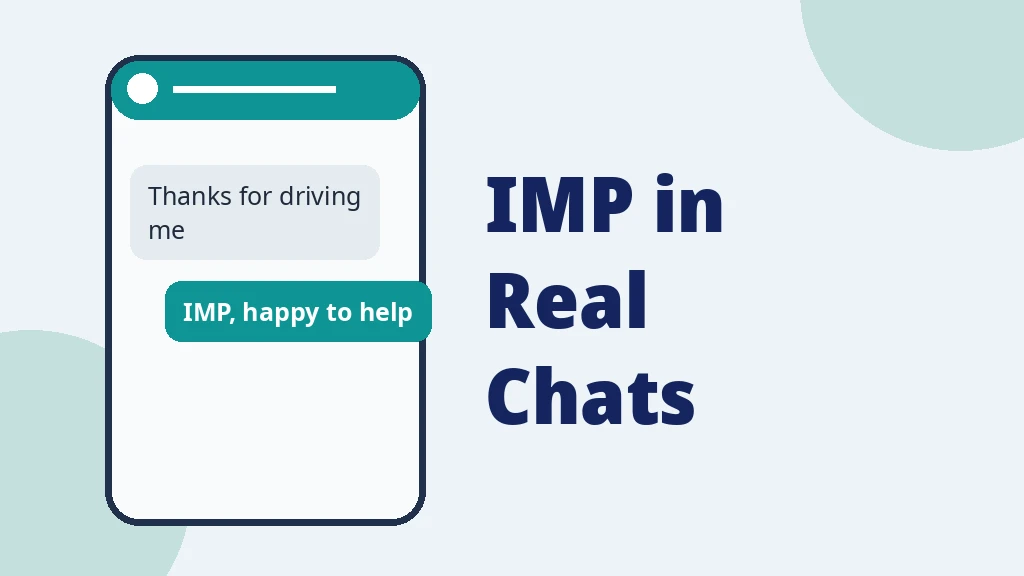
Example 1:
- Chat: “Thanks for driving me home. IMP, any time.”
Meaning: A warm reply to thanks, saying the lift was no trouble at all.
Example 2:
- Chat: “Thank you for helping with the move. IMP, happy to help.”
Meaning: The acronym used after a big favour, with the warmth spelled out.
Example 3:
- Chat: “You are such a little imp, you hid my keys again!”
Meaning: The lowercase noun, a playful label for a cheeky person, not the acronym.
Example 4:
- Comment: “My little imp drew on the wall again.”
Meaning: A caption calling a child an imp, the mischievous child sense from the dictionary.
Example 5:
- Chat: “A: Thanks for covering my shift. B: IMP, it was no trouble.”
Meaning: The acronym in a work chat, warmer than “no problem”, still professional.
IMP vs Similar Terms
| Term | Meaning | When to use it |
|---|---|---|
| IMP | It’s My Pleasure | A warm, slightly formal reply to thanks |
| NP | No Problem | The everyday reply to thanks, casual and safe |
| YW | You’re Welcome | The plain, standard reply to thanks |
| DW | Don’t Worry | Reassuring someone, not answering thanks |
| imp | Mischievous sprite or child | A playful noun, not a reply at all |
| GN | Good Night | Closing a chat warmly after the thanks are done |
Key difference: IMP, NP, and YW all answer “thank you”, and the imp vs np contrast is about warmth and risk. NP is the safe everyday choice: everyone knows it, nobody will misread it. YW is the plain standard: correct, clear, and a little flat. IMP is the warmest of the three, and also the riskiest, because many readers will not know the acronym and will read the lowercase word instead. DW is not a reply to thanks at all: it reassures someone who is worried, which is a different job. For a reassuring reply that never risks this confusion, here is what DW means in text, the “do not worry” that fits any chat.
Keep IMP apart from “important” as well. Some guides list IMP as a shortening of “important”, as in “imp notice”, and that reading is real, but it is a shortening, not an acronym. In a chat, “imp” on its own will not read as “important” unless the sentence around it makes that obvious.
The Other IMP Meanings You Should Know
“Important” is a shortening, not the acronym. IMP can stand for “important” in notes and headlines, as in “imp update”, and both 7ESL and TheFreeDictionary list that reading. Treat it as shorthand for busy notes, not as a texting reply.
The lowercase “imp” is the dominant sense on the open web. Merriam-Webster defines it as a small demon and a mischievous child, and Wiktionary traces it back through Middle English to a word for a young shoot or graft, which grew into the sprite and then the cheeky child. In games and fantasy stories, imps are small demons who cause trouble. In everyday speech, calling a child a little imp is affectionate, not an insult.
Outside texting, IMP has formal meanings. In the military, IMP is an Individual Meal Pack, a ration pack for soldiers. In technology, IMP has meant an Interface Message Processor, an early piece of internet hardware, and an Internet Message Protocol. None of these is a texting meaning.
Tone rule in one line: capital letters and a thank you just before it mean the polite reply, lowercase letters and a story about a prank mean the sprite or the cheeky child.
How to Reply to IMP
Your reply depends on which IMP you just received, because the two readings need opposite answers.
If someone sent IMP after you thanked them: they were being warm and polite. A simple “Thank you again” or a smile emoji closes the exchange nicely.
If someone called you or your child a little imp: they were teasing you affectionately. Play along: “Guilty, and proud of it” or a laughing emoji is the right reply.
If you want to use IMP yourself: use the capital letters, use it only right after a thank you, and add a few words so the meaning is clear, as in “IMP, happy to help”. If you are not sure the other person knows the code, write “you’re welcome” or “my pleasure” in full instead. If the thanks came at the end of a long day, here is what GN means in text, the good night that closes a chat warmly.
When to Use IMP (and When to Avoid It)
Good situations:
- Replying to a thank you from someone who knows the acronym
- Adding warmth to a polite reply at work or to an older person
- Writing the lowercase noun when you mean a cheeky child or a sprite
Avoid using IMP when:
- The other person may not know the acronym, which is most people
- You are texting quickly and the reader may skim past the capital letters
- You are in a group chat where half the readers will read the sprite sense
Common Misunderstandings About IMP
IMP is not a common acronym. This is the biggest misunderstanding, and CyberDefinitions says it plainly: IMP is a rare term. Most guides that list it treat it as a curiosity, not as an everyday reply. If you use it expecting instant understanding, you will often be disappointed.
Lowercase “imp” is not the acronym. The case is not a decoration. Uppercase IMP is a phrase shortened to three letters. Lowercase imp is a whole word with centuries of history behind it, from a young shoot to a sprite to a cheeky child. Writing the acronym in lowercase removes the only signal that tells the reader which one you mean.
IMP is not a safer NP. NP is short, warm enough, and understood by everyone. IMP is short and warmer, but understood by almost no one. The trade is real: you gain a little warmth and lose a lot of clarity, and for most chats that trade is not worth making.
Frequently Asked Questions
What does IMP mean in text?
IMP means “It’s My Pleasure”. It is a polite, warm reply to “thank you”, saying you were glad to help and it was no trouble.
What does lowercase imp mean?
Lowercase “imp” is a word, not an acronym. It means a small, mischievous sprite, or a cheeky, naughty child, as in “you little imp”.
Is IMP common in texting?
No, it is rare. CyberDefinitions calls it a rare term, and most readers will not know the acronym.
What is the difference between IMP and NP?
Both reply to “thank you”. NP means “No Problem” and is casual and widely understood. IMP means “It’s My Pleasure”, sounds warmer and more formal, and is much less widely known.
Does IMP mean important?
It can be a shortening of “important” in notes, as in “imp notice”, but that is not the texting reply. In a chat, write “important” in full to avoid confusion.
What does IMP mean on TikTok?
On TikTok, lowercase “imp” usually means the sprite or cheeky child sense, in captions and comments about a prank or a mischievous person. The acronym reply is rare there.
Should I use IMP at work?
Only if the other person knows it, or if you add words that make it clear, as in “IMP, happy to help”. Otherwise, “you’re welcome” is the safer professional reply.
Final Thoughts
IMP is a tale of two readings in three letters. In capitals, it means “It’s My Pleasure”, a warm and slightly formal reply to “thank you” that says the help was a pleasure, not a burden. In lowercase, “imp” is a small, mischievous sprite or a cheeky child.
Now you can read it at a glance: a thank you just before it and capital letters mean the polite reply, a story about a prank and lowercase letters mean the sprite, and when in doubt, write “my pleasure” in full.
The acronym lead is documented by CyberDefinitions, which says that in a text IMP means “It’s My Pleasure”, while warning that it is a rare term. The lowercase word is defined by Merriam-Webster, which gives “a small demon” and “a mischievous child” as its senses.