
Your friend asks whether you want pizza or pasta, and you have no preference. You could type a whole sentence. Instead you send three letters, and the choice is theirs.
Here is the short answer: IDC usually means “I Don’t Care” in a text. It is the bluntest shrug in texting, and the same three letters can hand someone a choice kindly or shut a conversation down cold.
In this guide you will learn the idc meaning in text, how punctuation and context change its tone, how it differs from IDK, IDEC, and IDM, and what to send back when someone drops it on you.
What Does IDC Mean in Text?
In a chat, IDC is a statement of indifference. It says the topic, the choice, or the outcome does not matter enough to the sender to pick a side.
That sounds simple, but the tone does all the work. “idc, you pick” is generous: the sender is giving the choice away. “idc.” with a full stop is a wall: the sender is done with the topic, and possibly with the conversation. Same letters, opposite messages.
Quick definition: IDC means “I Don’t Care” in a text. It tells the other person that you have no preference, no interest, or no wish to keep discussing the subject.
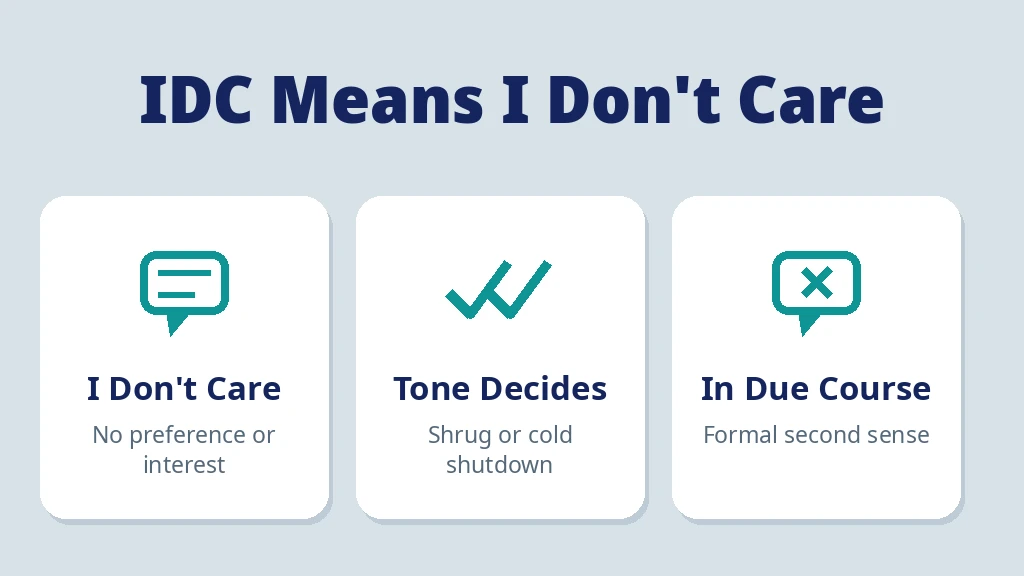
The sources agree on this reading completely. CyberDefinitions gives “I Don’t Care” as the first definition of IDC in a text, with “In Due Course” as a formal second sense. Dictionary.com lists “I don’t care” as the meaning of IDC, noting it comes from digital communications. Wiktionary labels it internet slang and text messaging for “I don’t care”. The niche guides that rank for this term are unanimous too: How-To Geek, EnglishPairs, and MeaningWow all lead with “I Don’t Care” and spend most of their guides on the tone, not the definition, because the definition was never in doubt.
That unanimity matters, because IDC is one of the oldest pieces of texting shorthand. How-To Geek traces it to 1990s chatrooms and instant messaging, alongside IDK and BRB, with the first Urban Dictionary entry dated 2003. Three decades of use have not changed the meaning. They have only sharpened the tone.
IDC Meaning in Easy Words
Think of IDC as a shrug you can type.
Somebody offers you two options, or tells you some news, or pushes a topic you have no feelings about. Instead of a polite paragraph, you shrug in three letters. The shrug can be warm or cold, and the chat around it decides which.
In the simplest words:
IDC = “This does not matter to me, so you decide, or let us drop it.”
Where Is IDC Used?
IDC lives anywhere people chat fast and feelings run close to the surface.
Common places:
- Private text messages and WhatsApp chats, when a choice needs making or a topic needs ending
- Instagram DMs and TikTok comments, where “idc what anyone thinks” is a whole attitude in a caption
- Twitter and Threads posts, where a user brushes off a trending topic they find boring
- Discord and gaming chats, where a player shrugs off a loss or a lobby argument
- Group chats, where one member opts out of a plan without blocking it
Typical situations:
- Handing over a choice: “Pizza or pasta?” “IDC, you pick”
- Brushing off gossip: “Did you hear what she said about you?” “IDC, honestly”
- Ending an argument: “Fine, IDC.” sent alone, with a full stop
- Posting an unbothered caption: “idc what anyone thinks, posting it anyway”
- Opting out of a plan: “Are you coming on Saturday?” “IDC, count me out”
Why Do People Use IDC?
It ends a decision in three letters
Some choices are not worth a debate. When dinner, a film, or a meeting time genuinely does not matter, IDC hands the decision to the other person and the chat moves on. That is the kindest use of the term, and the most common one.
It protects the sender in an argument
In a heated exchange, caring looks like losing. IDC lets the sender step back without admitting defeat or giving ground. It says “this no longer deserves my energy”, which can be true, or can be a shield for feelings the sender does not want to show.
Real-Life Examples of IDC
Here is how IDC actually shows up in chats and captions:
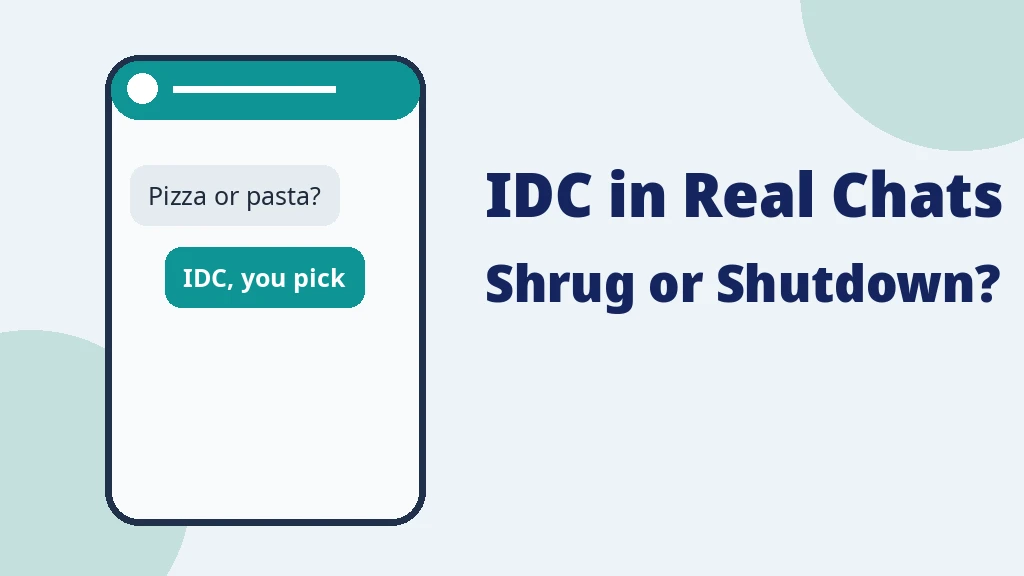
Example 1:
- Chat: “Pizza or pasta tonight?” “IDC, you pick, both sound good”
Meaning: The harmless shrug. The sender has no preference and is happily handing the choice over.
Example 2:
- Chat: “IDC about the weather, it is not a long drive anyway”
Meaning: IDC used inside a sentence, like a verb. The sender is saying one factor does not change the plan.
Example 3:
- Chat: “You never listen to me, you always do this” “idc.”
Meaning: The cold shutdown. One word, lowercase, full stop. The sender is ending the conversation, not the topic.
Example 4:
- Caption: “idc what anyone thinks, posting my dance anyway”
Meaning: The unbothered caption. The poster is performing confidence for an audience, and the IDC is aimed at critics, not at a friend.
Example 5:
- Chat: “Matt and I are flying to the airport tonight” “IDC”
Meaning: Plain indifference to news. The sender is telling the other person the information does not affect them, which can feel dismissive even when it is true.
IDC vs Similar Terms
| Term | Meaning | When to use it |
|---|---|---|
| IDC | I Don’t Care | When a topic or choice does not matter to you |
| IDK | I Don’t Know | When you lack the information, not the interest |
| IDEC | I Don’t Even Care | When the indifference is stronger, or proudly announced |
| IDM | I Don’t Mind | When you are agreeable and fine with any option |
| IDRC | I Don’t Really Care | When you want the same shrug with a softer edge |
Key difference: IDC is about interest, IDK is about knowledge. “I don’t know what time it starts” is a fact gap. “I don’t care what time it starts” is an attitude. Mixing them up changes the message completely: one asks for help, the other refuses it.
IDM is the term IDC is most often confused with, and the confusion matters. IDM means “I Don’t Mind”, which is warm and agreeable: any option works, and the sender is happy to go along. IDC means “I Don’t Care”, which can be warm too, but can also be cold. If you mean “either is fine with me”, IDM is the safer choice. If you mean “this does not matter to me at all”, IDC is the honest one.
IDEC is IDC with an extra gear. The “even” adds emphasis: not only do I not care, I do not even care. Use it when the indifference is the point, and expect it to land harder than IDC.
The Other IDC Meanings You Should Know
“In Due Course” is the formal second sense. In business and administrative writing, IDC can mean something will happen at the expected time, as in “Confirmation will be sent idc”. CyberDefinitions lists this as the second definition, and notes it is often written in lowercase too. In a chat, this sense almost never appears. Medical reports add invasive ductal carcinoma, and tech business news adds International Data Corporation, but each is obvious from the document it sits in, and none of them is a texting meaning.
The lowercase rule in one line: capital IDC in a chat is usually the same as lowercase idc, but lowercase with a full stop, “idc.”, is almost always the cold version, while “idc, you pick” with a comma and a friendly follow up is almost always the warm one.
How to Reply to IDC
Read the punctuation before you read the letters.
If it was the friendly shrug: just decide. “Okay, pizza it is” is the perfect reply. The sender gave you the choice, so take it without a second round of asking.
If it was the cold shutdown: do not push the topic. A short “okay, let us talk later” gives the sender space without surrendering the conversation. Returning to the same point immediately usually earns a second, colder IDC.
If you are not sure which one it was: ask gently, once. “Do you mean you are fine with either, or do you want to drop it?” clears up the ambiguity faster than guessing, and it shows you noticed the tone instead of ignoring it.
If IDC hurt: say so plainly, later, when tempers have cooled. “When you sent idc, it felt like you were shutting me out” names the effect without accusing the sender of intent. Most people who send a cold IDC in anger will soften once the heat is gone.
When to Use IDC (and When to Avoid It)
Good situations:
- Handing a low stakes choice to a friend who asked your preference
- Brushing off gossip or news that genuinely does not affect you
- Ending a debate about a topic you have no stake in
- Posting an unbothered caption where the attitude is the point
Avoid using IDC when:
- Someone is upset and needs comfort, since IDC reads as dismissal in that moment
- You are talking to a boss, a teacher, or a client, where it sounds unprofessional
- You actually do care but are hiding it, since the mask usually slips later
- The topic is the other person’s feelings, because “I don’t care” about feelings is never harmless
Common Misunderstandings About IDC
IDC does not always mean the sender is angry. The friendly shrug is probably the most common use in everyday chats between friends. Judging every IDC as a fight starter will create fights where none existed.
IDC does not mean “I don’t know”. This is the most frequent mix up, and it changes everything. IDK asks for information. IDC refuses the topic. If a friend asks a question and you answer IDC, you have not answered the question at all.
IDC is not the same as IDM. IDM is agreeable and warm: any option works. IDC is indifferent and can be cold: no option matters. Choosing IDM when you mean “either is fine” avoids most of the trouble IDC causes. For a term that keeps a chat warm when someone shrugs, here is what DW means in text and when that reassurance fits.
Frequently Asked Questions
What does IDC mean in text?
In a text, IDC means “I Don’t Care”. It says the sender has no preference about a choice, or no interest in a topic, and the tone decides whether it is friendly or cold.
Is IDC rude?
It can be. As a friendly shrug, “idc, you pick” is harmless. As a bare “idc.” aimed at a person during an argument, it is dismissive and often rude.
What is the difference between IDC and IDK?
IDC is about interest: the sender does not care. IDK is about knowledge: the sender does not know. One refuses a topic, the other asks for information.
What is the difference between IDC and IDM?
IDC means “I Don’t Care” and can sound cold. IDM means “I Don’t Mind” and sounds agreeable: any option works for the sender. If you mean “either is fine”, IDM is the safer word.
What does “idc.” with a full stop mean?
The full stop makes it a shutdown. A bare “idc.” usually means the sender is done with the topic or the conversation, while “idc, you pick” means the sender is happily handing over the choice.
What does IDC mean on TikTok?
On TikTok, “idc” often appears in captions and comments as an unbothered attitude, as in “idc what anyone thinks”. It is a performance of confidence, aimed at critics rather than at a friend.
How do you reply to IDC?
If it was a friendly shrug, just decide. If it was a cold shutdown, give the sender space and return to the topic later. If you are unsure, ask once what they meant.
Final Thoughts
IDC is three letters with two temperatures. In a text it means “I Don’t Care”, and the same abbreviation can hand a friend a choice with a warm shrug or end a conversation with a cold full stop.
Now you know how to read it at a glance: “idc, you pick” means decide for me, and “idc.” means leave it alone. Use it for low stakes choices, avoid it when feelings are on the table, and reach for IDM when “either is fine” is what you really mean.
The definition is documented by Dictionary.com, which lists “I don’t care” as the meaning of IDC from digital communications, and CyberDefinitions gives the same first definition, with “In Due Course” as the formal second sense. If shrugs and tone keep tripping you up, here is what FR means in text, another short reply whose tone depends entirely on context.
3 thoughts on “IDC Meaning in Text | Shrug, Shutdown, or Something Else?”