
Your friend asks whether you want tea or coffee, and you answer with four letters that sound like a door closing. It is not quite “I don’t care”. It is louder than that, and it leaves no room for a follow up question.
Here is the short answer: IDEC usually means “I Don’t Even Care” in a text. It is IDC with the volume turned up, and it often hides more feeling than it admits.
In this guide you will learn the idec meaning in text, how the word “even” changes the tone, when IDEC masks real feelings, how it differs from IDC and IDEK, and what to send back when someone drops it on you.
What Does IDEC Mean in Text?
In a chat, IDEC is a declaration of indifference. It says the sender has no opinion and no interest in the subject, and it says it with emphasis.
The extra letter does the work. IDC says “I don’t care”. IDEC says “I don’t even care”, as if caring was never on the table at all. That “even” makes the shrug bigger, prouder, and sometimes colder.
Quick definition: IDEC means “I Don’t Even Care” in a text. It tells the other person that you have no interest in the topic, and the “even” adds emphasis, so it lands stronger than a plain IDC.

The sources agree on this reading. CyberDefinitions gives “I Don’t Even Care” as the definition of IDEC in a text, and it notes the abbreviation is often used when the sender has no opinion or interest in a subject. The niche guides that rank for this term lead with the same expansion: Oreate AI calls IDEC an abbreviation for “I don’t even care”, the FreeDictionary acronym list gives “I Don’t Even Care” as the texting sense, and AbbreviationFinder lists the same expansion first.
That agreement matters, because IDEC carries a warning that IDC does not. CyberDefinitions notes that IDEC is often used to show a genuine lack of interest, but is also used when the sender is interested and does not want to admit it, especially in matters concerning relationships. The abbreviation can be a mask as well as a message, and this guide treats that masked use as part of the meaning, not as an exception to it.
IDEC Meaning in Easy Words
Think of IDEC as a shrug with a raised voice.
Somebody offers you a choice, or tells you news that stings, or pushes a topic you want to walk away from. Instead of explaining yourself, you close the subject in four letters. The message is simple: this does not reach me.
In the simplest words:
IDEC = “This matters so little to me that I will not even discuss it.”
Notice the performance in that sentence. IDEC is rarely quiet. It is the kind of message someone sends when they want the other person to know, clearly, that they are unbothered. Sometimes that is true. Sometimes the loudness is the tell: people who truly do not care rarely announce it in capital letters.
Where Is IDEC Used?
IDEC lives in casual chats where someone wants to end a topic with style rather than with silence.
Common places:
- Private text messages and WhatsApp chats, when a choice or a piece of gossip needs shutting down
- Instagram DMs and TikTok comments, where an unbothered reply earns approval from an audience
- Twitter and Threads replies, where a user brushes off criticism in public
- Discord and gaming chats, where a player shrugs off a loss or a taunt
- Group chats, where one member opts out of a debate without leaving the group
Typical situations:
- Handing over a choice with impatience: “Shall I have tea or coffee this morning?” “IDEC what you make, just hurry up”
- Brushing off an insult: “You are so ugly, when you looked in the mirror your reflection walked away” “IDEC what you think”
- Masking hurt about an ex: “IDEC that my ex is now dating my best friend”
- Ending a debate: “IDEC if they do not really exist, it just looks good”
- Posting an unbothered reply: “IDEC what the comments say”
Why Do People Use IDEC?
It ends a topic with emphasis
IDC ends a topic. IDEC ends it with a flourish. When the sender wants the other person to hear the indifference, not just receive it, the extra letter does that job. It is the difference between closing a door and slamming it.
It protects feelings the sender will not admit
This is the masked use, and it is the most human part of IDEC. CyberDefinitions gives the example of an ex dating a best friend: “IDEC that my ex is now dating my best friend” could mean genuine indifference, or it could mean the sender is deeply hurt and does not want to admit it. The abbreviation lets the sender say the safe thing while feeling the unsafe thing. Care should always be taken to assess the true meaning, as CyberDefinitions warns.
Real-Life Examples of IDEC
Here is how IDEC actually shows up in chats and comments:
Example 1:
- Chat: “Shall I have tea or coffee this morning?” “IDEC what you make, just hurry up”
Meaning: The genuine shrug, with impatience. The sender has no preference and wants the decision made fast.
Example 2:
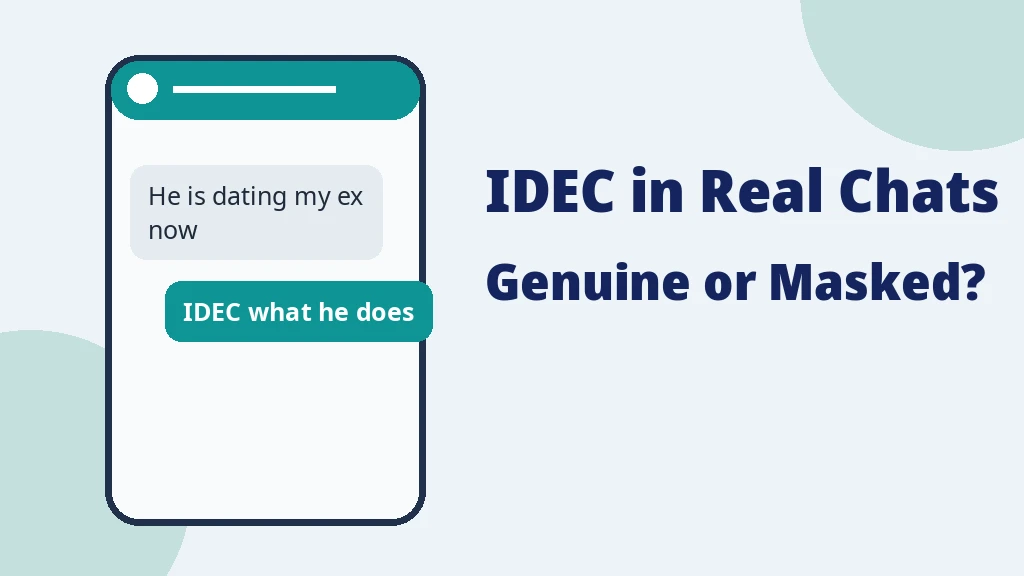
- Chat: “He is dating your best friend now, did you hear?” “IDEC what he does anymore”
Meaning: The masked feeling. This may be genuine indifference, or it may be hurt dressed as indifference. The chat history decides which.
Example 3:
- Chat: “You are so ugly, when you looked in the mirror your reflection walked away” “IDEC what you think”
Meaning: The brush off. The sender refuses to let an insult land, and the IDEC is the shield.
Example 4:
- Chat: “Are you coming to the party or not?” “IDEC, do whatever, I am staying home”
Meaning: Opting out with emphasis. The sender is not just undecided, they are announcing that the event does not matter to them.
Example 5:
- Comment: “Everyone in the replies is so pressed about this” “IDEC what the comments say”
Meaning: The public posture. The commenter is telling an audience, not a friend, that criticism does not reach them.
IDEC vs Similar Terms
| Term | Meaning | When to use it |
|---|---|---|
| IDEC | I Don’t Even Care | When indifference needs emphasis, or feelings need hiding |
| IDC | I Don’t Care | When a topic simply does not matter to you |
| IDEK | I Don’t Even Know | When you are confused or overwhelmed, not indifferent |
| IDK | I Don’t Know | When you lack the information |
| IDM | I Don’t Mind | When you are agreeable and fine with any option |
Key difference: IDEC and IDC differ by emphasis, not by definition. IDC says the topic does not matter. IDEC says the topic does not matter and the sender wants you to know it. In a friendly chat, IDC is usually enough. IDEC is the version you reach for when the shrug itself is the message, or when the feeling behind the shrug needs a cover.
IDEK is the confusion trap. It looks almost identical to IDEC, one letter apart, but it means “I Don’t Even Know”, which is about confusion, not indifference. Mixing the two up changes the message completely.
IDM is the opposite end of the family. “I Don’t Mind” is warm and agreeable, while IDEC is dismissive by design. If you mean “either is fine with me”, IDEC will say the opposite of what you intended.
The Other IDEC Meanings You Should Know
The masked feeling is not a second definition, it is part of the first. CyberDefinitions is explicit: IDEC is often used to indicate a genuine lack of interest, but is also used when the sender is interested and does not want to admit it, especially in matters concerning relationships. That means a single IDEC can be honest or a cover, and only the chat history tells you which.
Field senses include Interior Design Educators Council in education, inflammatory dendritic epidermal cells in dermatology, and the Eastern Canadian Diatom Index in river science. Each belongs to its own field, and none of them appears in a casual chat.
Confusion guard in one line: IDEC is about caring, IDEK is about knowing, and the two are one letter apart, so read the third letter before you decide which conversation you are in.
How to Reply to IDEC
First decide whether the feeling is genuine or masked. The reply changes completely.
If it was a genuine shrug: accept it and move on. “Okay, I will decide then” is the right answer to a real IDEC about tea or coffee. Pushing for an opinion the sender does not have only creates a second argument.
If it might be a mask: do not argue with the letters, answer the feeling. “You do not have to pretend it does not bother you” gives the sender a way back without forcing a confession. If they still insist, respect the boundary and return to the topic later, when the sting has faded.
When to Use IDEC (and When to Avoid It)
Good situations:
- Ending a low stakes debate with emphasis, when IDC feels too soft
- Brushing off an insult or a taunt without engaging with it
- Opting out of a plan or a topic you genuinely have no stake in
- Posting a public reply where the unbothered attitude is the point
Avoid using IDEC when:
- Someone is upset and needs comfort, since IDEC reads as dismissal in that moment
- You actually do care, because the mask usually slips and the hurt comes out later, louder
- You are talking to a boss, a teacher, or a client, where it sounds unprofessional and hostile
- The topic is the other person’s feelings, because “I don’t even care” about feelings is never harmless
Common Misunderstandings About IDEC
IDEC does not always mean the sender truly does not care. The masked use is documented, not guessed. When the topic touches an ex, a breakup, or a lost friendship, IDEC can be the exact opposite of its literal meaning: a person who cares deeply and refuses to admit it.
IDEC is not the same as IDEK. One letter apart, opposite meanings. IDEK means “I Don’t Even Know” and asks for help understanding. IDEC means “I Don’t Even Care” and refuses the topic. Confusing the two will send your reply to the wrong conversation.
IDEC is not a polite way to say “I don’t mind”. That is IDM, and it is warm and agreeable. IDEC is dismissive by design, and using it where IDM belongs will make a friendly chat feel like a fight. For a term that keeps a chat warm when someone shrugs, here is what DW means in text and when that reassurance fits.
Frequently Asked Questions
What does IDEC mean in text?
In a text, IDEC means “I Don’t Even Care”. It is a stronger, more emphatic version of IDC, saying the sender has no interest in the topic.
What is the difference between IDEC and IDC?
IDC means “I Don’t Care”. IDEC adds “even”, which adds emphasis: the sender does not care at all, and wants you to know it. IDEC lands harder and colder than IDC.
What is the difference between IDEC and IDEK?
IDEC means “I Don’t Even Care” and refuses a topic. IDEK means “I Don’t Even Know” and expresses confusion. They are one letter apart, so read the third letter carefully.
Can IDEC mean the sender actually cares?
Yes, sometimes. CyberDefinitions notes that IDEC is also used when the sender is interested but does not want to admit it, especially about relationships and exes.
Is IDEC rude?
Often, yes. As a genuine shrug about a low stakes choice it is blunt but harmless. Aimed at a person, or at their feelings, it is dismissive and usually rude.
How do you reply to IDEC?
If it was a genuine shrug, decide and move on. If it might hide real feelings, answer the feeling gently instead of arguing with the letters.
How is IDEC pronounced?
It can be pronounced as a single word, “ee-deck”, because it is formed from the initial letters of “I Don’t Even Care” spoken together.
Final Thoughts
IDEC is IDC with the volume turned up. In a text it means “I Don’t Even Care”, a stronger shrug that ends a topic with emphasis, and it sometimes hides the very feeling it denies.
Now you know how to read it at a glance: a low stakes choice plus IDEC means genuine indifference, and a painful topic plus IDEC means check for the mask. Use it for debates you want to end, avoid it when feelings are on the table, and reach for IDM when “either is fine” is what you really mean.
The definition is documented in detail by CyberDefinitions, which defines IDEC as “I Don’t Even Care” and warns that it is also used when the sender is interested but does not want to admit it. If the not caring family keeps tripping you up, here is what FR means in text, another short reply whose tone depends entirely on context.