
Your friend sends a meme with three layers of inside jokes, and you stare at it for ten seconds. It is funny to everyone else. To you, it is a puzzle with no solution, so you ask for help in four letters.
Here is the short answer: IDGI usually means “I Don’t Get It” in a text. It is a short, friendly way to say you are confused and would like an explanation.
In this guide you will learn the idgi meaning in text, how it differs from IDK, where it shows up on social media, what to say when someone sends it to you, and the rare second meanings worth knowing.
What Does IDGI Mean in Text?
In a chat, IDGI is a request for help. It says the sender missed the joke, the reference, or the point, and is asking the other person to explain it.
Unlike most texting abbreviations, IDGI is not a reaction or a sign off. It is an invitation. It opens a conversation instead of closing one, because the only useful reply is an explanation.
Quick definition: IDGI means “I Don’t Get It” in a text. It tells the other person that you do not understand a joke, a meme, a message, or a reference, and you would like it explained.
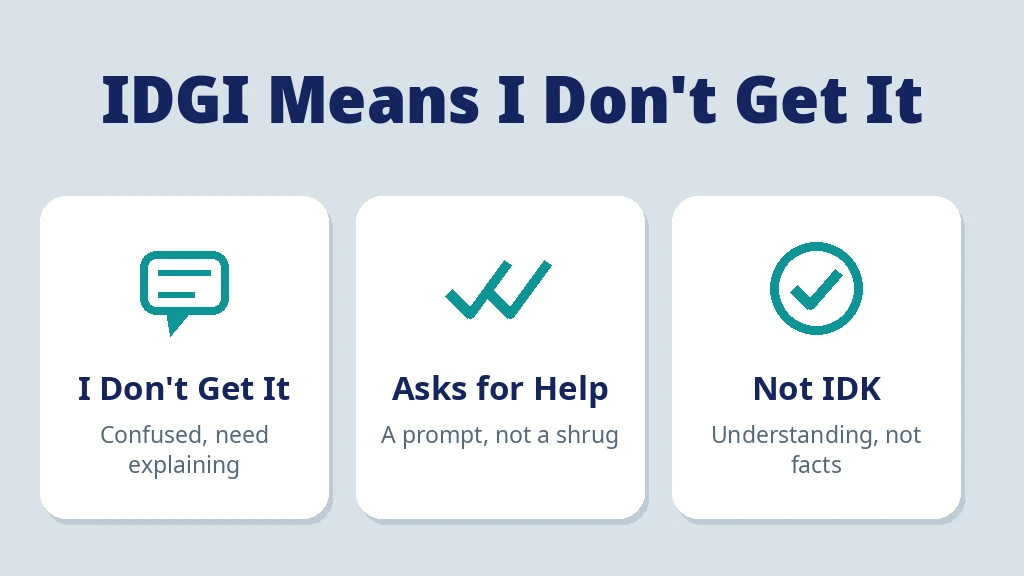
The sources agree on this reading completely. CyberDefinitions gives “I Don’t Get It” as the meaning of IDGI in a text, calling it the most common meaning in texting. The Farlex Dictionary of Idioms defines IDGI as an initialism of “I don’t get it”, used primarily in text messages or online communications to show confusion. Wiktionary lists it as a text messaging initialism of “I don’t get it”, used to express confusion. The niche guides that rank for this term are unanimous too: How-To Geek, Vaizle, SocialEZ, and NapoleonCat all lead with “I Don’t Get It”, and Vaizle notes that 99 percent of the time, someone typing IDGI means exactly that.
That unanimity matters, because IDGI is an old piece of slang with a long history. How-To Geek notes it appears on internet slang lists dating back to 1997, and it took off between 2009 and 2012, when texting got cheaper and social media exploded. Three decades of use have not changed the meaning. They have only made it more familiar.
IDGI Meaning in Easy Words
Think of IDGI as a polite hand raised in class.
Somebody says something clever, or shares a joke that depends on background you do not have. Instead of pretending you understood, or staying silent, you admit the gap in four letters and ask for the missing piece.
In the simplest words:
IDGI = “I missed that, can you explain it to me?”
Notice the warmth in that sentence. IDGI is not rude, and it is not lazy. It is honest about confusion, and it trusts the other person enough to ask for help.
Where Is IDGI Used?
IDGI lives wherever jokes, memes, and references travel faster than explanations.
Common places:
- Private text messages and WhatsApp chats, when a friend sends a joke that needs context
- Instagram and TikTok comments, under memes and videos with layered references
- Reddit threads and Facebook comments, where an inside joke leaves new readers behind
- Twitter and Threads replies, where irony and sarcasm hide the real meaning
- Discord and gaming chats, when a callout or a joke lands flat for one player
- Group chats, when the group laughs at something one member missed
Typical situations:
- Missing a joke: “Did you see what he posted?” “IDGI, what is the joke?”
- Missing a meme: a friend sends a meme with three layers of references, and you reply “IDGI, explain please”
- Missing a reference: “It is just like that scene in the film” “IDGI, I never watched it”
- Missing a sarcastic point: “Oh great, another Monday, my favourite” “IDGI, are you being serious?”
- Missing a group chat thread: scrolling up through 40 messages and replying “IDGI, what happened?”
Why Do People Use IDGI?
It admits confusion without embarrassment
Not getting a joke feels awkward, especially in a group. IDGI makes the admission small and casual. Four letters say “I am lost” without a paragraph of apology, and the group usually explains instead of judging.
It is faster than the full sentence
“I don’t get it” is a natural sentence, but in a fast comment thread, four letters keep the pace. The meaning survives the shortcut because everyone in the thread already knows the phrase.
Real-Life Examples of IDGI
Here is how IDGI actually shows up in chats and comments:
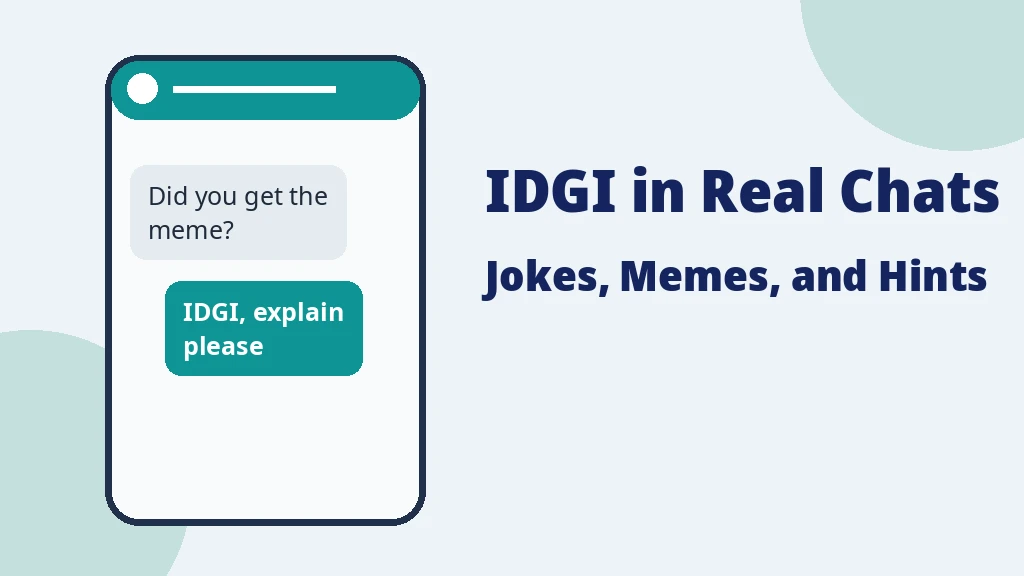
Example 1:
- Chat: “What did the surfer say about the London Underground?” “IDGI” “It is a joke about the Tube, the underground train”
Meaning: The sender missed a wordplay joke, asked for help, and got a short explanation.
Example 2:
- Chat: “Did you get the meme I sent?” “IDGI, explain please, who is that guy?”
Meaning: A genuine request. The sender missed a reference to a person they do not know.
Example 3:
- Comment: “This video is so deep once you know the backstory” “IDGI, what is the backstory?”
Meaning: IDGI in a comment thread, asking for context.
Example 4:
- Chat: “I didn’t say one offensive thing, but she is all upset!” “IDGI, what is the issue? I am just stating the facts”
Meaning: The Farlex dialogue example. Here IDGI is about a social situation, not a joke: the sender does not understand why someone is upset, and is asking for the missing context.
Example 5:
- Chat: “Oh great, another meeting that could have been an email” “IDGI, are you happy about it or annoyed?”
Meaning: IDGI used to check sarcasm. The sender cannot tell whether the message is sincere or ironic.
IDGI vs Similar Terms
| Term | Meaning | When to use it |
|---|---|---|
| IDGI | I Don’t Get It | When you do not understand and want an explanation |
| IDK | I Don’t Know | When you lack the information, not the understanding |
| IGI | I Get It | When you do understand, the opposite of IDGI |
| IDC | I Don’t Care | When the topic does not matter to you at all |
| Huh | Confusion sound | When you want the shortest possible reaction |
Key difference: IDGI is about understanding, IDK is about information. Vaizle puts it cleanly: IDGI asks for help understanding, IDK states you do not have information. If a friend asks what time a film starts and you do not know, IDK is honest. If a friend tells a joke and you do not understand it, IDGI is honest. NapoleonCat makes the same distinction, and it is the first confusion to clear up.
IGI is the opposite term, and it is worth knowing because it appears in the same chats. IGI means “I Get It”, and it is less common than IDGI, but you will see it when someone wants to confirm they understood. The two sit side by side: one asks for the missing piece, the other says the piece arrived.
IDC is the term IDGI is sometimes confused with in heated moments. “I don’t care” refuses a topic. “I don’t get it” asks for help with it.
The Other IDGI Meanings You Should Know
“I Don’t Give In” is a rare second sense. Vaizle lists it as a rare reading, mostly in motivational contexts, where IDGI means refusing to quit. It has only thin support, a single niche guide, and no dictionary entry. Treat it as a curiosity, not as an established sense. In 99 percent of chats, IDGI means “I Don’t Get It”, and the motivational reading only fits when the sentence is about persistence or a challenge.
Field senses include Important Direction Gradient Integration, a framework for explaining machine learning models, which shares the letters IDGI in academic papers. It belongs to research writing, and it never appears in a casual chat.
Context rule in one line: a joke, a meme, or a confusing message plus IDGI means “I Don’t Get It”; a sentence about refusing to quit is the only place the rare motivational reading fits.
How to Reply to IDGI
Someone who sends IDGI is asking for help, so the best reply is an explanation, not a reaction.
If they missed a joke: explain the reference in one or two sentences. “It is a joke about the Tube, the underground train” is the Farlex pattern: short, kind, and complete. Long explanations kill jokes, so keep it brief.
If they missed a meme: name the reference they missed. “That guy is from a viral video last year” gives them the missing piece without retelling the whole meme.
If they missed a sarcastic point: say plainly whether you were serious. “I was joking, I hate Mondays” clears up the tone faster than another layer of sarcasm.
If you sent IDGI and got no answer: ask once more, with the specific gap named. “IDGI, who is the guy in the picture?” is easier to answer than a bare IDGI, because it tells the other person exactly what to explain.
When to Use IDGI (and When to Avoid It)
Good situations:
- Asking for an explanation when a joke, meme, or reference passes you by
- Checking whether a message was sarcastic or sincere
- Catching up in a group chat after missing part of the thread
- Admitting confusion in a casual chat without embarrassment
Avoid using IDGI when:
- You actually do not know the fact, in which case IDK is the honest word
- You are writing to a teacher, a boss, or a client, where the full sentence sounds more careful
- You mean “I don’t care”, since IDGI asks for help and IDC refuses it
- You are using it sarcastically to criticise a joke, unless you are ready for the reply that follows
Common Misunderstandings About IDGI
IDGI does not mean “I don’t know”. The two answer different gaps. IDK is about missing information. IDGI is about missing understanding. A person can know every fact in a joke and still not get it, and a person can get the joke while missing a fact.
IDGI is not rude. New users sometimes worry that admitting confusion looks foolish. In practice, IDGI is one of the friendliest abbreviations in texting, because it trusts the other person enough to ask for help, and most people enjoy explaining a joke they love.
IDGI is not the same as “I Don’t Give In”. That reading is rare, thinly supported, and confined to motivational contexts. Reading every IDGI as a statement of persistence will confuse an ordinary chat where someone simply missed a joke. For a term that shows the opposite reaction, here is what SMH means in text, the head shake people send when a joke lands badly instead of being missed.
Frequently Asked Questions
What does IDGI mean in text?
In a text, IDGI means “I Don’t Get It”. It is a short way to say you do not understand a joke, a meme, or a message, and you would like it explained.
What is the difference between IDGI and IDK?
IDGI is about understanding: you do not get the joke or the point. IDK is about information: you do not know the fact. One asks for an explanation, the other states a gap.
What does IDGI mean on TikTok?
On TikTok, IDGI appears in comments when someone misses a joke, a reference, or a trend in a video. It is a request for context, and other commenters usually explain.
Does IDGI mean “I Don’t Give In”?
Rarely, and only in motivational contexts. That reading has thin support from a single niche guide, while “I Don’t Get It” is backed by dictionaries and every major guide.
What does IGI mean?
IGI means “I Get It”. It is the opposite of IDGI, used to confirm that you understood the joke or the point. It is less common than IDGI.
Is IDGI rude?
No, IDGI is casual and friendly, not rude. It can carry a sarcastic edge when someone uses it to suggest a joke is not funny, but the plain use is a polite request for help.
How do you reply to IDGI?
Explain the missing piece in one or two sentences. Name the reference, the wordplay, or the backstory, and keep it short so the joke survives the explanation.
Final Thoughts
IDGI is one of the friendliest abbreviations in texting. In a text it means “I Don’t Get It”, a short request for an explanation when a joke, a meme, or a message passes you by.
Now you know how to read it at a glance: a confusing message plus IDGI means explain it to me, and a missing fact plus IDK means tell me the answer. The next time a meme leaves you behind, send it without embarrassment, and answer it with one kind sentence when someone sends it to you.
The definition is documented by Wiktionary, which lists IDGI as a text messaging initialism of “I don’t get it”, and CyberDefinitions gives the same meaning as the most common use in texting. If confusion keeps coming up in your chats, here is what DW means in text, a reassuring reply for the moments when someone else is the confused one.