Your friend texts you, “This week has felt ten years long.” You do not just know it. You feel it in your bones. You type three letters back: “ikr”. They reply with a laughing emoji. You both feel better.
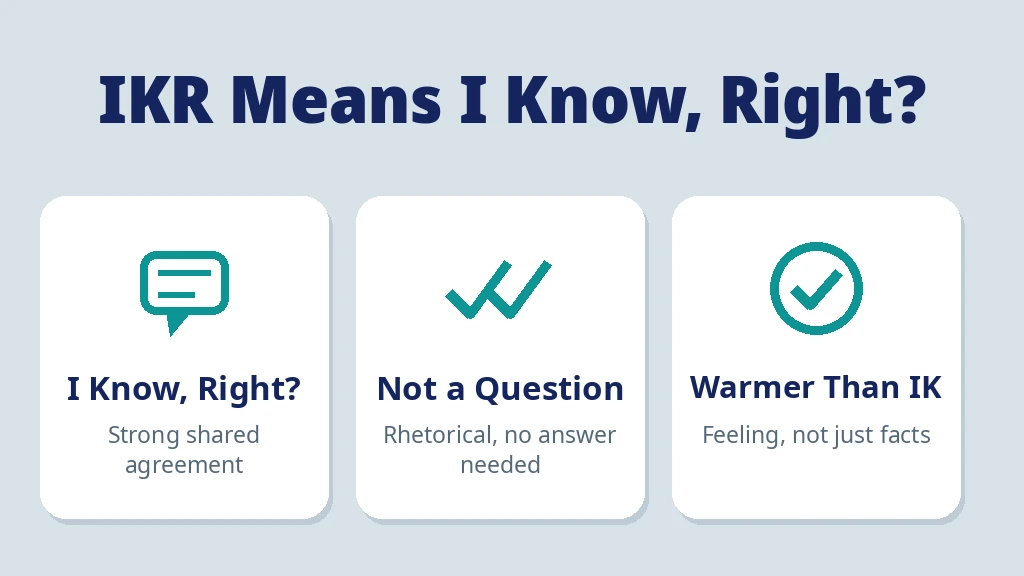
Here is the short answer: IKR means “I Know, Right?” It is a warm way to say you agree completely and you feel exactly the same. The “right?” is not a real question. It is an invitation to share the feeling.
In this guide you will learn the ikr meaning in text, why it feels warmer than a plain “I know”, where it shows up, why people reach for it when a simple yes is not enough, and what to send back when someone sends it to you.
What Does IKR Mean in Text?
IKR is agreement with a heartbeat. It does not just say the words are true. It says the feeling behind them is shared.
When a friend says “this traffic is the worst” and you reply “ikr”, you are saying more than “I agree”. You are saying “I have sat in that same traffic, I felt the same frustration, and I am glad someone else said it first”. That shared feeling is the whole point of the term.
Quick definition: IKR means “I Know, Right?” In texting and social media it expresses strong, warm agreement with an opinion, a complaint, or a feeling. The “right?” is rhetorical, asked for effect, not for an answer.
The sources agree on the expansion, and they agree on the warmth. CyberDefinitions says IKR means “I Know Right”, and calls it the most common meaning in texting. Cambridge Dictionary lists “ikr” as a written abbreviation for “I know, right?”, used for example on social media to show that you agree with what someone has written. Merriam-Webster lists IKR among common texting abbreviations meaning “I know, right?” Grammarly says “ikr” stands for “I know, right” and tells the reader to use it to agree with something someone said. The niche guides that rank for this term say the same thing in different words: all three of the top three lead with “I know, right?”, and each one stresses that it shows strong agreement or a shared feeling. The spoken phrase dates to the 1990s, and the abbreviation first appeared on Urban Dictionary in 2005.
IKR Meaning in Easy Words
Think of IKR as a high five in text form. That is the ikr meaning in one image.
A high five is not just a greeting. It is two people agreeing, in the same moment, that something is true or funny or frustrating. IKR is the typed version of that high five. It says “exactly, same here” in three letters, and it leaves both people feeling understood.
In the simplest words:
IKR = “I completely agree, and I feel the same way you do.”
The “right?” at the end is what makes it a high five instead of a nod. A nod says “I know”. A high five says “I know, and I am with you”. That extra word turns a statement into a shared moment.
Where Is IKR Used?
As ikr slang, IKR lives wherever people react to opinions and feelings, and it almost never leaves that world.
Common places:
- Private texts and DMs, as a warm reply to a friend’s opinion
- Group chats, where one “ikr” can unite the whole group
- Instagram comments, under relatable posts and memes
- TikTok comments, under videos that describe a shared experience
- Facebook and X replies, agreeing with a post in public
- Discord and gaming chats, where friends react to the same moment
Typical situations:
- A friend complains about a long week and you feel the same
- Someone posts a relatable meme and you want to say “same”
- A friend shares an unpopular opinion you secretly hold too
- Someone describes a frustration you have felt yourself
- A funny observation lands, and you want to agree with a laugh
Why Do People Use IKR?
It says “same” with feeling
A plain “same” can sound flat. IKR carries the same meaning with warmth built in. It tells the other person that the agreement is emotional, not just factual, and that warmth is what makes the reply feel good to receive.
It builds connection fast
Finding out that someone else feels the same way is a small moment of relief. IKR delivers that relief in three letters. It tells the writer they are not alone in the feeling, and that shared feeling is what turns a chat into a friendship.
It works for good feelings and bad ones
IKR agrees with excitement just as easily as it agrees with frustration. “This weather is amazing, ikr” shares joy. “This week is endless, ikr” shares exhaustion. The term mirrors the feeling of the message it answers, so it fits almost any shared emotion.
Real-Life Examples of IKR
Here is how IKR actually shows up in chats and comments:
Example 1:
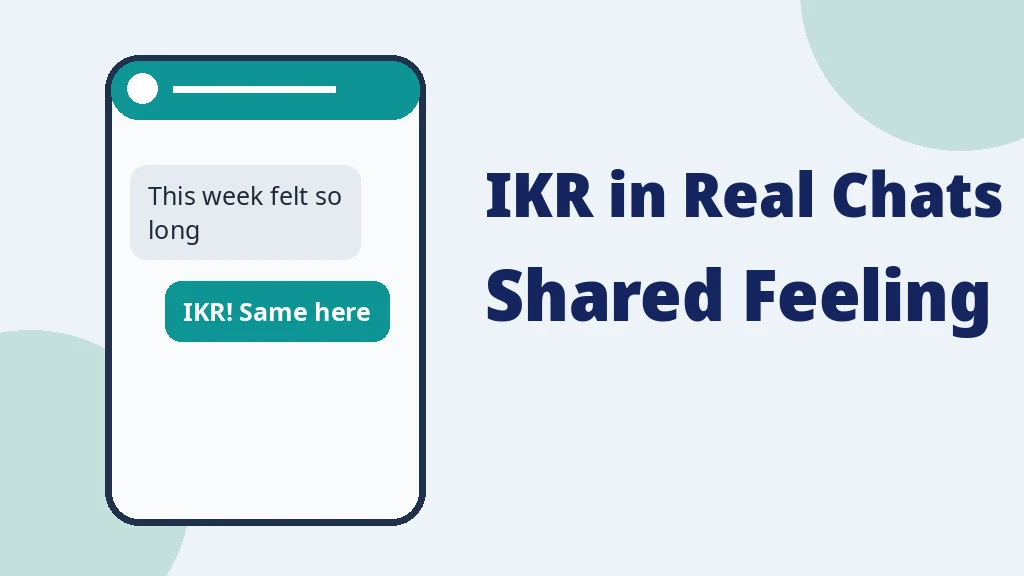
- Chat: “This week has felt ten years long.” “IKR! I need the weekend already.”
Meaning: Shared exhaustion, the sender feels the same tiredness.
Example 2:
- Comment: “This weather is amazing!” “IKR! It is perfect today.”
Meaning: Shared joy, the sender agrees and feels the same happiness.
Example 3:
- Chat: “I cannot believe he said that in the meeting.” “IKR, I was shocked.”
Meaning: Shared disbelief, the sender was surprised too.
Example 4:
- Chat: “Mondays should be illegal.” “IKR, I never feel ready.”
Meaning: Playful shared complaint, the sender agrees with a laugh.
Example 5:
- Chat: “That show gets better every season.” “IKR! The last episode was unreal.”
Meaning: Enthusiastic shared opinion, the sender loves the show just as much.
IKR vs Similar Terms
| Term | Meaning | When to use it |
|---|---|---|
| IKR | I Know, Right? | Warm, shared agreement with feeling |
| IK | I Know | Plain, calm acknowledgement |
| IKK | I Know, Know, Know | Stretched, emphatic agreement |
| IKRR | I Know, Right, Right? | Extra emphasis version of IKR |
| FR | For Real | Agreeing that something is true |
Key difference: IKR is the warmest member of the “I know” family. IK is plain and calm, and it can even sound sharp when it stands alone with a full stop. IKR never sounds sharp in the same way, because the “right?” turns the statement into an invitation. IKK stretches the agreement louder, but it does not add the warmth of the question. IKRR is IKR with the emphasis turned up further, the same warmth with more feeling. FR agrees that something is true, while IKR agrees that something is felt. If you want to sound calm, use IK. If you want to sound warm and connected, use IKR. For a reply that is warm without any risk of sounding sharp, here is what DW means in text, the “do not worry” that fits any chat.
The Other IKR Meanings You Should Know
“I Know, Right?” is the only texting meaning. In chats, DMs, and comments, IKR means “I Know, Right?” and nothing else. Every dictionary and guide that covers texting agrees on that, and there is no rival texting reading with real support.
IKRR is the stretched version. Adding another R gives IKRR, “I know, right, right?”, which is the same agreement with extra emphasis. It works the same way IKK stretches IK: more letters, more feeling, same meaning. Use it when one “right?” is not enough for the feeling.
Tone rule in one line: lowercase “ikr” is a calm nod of agreement, “IKR!” with an exclamation mark is enthusiastic shared feeling, and “IKR?!” is emphatic disbelief or excitement. The punctuation is the volume control, and the message it answers is the feeling.
How to Reply to IKR
Your reply depends on what the IKR was agreeing with, because IKR is a reaction, and the best reply builds on the feeling it shared.
If it agreed with a complaint: share the feeling and add your own detail. “Right? I have been counting the hours” or “Same, this week has been endless” keeps the shared frustration going. The writer wanted company, so give them some.
If it agreed with good news: match the excitement. “I know, it was perfect” or “Exactly, best day in ages” builds on the joy. The writer wanted to celebrate together, so celebrate with them.
If you want to use IKR yourself: use it whenever you genuinely feel the same way about an opinion, a complaint, or a feeling. It works best as a reply, not as an opening line, because it needs something to agree with. Keep it for casual chats and comments, and never use it in a formal message. For a friendly way to accept any plan, here is what IDM means in text, the “I don’t mind” that keeps every choice easy.
When to Use IKR (and When to Avoid It)
Good situations:
- Agreeing warmly with a friend’s opinion or feeling
- Answering a relatable post or meme in a comment
- Sharing frustration, excitement, or disbelief with someone
- Letting someone know they are not alone in a feeling
Avoid using IKR when:
- You are talking to a teacher, a boss, or anyone formal
- You do not actually agree, since the warmth would be dishonest
- Someone is sharing serious news and needs a real response
- You are opening a conversation, since IKR needs something to agree with
Common Misunderstandings About IKR
IKR is not a real question. This is the biggest misunderstanding, and it comes from the question mark. The “right?” is rhetorical, asked for effect, not for an answer. Nobody is waiting for you to confirm that they are right. The confirmation is already in the letters.
IKR is not the same as IK. Both start with “I know”, but they do different jobs. IK says you already knew something. IKR says you feel the same way about it. IK can sound sharp. IKR almost always sounds warm. Using one when you mean the other changes the feeling of the whole message.
IKR is not only for girls or only for young people. The phrase became famous through 1990s Valley Girl speech and the 2004 film Mean Girls, but the abbreviation is used by everyone now, in every kind of casual chat. The history is interesting, and the history is not a rule about who may use it.
IKR is not rude. It is casual, warm, and conversational, and it is one of the friendliest replies in texting. The only risk is using it where a formal reply was expected, and that is a question of setting, not of tone.
Frequently Asked Questions
What does IKR mean in text?
IKR means “I Know, Right?” It is a warm way to say you agree completely and feel exactly the same as the other person.
Is IKR a question?
No. The “right?” is rhetorical, asked for effect, not for an answer. IKR is a statement of agreement wearing a question mark.
What does IKR mean on TikTok?
On TikTok, IKR usually means “I Know, Right?” in comments, as strong agreement with a relatable video. It is the standard reply under a post that describes the commenter’s life.
What is the difference between IKR and IK?
IK means “I Know” and is plain acknowledgement, while IKR means “I Know, Right?” and adds warm, shared feeling. IK is calm, IKR is the warmer version that invites the other person in.
What does IKRR mean?
IKRR means “I Know, Right, Right?” It is IKR with extra emphasis, the same warm agreement with more feeling behind it.
Can IKR be sarcastic?
Yes. IKR can agree with a sarcastic remark, or be used sarcastically itself. The message it answers and the tone around it tell you whether the agreement is sincere or a joke.
Should I use IKR at work?
No. It is informal and belongs in casual chats and comments. In a work message, write “I completely agree” in full instead.
Final Thoughts
IKR is the warmest way to agree in texting. It means “I know, right?”, and it says something a plain yes cannot: I feel the same, I have been there too, and you are not alone in it. The “right?” is not a question. It is an invitation, and accepting it is what turns a chat into a connection.
Now you can read it at a glance: a relatable post with “ikr” underneath means shared feeling, an exclamation mark means shared excitement, and a complaint with “ikr” underneath means shared frustration. The next time a friend says exactly what you were thinking, you can answer in three letters, and they will know you mean every one of them.
The lead is documented by CyberDefinitions, which says IKR means “I Know Right” and calls it the most common meaning in texting. Cambridge Dictionary lists “ikr” as a written abbreviation for “I know, right?”, used on social media to show agreement with what someone has written. For a friendly way to accept any plan, here is what IDM means in text, the “I don’t mind” that keeps every choice easy.
6 thoughts on “IKR Meaning in Text | The Reply That Says You Agree”