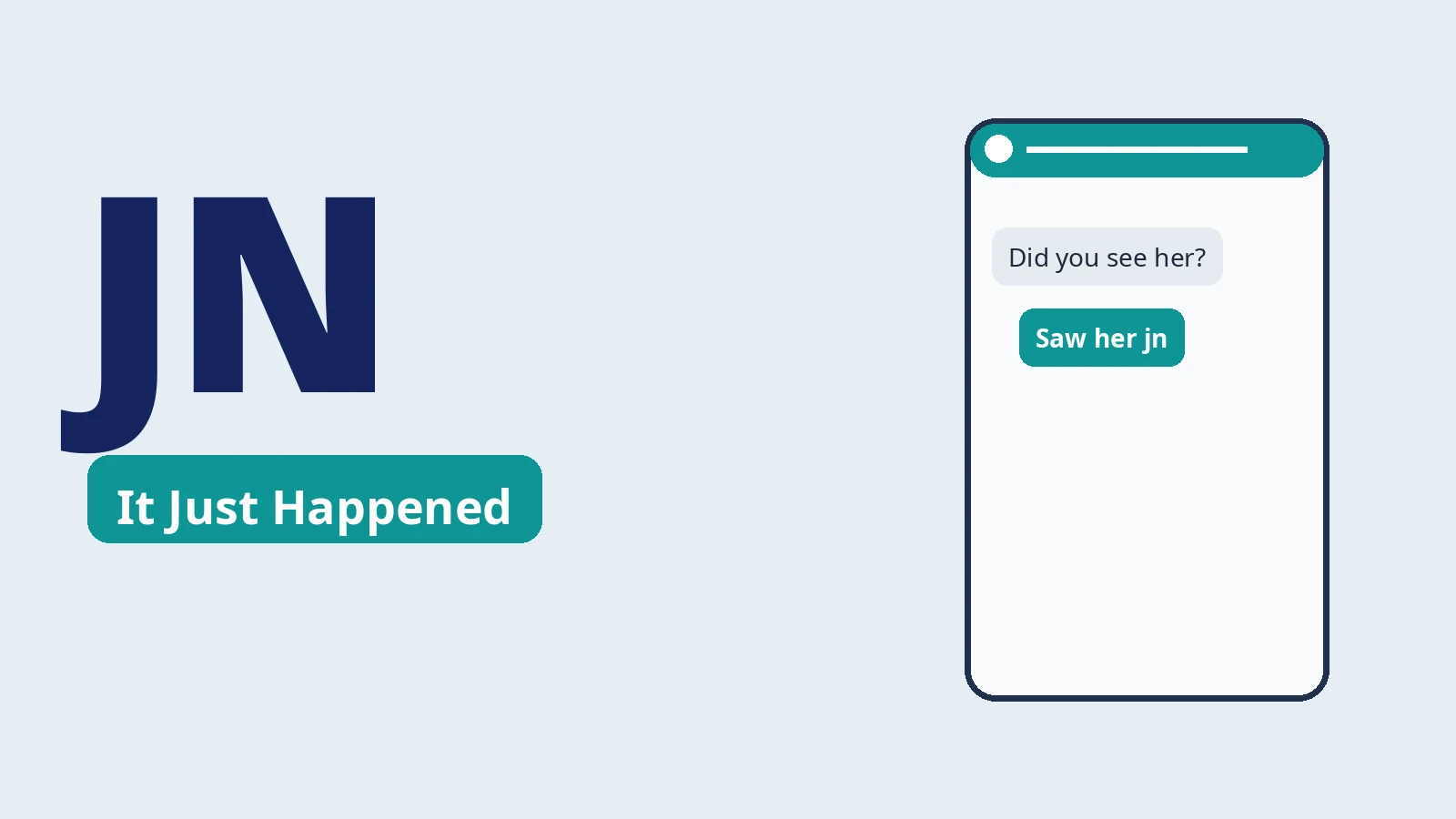
Your friend texts you from across the room: “Did you see her?” You glance up, nod, and type back: “Saw her jn.” Two letters, and your friend knows exactly when it happened: a moment ago, not an hour ago, not yesterday.
Here is the short answer: JN means “Just Now”. It is a fast shorthand for something that happened a moment ago, the kind of fresh news that still feels warm. It is rare, it is easy to miss, and once you know it, you will spot it in fast chats everywhere.
In this guide you will learn the jn meaning in text, how it differs from RN, where it shows up, why people reach for it instead of typing the full phrase, and what to send back when someone sends it to you.
What Does JN Mean in Text?
JN is a time stamp in two letters. It points backwards by a very short distance: seconds ago, a minute ago, a moment ago. When someone writes “he called me jn”, they are saying the call just ended. When they write “saw her jn”, they are saying the sighting is fresh.
JN never points forward. It does not mean “in a minute” or “soon”. It only ever looks back at something that has already happened, and the shorter the gap, the better it fits. If the thing happened yesterday, JN is the wrong word, and “earlier” or “today” would say it better.
Quick definition: JN means “Just Now”. In texting and social media it marks something that happened a moment ago, a quick way to say “this is fresh news” without typing the full phrase.
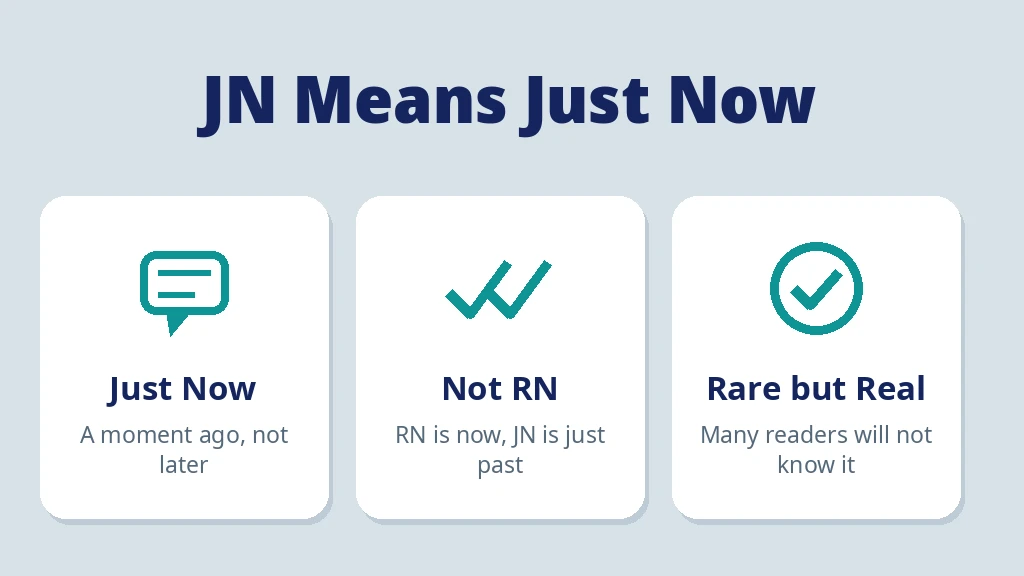
The sources agree on the expansion, and they agree that the term is rare. CyberDefinitions says JN means “Just Now” when used in a text, calls it the most common meaning in texting, and adds that it is a rare term with a guessability score of 4, which means it is difficult to guess. The niche guides that rank for this term lead with the same reading: one calls it a quick text shorthand for something that happened very recently, with “I saw her jn” and “he called me jn” as its example sentences, and another calls “Just Now” the most common definition for JN on Snapchat, WhatsApp, Facebook, Twitter, Instagram, and TikTok.
JN Meaning in Easy Words
Think of JN as a “fresh” sticker on a message.
When a shop puts a “fresh today” sticker on bread, it is telling you the bread is new, not from yesterday. JN does the same job for news: this just happened, it is still warm, and you are hearing it almost as it happened. Without the sticker, “I saw her” could mean this morning or last week.
In the simplest words:
JN = “This happened a moment ago, and the news is still fresh.”
Where Is JN Used?
JN lives in fast, informal chats where speed matters more than full spelling, and it almost never leaves that world. It shows up where friends update each other in real time, and it is typed in lowercase as often as in capitals.
Common places:
- Private texts and DMs, as a quick update between friends
- Group chats, where one “jn” stamps a piece of news as fresh for everyone at once
- Snapchat chats, where short reactions and fast updates are the norm
- Discord chats, where gamers report what just happened in a match
- Instagram and TikTok comment replies, answering “did you see it?” with a fresh sighting
Typical situations:
- Reporting that someone just called, texted, or walked past
- Answering “did you see that?” with a fresh yes
- Updating a group chat the second something happens
- Telling a friend a plan just changed, a moment ago
- Confirming that a message or a delivery just arrived
Why Do People Use JN?
It saves time and typing
“Just now” is eight letters and a space. JN is two letters, and in a fast chat that difference matters. People use it like any shortcut: the full phrase adds nothing, so they cut it, and the update gets sent while it is still fresh.
It marks news as fresh
Freshness is the whole point of a fast update. “She called” could have happened at any time today. “She called jn” tells the reader the call just ended, and that the news is worth hearing right now. JN is not only shorter than “just now”, it is clearer about timing, because it pins the event to this very moment.
It keeps a fast chat fast
In a group chat, a long message about when something happened slows everyone down. JN keeps the update to a tap: the event, plus two letters, and the whole group knows it just happened. The conversation moves on without anyone having to ask “when?”
Real-Life Examples of JN
Here is how JN actually shows up in chats and comments:
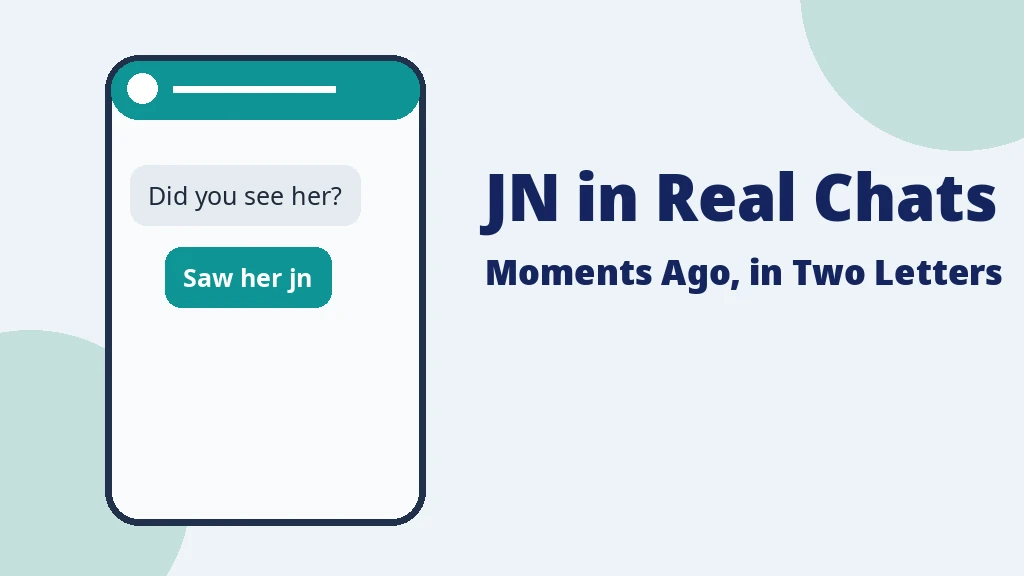
Example 1:
- Chat: “Did you see Sara?” “Saw her jn, she just left.”
Meaning: Fresh sighting, the sender saw Sara a moment ago.
Example 2:
- Chat: “He called me jn, I will call you back.”
Meaning: Fresh call, the sender is reporting something that just happened.
Example 3:
- Chat: “Did the food arrive?” “JN, it is still hot.”
Meaning: Fresh arrival, the food came a moment ago.
Example 4:
- Chat: “Did you finish your homework?” “Finished jn, sending it now.”
Meaning: Just completed, the work ended a moment ago.
Example 5:
- Comment: “Did anyone see the goal?” “Saw it jn, unreal finish.”
Meaning: Fresh sighting in a comment reply, the sender just watched it happen.
JN vs Similar Terms
| Term | Meaning | When to use it |
|---|---|---|
| JN | Just Now | Something happened a moment ago |
| RN | Right Now | Something is happening at this very second |
| ATM | At The Moment | Something is true right now, not finished |
| BRB | Be Right Back | You are leaving the chat briefly |
| LYK | Let You Know | You will update someone later |
Key difference: JN is the recent past, and RN is the present, and mixing them flips the timeline. “Saw her jn” means the sighting already happened, a moment ago. “Seeing her rn” means the sighting is happening right now, as you read this. If the event is over, use JN. If it is still happening, use RN. For a reply that misses someone right back, here is what IMYT means in text, the warm answer when someone says they miss you first.
Keep JN apart from LYK as well. LYK points forward: you will update someone later, when you know more. JN points backward: the thing already happened, a moment ago. One promises future news, the other reports fresh news, and they are never interchangeable.
The Other JN Meanings You Should Know
“Just Now” is the only texting meaning. In chats, DMs, and comments, JN means “Just Now” and nothing else. Every texting source that covers JN agrees on that, and there is no rival texting reading with real support.
Outside texting, JN has formal meanings. As a month abbreviation, JN can stand for June. In Bible references, Jn is short for the Gospel of John. In Indian rail transport, JN is an abbreviation for junction, which is the only sense Wiktionary lists. In offices and forms, JN can stand for Job Number. In science, JN is short for juxtanodin, a protein, and in Portugal it is short for Jornal de Noticias, a newspaper.
Rarity rule in one line: JN is a rare term, and many readers will not know it, so use it only with people who already know your shortcuts, and spell out “just now” with anyone new. When in doubt, the full phrase is always safe.
How to Reply to JN
Your reply depends on what the JN was attached to, because the two letters only tell you when something happened, not what to do about it.
If it was fresh news: react to the news itself. “Nice, tell me more” or “what did she say?” keeps the conversation moving, because the sender shared the update while it was still warm.
If it was a fresh change of plan: confirm you heard it. “Got it, thanks for the heads up” tells the sender the update landed, and that you will act on the new plan instead of the old one.
If you did not understand JN: say so plainly. “What does jn mean?” is a fair question, because JN is rare and difficult to guess, and the sender probably knows that. For a reply that says you feel exactly the same, here is what IKR means in text, the warm agreement that never needs explaining.
When to Use JN (and When to Avoid It)
Good situations:
- Reporting something that happened a moment ago to a close friend
- Updating a group chat the second something happens
- Answering “did you see that?” with a fresh yes
- Confirming a delivery, a call, or a message just arrived
Avoid using JN when:
- You are talking to someone who may not know the abbreviation, since it is rare
- The event happened hours ago, since JN only means a moment ago
- You are talking to a teacher, a boss, or anyone formal
- The timing matters and a misunderstanding would cause a real problem
Common Misunderstandings About JN
JN does not mean “join”. This is the most common mix up, and it comes from reading the letters as a word instead of an abbreviation. JN is not a verb, and it never invites anyone to join anything. It is a time stamp, and it only ever means “just now”.
JN is not the same as RN. RN means “right now”, the present second. JN means “just now”, the moment that just passed. Swapping them moves an event from the past into the present, and in a fast chat that small shift can confuse the whole conversation.
JN is not a name or initials. Two capital letters can look like someone’s initials, and JN has been used as initials for plenty of people. In a chat, though, JN on its own is almost never a person. If a message says “saw her jn”, the JN is the timing, not the person.
JN is not common, and that is worth knowing. Most texting abbreviations are widely known, and JN is not one of them. CyberDefinitions calls it a rare term, and its guessability score says it is difficult to guess. Using it with strangers will often mean explaining it, so save it for people who already speak your shorthand.
Frequently Asked Questions
What does JN mean in text?
JN means “Just Now”. It is a short way to say something happened a moment ago, as in “saw her jn” or “he called me jn”.
What does JN mean on Snapchat?
On Snapchat, JN means “Just Now”, the same as in any chat. It marks a message, a call, or a sighting as fresh, something that happened a moment ago.
Is JN the same as RN?
No. JN means “Just Now”, the recent past, while RN means “Right Now”, the present second. “Saw her jn” means the sighting already happened, “seeing her rn” means it is happening now.
What does “saw her jn” mean?
It means “I saw her just now”. The sender saw the person a moment ago, and the news is still fresh.
Does JN mean June?
Outside texting, JN can be an abbreviation for June, and in Bible references it can stand for the Gospel of John. In a chat, though, JN means “Just Now”, and the month reading does not apply.
Should I use JN at work?
No. It is informal and rare, and many readers will not know it. Write “just now” in full instead, so there is no chance of a misunderstanding.
What does JN mean in gaming?
In a gaming chat, JN means “Just Now”, usually reporting something that just happened in the match, as in “he left jn”. It does not mean “join” or “job number” in that setting.
Final Thoughts
JN is the smallest time stamp in texting, and one of the most useful once you know it. It means “just now”, and it does the work of a freshness sticker: this happened a moment ago, the news is still warm, and you are hearing it almost as it happened. The letters are rare, and many readers will not know them, but every source that covers JN agrees on the same reading.
Now you can read it at a glance: “saw her jn” means the sighting just happened, “he called me jn” means the call just ended, and “finished jn” means the work ended a moment ago. The next time those two letters land in your chat, you will know the news is fresh, and you will know to answer fast, while it still is.
The lead is documented by CyberDefinitions, which says JN means “Just Now” in a text, calls it the most common meaning in texting, and notes that it is a rare term that is difficult to guess.