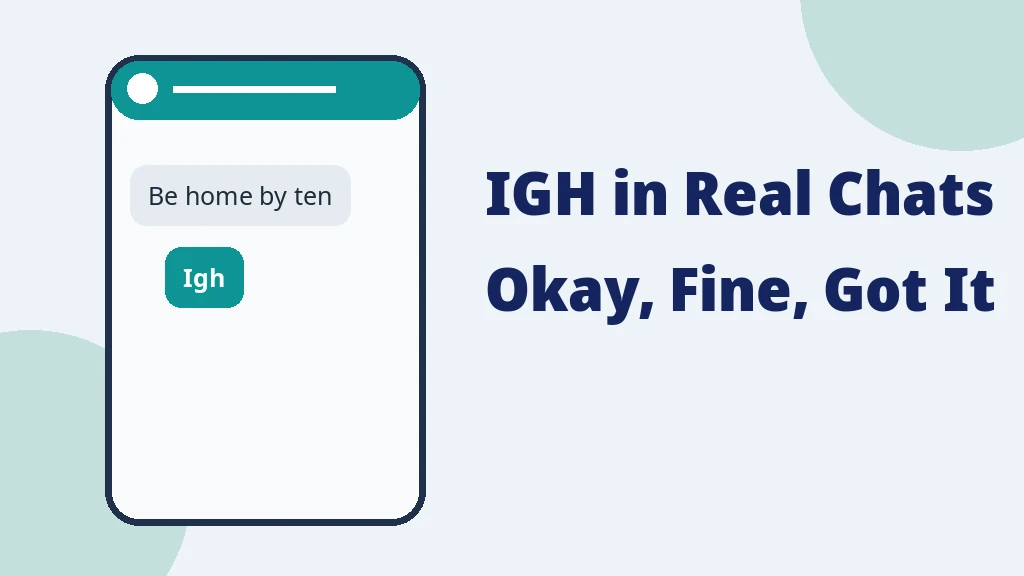
You text a friend “be home by ten” and the reply comes back as three letters: “igh”. No emoji, no extra word, no punctuation. It is not a yes, it is not a no, and it is definitely not a typo.
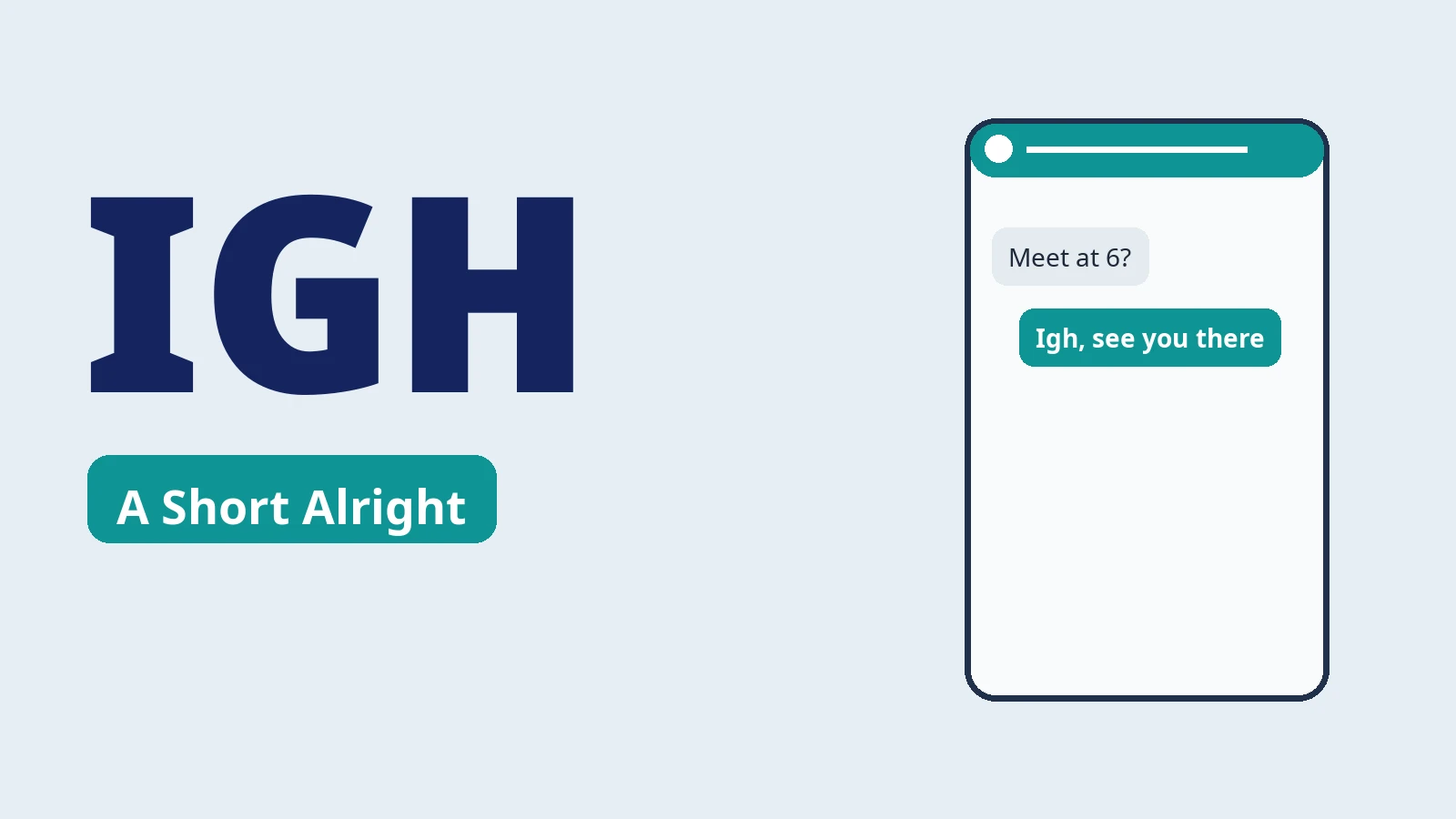
Here is the short answer: IGH usually means “alright” or “okay”. It is a clipped spelling of “aight”, which is itself a casual spelling of “alright”. Your friend just agreed, calmly and with very little energy, and the conversation is basically closed.
In this guide you will learn the igh meaning in text, where the spelling comes from, how its tone shifts from warm to cold, what it can mean on Snapchat and in gaming chats, and when a bare “igh” deserves a follow up question instead of a nod.
What Does IGH Mean in Text?
IGH is not really an acronym. It is a sound written down.
Say “alright” quickly in a relaxed voice and it collapses into “aight”. Say “aight” even faster, drop the first letter, and you get “igh”. The letters do not stand for three words. They spell the sound of a person agreeing without making a fuss about it. That is why guides that try to expand IGH into a three word phrase usually get it wrong: there is no phrase to expand.
Quick definition: IGH means “alright” or “okay”. It is a short, casual way to agree, accept a plan, or confirm you understood a message, usually with a calm or slightly resigned tone. That is igh in texting at its simplest.
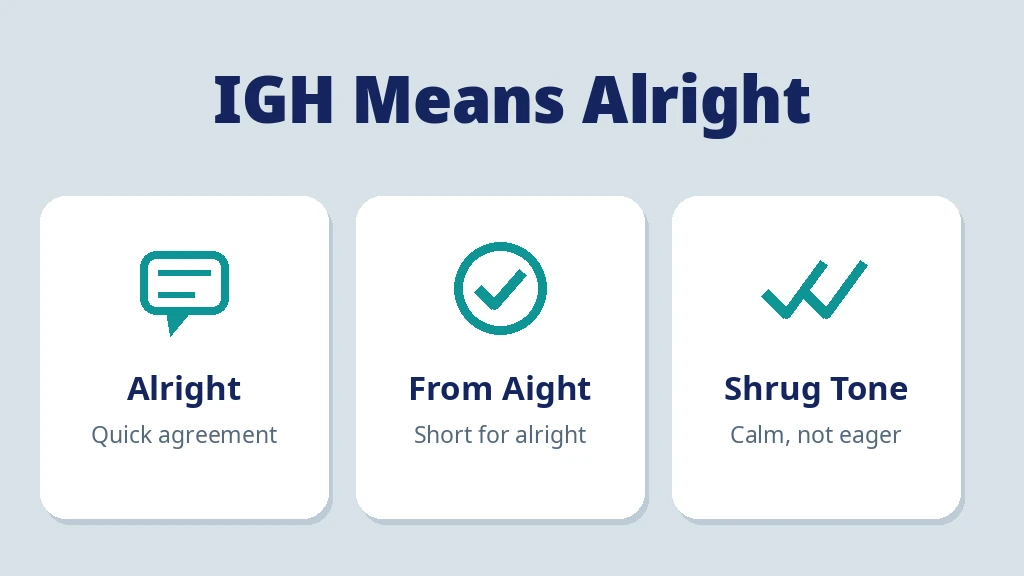
The sources agree on this reading. The niche guides that rank for this term lead with “alright” again and again: a clipped version of “aight”, a casual spelling of “alright”, used to agree, confirm, or accept. Wiktionary backs the chain from the other end, defining “aight” as a contraction of “all right” and a slang way of saying “okay”. One conflicting source family, slangify, leads with “I am Good Here” instead, but that reading appears in no other independent guide, and it does not match how the word is actually used in the examples, where “igh” answers a plan rather than declining help.
IGH Meaning in Easy Words
Think of IGH as a nod in text form. The igh aight spelling works the same way in every chat: a quick nod, nothing more.
Someone in real life nods when they hear a plan they accept. They do not cheer, they do not argue, they just nod and move on. “Igh” is that nod typed out. It says “okay, got it, fine” in three letters, and it expects the conversation to move on without further discussion.
In the simplest words:
IGH = “Alright. I heard you, I agree, let us move on.”
Where Is IGH Used?
IGH lives in fast, informal chats where typing the full word feels like too much work, and as igh slang it is most common among teens and gamers.
Common places:
- Private texts and DMs, as a one word reply to a plan or an instruction
- Group chats, where someone confirms they read the message without adding to the thread
- Snapchat replies, where short answers are the default
Typical situations:
- Confirming you understood, as in “did you get my message?” and “igh, got it”
Why Do People Use IGH?
It agrees without spending energy
Typing “alright, that sounds fine to me” takes time and feels formal for a small decision. “Igh” does the same job in a second, and in a fast chat that speed is a feature, not laziness.
It closes a topic gently
A bare “igh” is a soft full stop. It says the matter is settled and there is nothing more to add. Friends use it to end a small negotiation without a formal goodbye, and it usually works because both sides understand the signal.
It fits the sound of casual speech
People do not say “all right” in full when they talk casually. They say “aight” or “ight”. Typing “igh” matches how the word actually sounds, which is why it spread among teens and in gaming chats first. It is spelling that follows speech, not a code that needs decoding.
Real-Life Examples of IGH
Here is how IGH actually shows up in chats:
Example 1:
- Chat: “Meet at 6?” “Igh, see you there.”
Meaning: Alright, agreed.
Example 2:
- Chat: “Be home by ten.” “Igh.”
Meaning: Alright, accepted.
Example 3:
- Chat: “We need to talk about the trip.” “Igh, fine, what about it?”
Meaning: Reluctant agreement.
Example 4:
- Chat: “Did you get my message about the tickets?” “Igh, got it.”
Meaning: Confirmation.
Example 5:
- Chat: “You still coming on Saturday?” “Igh, I will be there.”
Meaning: Alright, confirmed.
IGH vs Similar Terms
| Term | Meaning | When to use it |
|---|---|---|
| IGH | Alright / Okay | Calm agreement or confirmation in a fast chat |
| Ight | Alright | The same idea, spelled with the t kept |
| Aight | Alright | The fuller casual spelling, slightly warmer |
| IG | I Guess | Reluctant agreement with visible doubt |
| OK | Okay | Neutral agreement, the safest default |
Key difference: IGH, ight, and aight are the same word in three spellings, and they sit on a scale of effort. “Aight” is the fullest and warmest, “ight” is the middle, and “igh” is the shortest and coolest. OK is the neutral cousin: it agrees without any tone at all, which is why it works everywhere IGH would feel too casual. IG, the “I guess” reading, is the reluctant cousin: it agrees while showing doubt, while IGH agrees while showing calm. If you want to learn the reluctant one properly, IG means “I guess” in text, the shrug that looks similar but feels different. The igh i guess reading sits beside “alright” in several guides.
Keep IGH apart from IHH as well. The two look like siblings, and both are sometimes described as “alright” spellings, but they are different words with different habits. IGH is the common one for “alright”. IHH is far less settled, and it is often an expressive sound rather than a word at all, so do not copy an IGH meaning into an IHH message and expect it to land the same way.
The Other IGH Meanings You Should Know
“I am Good Here” is the main conflicting reading. Slangify leads with it, describing IGH as a way to say you are content and do not need anything. It is a real phrase, and it fits the letters neatly, but no other independent guide agrees, and the examples in real chats point the other way: people answer plans with “igh”, they do not usually decline help with it. Treat it as a claimed reading, not a settled one. If someone writes “igh” after you offer help, then “I am good here” is possible, and asking is safer than assuming.
“I Got High” is a context sense. In cannabis and party talk, IGH has been used to mean “I got high”, and the igh i got high reading only works in that context. It is documented in slang lists, but it needs that context to work. In an ordinary chat about plans, nobody will read it that way, and using it as a joke in the wrong chat will confuse people.
“I am Going Home” appears in some lists. A few guides list “I am going home” as an IGH reading, usually in gaming or late night chats. It is rare, and it only works when leaving is already the topic. Without that context, “igh” will be read as “alright” first.
Spelling rule in one line: IGH is a sound, not an initialism, so do not expand it letter by letter. If it answers a plan, read it as “alright”. If it follows an offer of help, consider “I am good here” and ask. If the chat is about cannabis or going home, the context will tell you.
How to Reply to IGH
Most of the time, IGH needs no real reply. It is a closing word, and the conversation is expected to move on. What you do depends on the tone you hear in it.
If IGH agreed to your plan: confirm once and move on. “Great, see you at 6” is enough. Do not ask again, since the person already said yes in their own short way.
When to Use IGH (and When to Avoid It)
Good situations:
- Agreeing to a small plan with a close friend in a fast chat
- Confirming you read and understood a message
- Closing a minor topic without a long goodbye
- Answering in a gaming lobby or group chat where short replies are normal
Avoid using IGH when:
- The other person needs a clear, warm yes, since “igh” can read as cold
- The topic is serious or emotional, since a nod is not a real answer there
- You are talking to someone older, at work, or in a formal chat
- You actually mean “I am good here” after an offer of help, since most readers will hear “alright” instead
Common Misunderstandings About IGH
IGH is not a typo. New readers sometimes think the sender missed a key or meant “ugh”. It is deliberate. The spelling follows how “aight” sounds when it is said quickly, and it has been used that way for years in chats, Snapchat, and gaming lobbies.
IGH is not an enthusiastic yes. It agrees, but it does not cheer. If you need excitement, look for “bet”, “sounds good”, or an emoji beside it. A bare “igh” on its own is calm at best and resigned at worst, and treating it as excitement will misread the room.
IGH does not always mean “I am Good Here”. That reading is tidy and it fits the letters, but it comes from one source family and it does not match the most common use. In real chats, “igh” answers plans far more often than it declines help. If you want to say you are good, type “I am good” in full. It is clearer and it cannot be misread. For a genuinely reassuring reply that does mean “do not worry”, here is what DW means in text and when that reassurance fits.
IGH is not rude by itself. Short replies feel blunt on a screen, and a lone “igh” can sting when you expected a sentence. But in the chats where it lives, it is normal, not hostile. The rudeness, if there is any, is in the pattern: “igh” to every message, every day, is a signal that something is off, while one “igh” is just a quick nod.
Frequently Asked Questions
What does IGH mean in text?
IGH usually means “alright” or “okay”. It is a clipped spelling of “aight”, a casual form of “alright”, used to agree or confirm quickly.
Is IGH an acronym?
No. IGH is not an initialism with three words behind it. It is a spelling of the sound “aight”, which is itself a casual spelling of “alright”.
Does IGH mean “I am Good Here”?
One source family says so, but no other independent guide agrees, and real chat examples point to “alright” instead. If IGH follows an offer of help, “I am good here” is possible, so ask rather than assume.
What does IGH mean on Snapchat?
On Snapchat, IGH usually means “alright”, the same as in texts. It is a quick reply to a plan or a message, often sent as a single word.
Is IGH rude?
Not usually. It can sound cold or dismissive when it stands alone after a long message, but in fast chats it is a normal, neutral way to agree.
What is the difference between IGH and IGHT?
Almost none, and the igh vs ight question comes up because the two are the same word in different spellings. IGHT keeps the t from “aight”, while IGH drops it. Both mean “alright”.
Can IGH mean “I Got High”?
Yes, in cannabis or party talk IGH has been used for “I got high”. That reading needs that context, and in ordinary chats about plans it will be read as “alright” instead.
Final Thoughts
IGH is a small word with a simple job. It means “alright”, spelled the way it sounds when someone says it quickly. It agrees, it confirms, and it closes a topic without a fuss. The confusion around it comes from people trying to expand three letters into a phrase, when there was never a phrase to expand.
Now you can read it at a glance: an answer to a plan is “alright”, a reply after an offer of help might be “I am good here” and deserves a quick check, and a party chat might mean something else entirely. The next time a bare “igh” lands in your chat, do not overthink it. It is usually just a nod.
The chain behind the spelling is documented by Wiktionary, which defines “aight” as a contraction of “all right” and a slang way of saying “okay”. For a term that sits close by in the same family of short replies, here is what FR means in text, another quick agreement that is easy to misread.