Your best friend drops off soup when you are sick and adds three small letters at the end of the message. You smile before you even reply. Those three letters carry a whole feeling in almost no space at all.
Here is the short answer: ILY means “I love you”. It is the quick, lighter version of the full phrase, used for partners, family, and close friends, and sometimes as a playful thank you. The letters say the same words, but they usually carry less weight than saying them in full.
In this guide you will learn the ily meaning in text, when it is sincere and when it is playful, where it shows up, how it differs from ILYSM and its playful opposite IHY, and what to send back when someone sends it to you.
What Does ILY Mean in Text?
ILY is short for “I love you”, and it is one of the oldest and most used texting shortcuts. It turns three words into three letters, and it keeps the warmth while dropping the formality, and each user means something slightly different by it.
Quick definition: ILY means “I love you”. In texts and comments it is a warm, quick sign of affection. It can be sincere love, friendly warmth, or grateful thanks, and the relationship and the moment decide which one you are reading.

The sources agree completely on this one. Dictionary.com defines ILY as an abbreviation for “I love you”, used in digital communication as an earnest or playful declaration of affection, and it notes the link to an American Sign Language sign for “I love you”. Wiktionary lists it the same way, as an initialism of “I love you”, with ILYSM and IMY as related terms. CyberDefinitions agrees, adding that ILY should not always be taken literally, since it is sometimes used just to show grateful affection.
ILY Meaning in Easy Words
Think of ILY as a wave across the room. A wave is not a hug, and it is not a speech. It is a small gesture that says “I see you, and I am glad you are here”, and everyone understands it at once. ILY works the same way in a chat.
That is why it fits so many relationships. A partner can send it at the end of the day, a friend can send it after a favour, and a parent can send it at bedtime, and none of them has to explain what they meant.
In the simplest words:
ILY = “I care about you, and I wanted you to know it in three letters.”
Where Is ILY Used?
As ily slang, ILY lives wherever people talk to the people they love, and it almost never leaves that warm circle.
Common places:
- Private texts and DMs, as a sign-off at the end of a chat or before bed
- Group chats, where friends drop it after good news or a shared joke
- Snapchat chats and stories, where short affectionate replies are the norm
- Instagram and TikTok comments, under photos of friends, family, and couples
- Photo captions, where “ily” sits next to a heart or a tagged friend
Typical situations:
- Saying goodnight to a partner, a friend, or a family member
- Thanking someone for help, a gift, or a lift home
- Replying to good news, like a new job or a passed exam
- Ending a call or a long chat on a warm note
- Posting a birthday message or an anniversary photo
Why Do People Use ILY?
It is faster than the full phrase
Typing “I love you” takes a moment, and in a fast chat that moment matters. ILY says the same thing in three keystrokes, which is why it survives in a world of voice notes and one line replies.
It softens a big feeling
The full phrase “I love you” is heavy. It can feel like a declaration or a promise, and that weight can be too much for an ordinary Tuesday. ILY keeps the feeling but lowers the stakes, which is why friends use it so freely.
It works as a warm sign-off
Many people end their chats with ILY the way others end a letter with love. A plain “bye” ends things; “ily” ends things warmly, and that small difference is why it became a habit.
Real-Life Examples of ILY
Here is how ILY actually shows up in chats and comments:
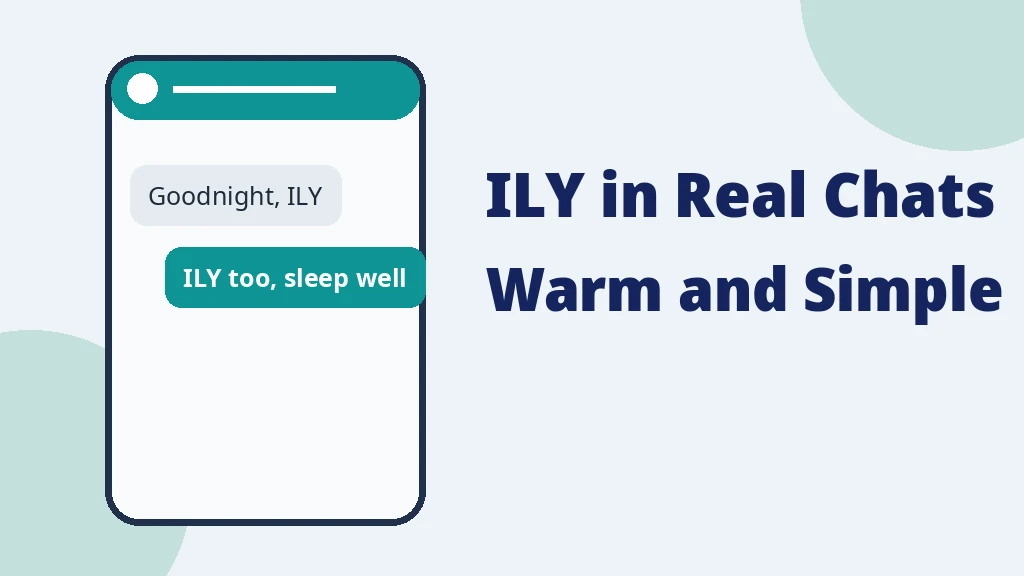
Example 1:
- Chat: “Goodnight, ILY. See you tomorrow.”
Meaning: A warm goodnight to a partner, the classic sign-off use.
Example 2:
- Chat: “You brought me takeout? You are the best. ILY!”
Meaning: Grateful thanks to a friend, affection as appreciation.
Example 3:
- Chat: “Mum: Drive safe. Dad and I love you. Me: ILY too, call you when I get there.”
Meaning: Family affection, returned in kind.
Example 4:
- Comment: “You got the job! So proud of you, ily.”
Meaning: Playful, proud affection under good news, in lowercase.
Example 5:
- Chat: “Thanks for helping me move all day. ILY, I owe you big time.”
Meaning: Warm thanks to a close friend after a big favour.
ILY vs Similar Terms
| Term | Meaning | When to use it |
|---|---|---|
| ILY | I Love You | Warm, quick affection for partners, family, and close friends |
| ILYSM | I Love You So Much | Stronger affection or big gratitude, when ILY feels too small |
| ILY2 | I Love You Too | Returning someone else’s ILY |
| IHY | I Hate You | Playful fake anger, the joking opposite of ILY |
| IMY | I Miss You | When the feeling is absence, not just affection |
Key difference: ILY and ILYSM are the same feeling at two volumes: ILY is the everyday version, and ILYSM turns it up for big moments. ILY2 is simply the reply, the “you too” that completes the exchange. IHY is the playful opposite, and the ily vs ihy contrast is the joke: ILY says the affection plainly, while IHY borrows the language of hate to tease someone you like. If you want the full story of that opposite, here is what IHY means in text, the fake insult that only works between friends. IMY is the quiet cousin: it says the affection is there and the person is not, which is a different feeling from ILY altogether.
The Other ILY Meanings You Should Know
“I’m Leaving You” is a rare second reading. CyberDefinitions lists it as a second definition of ILY, but adds that it is very rarely used that way. In almost every chat, ILY means “I love you”, and the leaving sense only fits if the whole conversation is a breakup. If someone writes “ILY” after a fight about leaving, check the context before you assume affection.
ILY is also an American Sign Language sign. Dictionary.com notes that ILY is associated with an ASL sign for “I love you”: thumb, index finger, and little finger extended, with the middle and ring fingers tucked down. You will see it in photos, at concerts, and in emoji form, and it means the same thing as the letters.
ILY2 and ILYT mean “I love you too”. These are the reply forms. When someone sends ILY, answering “ILY2” or “ILYT” returns the feeling in the same shorthand. Lowercase “ily” is the softest form of all: the everyday version, tucked at the end of a message between friends.
Capital letters change the volume, not the meaning. “ILY” in capitals feels more deliberate, like a small shout of affection. Lowercase “ily” feels casual, like a murmur at the end of a chat. The words stay the same; only the energy changes.
How to Reply to ILY
Your reply depends on who sent it, because the same three letters can ask for different things.
If a partner or family member sent it: reply in kind. “ILY too” or “ILY2” is the simplest answer, and it keeps the warmth going. If you have more to say, say it in full.
If a close friend sent it playfully: play along. “ILY too, you are the best” or a heart emoji is enough. The friend wanted a warm moment, not a serious talk, so keep your reply light.
If you are not sure how they meant it: match their energy and keep it simple. “ILY too” is safe in almost every case, and a thank you plus the reply covers both readings if the message came with a joke or a favour.
If you do not feel the same way: do not fake it. A warm but honest reply, like “Thank you, that means a lot”, respects the sender without saying words you do not mean. For a reply that is warm without promising anything, here is what DW means in text, the “do not worry” that fits any chat.
When to Use ILY (and When to Avoid It)
Good situations:
- Saying goodnight to a partner, a friend, or a family member
- Thanking someone close for help, a gift, or a kind word
- Replying to good news from someone you care about
- Ending a long chat or a call on a warm note
Avoid using ILY when:
- You are talking to a stranger, a colleague, or someone new
- The message is work related or formal in any way
- You are saying it for the first time to someone you are dating, since the shortcut can sound less sincere than the full words
- You do not mean it, because even a light version of “I love you” still counts
Common Misunderstandings About ILY
ILY does not always mean deep romantic love. Friends send it, siblings send it, and parents send it, and in those chats it means warmth, gratitude, or closeness, not romance. The relationship decides the meaning, not the letters.
ILY is not always less sincere than the full phrase. It is true that the shortcut is lighter than saying “I love you” in full, and CyberDefinitions warns against using it to tell someone for the first time that you love them. But between people who say it every day, the letters are a habit of care, not a lack of it.
Lowercase “ily” does not mean nothing. Some readers treat the lowercase form as empty or automatic, as if the sender typed it without thinking. Usually the opposite is true: lowercase is the comfortable form, used when the affection is so normal that it needs no capital letters.
Frequently Asked Questions
What does ILY mean in text?
ILY means “I love you”. In texts and comments it is a warm, quick sign of affection, used for partners, family, and close friends, and sometimes as a playful thank you.
Is ILY serious?
It can be, but it is usually lighter than the full phrase “I love you”. Between partners and family it is often sincere, and between friends it is usually warm and playful. The relationship and the moment decide.
What does lowercase “ily” mean?
Lowercase “ily” means the same thing, “I love you”, but it feels softer and more casual. It is the everyday form, often tucked at the end of a message as a warm sign-off between friends.
What is the difference between ILY and ILYSM?
ILY means “I love you” and ILYSM means “I love you so much”. ILYSM is the stronger version, used for big gratitude or deep affection, while ILY is the everyday version.
What does ILY mean on Instagram?
On Instagram, ILY usually means “I love you” in comments and captions, often under photos of friends, family, or couples, and sometimes as a playful thank you. It is the same warm meaning as in a text.
What is the ASL sign for ILY?
The ASL sign for “I love you” is a hand shape that combines the letters I, L, and Y: thumb, index finger, and little finger extended, with the middle and ring fingers tucked down. It means the same thing as the letters.
Should I use ILY at work?
No. It is informal and affectionate, and in a work chat it will read as strange or unprofessional. Keep it for partners, family, and close friends outside work.
Final Thoughts
ILY is a small shortcut with a big job: it carries affection across a screen in three letters. It means “I love you”, and it is lighter than the full phrase, which is exactly why people reach for it every day, as a goodnight, a thank you, or a warm sign-off.
Now you can read it at a glance: a goodnight message means warmth, a thank you means gratitude, and a lowercase “ily” at the end of a chat means the affection is so comfortable it needs no capital letters. The next time a friend sends it after you helped them out, send it back.
The lead is documented by Dictionary.com, which defines ILY as an abbreviation for “I love you”, used as an earnest or playful declaration of affection, and by Wiktionary, which lists it as an initialism of “I love you”. For the playful opposite of this warm little shortcut, here is what IHY means in text, the fake insult that only works between friends.
1 thought on “ILY Meaning in Text | Real Examples and Simple Replies”