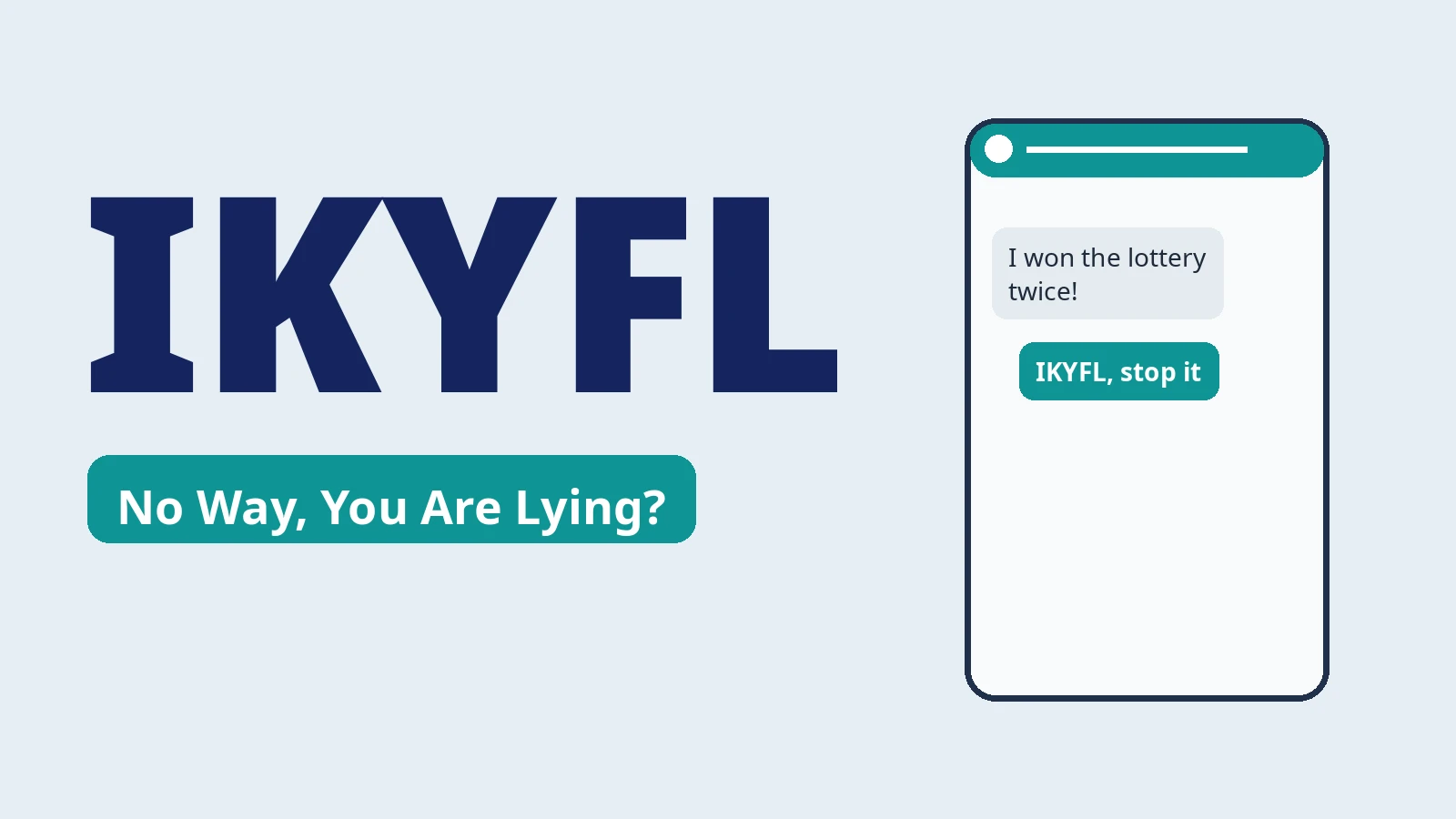
Your friend texts that he met a celebrity at the grocery store, got a selfie, and was offered a part in a movie, all before lunch. You stare at the message. You do not believe a word of it, so you type five letters: “IKYFL”.
Here is the short answer: IKYFL means “I Know You F***ing Lying”. It is a dramatic way to call out a claim that sounds impossible, usually with a laugh rather than real anger. The swear word adds shock, not hate, and the message is closer to “no way” than to a real accusation.
In this guide you will learn the ikyfl meaning in text, when it is playful and when it stings, where it shows up on TikTok and in chats, and what to say back when someone sends it to you.
What Does IKYFL Mean in Text?
IKYFL is disbelief with the volume turned all the way up. When a claim sounds too good, too wild, or too ridiculous to be true, a calm “really?” does not capture the feeling. IKYFL does.
Quick definition: IKYFL means “I Know You F***ing Lying”. In most texting and social media use it expresses shock, disbelief, or amusement at a claim that sounds impossible. It is usually playful between close friends, not a hostile accusation, though the swear word means it can sting when the tone is serious.
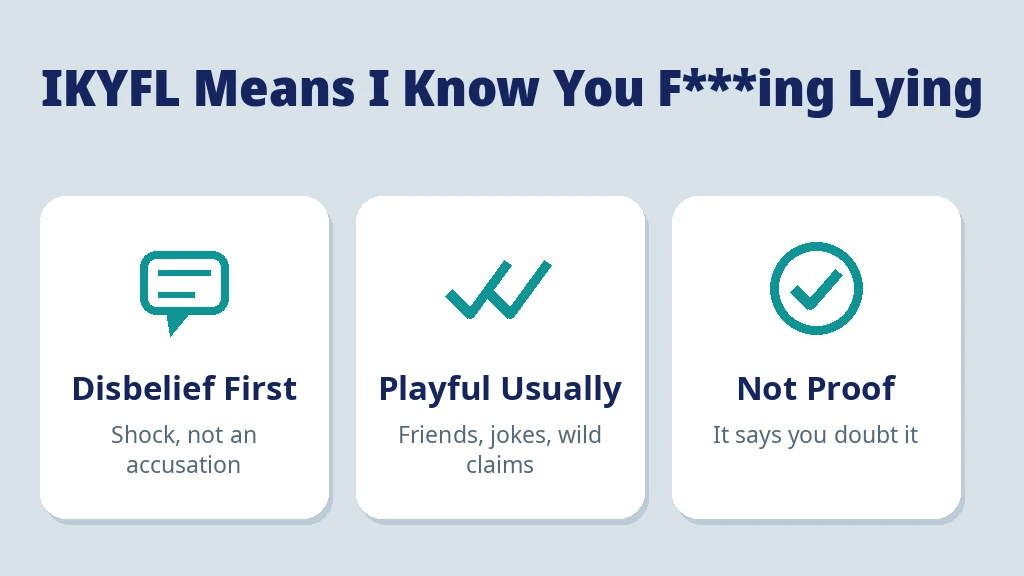
The sources agree on the expansion, and they agree on the tone split. The guides that rank for this term all lead with the same phrase: “I Know You F***ing Lying”, with some writing it as “I Know You’re F***ing Lying”, which is the same lead with one extra word. They also agree that the usage is rarely as aggressive as it sounds, that it is less a hostile accusation and more a gut reaction to something that seems too good, too wild, or too ridiculous to be true. CyberDefinitions has no page for IKYFL, so the lead rests on the unanimous niche guides rather than on a dictionary entry. The ikyfl meaning in texting is the same as on social media: disbelief, not proof.
The phrase has roots in African American Vernacular English, where “I know you lying” has long been used to call out an unbelievable claim with humor and friendly confrontation. It spread through Black Twitter in the early to mid-2010s, then into TikTok, Instagram, and everyday texting.
IKYFL Meaning in Easy Words
Think of IKYFL as a dramatic eye roll in five letters. That is the ikyfl meaning in one image.
An eye roll says “I do not believe you” without starting a fight. IKYFL is the typed version, only louder: the swear word is the raised eyebrow, and the whole phrase is the laugh that follows it. It says the claim is so wild that the only honest reply is disbelief.
In the simplest words:
IKYFL = “No way. That story is too wild to be true, and we both know it.”
Where Is IKYFL Used?
As ikyfl slang, IKYFL lives in informal chats and comment sections, wherever unbelievable claims get told for laughs.
Common places:
- Private texts and DMs, as a reaction to a friend’s wild story
- Group chats, where one “IKYFL” gets a round of laughing reactions
- TikTok comments, under unbelievable stories and plot twists, where the ikyfl tiktok use is the same expansion, just louder in public
- Instagram comments and captions, as a dramatic reaction to a bold claim
- X/Twitter replies, where short disbelief travels fast
- Snapchat chats, where friends trade exaggerated stories
Typical situations:
- Someone claims they won the lottery for the third time this month
- A friend says they finished a huge project in one hour
- A classmate says the professor cancelled the exam
- A creator posts a story that sounds too good to be true
- Someone shares an excuse for missing plans again
IKYFL is a reaction phrase. It almost always answers a claim that was just made, and it almost never starts a conversation.
Why Do People Use IKYFL?
It calls out the unbelievable fast
Some claims deserve a long reply, and some deserve five letters. When a story is obviously exaggerated, typing a careful response wastes the moment. IKYFL lands instantly, it names the disbelief, and it keeps the chat moving.
It keeps disbelief playful
Saying “you are lying” in full sounds like an accusation, and it can start a real argument. IKYFL says the same thing with a laugh built in, and that laugh changes everything. The swear word makes it dramatic, the slang makes it casual, and together they signal that the writer is joking rather than judging.
It fits meme and reaction culture
On TikTok and Instagram, big reactions are the language of the platform. A plain “I do not believe you” disappears in a comment section, but IKYFL stands out, and other readers recognize the feeling instantly.
Real-Life Examples of IKYFL
Here is how IKYFL actually shows up in chats and comments:
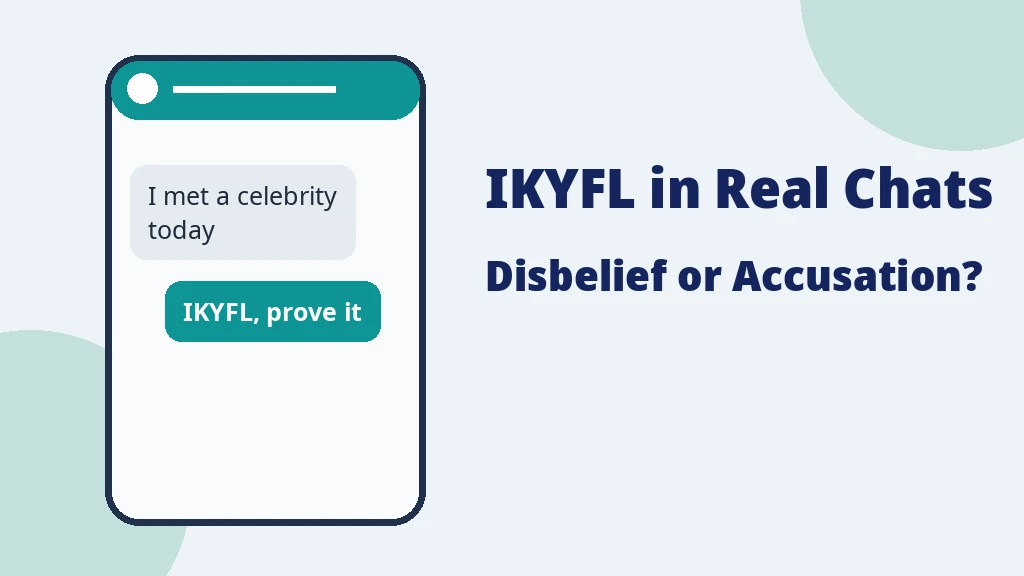
Example 1:
- Chat: “I just found a hundred dollar bill on the street. IKYFL, pick it up right now.”
Meaning: Playful disbelief at a lucky claim, with a laughing tone.
Example 2:
- Chat: “My professor cancelled the exam. IKYFL, you better be serious right now.”
Meaning: Shocked disbelief, hoping the good news is real.
Example 3:
- Chat: “You finished that project in one hour? IKYFL!”
Meaning: “That is impossible, you must be joking.”
Example 4:
- Chat: “Plans changed last minute again? IKYFL.”
Meaning: Disbelief in an excuse, with a sharper edge.
Example 5:
- Comment: “I won the lottery for the third time this month. IKYFL!”
Meaning: Public, joking disbelief under an unbelievable claim.
IKYFL vs Similar Terms
| Term | Meaning | When to use it |
|---|---|---|
| IKYFL | I Know You F***ing Lying | Dramatic disbelief at an unbelievable claim |
| Cap | Lie or exaggeration | Labelling a statement as a lie |
| No cap | Not lying, for real | Insisting a wild story is true |
| GTF | Get The F*** | Profane dismissal or disbelief |
| SMH | Shaking My Head | Disappointment, no accusation of lying |
Key difference: Cap and IKYFL look alike, but they do different jobs. The ikyfl vs cap choice is simple: “that is cap” labels a statement as a lie, like putting a tag on it, while IKYFL is a full sentence reaction aimed at the person, with shock and feeling attached. No cap is the opposite move: it insists a wild story is actually true, which is the reply you send when someone answers your true story with IKYFL. GTF is the closest cousin in tone, since it also uses profanity for emphasis, but it dismisses rather than doubts. If you want a profane reaction that fits the same energy, here is what GTF means in text, the blunt dismissal that lands just as hard.
SMH is the calm alternative in the table. It shows disappointment without accusing anyone of lying, which is why it is safer when you are not sure the claim is false.
The Other IKYFL Meanings You Should Know
“I Know You For Life” is wrong, and it should not be led with. One guide says IKYFL stands for “I Know You For Life”, an affectionate way to say you have someone’s back forever. That reading is a single source, it contradicts every other guide, and it fails the letter breakdown: F stands for “F***ing” and L stands for “Lying”, not “For Life”.
“I Know You Feel Like” is a minor reading with a different world. A few sources list “I Know You Feel Like” as a lesser known definition, used on welcome mats alongside the phrase “popping up here”, as in “I know you feel like coming inside”. That is a doormat slogan, not a texting sense.
“I Know You’re F***ing Lying” is the same lead, not a second sense. Some guides include the word “You’re” and some leave it out. Both spellings mean the same thing, and the article uses the shorter form because it matches the letters exactly: I, K, Y, F, L.
Tone rule in one line: a laughing or crying emoji, an unbelievable claim, and a close friend mean playful disbelief; a serious argument, no emoji, and a real lie mean it may be a hostile accusation, so read the room before you laugh it off.
How to Reply to IKYFL
Your reply depends on whether the IKYFL was a joke, because the wrong reply to either version makes things worse.
If it was clearly a joke: play along. “I swear, I have the photo to prove it” or “No cap, it really happened” keeps the joke going. A laughing emoji works too.
If it was a real accusation: do not laugh it off. “I hear you, here is what actually happened” takes the doubt seriously and opens a real conversation.
If you want to use IKYFL yourself: use it only with close friends, only about claims that genuinely sound unbelievable, and pair it with a laugh or an emoji the first few times.
When to Use IKYFL (and When to Avoid It)
Good situations:
- Reacting to a close friend’s wild or unbelievable story
- Joking disbelief in a group chat where everyone knows the tone
- Replying to an unbelievable claim on TikTok or Instagram
- Calling out an obvious exaggeration between friends
Avoid using IKYFL when:
- You are talking to a stranger, a colleague, or someone new
- The conversation is serious and trust is already shaky
- Children are reading the chat, since the phrase contains a swear word
- You are at work or in any formal setting
- You actually believe the claim, since IKYFL says you do not
- You have no relationship with the person to absorb the teasing
Common Misunderstandings About IKYFL
IKYFL does not always mean a real accusation. Most of the time, IKYFL is a joke between friends, and the “lying” is playful. Reading every IKYFL literally would make the internet look far more hostile than it is.
IKYFL does not mean “I know you for life”. That reading comes from a single guide, and it contradicts the majority and the letter breakdown. If you write “IKYFL” expecting people to read an affectionate forever friendship message, most of them will read an accusation of lying instead, and the confusion will be entirely avoidable. Write the friendship message in full.
IKYFL does not prove anyone is lying. The phrase says the speaker doubts the claim, not that the claim is false. A true story can earn an IKYFL simply because it sounds wild, and a false story can pass without one.
IKYFL is not safe with everyone. The joke needs trust, and trust takes time. With a new friend, a colleague, or anyone who has not heard the joke before, the letters can land as a real insult.
Frequently Asked Questions
What does IKYFL mean in text?
IKYFL means “I Know You F***ing Lying”. In most chats it expresses shock or playful disbelief at a claim that sounds impossible, not a serious accusation.
Is IKYFL rude?
It can be. Between close friends it is usually playful, but it contains a swear word and accuses someone of lying, so with strangers or in a serious argument it can sting. Read the tone before you use it.
What does IKYFL mean on TikTok?
On TikTok, IKYFL means “I Know You F***ing Lying” in comments, and it is usually a dramatic, joking reaction to an unbelievable story or plot twist in a video.
Does IKYFL mean “I know you for life”?
No. One guide says so, but every other guide agrees on “I Know You F***ing Lying”, and the letters fit that reading, not “for life”. Do not use IKYFL for friendship; write the message in full.
What is the difference between IKYFL and cap?
Cap labels a statement as a lie, as in “that is cap”. IKYFL is a full reaction aimed at the person, as in “I know you are lying”, with shock and feeling attached. Cap tags the claim, IKYFL reacts to the person telling it.
What does “I know you’re f***ing lying” mean?
It is the same lead as IKYFL with the word “You’re” added. Both spellings mean the speaker does not believe the claim. The article uses the shorter form because it matches the letters exactly.
Should I use IKYFL at work?
No. It is informal, it contains profanity, and in a work chat it will read as an accusation of lying. Keep it for close friends outside work.
Final Thoughts
IKYFL is disbelief turned into theatre. It means “I know you f***ing lying”, and in most chats it means the opposite of a real accusation: I like your story, I cannot believe it, and I trust you enough to joke about it.
Now you can read it at a glance: a laughing emoji and an impossible claim mean the joke, a serious argument and a sentence about real dishonesty mean it may be hostile, and a bare “IKYFL” from a stranger deserves a question before a laugh.
For a calmer reaction that never risks sounding like an accusation, here is what SMH means in text, the head shake that says you doubt the story without calling anyone a liar.