Your friend posts the opinion you have held for years, worded better than you ever managed. You could type “yes”, but “yes” feels flat. You type four letters instead: “IKTR”.
Here is the short answer: IKTR means “I Know That’s Right”. It is a confident way to agree hard with someone, to say their statement is correct and you stand behind it. It comes from the spoken phrase “I know that’s right”, which has long been used in African American Vernacular English as an affirmation.
In this guide you will learn the iktr meaning in text, how it differs from IKR, where it shows up on TikTok and in chats, and what to say back when someone sends it to you.
What Does IKTR Mean in Text?
IKTR is agreement with its chest out. Where a plain “yes” only confirms, and IKR asks “right?” as if it still needs a second opinion, IKTR states the agreement as a fact: I know that is right, and I am not hedging.
Quick definition: IKTR means “I Know That’s Right”. In most texting and social media use it expresses strong agreement, validation, or enthusiastic support for something someone just said or posted. It is informal, positive, and confident, and it works as a reaction rather than as part of a longer sentence.
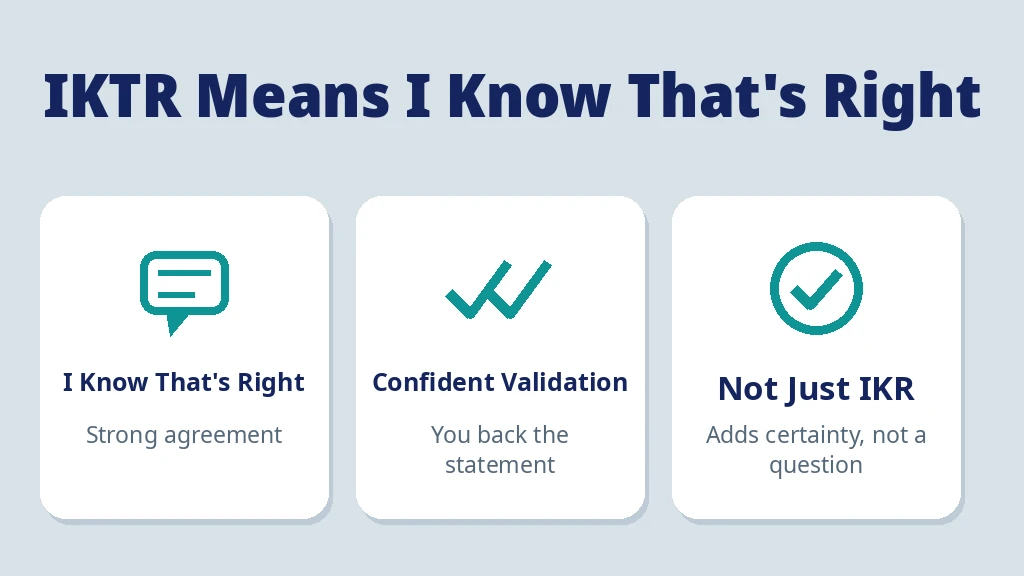
The sources agree on the expansion, and they agree on the tone. CyberDefinitions says IKTR means “I Know That’s Right”, and adds that it is used to emphasize a statement or to express agreement with something another person has just said. The niche guides that rank for this term say the same thing in different words: all three of the top three lead with “I Know That’s Right” and stress strong agreement, validation, and enthusiastic support. An Urban Dictionary entry defining IKTR as “I know that’s right” dates back to 2005, so the abbreviation has been around for years rather than being a brand new social media invention. The iktr meaning in texting is the same as on TikTok and Instagram: strong agreement, no separate sense.
IKTR Meaning in Easy Words
Think of IKTR as a nod plus a snap of the fingers. That is the iktr meaning in one image.
A nod says “I agree”. A snap says “yes, that was well said”. Put them together and you get IKTR: agreement with applause built in. It is the reply you send when someone says the thing you were thinking, and says it better than you could.
In the simplest words:
IKTR = “Exactly. You are absolutely right, and I feel that too.”
Where Is IKTR Used?
As iktr slang, IKTR lives in casual chats and comment sections, wherever people react to opinions rather than just exchanging information.
Common places:
- Private texts and DMs, as a confident reply to a friend’s opinion
- Group chats, where one “IKTR” backs up a hot take
- TikTok comments, under confident, relatable, or empowering videos, where the iktr tiktok use is the same expansion, just louder in public
- Instagram comments and captions, as a hype reply to a bold post
- X/Twitter replies, where short affirmations travel fast
- Snapchat chats, where quick reactions are the norm
Typical situations:
- Someone states a relatable truth, like “that restaurant has the best tacos in town”
- A friend shares a confident opinion, and you want to back them publicly
- A creator posts a bold take, and the comments fill with support
- Someone says something clever or self assured, and you want to hype them up
IKTR is a reaction phrase. It almost always answers something that was just said or posted, and it almost never starts a conversation.
Why Do People Use IKTR?
It validates, not just agrees
“Yes” confirms a fact. IKTR confirms a person. When someone shares an opinion they care about, a plain agreement can feel thin, as if you barely noticed. IKTR says you heard them, you think they are right, and you are willing to say so out loud.
It adds confidence to the chat
Some agreements are shy, and some are bold. IKR asks a question, which softens it. IKTR makes a statement, which strengthens it. The tone fits moments when the writer wants to sound sure: backing a friend, celebrating a win, or agreeing with a statement that feels obvious and true.
It works as hype
On TikTok and Instagram, IKTR is often a hype reply. A creator posts something confident, funny, or self assured, and “IKTR” in the comments is applause in four letters. It tells the creator the audience is with them, and it tells other commenters the take has support.
Real-Life Examples of IKTR
Here is how IKTR actually shows up in chats and comments:
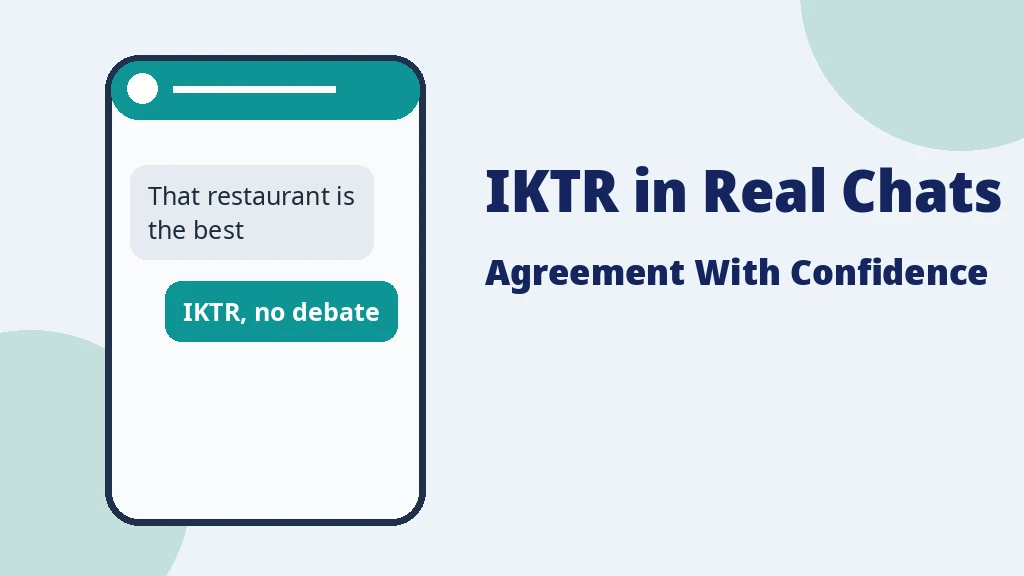
Example 1:
- Chat: “That restaurant has the best tacos in town. IKTR, no debate.”
Meaning: Strong agreement, stated as a fact.
Example 2:
- Comment: “She really nailed that speech! IKTR!”
Meaning: Enthusiastic support and praise.
Example 3:
- Chat: “They said they would do it, but they never meant it. IKTR.”
Meaning: “I hear you, and you are right about them.”
Example 4:
- Chat: “I am done apologizing for having standards. IKTR, say it louder.”
Meaning: Validation of a confident, empowering statement.
Example 5:
- Chat: “This new coffee shop downtown is amazing. IKTR, the pastries are unreal.”
Meaning: Confident agreement that adds a supporting detail.
IKTR vs Similar Terms
| Term | Meaning | When to use it |
|---|---|---|
| IKTR | I Know That’s Right | Confident agreement and validation |
| IKR | I Know, Right? | Strong agreement, asked as a question |
| IK | I Know | Plain acknowledgment, no emphasis |
| FR | For Real | Sincere agreement, “this is really true” |
| SMH | Shaking My Head | Disbelief or disappointment, no agreement |
Key difference: IKTR and IKR are cousins, not twins. The iktr vs ikr choice comes down to grammar: IKR is “I Know, Right?”, a rhetorical question that invites shared feeling, while IKTR is “I Know That’s Right”, a flat statement that adds certainty. IK is the plain version of both: “I Know” acknowledges without the emphasis, and on its own it can even sound cold. FR is the closest alternative when you want sincerity without the swagger: it means “for real” and agrees by saying the statement is genuinely true. If you want a safe, standard way to agree with feeling, here is what FR means in text, the “for real” that fits almost any chat.
Do not confuse IKTR with IKR in the other direction either. One guide wrongly defines IKTR as “I Know, Right?”, but that is the IKR expansion wearing the wrong letters. If you mean the question, write IKR. If you mean the confident statement, write IKTR.
The Other IKTR Meanings You Should Know
“I Know, Right?” is a confusion, not a real IKTR sense. One guide defines IKTR in its body as “I Know, Right?” while its own comparison table says “I Know That’s Right”. That is a mix-up with IKR, and no other independent source agrees with it. Read IKTR as “I Know That’s Right” and keep IKR for the question form.
“I Know the Rules” is incorrect in casual texting. Some readers guess the R stands for “rules”, but that reading has no support in any guide, and it does not match the examples, where IKTR always answers an opinion or a statement rather than a game or a set of rules.
“I know that reference” belongs to one small community. In a Flight Rising forum game about dragon designs, players use IKTR to mean “I know that reference”. That is a niche in-joke for one game, not a texting sense.
Tone rule in one line: an exclamation mark, a confident post, or a hype comment means warm support; a sarcastic reply to a bad take can flip it, so read the message above it before you decide which tone you are seeing.
How to Reply to IKTR
Your reply depends on whether the IKTR was supporting you or just joining the chat, because the letters themselves only say “you are right”.
If someone sends you IKTR: take it as a compliment. “Thank you, I knew you would get it” or “Right? I had to say it” keeps the energy going. A fire or clapping emoji works too. The writer validated you, so a short warm reply is enough.
If you want to use IKTR yourself: use it when you genuinely agree and want the other person to feel backed up. Pair it with the thing you agree about, as in “IKTR, she deserved that award”, so the reader is never left guessing. It works best with friends and in comment sections, and it sounds best when the statement you are backing is confident or relatable.
If the IKTR sounded sarcastic: check the message above it. IKTR can carry a sassy edge when it answers a bad take, as in “oh, IKTR” under a claim nobody believes. If the tone feels off, ask what they meant rather than assuming support.
When to Use IKTR (and When to Avoid It)
Good situations:
- Backing up a friend’s opinion you genuinely share
- Hyping a creator or a friend under a confident post
- Agreeing with a relatable truth in a group chat
- Validating someone who just took a stand
Avoid using IKTR when:
- You are talking to a stranger, a colleague, or someone new
- The chat is formal, serious, or work related
- You only mildly agree, since IKTR promises strong feeling
- You are correcting someone, since agreement is the opposite of a correction
- The reader might read it as IKR and miss the confidence you meant
Common Misunderstandings About IKTR
IKTR is not just a longer IKR. This is the biggest misunderstanding, and it is the whole point of the term. IKR asks “right?” and IKTR states “that’s right”. The extra letter changes the grammar from a question to a statement, and that change is what gives IKTR its confidence. Swapping them loses the exact tone the writer chose.
IKTR does not mean you knew a fact in advance. Some readers hear “I know” and think the writer is claiming prior knowledge, as in “I knew that already”. That is not the sense. IKTR means “I agree that what you said is right”, not “I already knew it”. The knowledge in the phrase is agreement, not a claim about the past.
IKTR is not safe for every audience. It is informal slang, and in a work chat or a formal message it will look out of place. It also carries a sassy edge in some circles, so with people who do not know the term, the confidence can read as attitude. Use it where the audience already speaks this shorthand.
IKTR does not prove the statement is true. Four letters of agreement are not evidence. IKTR says the writer believes the statement, not that the statement is a fact.
Frequently Asked Questions
What does IKTR mean in text?
IKTR means “I Know That’s Right”. It is a confident way to agree with someone, showing strong agreement, validation, or enthusiastic support for what they just said.
What is the difference between IKTR and IKR?
IKR means “I Know, Right?” and asks agreement as a rhetorical question. IKTR means “I Know That’s Right” and states agreement as a fact, with more certainty and confidence.
What does IKTR mean on TikTok?
On TikTok, IKTR means “I Know That’s Right” in comments, and it is usually a hype reply under a confident, relatable, or empowering video.
Where did IKTR come from?
IKTR comes from the spoken phrase “I know that’s right”, which has long been used in African American Vernacular English as an affirmation. The abbreviation has been used online since at least 2005.
Is IKTR rude or sarcastic?
Usually not. It is normally warm and supportive, but it can carry a sassy edge when it answers a bad take. Read the message above it to tell which tone you are seeing.
Can I use IKTR at work?
No. It is informal slang, and in a work chat it will look out of place. Keep it for friends and casual comment sections, and use plain words like “exactly” at work.
Does IKTR mean “I know the rules”?
No. That reading has no support in any guide and does not match how IKTR is used. In casual texting, IKTR always means “I Know That’s Right”.
Final Thoughts
IKTR is agreement with confidence built in. It means “I know that’s right”, and it says more than “yes” ever could: the statement is correct, it deserves to be heard, and the writer is glad someone said it.
Now you can read it at a glance: a confident opinion plus IKTR means warm support, and a bad take plus a sarcastic IKTR means the opposite, so always read the message above it first.
The lead is documented by CyberDefinitions, which says IKTR means “I Know That’s Right” and notes that it is used to emphasize a statement or to express agreement with something another person has just said. For a reaction that shows disbelief instead of agreement, here is what SMH means in text, the head shake that fits the moments when agreeing is the last thing on your mind.