
Someone drops three letters into a comment, “GTF”, and the whole tone of the thread changes. Is it a joke? An insult? A dare?
Here is the short answer, stated plainly: on Instagram and TikTok, GTF is a blunt, profane dismissal, most often read as “Get The F***” or “Go The F***”. It tells someone to go away, or it reacts to something unbelievable with a shocked “no way”. It is not a clean abbreviation, and cleaning it up into something polite changes its meaning entirely.
This guide handles GTF honestly and carefully. The profanity is censored throughout, but the meaning is not softened, because softening it is exactly how readers get misled. You will learn what GTF means, how it differs from GTFO, when it is playful and when it is hostile, and what to say when it lands in your chats.
What Does GTF Mean in Text?
GTF stands for “Get The F***” or “Go The F***” in social-media and texting use. Both wordings point the same way: a forceful dismissal. The small difference is grammar, not meaning. “Get” reads like an order to leave, while “Go” reads like telling someone to get lost. In practice, readers treat them as the same word.
Quick definition: GTF means “Get The F***” or “Go The F***”, a profane, blunt way to dismiss someone, express annoyance, or react with shocked disbelief. It is informal, it can offend, and it is never appropriate in formal writing.
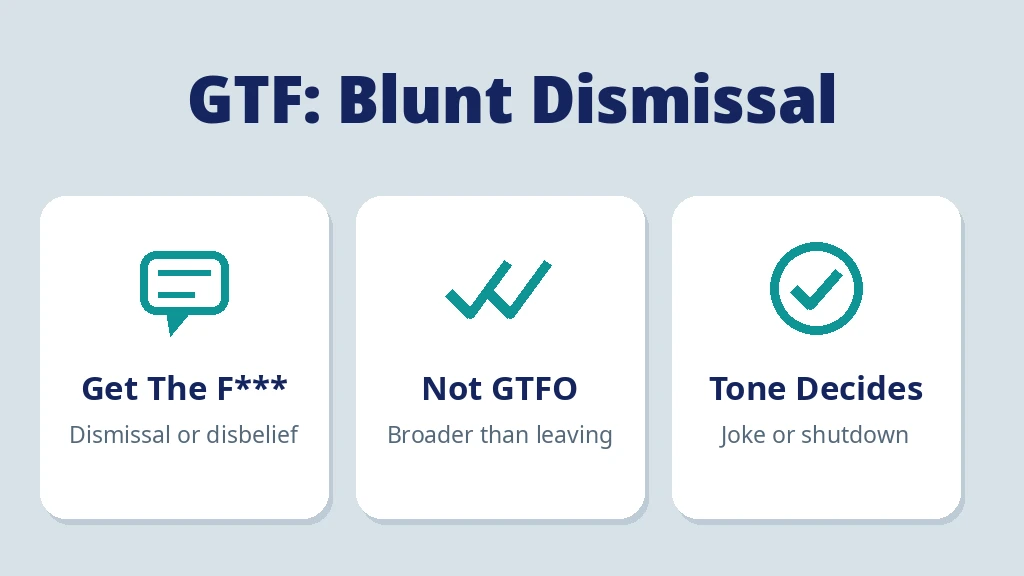
Two things matter most about this definition. First, the censored word is doing real work: without it, GTF loses its force, and that force is the point. Second, GTF is a reaction word, not a description word. People do not use it to explain something; they use it to push back, to laugh in disbelief, or to end an exchange.
GTF Meaning in Easy Words
Think of GTF as the texting version of waving someone away with feeling:
When a friend posts something outrageous and you reply “GTF”, you are really saying “no way, I cannot believe that”, with a laugh behind it. The words are harsh, but the intent is playful disbelief.
When someone you are arguing with writes “GTF”, they are really saying “go away, I am done with this”. The same letters now carry real hostility, and the conversation is probably over.
When a stranger drops “GTF” in a public comment thread, they are usually signalling disagreement in the loudest, shortest way available. It is less an argument and more a door slamming.
So the simplest rule is this: GTF always pushes something away, and the tone of the chat tells you whether it is a joke or a shutdown. Between friends it is usually the joke. Anywhere else, assume the shutdown until proven otherwise.
Where Is GTF Used?
GTF lives where reactions are fast and moderation is light:
- TikTok comments and captions: the most common home of GTF, used for dismissal, annoyance, or shocked reactions to videos.
- Instagram comments and DMs: the same dismissal, often aimed at a post, a claim, or a person in a thread.
- Snapchat chats: used between friends for urgency, excitement, or frustration, including telling someone to hurry up.
- Gaming chats: used in heated moments, and sometimes as a capture-the-flag call, “Get To Flag”, in that narrow game mode.
- Group chats and X (Twitter) replies: used as a punchy reaction to gossip, flexes, or takes people refuse to accept.
These places share one trait: none is formal, and all reward short, emotional reactions. GTF is built for exactly that environment.
Why GTF Is Not a Clean Abbreviation
Search results for GTF contain a few clean readings, and every one of them should be treated with care. The most common clean claim is “Get The Facts”, presented as advice to check information before judging. Another is “Good To Go” or “Good To Fly”, meaning ready to leave. These readings exist in lists, but they are not the social-media lead, and they do not match how GTF is actually used on TikTok or Instagram.
The evidence for the profane lead is consistent across independent slang guides: TikTok guides lead with “Go To F***”, Instagram guides lead with “Go The F***”, Snapchat guides lead with “Get The F***”, and abbreviation lists record “Get The F***” as the chat sense. When several unrelated sources agree on the same blunt reading, and the clean readings appear only in single, weaker lists, the honest article leads with the blunt reading and labels the clean ones as minor or unsupported.
This matters because sanitising GTF misleads readers in both directions. A reader who believes GTF means “Get The Facts” will miss an insult aimed at them. A reader who uses GTF believing it is clean will accidentally insult someone else. Censoring the spelling protects the page; hiding the meaning harms the reader. This article censors the letters and keeps the meaning visible.
GTF vs GTFO: Close, But Not the Same
GTFO is the nearest neighbour of GTF, and the two are constantly confused. GTFO stands for “Get The F*** Out”, and it adds one explicit idea that GTF leaves implied: out. GTFO tells someone to leave a place, a thread, or a conversation, and it often lands slightly harder because the destination is spelled out.
GTF is shorter and slightly more flexible. It can dismiss a person, but it can also dismiss an idea, a claim, or a piece of news, without necessarily telling anyone to physically leave. “GTF, that never happened” dismisses a story. “GTFO” in the same spot would sound more like an order to exit the chat.
In practice, many people use them interchangeably, and the difference rarely changes the outcome of a conversation. But when you are writing about them, the distinction is worth keeping: GTFO is the leaving word, GTF is the dismissal word, and GTF’s missing letter is what makes it broader.
| Term | Meaning | Main difference from GTF |
|---|---|---|
| GTF | Get / Go The F*** | Broad dismissal, person or idea |
| GTFO | Get The F*** Out | Explicitly orders someone out |
| STFU | Shut The F*** Up | Orders silence, not departure |
| GTH | Go To Hell | A curse, not a dismissal |
| GTG | Got To Go | A polite exit, no profanity at all |
Real-Life Examples of GTF
Here is how GTF actually looks in everyday chats. The profanity stays censored, and the tone notes explain what changes the meaning:
Example 1 (playful disbelief):
- Friend: “He said he met a celebrity at the grocery store”
- You: “GTF, no way”
Meaning: Shocked, laughing disbelief. Between friends this is a joke, not an attack.
Example 2 (hostile dismissal):
- Stranger in comments: “Your opinion is embarrassing”
- Reply: “GTF”
Meaning: A shutdown. No argument follows, because none is invited.
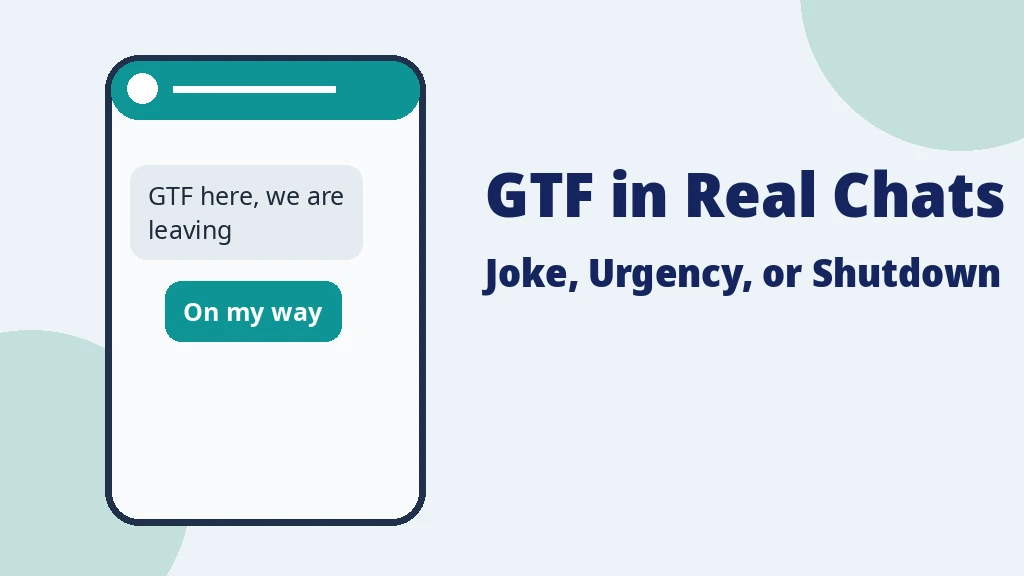
Example 3 (urgency between friends):
- Friend: “GTF here, we are about to leave”
Meaning: Hurry up. On Snapchat this urgent, “get here” flavour is common among close friends.
Example 4 (reaction to a flex):
- Post: “Just bought my dream car at 19”
- Comment: “GTF, congrats though”
Meaning: Disbelief softened by praise. The commenter is stunned, not angry, and the follow-up proves it.
Example 5 (argument ender):
- Chat: “I am done explaining this to you. GTF.”
Meaning: The conversation is over. Replying further usually only escalates it.
How to Reply to GTF
Your reply should match the tone, not just the letters:
If it is playful disbelief from a friend: play along. “I know, right?” or “I swear, it actually happened” keeps the joke going, and a laughing emoji confirms you read it as banter.
If it is urgency from a close friend: answer the need, not the wording. “On my way” is the right reply to “GTF here”, because the message is really about time.
If it is hostile dismissal from a stranger: do not escalate. The best replies are no reply, a block, or a calm “Alright, moving on”. Answering a dismissal with a longer dismissal almost never improves the thread.
If it ends an argument: let it end. A short “Understood” or silence protects your time better than a comeback, and it denies the exchange the fuel it needs to continue.
If you are unsure: check the relationship before the wording. Friends get the benefit of the doubt; strangers in a heated thread do not. When in doubt, a neutral reply like “Haha, noted” works for banter and stays safe if the tone was sharper than you thought.
When to Use GTF (and When to Avoid It)
Occasions where people do use it:
- Playful disbelief between close friends who already talk this way
- Reacting to shocking or unbelievable news in a casual comment thread
- Urging a close friend to hurry, in private chats only
- Quoting or discussing slang, as this article does, with the profanity censored
Avoid using GTF when:
- You are talking to strangers, colleagues, teachers, or anyone formal
- The conversation is serious, and a dismissal could cause real harm
- You are unsure whether the other person will read it as a joke
- Children may see the message, since the underlying phrase is profane
- A platform’s rules could flag it: repeated profane dismissals can draw blocks or bans
- A softer reply would do the same job: “No way”, “Get out of here”, or “I do not buy that” carry the feeling without the profanity
Common Misunderstandings About GTF
GTF does not mean “Get The Facts” in social use. That clean reading appears in some lists, but it is not how TikTok, Instagram, or Snapchat users actually use GTF. Treating it as clean advice will make you miss insults and misuse the term yourself.
GTF is not the same as GTFO. GTFO adds “Out” and orders someone to leave. GTF dismisses more broadly: a person, a claim, or a story. They overlap, but they are not identical.
GTF is not always angry. Between friends it is often laughing disbelief. The same letters in a public argument are usually hostile. Tone and relationship decide, not the abbreviation alone.
GTF is not safe for formal settings just because it is short. Abbreviation does not remove profanity. In work, school, or public writing, the full phrase behind GTF is still profane, and readers will judge it that way.
GTF is not “Good To Go”. That is GTG territory, sometimes written as “Good To Go” or “Good To Fly” in readiness talk. If someone means ready, they almost always write GTG, not GTF.
Frequently Asked Questions
What does GTF mean in text?
On Instagram and TikTok, GTF means “Get The F***” or “Go The F***”, a blunt, profane dismissal used to tell someone to go away or to react with shocked disbelief. It is informal, it can offend, and it is never appropriate in formal writing.
What does GTF mean on TikTok?
On TikTok, GTF most commonly means “Go To F***”, used to express dismissal, annoyance, or a strong negative reaction to a video or comment. Between friends it can be playful banter, but in a public thread it usually signals hostility.
What does GTF mean on Instagram?
On Instagram, GTF almost always means “Go The F***”, a blunt way of telling someone to leave or go away. Among close friends it can be joking dismissal, like “get outta here”, but in public comments it almost always signals disagreement or dislike.
Is GTF the same as GTFO?
No, though they are close. GTFO means “Get The F*** Out” and explicitly orders someone out, while GTF means “Get The F***” or “Go The F***” and dismisses more broadly, including ideas and claims. Many people use them interchangeably, but GTFO is usually slightly more forceful.
Does GTF mean Get The Facts?
No, not in real social-media use. “Get The Facts” appears in some lists as a clean reading, but TikTok, Instagram, and Snapchat users use GTF as a profane dismissal. Treating it as clean advice will make you miss insults and misuse the term yourself.
Is GTF rude?
Yes, usually. Between close friends it can be playful, but with strangers, in arguments, or in any formal setting it reads as rude and dismissive, and it carries profanity. Softer alternatives like “No way” or “Get out of here” carry the same surprise without the offence.
Related Texting Slang
Keep exploring the dictionary: cap in chats and texts, dls meaning in text, what mid means in a text, murk, explained with real examples, the meaning of POS.
Final Thoughts
GTF is a small abbreviation that carries a large tone problem, and honesty about it is the whole point of this guide. On TikTok and Instagram it is a profane dismissal, close to GTFO but broader, playful between friends and hostile everywhere else. The censored spelling on this page does not change that meaning, and no clean rewrite should either.
Next time GTF appears, read the relationship before the letters. A friend laughing at unbelievable news is bantering. A stranger in a heated thread is shutting you down.
And if you ever need the softer side of internet reactions, you may like what FFS means in text, another frustrated abbreviation with its own tone rules, and what FR means in text for the sincerity marker that does the opposite job. For the formal side of the letters, Wikipedia lists the non-slang GTF senses, from science to technology, which shows how far the chat meaning sits from every official use.
1 thought on “GTF Meaning in Text | Why Tone Changes Everything Here”