
Your friend texts you about a party on Friday. You type back three letters: “ion wanna go”. They laugh. Nobody asks what you meant.
Here is the short answer: ion means “I don’t”. It is a phonetic spelling of how “I don’t” sounds when you say it fast, and it is the shortest way to say you do not want something, do not know something, or do not think so. It lives in chats where sounding casual matters as much as being clear.
In this guide you will learn the ion meaning in text, how case and position change it into something else entirely, where it shows up, and what to send back when someone sends it to you.
What Does ION Mean in Text?
Ion is a tiny refusal with a big job. It tells the other person that the answer is no, that you do not know, or that you do not agree.
When a friend says “we should go out tonight” and you reply “ion wanna go”, you are saying three things at once: I do not want to go, I am saying it casually, and we can move on. The letters do the work of a whole phrase, and that is why they survive in fast chats.
Quick definition: ion means “I don’t”. In texting and social media it is a phonetic spelling of “I don’t”, used before a verb to refuse, disagree, or say you do not know. Written in all caps at the start of a new thought, ION means “In Other News” instead.

The sources agree on the lead, and they agree on the case rule. CyberDefinitions says ION is used on social media and in text messaging with the meaning “In Other News”, and adds that it is also used as an abbreviation of the phrase “I Don’t”. Wiktionary lists “ion” as African American Vernacular slang for “I don’t”, from a reduction of “I don’t”, with the examples “ion know what 2 do” and “ion want 2”. Dictionary.com documents both uses in internet writing, with examples dating back to the 2000s. The niche guides that rank for this term say the same thing: all three of the top three lead with “I don’t”, and each one stresses that lowercase ion plus a verb means “I don’t”, while caps ION at the start of a thought means “In Other News”. The spelling comes out of African American Vernacular English, where “I don’t” said fast drops the “d” and “t” sounds.
ION Meaning in Easy Words
Think of ion as “I don’t” said fast and written the way it sounds. That is the ion meaning in one image.
Say “I don’t know” out loud, then say it faster, then faster again. The “d” softens and disappears, the “t” drops away, and what is left sounds like “ion know”. People started writing it exactly how it sounds. It is no typo. It is a deliberate choice to sound casual.
In the simplest words:
ion = “I don’t”, written the way it sounds when you say it fast.
Where Is ION Used?
As texting slang, ion lives in casual chats between people who already share some context.
Common places:
- Private texts and DMs, as a quick refusal or a “I do not know”
- Group chats, where one “ion care” closes a point without a debate
- Twitter and X posts, where short replies carry the conversation
- TikTok and Instagram comments, answering a relatable post with a shrug
- Snapchat chats, where short reactions are the norm
Typical situations:
- A friend suggests a plan and you do not want to go
- Someone asks a question and you do not know the answer
- A relatable post says what you were already thinking, and you do not care
- Someone states an opinion and you do not think so
- A friend asks if you like something, and you do not
Why Do People Use ION?
It sounds like real speech
Ion is three letters instead of a phrase with an apostrophe, and in a fast chat that difference matters. But speed is only half of it. Typing “ion” keeps the sound of the way the person actually talks, and that makes a chat feel like a conversation instead of a memo.
It softens a no
Sometimes you need to refuse something and there is nothing useful to add. Typing “I do not want to go” can sound cold and formal. Ion says “no” in the smallest, softest possible space.
It marks the chat as casual
Ion tells the reader that this is a relaxed conversation between friends. The word itself sets the tone, so the rest of the message can stay short.
Real-Life Examples of ION
Here is how ion actually shows up in chats and comments:
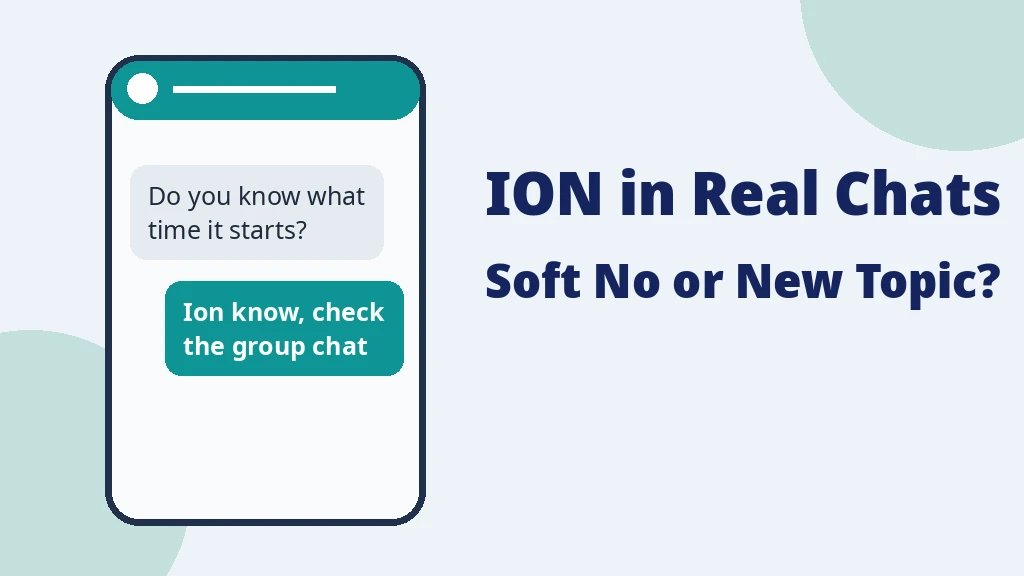
Example 1:
- Chat: “Do you know what time it starts?” “Ion know, check the group chat.”
Meaning: Plain “I don’t know”, the sender does not have the answer and points to where it is.
Example 2:
- Chat: “Want to go to that new place tonight?” “Ion wanna go, I am tired.”
Meaning: Soft refusal, the sender does not want to go and gives a short reason.
Example 3:
- Chat: “This movie is so bad.” “Ion care, I liked it.”
Meaning: Casual disagreement, the sender does not care about the criticism.
Example 4:
- Comment: “Everyone is going to love this song.” “Ion think so, it is boring.”
Meaning: Honest disagreement with a stranger’s post, the plain ion doing the disagreeing.
Example 5:
- Chat: “He is going to win, right?” “ION, did you see the game last night?”
Meaning: Caps ION doing the other job, “In Other News”, changing the subject instead of answering.
ION vs Similar Terms
| Term | Meaning | When to use it |
|---|---|---|
| ion | I Don’t | Refusing, disagreeing, or not knowing, before a verb |
| IDK | I Don’t Know | Only when you do not know, never a refusal |
| IDC | I Don’t Care | Saying you do not care, blunt and direct |
| ION | In Other News | Caps only, changing the subject at the start of a thought |
| IMO | In My Opinion | Flagging a take as personal, not a fact |
Key difference: ion is the flexible one of the family. IDK only says you do not know, and IDC only says you do not care, but ion can do both jobs and more, because the verb after it picks the meaning. “Ion know” is “I don’t know”, “ion care” is “I don’t care”, and “ion think so” is “I don’t think so”. For the calmest way to say you already know something in a chat, here is what IK means in text, the plain “I know” that is the opposite of ion.
Keep ion apart from caps ION as well. Lowercase ion plus a verb is “I don’t”. Caps ION at the start of a sentence, usually followed by a comma, is “In Other News”. If it sits mid sentence before a verb, it is “I don’t”. If it opens a brand new thought, it is “In Other News”.
The Other ION Meanings You Should Know
“I don’t” is the only everyday texting meaning. In chats, DMs, and comments, lowercase ion means “I don’t” and nothing else. Every source that covers texting agrees on that, and there is no rival texting reading with real support.
Caps ION has a second texting job. Written in all caps at the start of a new thought, ION stands for “In Other News”, a way to change the subject, usually because the sender is not interested in what was being discussed or has news to share. CyberDefinitions documents it as the first definition, and Dictionary.com records it from the 2000s. It can also be used sarcastically, as a response to something the sender finds obvious, like answering “ION, the sky is blue!” to a statement everyone already knew.
Outside texting, ion has a science meaning. In chemistry, an ion is an atom or group of atoms with an electric charge. ION is also the name of a US TV network, and Ion is a Romanian given name. None of these will appear in a chat about Friday plans.
Case rule in one line: lowercase ion plus a verb means “I don’t”, caps ION plus a comma at the start of a thought means “In Other News”, and in a science class it means a charged atom. When in doubt, look at the word right after it: a verb means “I don’t”.
How to Reply to ION
Your reply depends on which ion you received, because the same three letters can refuse a plan or change the subject.
If it was “I don’t”: answer the sentence around it, not the word itself. If someone says “ion know”, give them the answer or point them to it. If someone says “ion wanna go”, accept the no and suggest something else. Do not argue with the word; it is already a soft no.
If it was caps ION: follow the new subject. The sender changed the topic on purpose, so replying to the old topic will feel like you missed the turn. For a reply that keeps any choice friendly, here is what IDM means in text, the “I don’t mind” that never sounds dismissive.
When to Use ION (and When to Avoid It)
Good situations:
- Refusing a plan softly in a chat with friends
- Saying you do not know something in a fast-moving chat
- Disagreeing casually in a comment on a relatable post
- Changing the subject with caps ION when a topic has run its course
Avoid using ion when:
- You are talking to a teacher, a boss, or anyone formal
- Someone is sharing serious news and needs a real response
- The reader may not know the slang and will read it as the chemistry word
- You actually do know, since “ion know” says you do not
Common Misunderstandings About ION
Ion is not a typo. This is the biggest misunderstanding, and it comes from reading the letters as a broken word. Ion is a deliberate phonetic spelling of “I don’t” with roots in African American Vernacular English, written this way in internet chats since the 2000s. Autocorrect did not make it.
Ion does not always mean “In Other News”. That reading only applies to caps ION at the start of a new thought. Lowercase ion before a verb is always “I don’t”. Reading every ion as “In Other News” would turn most chats into nonsense.
Ion is not the chemistry word in a chat. In a science class, an ion is a charged atom. In a text about Friday plans, it is “I don’t”. The room decides the meaning.
Ion is not rude on its own. The word is a softener, not a slap. It can sound dismissive when it answers a question the sender cared about, but the rudeness comes from the situation, not the letters. A little warmth around it keeps it friendly.
Frequently Asked Questions
What does ion mean in text?
Ion means “I don’t”. It is a phonetic spelling of how “I don’t” sounds when said fast, used before a verb like know, care, think, or want.
What does “ion know” mean?
“Ion know” means “I don’t know”. It is the most common use of ion.
What does ION mean in all caps?
In all caps, ION usually means “In Other News”. It opens a new thought or changes the subject.
What is the difference between ion and IDK?
IDK means “I don’t know” and only says you do not know. Ion means “I don’t” and works with any verb.
Is ion rude?
Usually it is not. It is a casual, soft way to refuse or disagree. Add a short reason when you mean it kindly.
What does ion mean on TikTok?
On TikTok, ion usually means “I don’t” in comments, often as agreement with a relatable video. Caps ION in a comment can mean “In Other News” instead.
Should I use ion at work?
No. It is informal slang and can confuse readers who do not know it. Write “I don’t” in full instead.
Final Thoughts
Ion is the smallest refusal in texting, and one of the most useful. It means “I don’t”, and it does the work of a shrug: I do not want to, I do not know, I do not think so, and we can move on. The letters are casual, and the meaning comes from the case, the verb after them, and the sentence they answer.
Now you can read it at a glance: lowercase ion before a verb means “I don’t”, caps ION at the start of a new thought means “In Other News”, and in a science class it means a charged atom.
The lead is documented by CyberDefinitions, which says ION is used as an abbreviation of the phrase “I Don’t” and also means “In Other News”. Wiktionary lists “ion” as African American Vernacular slang for “I don’t”, from a reduction of “I don’t”, with examples like “ion know what 2 do”. For the plain way to say you already know something, here is what IK means in text, the calm “I know” that is the opposite of ion.