Someone texts you “GI?” after you share an idea, and you freeze. Are they agreeing with you, talking about a soldier, or asking about your stomach?
With GI, the honest answer is that context decides everything. There is no single settled texting lead, and anyone who gives you one without a warning is oversimplifying a genuinely multi sense abbreviation.
Short answer: GI traces to American Soldier and Government Issue, but in casual chat it can also mean Good Idea. CyberDefinitions lists American Soldier first, Government Issue second, and Good Idea third, and calls GI a rare term. In everyday texting, Good Idea is the casual agreement sense, while soldier, medical, and nutrition senses take over in their own contexts.
This guide covers the gi meaning in texting, what does gi mean in chat in each setting, and how to read GI correctly from the sentence around it.
What Does GI Mean in Text?
GI has a context led set of meanings, not one confident chat lead.
The strongest documented lineage is military. CyberDefinitions gives “American Soldier” as its quick answer, with Government Issue second and Good Idea third, less common. Wikipedia confirms the history: G.I. began in US Army paperwork, was reinterpreted as government issue, and transferred to soldiers during World War II, giving us G.I. Joe from 1942.
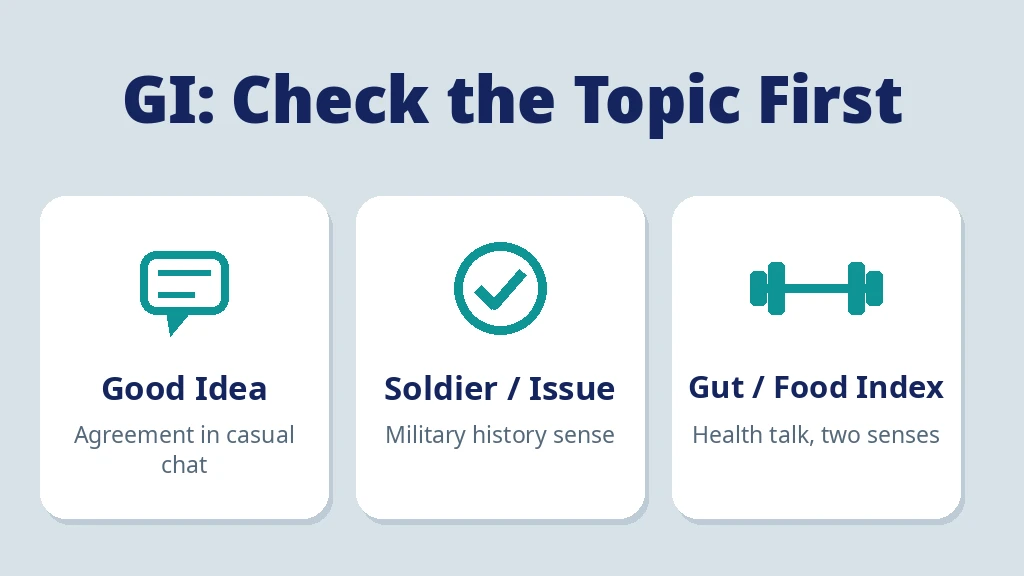
Quick definition: GI means American Soldier or Government Issue in military talk, Good Idea as casual agreement in chats, gastrointestinal in medical talk, and glycemic index in nutrition talk. The topic of the conversation picks the meaning.
The casual chat rival deserves a clear label. Good Idea as a GI sense rests on slang sites only. Slangify leads its GI guide with Good Idea for agreeing with a suggestion, and CyberDefinitions lists it third, noting it is not common. No dictionary entry for GI meaning Good Idea was found in this check, so treat it as real chat usage, not dictionary usage. That distinction matters: Good Idea is how many casual texters actually use GI, even though it is not the best documented sense overall.
Two weak claims should not set your reading. A long texting list gives “Google It” for GI, a single weak list entry, and another guide leads with General Information, again from one source. Neither matches the soldier lineage or Good Idea chat use, so keep them as footnotes.
GI Meaning in Easy Words
Think of GI as a label that changes with the room it walks into.
In a military room, GI is a soldier, or the gear issued to one. In a friends chat, GI is a thumbs up in two letters: “Good idea, let us do that.” In a doctor’s office chat, GI is your gut: the GI tract, GI distress, GI bleeding. In a food chat, GI is a number: low GI foods release energy slowly, high GI foods spike blood sugar faster.
GI = “Soldier, Good Idea, gut, or food index, check the topic first.”
The topic test solves most cases in one step. War or veterans points to soldier, a suggestion points to Good Idea, stomach symptoms point to gastrointestinal, and bread or diets point to glycemic index. If none fits, ask the sender, because GI is too split to guess blindly.
Where Is GI Used?
GI appears in very different places, which is exactly why it confuses people. Unlike pure slang, it is also a serious abbreviation in medicine, nutrition, and military history.
Common places:
- Casual chats, where GI means Good Idea as agreement with a suggestion
- Military and history talk, where GI means a US soldier or issued gear
- Medical chats and notes, where GI means gastrointestinal
- Nutrition and fitness chats, where GI means glycemic index
- Veterans topics, where GI Bill means education and housing benefits for veterans
Example situations:
- A friend suggests a movie night and you reply “GI, let us go”
- A history post refers to GIs landing in Normandy
- A patient message mentions GI pain after a meal
- A diet chat compares low GI oats with high GI white bread
The gi meaning in gaming is minor and single source only: Game Interface appears on one slang guide and nowhere else in this check, so do not treat gaming as a GI home.
Why Do People Use GI?
It is short for a long history
Soldier, government issue, gastrointestinal, and glycemic index are all long phrases. GI compresses each of them into two letters, which is why professionals and history buffs adopted it long before texting existed.
It works as a fast agreement
In a chat, typing “Good idea” takes a second. Typing GI takes a blink, and among friends who use it that way, it lands as instant agreement. That is the whole appeal of the chat sense, even though it is the least documented one.
It signals insider knowledge
Using GI correctly in a specialist topic signals that you know the field. Using it in the wrong room signals confusion, which is why this guide keeps pushing the topic test.
GI Across Platforms and Contexts
No distinct TikTok caption, hashtag, or fandom edit sense for GI was documented by two or more sources in this check, so this guide does not invent one. Platforms show the same topic split: a history video comment saying “GI” means soldier, a recipe comment about low GI meals means glycemic index, and a story reply to a plan means Good Idea. The platform does not pick the meaning, the topic does.
The gi soldier meaning carries the deepest history, from galvanized iron in early Army paperwork to government issue gear, then to soldiers themselves. The gi government issue meaning still describes equipment, while the soldier sense describes the person: “GI gear” is equipment, “a GI” is a soldier.
The gi gastrointestinal meaning and the gi glycemic index meaning confuse casual readers most, because both use the same letters in health talk. The fix is the noun nearby: tract, pain, or bleeding points to gastrointestinal, while food, low, or high points to glycemic index. The gi bill meaning is a separate phrase: the GI Bill helped World War II veterans with education and housing, so it is not a chat abbreviation.
Real-Life Examples of GI
Here is how GI actually looks in real chats, with each meaning spelled out:
Example 1:
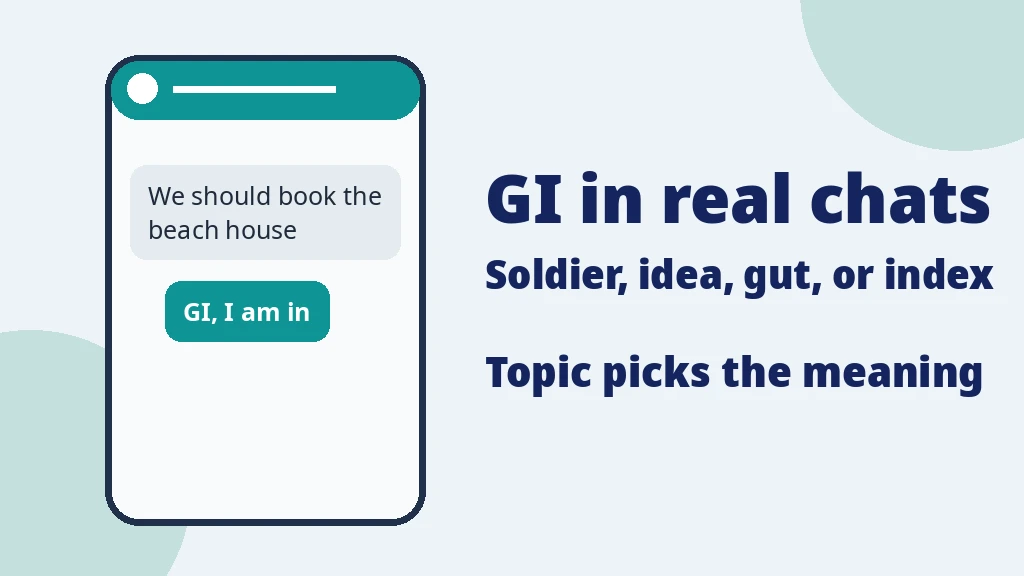
- Friend: “We should book the beach house this weekend.”
- You: “GI, I am in.”
Meaning: Good idea, I agree with the plan. This is the casual chat sense, slang site usage.
Example 2:
- Post: “My grandad was a GI in 1944.”
- Reply: “Respect to him.”
Meaning: An American soldier. The year and family history make the military sense certain.
Example 3:
- Friend: “Doctor said my GI issues are just stress.”
- You: “Hope it settles soon.”
Meaning: Gastrointestinal issues, stomach and intestine problems. The doctor context decides it.
Example 4:
- Friend: “Swapping to low GI breakfasts this month.”
- You: “Oats are a good start.”
Meaning: Low glycemic index foods. The food and diet context points to nutrition, not medicine.
Example 5:
- Friend: “GI gear from that surplus store is solid.”
- You: “Good quality for the price.”
Meaning: Government Issue gear, military equipment. “Gear” marks it as equipment, not a person.
GI vs Similar Terms
The gi vs general information question comes up because one guide leads with General Information for GI. Treat that as a weak, single source claim. In real use, GI readers will almost always take a military, medical, nutrition, or Good Idea reading first.
| Term | Meaning | When to use it |
|---|---|---|
| GI | Soldier / Good Idea / gut / food index | Only when the topic makes it clear |
| GM | Good Morning | Morning greetings in chats |
| GOAT | Greatest Of All Time | Praising someone or something |
| GE | Good Evening | Evening greetings, less common |
| GI Bill | Veterans benefits law | Benefits and education talk only |
Key difference: GM and GOAT have settled chat meanings, while GI does not, so GI needs its topic nearby. The gi good idea meaning is chat slang, while soldier and medical senses are established field uses, so do not present Good Idea as dictionary backed. For a settled agreement term, here is what FR means in text.
Variations: “G.I.” with periods is the older military spelling, “GI Joe” is the soldier figure and phrase from 1942, and “G.I. can” is the original galvanized iron item from Army paperwork. Lowercase “gi” in a fast chat usually means Good Idea, while capital “GI” in formal or field writing usually means one of the established senses.
How to Reply to GI
Your reply depends on which GI you just read, so name it first in your head before typing.
If it means Good Idea: carry the plan forward. “Perfect, let us do it” or “Yes, booked” matches the agreement and moves the chat on.
If it means soldier or gear: reply to the history or the item, not to an agreement. “Interesting story” or “Nice find” fits, while “Agreed” would sound odd.
If it is medical or nutrition: reply with care or curiosity. “Hope you feel better” fits a symptom message, while “What foods are you swapping?” fits a diet message.
If you are not sure: ask the topic question. “Do you mean Good Idea, or the military sense?” takes one line and prevents a reply that answers the wrong GI. For a short form with a much clearer single meaning, here is what SMH means in text.
When to Use GI (and When to Avoid It)
Good situations:
- Agreeing with a friend who already uses GI for Good Idea
- Military or history talk where the soldier sense is obvious
- Medical or nutrition talk where the field sense is standard
- Writing about the GI Bill, where the phrase itself removes doubt
Avoid using GI when:
- The reader could take a different sense, which is most casual chats
- The message is formal and the full phrase would be clearer
- You mean Good Idea to someone who only knows the soldier sense
- Clarity matters more than saving a few keystrokes
The safest rule for GI is topic first, abbreviation second. If the topic is not already in the conversation, spell the phrase out. “Good idea” is only five extra letters and it removes a four way ambiguity.
Common Misunderstandings About GI
It does not have one chat meaning. Any guide that crowns Good Idea or soldier as the only GI meaning is hiding the other layers. GI is multi sense by documentation, not by opinion.
Good Idea is not dictionary backed. It is real chat usage from slang sites and CyberDefinitions third definition, but no dictionary entry for that sense was found in this check. Label it honestly.
It is not a country code in chat. GI is the ISO code for Gibraltar, but nobody texting “GI” means Gibraltar unless the conversation is about country codes.
It is not Google It by default. That reading comes from one weak list entry. Do not reply to GI as if someone told you to search, unless the sentence clearly asks a question you should look up.
Frequently Asked Questions
What does GI mean in text?
GI has no single settled texting meaning. It traces to American Soldier and Government Issue, means Good Idea as casual chat agreement, gastrointestinal in medical talk, and glycemic index in nutrition talk. The topic decides.
Does GI mean Good Idea?
Yes, in casual chats GI can mean Good Idea, as agreement with a suggestion. That sense rests on slang sites and CyberDefinitions third definition, not on a dictionary entry, so label it as chat usage.
What does GI mean in medical talk?
In medical talk, GI means gastrointestinal, relating to the stomach and intestines, as in GI tract, GI pain, or GI bleeding.
What does GI mean in food and diet talk?
In food talk, GI means glycemic index, a ranking of how fast a food raises blood sugar. Low GI foods release energy slowly, high GI foods raise it faster.
What is the GI Bill?
The GI Bill is the law that helped World War II veterans with education and housing benefits. It is a proper phrase, not GI alone used as a chat abbreviation.
How do you reply to GI?
Match the sense: carry a Good Idea plan forward, reply to the history or item for soldier talk, show care for medical talk, and ask “Do you mean Good Idea?” when unsure.
Related Texting Slang
Keep exploring the dictionary: CV in chats and texts, FYI in chats and texts, FYP in chats and texts, slow startup on windows meaning in text, when someone texts you IBM.
Final Thoughts
GI rewards readers who check the topic before they react. In military talk it is a soldier or issued gear, in casual chat it is often Good Idea, in medical talk it is gastrointestinal, and in food talk it is glycemic index. No one sense wins every room.
When you use GI yourself, give readers the topic first or spell the phrase out. “GI, great plan” is clear, while a bare “GI” to a stranger is a guessing game. The two extra words are worth it.
The history is well documented. Wikipedia traces G.I. from Army paperwork to soldiers in World War II, and Wiktionary lists the military, gastrointestinal, and glycemic index senses side by side, which is exactly the split this guide describes.