A recruiter messages you: “Please send your CV.” A friend abroad says: “My CV is finally ready.” You have a resume saved on your laptop, but is that the same thing? Should you send it, or is something else being asked for?
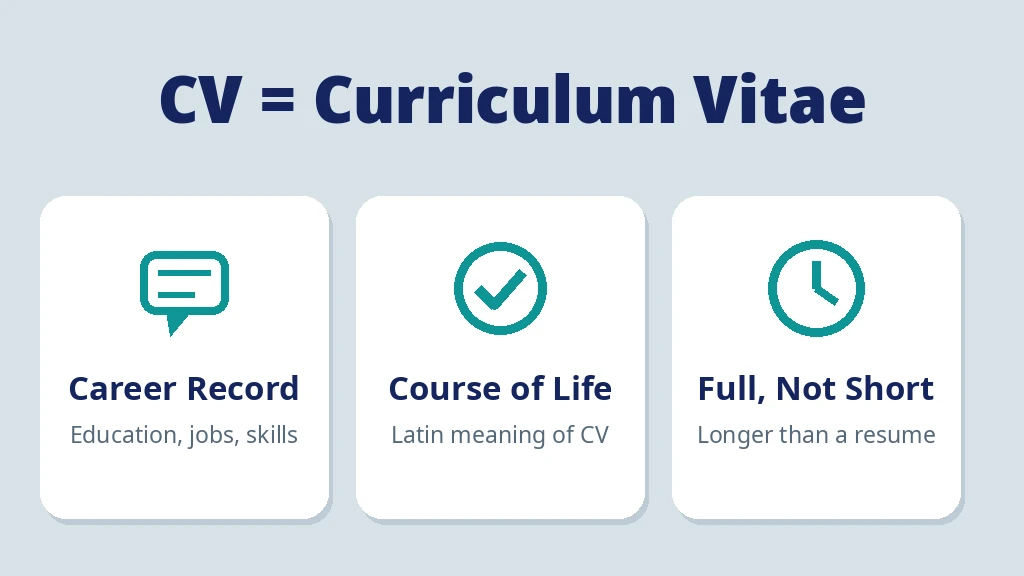
Here is the short answer: CV means “Curriculum Vitae,” Latin for “course of life.” It is a detailed document of your education, work history, skills, and achievements, used for jobs and academic roles. Outside North America, it is the standard job document, and it is usually longer and more detailed than a resume.
CV also has a few minor senses in other worlds, from anime credits to gaming, but in a job chat, the document meaning wins almost every time. This guide explains what a CV is, how it differs from a resume, what “send your CV” really asks for, and how to reply when the request lands in your messages.
📌 What Does CV Mean in Text?
CV stands for Curriculum Vitae, pronounced roughly “kuh-RIK-yuh-lum VEE-ty.”
A curriculum vitae is a complete record of your professional and academic life. It lists your education in full, every relevant job, publications or research if you have them, skills, awards, and references. Unlike a short summary, it is meant to grow over your career. A senior academic’s CV can run many pages, because it documents a whole working life, not just the last job.
✅ Quick definition: CV means “Curriculum Vitae” (Latin for “course of life”), a detailed career and academic document listing education, work history, skills, and achievements. Outside North America it is the standard job application document, and it is usually longer and more complete than a resume.
The geography matters. In the UK, Europe, Australia, and much of Asia and Africa, “CV” is the everyday word for the document you send with a job application. In the United States and Canada, people usually say “resume” for job applications and reserve “CV” for academic, research, and medical roles.
When someone texts “send your CV,” they are asking for a file, usually a PDF, that they can read and share with a hiring team. Treat it as a formal request, even in a casual chat app.
💡 CV Meaning in Easy Words
Think of a CV like the full story of your working life.
👉 A resume is the short trailer
👉 A CV is the full film
👉 Both tell your story, but the CV leaves less out
So in the simplest words:
CV = your complete career record in one document.
A resume is usually trimmed to one or two pages and tailored to one job. A CV keeps the fuller record, in order, so a reader can trace your path from start to now.
That difference explains why a CV feels more formal. It is evidence, not a quick pitch: a hiring manager wants the shape of a career, and an academic committee wants the full record.
🌍 Where Is CV Used?
CV lives in job hunting, hiring, and academic life, since so much recruiting now happens on chat apps.
📱 Common places:
- Job application emails and recruiter messages
- WhatsApp and LinkedIn chats with hiring managers
- University and research job postings
- Freelance and consulting introductions
- Internship and graduate program applications
- Professional networking groups
🗣️ Example situations:
- A recruiter asks a candidate to send their CV for a role
- A student applies for a research assistant position
- A freelancer shares a CV to win a consulting project
- A graduate prepares a CV for jobs abroad
- A manager asks a colleague for an updated CV for a bid
🤔 Why Do People Use CV?
🔥 It is the standard word in most of the world
Outside North America, nobody says “send your resume” in daily hiring talk. CV is simply the word everyone uses, so job chats use it without thinking.
😑 It signals a complete record
Saying CV instead of resume tells the reader to expect detail. That matters for academic and senior roles, where a short summary would hide the very experience being judged.
💬 It travels well across borders
International hiring needs a shared term. CV is understood by recruiters in London, Dubai, Sydney, and Lahore alike, even when local formats differ.
💬 Real-Life Examples of CV
Examples:
Example 1:
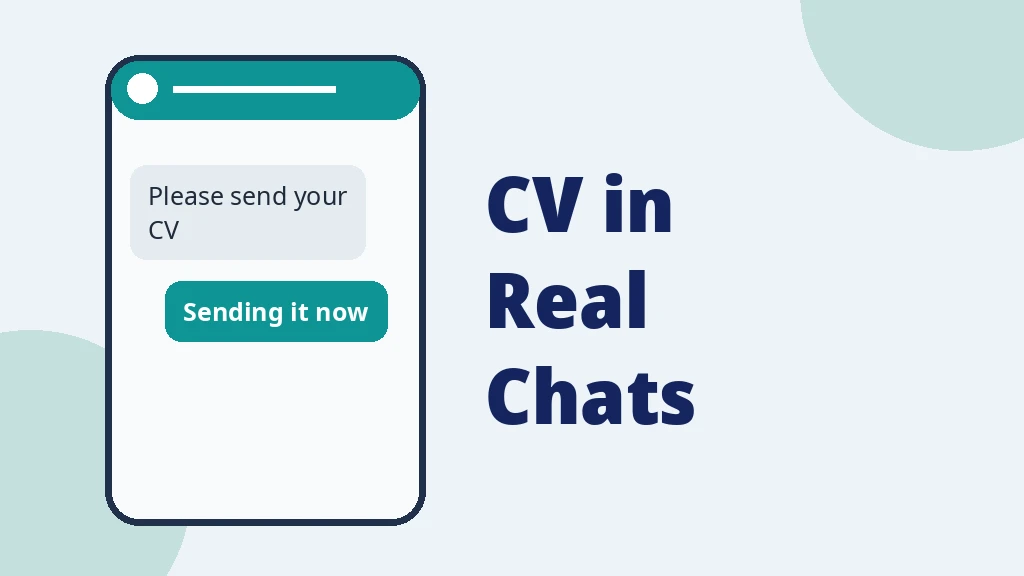
- Recruiter: “Thanks for your interest. Please send your CV.”
- You: “Sure, sending it as a PDF now.”
👉 Meaning: A formal request for your career document, usually as a PDF attachment.
Example 2:
- Friend: “My CV is finally ready for UK jobs.”
- You: “Nice, did you tailor it for each role?”
👉 Meaning: A job document prepared for applications abroad, where CV is the standard term.
Example 3:
- Manager: “Can you share an updated CV for the client proposal?”
- Employee: “Yes, I will send the latest version today.”
👉 Meaning: A current career record needed for a business document, not a job application.
Example 4:
- Student: “Do I need a CV for this internship?”
- Advisor: “Yes, even a short one helps. List your degree and projects.”
👉 Meaning: A first career document for someone with little work history yet.
⚖️ CV vs Similar Terms
| Term | Meaning | Typical length |
|---|---|---|
| CV | Curriculum Vitae | Full record, often several pages |
| Resume | Short career summary | Usually 1 to 2 pages |
| Bio | Short personal profile | A paragraph, not a document |
| Portfolio | Collection of work samples | As long as the work needs |
| Cover letter | Letter with an application | Usually 1 page |
🧠 Key difference:
- A CV is complete. A resume is selective. Send a CV when the full record is wanted, and a tailored resume when a short, focused pitch is wanted.
- A bio introduces you. A portfolio proves your work with samples. A CV lists the career behind both.
- A cover letter explains why you want one specific role. A CV shows whether your history fits it.
Job hunting short forms can pile up fast. Here is what BTO means in text, a work abbreviation you may meet in the same office chats where CV requests arrive.
🔁 CV Variations You Should Know
Academic CV is the longest form, listing degrees, teaching, research, publications, grants, and talks in full, and it is the standard for university jobs.
Professional CV is the everyday job hunting version, covering education, work history, skills, and achievements, usually in two to four pages.
Other minor senses: In anime credits, CV can mean “character voice,” the voice actor behind a character. In gaming, it can mean “clutch victory,” a win snatched from a losing position. CV is also the country code for Cape Verde. None of these beats the document meaning in a job chat.
↩️ How to Reply to CV
Your reply depends on what was asked and how ready you are.
If you have a CV ready: send it promptly as a PDF, with a short note. “Here is my CV for the role, happy to share anything else you need” is polite and professional.
If you only have a resume: say so honestly. “I have a resume ready, and I can expand it into a full CV if you need one” works well, especially for senders outside North America who expect the longer form.
If you need time: give a clear time, not a vague promise. “I will send an updated CV by tomorrow evening” beats “soon” and keeps the recruiter’s trust.
And if the request arrives while you are away from your files, a quick BRB style reply, like “BRB, I will send it from my laptop in ten minutes,” keeps the conversation warm.
⏰ When to Use CV (and When to Avoid It)
✅ Good situations:
- Applying for jobs outside North America
- Applying for academic, research, or medical roles anywhere
- Sharing a full career record for a proposal or bid
- Keeping a personal archive of your career history
⚠️ Avoid using CV when:
- A US employer asked for a resume and expects a short version
- The role wants a one page summary, not a full record
- You are chatting casually and no job is involved
- The document is out of date, since an old CV hurts more than a short one
⚠️ Common Misunderstandings About CV
Let’s clear up the confusion around CV:
❌ CV and resume are not always the same. In the US, a resume is short and a CV is academic and long. Outside North America, CV is the standard job document, and it may be shorter than an academic CV but still fuller than a US resume.
❌ A longer CV is not automatically better. Padding with old, irrelevant jobs weakens it. Complete means relevant and honest, not endless.
❌ “Send your CV” does not mean a chat summary. It means a document file. A few lines about yourself in the chat are a nice intro, but they do not replace the file.
❌ CV is not a slang reaction. It does not express a feeling like SMH or LOL. In almost every message, it names a document, or, rarely, one of the minor senses above.
💡 Pro Tips for Your CV
✅ Send a PDF, not an editable file. A PDF keeps your layout intact on every device, and it looks more professional than a document that can be changed by accident.
✅ Tailor the top third. Recruiters read the top of a CV first. Put the experience most relevant to the role there, not your earliest job.
✅ Update it after every role. Add new jobs, skills, and achievements while they are fresh. A CV updated once a year is a chore, but a CV updated as you go is a habit.
Related Texting Slang
Keep exploring the dictionary: ATM, the meaning of DM, EMA, explained with real examples, what ETP means in a text, FYI, explained with real examples.
Frequently Asked Questions
What does CV mean in text?
CV means “Curriculum Vitae,” Latin for “course of life.” It is a detailed document of your education, work history, skills, and achievements, used for jobs and academic roles.
What is the difference between a CV and a resume?
A CV is a fuller, longer record of your whole career and education. A resume is a short, tailored summary, usually one to two pages, focused on one specific job.
When should I send a CV instead of a resume?
Send a CV for jobs outside North America, where it is the standard term, and for academic, research, or medical roles anywhere. Send a resume when a US employer asks for a short summary.
What does “send your CV” mean in a chat?
It means send your career document as a file, usually a PDF, so the recruiter or manager can read it and share it with a hiring team. A short chat intro does not replace the file.
How long should a CV be?
There is no fixed length. A professional CV is often two to four pages, while an academic CV can be much longer because it lists publications, teaching, and research in full.
🧾 Final Thoughts
CV sounds mysterious until someone translates it once. After that, it is simple: a curriculum vitae is your career on paper, complete and in order.
Now you know what CV means, how it differs from a resume, what to send when a recruiter asks, and what the rare other senses are. Keep yours updated, save it as a PDF, and the next “send your CV” message will take you two minutes instead of a panicked evening.
For the standard definitions, Cambridge Dictionary defines CV as a short written description of your education and previous jobs that you send to an employer, and Merriam-Webster defines curriculum vitae as a short account of one’s career and qualifications.
3 thoughts on “CV Meaning in Text | More Than a Job Document?”