You open a post, and the comments are full of the same two letters: “DM.” A creator writes “DM for collab.” A friend writes “I will DM you later.” Someone else brags about sliding into DMs.
It sounds simple, but if you are new to social media, those two letters can feel like a locked door. What exactly is a DM, and why does everyone prefer it over a normal comment?
Here is the short answer: DM means “direct message.” It is a private message sent between two people on social media or a messaging app, and only the people in that chat can see it.
In this guide you will learn what DM means in text, where it is used, how it differs from a comment or a text message, and how to use it without the usual beginner mistakes. Real examples are included, so you can spot the meaning instantly next time it pops up.
What Does DM Mean in Text?
DM stands for Direct Message. It is a private conversation inside a social app, sent from one person to one person or to a small group, and hidden from the public feed.
Think of a public post as a noticeboard. Everyone walking past can read it. A DM is the opposite: a sealed note handed directly to one person. The rest of the internet sees nothing.
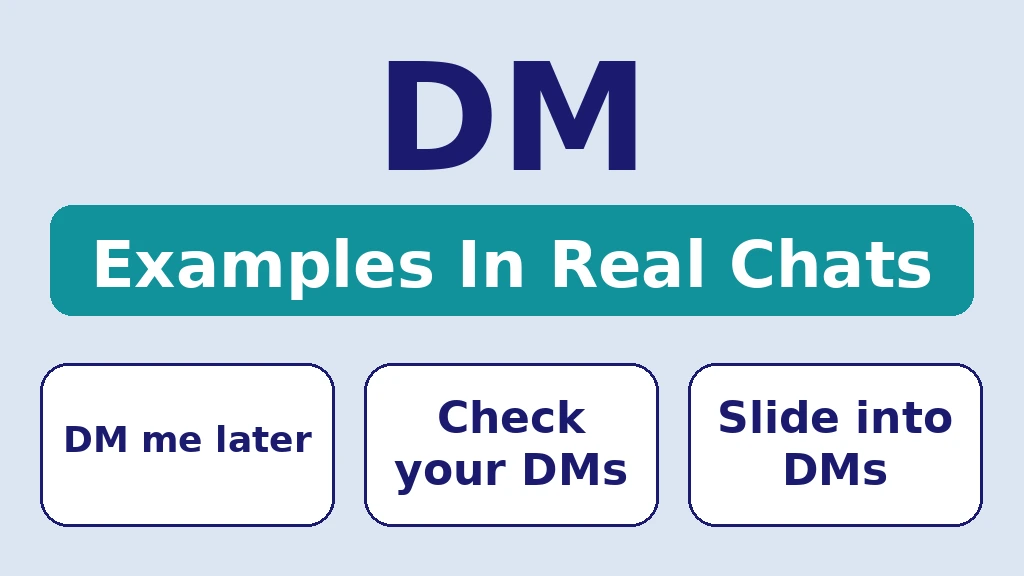
DM works as a noun and as a verb. As a noun, it is the message itself: “Check your DMs.” As a verb, it is the act of sending one: “I will DM you the address.” The plural, DMs, usually means your whole private inbox, not just one message.
Quick definition: DM means “direct message,” a private message between users on social media or a messaging app, separate from public posts and comments.
The term became popular on Twitter, now X, where early users needed a short way to talk about private messages. It spread from there to Instagram, Facebook, TikTok, Discord, and almost every app with an inbox. Today, even people who never used Twitter say DM without thinking twice.
DM Meaning in Easy Words
Picture a crowded party. A public comment is shouting across the room so everyone hears you. A DM is pulling one person aside and whispering just to them.
That is the whole idea. In the simplest words:
DM = “A private message, just between us.”
No code, no hidden joke, no secret handshake. When someone says DM, they mean a chat that stays between the sender and the receiver, away from likes, comments, and followers.
Where Is DM Used?
DM lives on almost every platform with a private inbox. The name of the inbox changes, but people still call it a DM.
Common platforms:
- Instagram direct messages, for friends, creators, and shops
- X direct messages, where the term started
- TikTok private messages between users and creators
- Facebook Messenger, often still called DMs in comments
- Snapchat chats, for quick private replies
- Discord direct messages, outside public servers
- LinkedIn messages, even in professional networking
Common situations:
- A friend sends a meme or a secret you should not post publicly
- A shop answers a price question without spamming its comments
- A creator talks to a brand about a collaboration
- A support team asks for an order number to fix a problem
- Someone starts a private conversation after meeting in a public thread
Why Do People Use DM?
Privacy first
Some things are not for public consumption: addresses, prices, phone numbers, complaints, and personal news. A DM keeps those details between the people who need them.
It feels personal
A comment is written for an audience. A DM is written for one person. That shift changes the tone completely, and it is why friendships, deals, and even romances often start in DMs rather than in comments.
It is faster than email
No subject line, no formal greeting, no waiting for an inbox refresh. A DM is a quick question and a quick answer, which is why small businesses now handle a large share of customer questions there.
It avoids public embarrassment
Asking for help, admitting a mistake, or negotiating a price all feel safer in private. A DM lets people be honest without an audience judging every word.
It builds real connections
Public comments spark introductions, but the real conversation almost always moves to DMs once things get personal, specific, or serious. That is true for friends, fans, customers, and collaborators alike.
Real-Life Examples of DM
Here is how DM actually appears in everyday chats, with a short note under each example so the tone is clear.
Example 1:
- Friend: “I will DM you the address so I do not post it publicly.”
- You: “Perfect, send it over.”
Meaning: A private detail shared safely. The address stays out of the public thread.
Example 2:
- Creator: “DM for collab inquiries.”
- Brand: “Just sent you a DM about next month.”
Meaning: A professional invitation. Business talk moves to a private inbox.
Example 3:
- Friend: “He slid into my DMs last night.”
- You: “Oh really? What did he say?”
Meaning: Someone started a private conversation, often with romantic or flirty intent. Context decides how flirty it really was.
Example 4:
- Shop: “Please DM us your order number so we can help.”
- Customer: “Sent. Thank you.”
Meaning: Customer support in private. The order number never appears in public comments.
Example 5:
- Friend: “Check your DMs, I sent you something funny.”
- You: “On it. Give me a second.”
Meaning: A simple nudge. A private message is waiting, separate from the public chat.
DM Variations You Should Know
DMs is the plural and usually means your inbox as a whole. “My DMs are full” means a lot of private messages are waiting, not just one.
DM me / DM us is a request. “DM me” asks you to message one person privately, while “DM us” is the version brands use for a shared inbox.
Slide into DMs means to start a private conversation with someone, often someone you do not know well. It is playful, and it often hints at romantic interest, but it can also be purely friendly.
My DMs are open means the person welcomes private messages from anyone, even strangers. It is an open invitation, not a demand.
DM’d / DMed is the past tense. “She DM’d me last night” means she already sent a private message.
DM request is a message from someone you do not follow. Many apps keep these in a separate folder, so they are easy to miss.
DM as “doesn’t matter.” As a bare reply, DM can also mean “doesn’t matter”: the sender has no strong preference. It usually answers a choice or a question, as in “Pizza or burgers?” “dm.”
DM as “don’t mind.” Closely related, a bare DM can mean “don’t mind,” again signalling that either option is fine. The tell for both senses is position: a DM with nothing after it, answering a question, is indifference, not an inbox. When DM is followed by “me” or names a message, it is the direct message sense.
DM vs Similar Terms
| Term | Meaning | Key difference |
|---|---|---|
| DM | Direct Message | Modern social media term for a private message |
| PM | Private Message | Older forum term, same basic idea |
| IM | Instant Message | Early chat apps like AIM and MSN, mostly outdated now |
| Text / SMS | Phone message | Uses a phone number, not a social app username |
| Comment | Public reply | Visible to everyone, the opposite of a DM |
Key difference: DM and PM mean the same thing in practice, but DM won the modern popularity contest thanks to Instagram and X. A text message is different because it leaves the social app entirely and goes to a phone number.
When to Use DM (and When to Avoid It)
Good situations:
- Sharing private details like an address, price, or order number
- Starting a personal conversation that does not belong in public
- Contacting a creator, shop, or brand about work or support
- Continuing a public thread that got personal or complicated
- Sending a meme, photo, or link meant for one person only
Avoid using DM when:
- The answer would help everyone reading, like a public event time
- You are writing a formal email, where “message me privately” reads better
- You are messaging a stranger with personal questions they did not invite
- The topic is serious, formal, or legal, and needs a proper record
- Someone has already said they prefer public comments
Common Misunderstandings About DM
DM does not always mean flirting. Sliding into DMs can be flirty, but most DMs are ordinary: friends, shops, support teams, and coworkers use them all day.
A DM is not the same as a text. Texting uses a phone number through SMS. A DM uses a social app username and stays inside that app.
DMs are not 100 percent private and safe. They are hidden from the public feed, but screenshots happen. Never send passwords, bank details, or anything sensitive to someone you do not trust.
Getting a DM does not mean someone likes you. Brands, bots, strangers, and support teams send DMs constantly. The content and the sender matter far more than the fact that a message arrived.
DM is not only a Twitter thing anymore. It started there, but today it describes private messages on Instagram, TikTok, Facebook, Discord, and almost every other platform.
How to Reply to DM
Your reply depends on what kind of DM it is.
If a friend DM’d you: just reply like a normal chat. No special format is needed. A quick “Hey, what is up?” or a direct answer to their question is perfect.
If someone writes “DM me”: confirm the move first. “Sending you a DM now” tells them to check their inbox, including their requests folder.
If a brand or creator DM’d you: keep it clear and polite, and state your question in the first message. “Hi, I have a question about my order” beats a bare “hi” that leaves them guessing.
If a stranger slides into your DMs: you are free to ignore it, reply briefly, or set a boundary. “I prefer to keep chats in the comments” is polite and final.
If the DM is flirty and unwanted: do not feel obliged to be polite at length. A short “Not interested, thanks” or no reply at all, plus block if needed, is a complete response.
If the DM is about work: answer in the DM, not in public comments, and keep the thread in one place so details do not get lost.
Pro Tips for Using DM Well
Check your requests folder. Messages from people you do not follow often hide there. Check it regularly, or you will miss opportunities and answers.
Lead with the point. A first DM should say who you are and what you want in two or three lines. Long, vague openers get ignored.
Keep business DMs professional. The format is casual, but the tone for work should stay clear, polite, and specific.
Do not overshare with strangers. Hold back addresses, financial details, and passwords until you are sure who you are talking to.
Reply promptly if you invited DMs. If your bio says “DM for collabs,” people expect an answer. A slow reply costs real opportunities.
Use DMs for sensitive topics. Anything you would not want in a public comment section belongs in a DM, with the screenshot warning in mind.
Frequently Asked Questions
What does DM mean in text?
DM means “direct message,” a private message sent between two people on social media or a messaging app, separate from public posts and comments.
What is the full form of DM?
The full form of DM is “direct message.” It describes a private, one to one conversation inside a social app.
Is DM the same as a text message?
No. Texting uses a phone number through SMS, while a DM stays inside a social app and uses usernames. They feel similar, but they are different channels.
What does sliding into DMs mean?
It means starting a private conversation with someone, often someone you do not know well. It often carries a flirty hint, but it can also be a friendly or business opener.
Are DMs private?
DMs are private from the public feed, but they are not fully secure. The other person can screenshot or forward them, so avoid sending sensitive personal or financial details.
What does DM mean in gaming?
In most gaming chats DM still means direct message, a private chat between players. In tabletop and some older games it can also mean Dungeon Master, the person who runs the game, so check the context.
Can DM mean doesn’t matter?
Yes. As a bare reply to a choice or question, DM can mean “doesn’t matter” or “don’t mind,” showing the sender is fine with either option. If DM is followed by “me” or talks about messages, it means direct message instead.
Related Texting Slang
Keep exploring the dictionary: the meaning of two exclamation marks, what DNI means in a text, when someone texts you IYKYK, FYP in chats and texts, GOAT in chats and texts, clock it, explained with real examples, DP.
Final Thoughts
DM is one of the simplest terms on the internet, and also one of the most useful. It means “direct message”: a private, one to one conversation inside a social app, away from public comments and posts.
Once you know that, the rest falls into place. “DM me” is a request to go private. “Check your DMs” means a private message is waiting. “Sliding into DMs” means starting a private chat, sometimes with a flirty edge. None of it is secret code, just a shortcut for privacy in a very public internet.
For a reference check, Wiktionary lists the social sense of DM alongside its many other uses, and CyberDefinitions puts Direct Message first in its summary table, ahead of its secondary senses. The same private versus public idea explains plenty of other short terms too, including what BRB means in text and what SMH means in text.
14 thoughts on “DM Meaning in Text | Real Examples That Make It Click”