If you have ever opened a profile and seen three capital letters at the top of the bio, you are not alone in wondering what they mean. DNI means do not interact. It is a short, firm boundary that tells certain people not to message, follow, comment, or engage with that account or post.
Unlike most chat slang, DNI is not a joke, a reaction, or a mood. It is a rule set by the person who wrote it. In this guide, you will learn exactly what DNI means in text, where it shows up, how people write it in bios and posts, and how to respond to it with respect. By the end, you will also know what DNI does not mean, so you never mix it up with a government title or a medical term.
What Does DNI Mean in Text?
DNI stands for do not interact. When someone writes DNI, they are asking a specific group of people not to engage with them or their content. That request can cover messages, follows, comments, likes, shares, and replies.
The most common form is a DNI list in a bio or pinned post. A DNI list names the groups the account does not want interaction from. A typical example is “DNI minors”, which means people under 18 should not interact with that account. Another is “DNI if you support hate speech”, which sets a values based boundary for the space.

DNI Meaning in Easy Words
Think of DNI as a “please do not enter” sign on a digital door. It does not lock the whole internet. It tells you, clearly and in advance, that this person or this post is not open to you or to the group named in the list.
A helpful way to read it is to split it into two parts. The “do not” part is the instruction. The “interact” part is everything that counts as engagement online: sending a message, leaving a comment, following the account, quoting the post, or joining a conversation around it. If the DNI list names your group, the respectful move is to scroll past and leave that space alone.
Where Is DNI Used?
DNI is mainly a social media term, not a private texting term. You will see it most often in these places.
On TikTok, DNI often appears in bios, video captions, and pinned comments. Creators use it to keep age restricted or sensitive content away from minors, and to keep arguments out of their comment section. On Instagram, it shows up in bios and story highlights, often next to a short list of who should not follow or message.
On X, formerly Twitter, DNI appears in bios and pinned posts, especially in fandom and art communities where people want a safer comment section. On Tumblr and Discord, DNI lists are part of community culture. Servers may post DNI rules in their guidelines, and individual users may put a DNI list in their profile or introduction.
In private chats between friends, DNI is rare. Friends do not usually need a formal boundary sign, because they can just say “please stop” in plain words. If you do see DNI in a private chat, treat it as a serious request, not as a joke.
Why Do People Use DNI?
People use DNI because it is short, clear, and public. One line in a bio can prevent dozens of unwanted messages. Without it, a creator would have to repeat the same boundary to every new visitor.
Safety is a major reason. Accounts that post adult humour, horror art, or mature discussion use DNI to warn minors away. Parents, teachers, and moderators may also appreciate a clear label, because it makes the intended audience obvious at a glance.
Comfort is another reason. Online spaces can turn hostile fast, especially around fandoms, politics, and identity. A DNI list lets a person say, in advance, which arguments they do not want in their space. It is a way to protect their peace without getting into a fight about it.
DNI Variations and Related Terms
DNI has a few close relatives that are worth knowing, because they are often written side by side in bios.
DNF means do not follow. It is softer than DNI in one way: it only asks people not to follow, while DNI asks them not to interact at all. BYF means before you follow. A BYF list tells new followers what they should know before they follow, such as the account’s age, content warnings, or posting habits.
MDNI means minors do not interact. It is a short form of “DNI minors” and is common on accounts with mature content. DN, short for do not, is sometimes used as a prefix, as in “DN: no DMs”. It works like a mini DNI list for one specific action.
Real Chat Examples of DNI
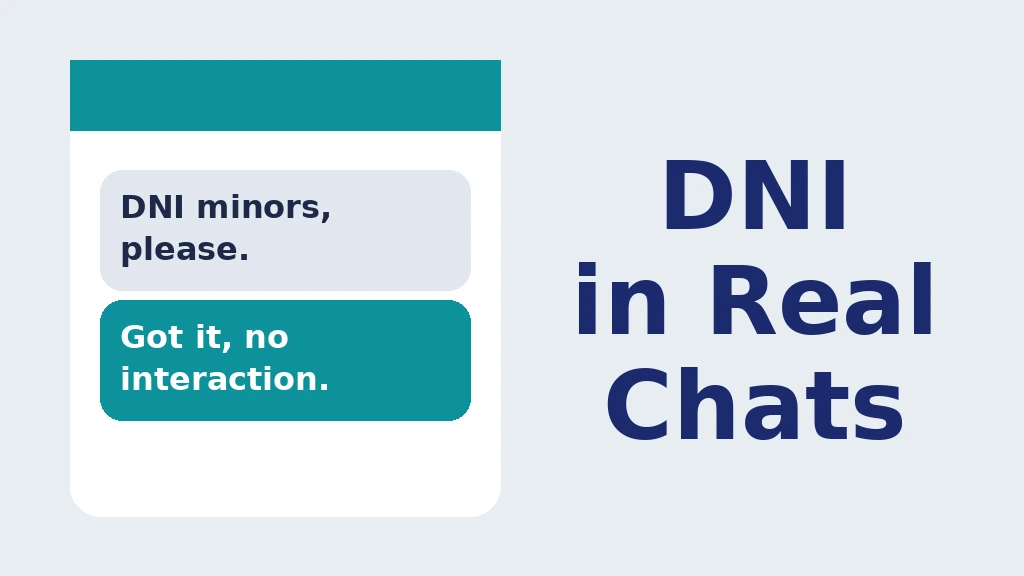
Here are realistic examples of how DNI appears in the wild. Each one is followed by a short note on what it means in context.
Example 1: “DNI minors. This account posts horror art and dark humour.” Meaning: People under 18 should not follow, comment, or message this account.
Example 2: “DNI if you hate this fandom. I post about it daily and I am not looking for arguments.” Meaning: Fans who dislike the fandom should not engage with these posts.
Example 3: “Please read my DNI before messaging me. I do not reply to strangers about personal topics.” Meaning: The bio contains a list. Read it first, and do not send a personal message if you fall in one of the listed groups.
Example 4: “DNI: trolls, spam accounts, and people who repost my art without credit.” Meaning: Those three groups should not interact with the account or its work.
DNI vs Similar Terms
It is easy to confuse DNI with other short terms, but each one does a different job. The table below keeps them straight.
DNI means do not interact, and it covers all engagement. DNF means do not follow, and it covers only following. BYF means before you follow, and it is information for new followers rather than a ban. “Blocked” means the account has already taken action against you. “Muted” means the other person will not see your posts, but you may not know it has happened.
If you are choosing a term for your own bio, pick the one that matches your goal. Use DNI when you want a group to stay away completely. Use DNF when following is the only problem. Use BYF when you want to inform people, not exclude them.
For other short chat terms, see our guide to SMH and our guide to BRB, two abbreviations that, unlike DNI, are used as reactions inside a conversation.
When to Use DNI and When to Avoid It
Use DNI when you run a public or semi public account and you want a clear, upfront boundary. It works well for creators, fandom accounts, art accounts, and community servers. It also works well when your content is not suitable for minors, or when you regularly receive unwanted arguments.
Use DNI in your bio or pinned post, not buried in a single old post. People can only respect a boundary they can find. Keep the list short and specific. A list of two or three clear groups is easier to follow than a long list of vague complaints.
Avoid DNI in private chats with close friends, where a plain sentence works better. Saying “please do not bring this up with me” is kinder and clearer than a formal acronym. Avoid DNI as an insult. Writing “DNI” at someone to win an argument turns a boundary tool into a weapon, and it usually makes the conflict worse.
Common Misunderstandings About DNI
One common misunderstanding is that DNI means the person hates everyone. It does not. A DNI list is aimed at specific groups, not at the whole internet. Most DNI lists leave the door open to everyone else.
Another misunderstanding is that DNI is rude by itself. It can feel blunt, because it is short and direct. But a clear boundary is often kinder than silence followed by a block. Many people write DNI politely, with words like “please” and a short reason.
A third misunderstanding is that DNI is a legal warning. It is not. Ignoring a DNI list is not a crime, but it is disrespectful, and it often leads to a block or a report. Think of it as a house rule, not a law.
A fourth misunderstanding is confusing DNI with its other meanings. In news, DNI can mean Director of National Intelligence. In medicine, it can mean do not intubate. In Spain and parts of Latin America, DNI is a national identity document. Context tells you which meaning applies, and in a social media bio, the meaning is almost always do not interact.
How to Reply to DNI
If you see a DNI list and you are in one of the listed groups, the best reply is no reply. Do not argue with the list, do not test it, and do not send a message to ask for an exception. Scroll past and find a space that welcomes you.
If someone sends you a direct “DNI”, stop interacting with them. You do not need to send a long apology, and you should not send a final message to get the last word. A short “Understood, I will leave you alone” is enough, and only if you feel a brief acknowledgement is appropriate. In many cases, silence is the most respectful answer.
If you are unsure whether a DNI list applies to you, read it twice and take the cautious path. If the list is vague, you can simply avoid that account. You do not need to ask the person to explain their boundary to you.
If you run into DNI on a server or in a community, follow the community rules as well. Moderators may enforce DNI lists, and breaking them can lead to a warning or a removal from the server.
Pro Tips for Using DNI Well
Keep your DNI list short, specific, and polite. Start with “please” when you can, and give a one line reason if it helps people understand. For example, “DNI minors, this account posts mature art” is clearer than a bare list of labels.
Review your list every few months. Interests change, fandoms change, and a list written a year ago may no longer match your space. Remove groups that no longer matter, and add only what you truly need.
Pair DNI with a positive note about who is welcome. A line like “Everyone else, welcome here” softens the boundary and tells friendly visitors that they belong. Boundaries work best when they are clear about both sides: who should stay away, and who is invited in.
Related Texting Slang
Keep exploring the dictionary: two exclamation marks meaning in text, what como means in a text, DM, DP, dre meaning in text, FYP in chats and texts, GOAT in chats and texts.
Final Thoughts
DNI is one of the simplest tools in online life, and also one of the most misunderstood. At its core, it means do not interact: a clear request from a person who wants a safer, calmer space for their posts. It is not a joke, not an insult, and not a mystery code. It is a boundary, written in public, so that everyone can see it before they engage.
If you write a DNI list, keep it short, specific, and kind. If you read one, respect it, even when you disagree with it. That small act of respect is what keeps online communities usable for everyone. For the reference definition, CyberDefinitions explains DNI as do not interact on social apps, and Wiktionary lists the same internet slang sense alongside its other, unrelated meanings.
Frequently Asked Questions
What does DNI mean in text?
DNI means do not interact. It tells certain people not to message, follow, comment, or engage with an account or post.
What does DNI minors mean?
DNI minors means people under 18 should not interact with that account. It is common on accounts with mature, horror, or adult themed content.
Is DNI rude?
DNI is not rude by itself. It is direct, and direct can feel blunt, but a clear boundary is usually kinder than ignoring people and then blocking them without warning.
What is the difference between DNI and DNF?
DNI asks people not to interact at all. DNF only asks people not to follow. DNI is the wider boundary, and DNF is the narrower one.
What does DNI mean on TikTok?
On TikTok, DNI usually appears in bios and captions. It tells certain viewers not to comment, follow, or engage, often to keep mature content away from minors or to keep arguments out of the comments.
Does DNI mean Director of National Intelligence?
Only in government and news contexts. In a social media bio or post, DNI almost always means do not interact. Context is the key.
How should I reply if someone says DNI to me?
Stop interacting with them. A brief acknowledgement is enough, and silence is also respectful. Do not argue with the boundary or send a final message to get the last word.