
If a friend has ever sent you four capital letters after a teasing message, you may have stared at the screen and wondered what just happened. DPMO means do not piss me off. It is a blunt, fast warning that says: stop pushing me, because my patience is running out.
DPMO is not a polite phrase, and it is not meant to be one. It sits somewhere between a joke and a real warning, and the tone depends on who sends it and what just happened. In this guide, you will learn what DPMO means in text, when it is playful, when it is serious, how it differs from PMO, and what to say instead when you want the same message without the rough edge. You will also learn the completely different business meaning, so a work report never confuses you.
What Does DPMO Mean in Text?
DPMO stands for do not piss me off. Each letter matches one word: D for do not, P for piss, M for me, and O for off. Put together, the phrase is a direct instruction to stop doing something annoying before the sender loses their temper.
People usually send DPMO in the middle of a chat, right after the annoying thing happens. A friend keeps spoiling a show, teases you about being late for the third time, or repeats a joke that has stopped being funny. Instead of typing a long complaint, the sender types four letters and the point lands at once.

DPMO Meaning in Easy Words
In plain words, DPMO means “you are testing my patience, please stop now”. It is the text version of holding up a hand and saying “enough”. The sender is not starting a long argument. They are drawing a line, quickly, before the argument starts.
The strength of DPMO comes from its bluntness. Because the full phrase uses a swear word, it sounds stronger than “please stop” or “that is annoying”. That is why friends use it with each other, and why it can sound harsh when a stranger uses it. The same four letters can be a joke between close friends or a real warning between people who are already tense.
Context is everything. An emoji, a laughing face, or a familiar joke can soften DPMO into teasing. No emoji, short replies, and a tense conversation can harden it into a serious warning. Always read the mood of the chat before you decide how to take it.
Where Is DPMO Used?
DPMO shows up wherever fast, informal chat happens. In private texts and group chats, it is a quick reaction to teasing or spoilers. In Instagram DMs, it often appears when a friend is pushing a joke too far or sharing a spoiler. On TikTok, it appears in comments and captions, often paired with memes about patience running out.
On X and Discord, DPMO works the same way. In a gaming chat, it might follow a teammate who keeps making the same mistake on purpose. In a fandom server, it might follow a spoiler posted without a warning. The setting changes, but the message stays the same: stop, before this turns into a fight.
Why Do People Use DPMO?
People use DPMO because it is fast and it cannot be misunderstood. A long message like “I am getting annoyed, please stop teasing me about this” takes time to type and can sound like the start of a lecture. Four letters deliver the same boundary in a second.
Humour is another reason. Between friends, DPMO is often exaggerated on purpose. No one truly believes a friendship will end over a spoiler, but saying DPMO makes the reaction funny and memorable. The exaggeration is part of the joke, and both sides usually know it.
DPMO Variations and Related Terms
DPMO belongs to a small family of frustration acronyms. Knowing the family helps you read the tone correctly.
PMO means piss me off. It describes a feeling that already happened: “That traffic pmo” means that traffic annoyed me. DPMO adds “do not” to the front, which turns a description into a warning: do not do the thing that would annoy me. That one change is the whole difference.
IDGAF means I do not give a swear word, and it expresses indifference rather than a warning. STFU is much harsher than DPMO, because it tells someone to be quiet. “Do not test me” and “watch it” are clean alternatives that carry a similar warning without the swear word.
Real Chat Examples of DPMO
Here are realistic examples of how DPMO appears in chats. Each one is followed by a short note on the tone.
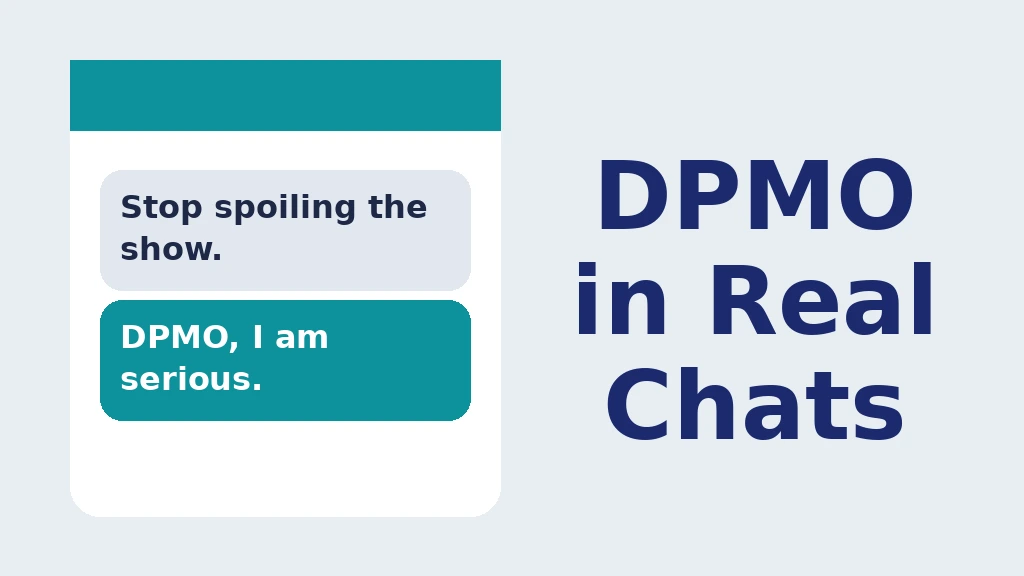
Example 1: “Stop spoiling the show. DPMO, I am serious.” Meaning: The sender is annoyed about spoilers and wants them to stop now. Tone: serious.
Example 2: “You are late again? DPMO, I waited an hour.” Meaning: The sender is frustrated about waiting, and the warning is real but not hostile. Tone: frustrated, honest.
Example 3: “DPMO, or I am leaving this group chat.” Meaning: The sender is setting a clear consequence. If the teasing continues, they will leave. Tone: firm.
Example 4: “Do not even start. DPMO.” with a laughing emoji. Meaning: The sender is teasing back, and the warning is playful. Tone: joking between friends.
DPMO vs PMO and Other Similar Terms
DPMO and PMO look alike, but they do different jobs. PMO describes annoyance that already happened. DPMO warns against annoyance that is about to happen. If a friend says “that pmo”, they are venting. If they say “DPMO”, they are asking you to stop.
DPMO is also stronger than “that is annoying” and softer than STFU. “That is annoying” states a feeling. DPMO states a boundary. STFU shuts the conversation down. If you want to keep the friendship intact, DPMO is usually a better choice than STFU, and a clean phrase like “please stop, I am not in the mood” is better still.
For other blunt and playful chat terms, see our guide to BAF and our guide to SMH. BAF shows how one acronym can carry several very different meanings, while SMH shows a reaction that is frustrated without being a warning.
The Business Meaning: Defects Per Million Opportunities
Outside of texting, DPMO has a completely different and fully formal meaning. In Six Sigma and quality management, DPMO stands for Defects Per Million Opportunities. It measures how many defects occur for every one million chances for a defect to happen.
The formula is simple: DPMO equals the number of defects, divided by the number of units times the number of defect opportunities per unit, times one million. A lower DPMO is better, because it means fewer defects. A process at Six Sigma quality has fewer than 3.4 defects per million opportunities, which is close to perfect.
How do you tell the two meanings apart? Look at the company it keeps. If DPMO appears next to numbers, sigma levels, defects, or process reports, it means Defects Per Million Opportunities. If it appears next to teasing, spoilers, or complaints in a chat, it means do not piss me off. The two worlds almost never overlap, which is why the confusion is easy to avoid once you know both.
When to Use DPMO and When to Avoid It
Use DPMO only with people who know your humour and will read it as teasing or as an honest boundary. Close friends, siblings, and long time group chats are the right places. Even there, save it for moments when you truly want the other person to stop, not for every small annoyance.
Avoid DPMO at work, at school, with strangers, and in any conversation where respect matters more than speed. The swear word in the full phrase can offend people, and it can make a small annoyance look like a real conflict. Avoid it with new friends too, until you know how they take blunt humour.
Avoid DPMO when you are already angry. A warning typed in anger often lands harder than intended, and it can start the very fight you wanted to prevent. If you feel your temper rising, step away from the chat for a few minutes, then come back with a calmer message.
Clean alternatives work in almost every case. Try “Please stop, I am not enjoying this”, “I need a break from this joke”, or “That is enough for today”. Each one sets the same boundary, without the rough edge, and each one is safe to use anywhere.
Common Misunderstandings About DPMO
One misunderstanding is that DPMO is always angry. It is not. Between friends, it is often playful exaggeration. The test is the relationship and the mood of the chat, not the letters alone.
Another misunderstanding is that DPMO means the friendship is over. It does not. Most of the time, it means the opposite: the sender cares enough to set a boundary instead of going silent. A friendship that can survive an honest “stop” is usually stronger, not weaker.
A third misunderstanding is mixing DPMO up with the business term in a chat. If someone types DPMO in a group chat about a TV show, they are not talking about quality control. If someone writes DPMO in a factory report, they are not warning a coworker. Context decides, every time.
A fourth misunderstanding is thinking DPMO is in major dictionaries. It is not yet a standard dictionary entry. Its meaning is documented by slang sources and meme culture, which is why this article labels it clearly as slang, while the business meaning is formally documented in quality management.
How to Reply to DPMO
If a friend sends you DPMO in a joking tone, the best reply is to stop the teasing and laugh it off. Try “Okay, okay, I will stop” or “Sorry, no more spoilers”. That shows you heard the boundary and you respect it.
If the tone is serious, stop at once and do not argue about whether the warning was fair. A good reply is “Got it, I will stop. Sorry about that.” If you need to discuss what happened, wait until tempers have cooled, then talk about it calmly and in plain words.
If you are unsure whether DPMO was a joke, ask gently. “Are you actually annoyed, or just joking?” is a fair question, and it is much better than guessing wrong. Most people will appreciate being asked.
Pro Tips for Using DPMO Well
Use DPMO rarely, so it keeps its power. If you send it ten times a day, people will stop taking it seriously. Save it for the moments when you truly need a line drawn.
Pair it with a reason when the reason matters. “DPMO with the spoilers” is clearer than a bare “DPMO”, and it tells the other person exactly what to stop. Clear warnings cause fewer arguments than vague ones.
Related Texting Slang
Keep exploring the dictionary: cap in chats and texts, how people actually use chile, the FAFO meaning, in plain words, when someone texts you FOH, how people actually use mid.
Final Thoughts
DPMO is a small phrase with a big tone. In texting, it means do not piss me off: a blunt warning that patience is running out and the other person should stop now. Between friends, it is often playful. When tempers are high, it is serious. In both cases, the respectful response is the same: stop, acknowledge the boundary, and move on.
Remember the other DPMO too. In a business or quality report, the same letters mean Defects Per Million Opportunities, a Six Sigma measure of how often a process goes wrong. Wikipedia documents that formal Six Sigma sense, which has nothing to do with a chat warning. Context, as always, is the clue that tells you which DPMO you are reading.
Frequently Asked Questions
What does DPMO mean in text?
DPMO means do not piss me off. It is a blunt warning used in chats to tell someone to stop annoying the sender.
Is DPMO rude?
It can be. The full phrase contains a swear word, so it sounds rude to strangers and in formal settings. Between close friends, it is often playful, but the clean alternatives are safer.
What is the difference between DPMO and PMO?
PMO describes annoyance that already happened. DPMO is a warning before it happens: do not do the thing that would annoy me.
What does DPMO mean in business?
In business and Six Sigma, DPMO means Defects Per Million Opportunities. It measures defects per one million chances for a defect, and Six Sigma quality is under 3.4 DPMO.
What does DPMO mean on TikTok?
On TikTok, DPMO usually appears in comments and captions as a playful or frustrated warning, often paired with memes about patience running out.
Can I use DPMO at work?
No. The swear word makes it unsuitable for work, school, and formal messages. Use a clean alternative like “Please stop, I am not in the mood for this”.
How should I reply if someone sends me DPMO?
Stop what you were doing, acknowledge the boundary with a short apology if needed, and move on. If you are unsure about the tone, ask gently whether they were joking or serious.