
Your friend shows you a dating app profile that says, in plain letters, “looking for FWB”.
Are they looking for a relationship? A friendship? Something in between?
Here is the short answer: FWB means “Friends With Benefits”. It describes a friendship that also includes physical intimacy, without the expectations of a committed romantic relationship. The two people are friends first, and they have agreed that their friendship includes a physical side, with no promise of romance, exclusivity, or a future together as a couple.
In this guide you will see FWB meaning in texting explained plainly and neutrally, learn how it differs from a situationship and NSA, find out how it shows up on dating apps, and pick up replies for every version of it.
What Does FWB Mean in Text?
FWB stands for Friends With Benefits.
This lead is unanimous. CyberDefinitions gives “Friends With Benefits” as its answer for FWB. Dictionary.com has a dedicated FWB entry with the same definition, tracing the phrase to the 1990s and noting that it spread online in the early 2000s. Wiktionary agrees, and the top niche guides for “FWB meaning in text” all lead with the same expansion. When every layer agrees, the lead is settled.
Quick definition: FWB means “Friends With Benefits”. It describes an arrangement between two people who are friends and also share physical intimacy, without being in a committed romantic relationship and without the expectations that usually come with one, such as exclusivity, labels, or long term plans.
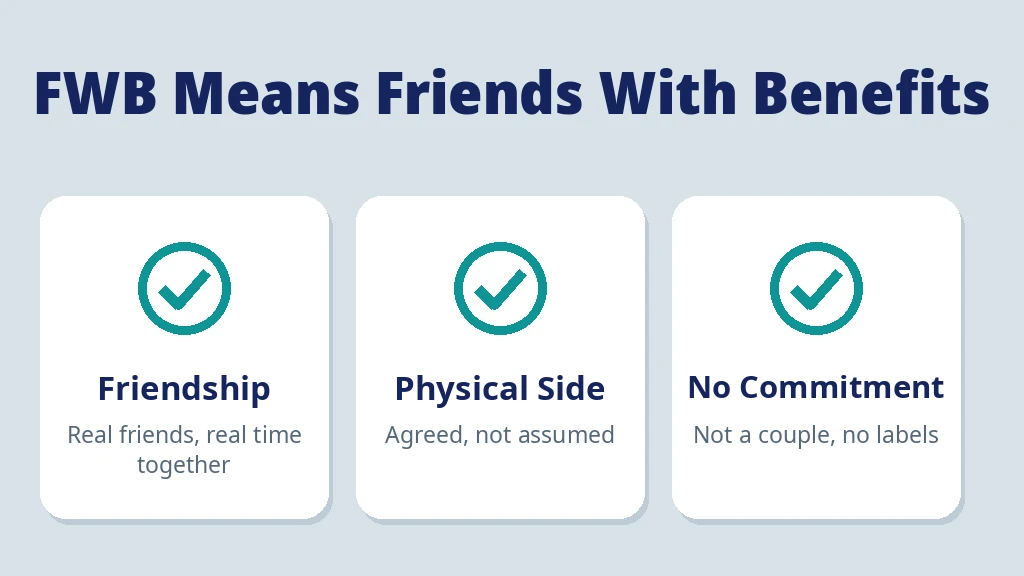
The key word is “benefits”. In this phrase it means the physical side of the arrangement, the part that goes beyond ordinary friendship. The key limit is just as important: there is no romantic commitment. The two people are not a couple, they do not owe each other exclusivity unless they explicitly agree it, and either person can end the arrangement without ending a relationship, because there is no relationship label to end.
FWB Meaning in Easy Words
Think of FWB as friendship with one extra, agreed layer.
Normally, a friendship has conversation, company, support, and shared time. An FWB arrangement keeps all of that and adds a physical side:
FWB = “We are friends, we enjoy a physical connection, and we are not a couple.”
It is the texting version of a boundary that two adults have talked about and agreed on. The friendship is real, the physical side is real, and the romantic expectations are deliberately left out. That combination is exactly what makes the term useful: no other short phrase describes it.
The arrangement only works when both people want the same thing. If one person secretly hopes it turns into a relationship while the other does not, the arrangement stops being fair, and that mismatch is the most common reason FWB arrangements end badly.
Where Is FWB Used?
FWB shows up wherever people talk honestly about dating and relationships. Common places include:
- Text messages and DMs between friends discussing dating
- WhatsApp chats and group chats about someone’s dating life
- Dating app profiles and “looking for” labels, where FWB signals the arrangement sought
- Dating app chat openers, where “fwb?” asks whether the other person is interested
- Instagram, Snapchat, and TikTok comments and captions, often jokingly
Example situations:
- A dating app profile says “looking for FWB” to signal the arrangement wanted
- A friend tells you about their arrangement and asks for advice
- Someone asks in a chat, “are you two FWB or dating?”
- A friend jokes about someone else’s dating life in a group chat
- Two friends agree on boundaries before starting an arrangement
FWB meaning on dating apps deserves a special note. There it works as a tag or label, a quick signal of what someone is looking for, so that people who want a relationship can skip past and people who want the same arrangement can match. It is a filter as much as a description. FWB meaning on Snapchat is the same as in texts: it describes the same arrangement, whether the tone is serious or joking.
Why Do People Use FWB?
It says something complicated in three letters
“We are friends who also share physical intimacy but are not a couple” takes a whole sentence. FWB says it instantly, and everyone who knows dating slang understands it.
It sets expectations early
On a dating app, writing “looking for FWB” is honest advertising. It tells the other person what is on offer before anyone invests time or feelings, which prevents misunderstandings later.
It keeps friendship at the centre
Unlike a one-off hookup, FWB implies an ongoing friendship. The two people actually like each other and spend time together. The friendship is not a cover story; it is half of the arrangement.
It avoids labels that do not fit
Some people do not want the label of a couple, with everything that label implies. FWB gives them a name for what they actually have, without forcing it into a box it does not fit.
Real-Life Examples of FWB
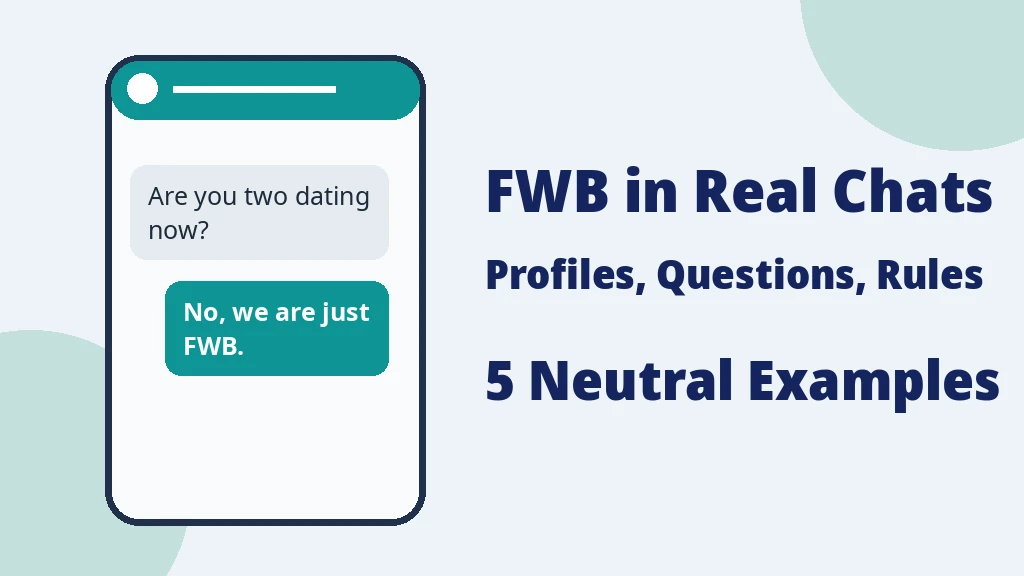
Here is how FWB actually looks in real chats, with the meaning spelled out each time. These FWB examples keep the explanations neutral and focus on the arrangement and the boundaries, not on graphic detail:
Example 1:
- Profile: “Looking for FWB, no drama, good conversation first.”
Meaning: This person is looking for a friends-with-benefits arrangement, and they want friendship and conversation to come first. The profile tag sets expectations before any chat begins.
Example 2:
- Friend: “Are you two dating now?”
- You: “No, we are just FWB. Friends, nothing more official than that.”
Meaning: We are friends with a physical side, but we are not a couple. This answer corrects the assumption of a relationship.
Example 3:
- Chat opener: “Hey, would you be open to FWB?”
- You: “Thanks for asking honestly, but that is not what I am looking for.”
Meaning: The opener asks whether the other person wants that arrangement. A clear, polite no is a complete answer, and honesty here is respectful.
Example 4:
- Friend: “We set FWB rules before anything happened, and it has actually worked.”
- You: “Good, that is the only way it works.”
Meaning: They agreed on boundaries first, which is why the arrangement is working. FWB rules, covered below, are the practical side of the term.
Example 5:
- Group chat joke: “He has a new FWB every month, or so he claims.”
Meaning: Friends joking about someone’s dating life. The term is the same, but the tone is teasing rather than serious.
FWB vs Situationship, NSA, and Similar Terms
| Term | Meaning | When to use it |
|---|---|---|
| FWB | Friends With Benefits | Friends with a physical side, no romantic commitment |
| Situationship | Undefined almost-relationship | It feels like a relationship but has no label or clarity |
| NSA | No Strings Attached | Physical connection with even less friendship implied |
| Hookup | One-off physical encounter | A single meeting, not an ongoing arrangement |
| BFFWB | Best Friends Forever With Benefits | The same arrangement between best friends |
Key difference: FWB vs situationship is the comparison people mix up most. A situationship is undefined: it feels like a relationship but nobody has said what it is. An FWB arrangement is defined: both people have agreed it is friendship plus a physical side, without romantic commitment. FWB vs NSA meaning is simpler: NSA implies even less friendship and less ongoing connection than FWB. If the friendship matters, it is FWB. If only the physical side matters, it is closer to NSA. For a term about close friendship without the physical side, here is what DW means in text and how it handles a different kind of close bond.
FWB Rules: The Practical Side
FWB rules are the boundaries two people agree on before or during the arrangement. Without rules the arrangement often ends in hurt feelings. Common rules people discuss include:
- Honesty about whether either person is seeing other people
- What happens if one person starts catching feelings
- How often they meet and how much they text between meetings
- Whether they tell mutual friends about the arrangement
- How either person can end it cleanly, without a breakup fight
None of these rules is part of the definition itself. They are practical wisdom about how people make the arrangement work. The one rule almost every guide agrees on is the feelings rule: if one person’s feelings change, they should say so early.
How to Reply to FWB
Your reply depends on the situation, and honesty is the thread through all of them.
If someone asks whether you want FWB: answer clearly. “Yes, I would be open to that” or “No, that is not what I am looking for” are both complete answers. A vague reply helps nobody.
If a friend tells you about their arrangement: listen without judging. “Sounds like you have talked it through” respects their choice and keeps the friendship safe.
If someone assumes you are dating and you are FWB: correct them kindly. “We are just FWB, not a couple” is enough, and it protects both people’s privacy.
If your own feelings change inside an arrangement: say so early. “I think my feelings have changed, can we talk?” is hard but fair, and it is far kinder than silence.
If you are setting up an arrangement: talk about rules before anything else. A short, honest conversation about expectations prevents most of the problems guides warn about. For a term that describes a close bond without labels, here is what DM means in text, where these conversations usually start.
When to Use FWB (and When to Avoid It)
Good situations:
- Describing your own arrangement honestly to a friend
- Signalling what you are looking for on a dating app
- Asking someone directly whether they want that arrangement
- Talking about dating and relationships in a casual, adult conversation
Avoid using FWB when:
- The message is for work, school, or anyone formal
- You are talking to someone who may not know the term
- Children or younger teens could read the message
- You are unsure the other person wants that kind of conversation
Common Misunderstandings About FWB
It is not the same as dating. Dating implies romantic intent and usually exclusivity. FWB deliberately leaves both out. Calling an FWB arrangement “dating” mislabels it and creates expectations nobody agreed to.
It is not the same as a situationship. A situationship is undefined. FWB is defined, by agreement, as friendship plus a physical side without romantic commitment. The clarity is the point.
It is not “Fun With Buddies” or “Friends We Bond”. Those readings appear in slang lists as folk guesses, but no dictionary supports them. The established expansion is “Friends With Benefits”.
It is not automatically casual about feelings. FWB arrangements involve real friendship, and real feelings can grow. The term describes the expectations, not the emotions, and emotions do not always follow the label.
Frequently Asked Questions
What does FWB mean in text?
FWB means “Friends With Benefits”. It describes a friendship that also includes physical intimacy, without the expectations of a committed romantic relationship.
What is the full form of FWB?
The FWB full form is “Friends With Benefits”. The phrase emerged in the 1990s and spread online in the early 2000s, and it was popularised by the 1995 Alanis Morissette song “Head over Feet”.
What does FWB mean on dating apps?
On dating apps, FWB works as a profile tag or “looking for” label. It signals that the person is seeking a friends-with-benefits arrangement, so people who want a relationship can skip past and people who want the same arrangement can match.
What is the difference between FWB and a situationship?
A situationship is undefined: it feels like a relationship but nobody has said what it is. An FWB arrangement is defined: both people have agreed it is friendship plus a physical side, without romantic commitment.
What is the difference between FWB and NSA?
NSA means “No Strings Attached” and implies even less friendship and less ongoing connection than FWB. If the friendship matters, it is FWB. If only the physical side matters, it is closer to NSA.
What are FWB rules?
FWB rules are the boundaries two people agree on, such as honesty about seeing other people, what happens if feelings change, how often they meet, and how either person can end the arrangement cleanly.
How do you reply when someone asks about FWB?
Answer clearly and honestly. “Yes, I would be open to that” or “No, that is not what I am looking for” are both complete answers, and a vague reply helps nobody.
Related Texting Slang
Keep exploring the dictionary: fwbs meaning in text, when someone texts you FWT, DTF, IMY, UNC in chats and texts.
Final Thoughts
FWB is a term that earns its place in dating slang because it names something no other short phrase names: a real friendship with a physical side and no romantic commitment. Use it honestly, whether you are describing your own arrangement, signalling what you want on a dating app, or answering someone else’s question. The honesty is the point.
The references agree completely on the meaning. Dictionary.com defines FWB as a friend someone occasionally has casual physical intimacy with, tracing the phrase to the 1990s, and CyberDefinitions gives “Friends With Benefits” as its answer for FWB. With both references agreeing, there is no need to guess at the folk readings.
4 thoughts on “FWB Meaning in Text | The Rules Nobody Spells Out”