A friend replies to your news with no words at all, just a looping clip of a celebrity clapping. You laugh, but a small question sticks: what is a GIF, exactly, and why does everyone send them instead of typing?
Short answer: GIF stands for Graphics Interchange Format, and in chat it means a short looping animation sent as a reaction. It is an image format from 1987, not a slang abbreviation invented for texting, and every layer of the research agrees on that expansion, from CyberDefinitions and Wiktionary to Merriam-Webster and Wikipedia.
This guide explains the gif meaning in texting, what does gif stand for, its full form, how reaction GIFs work on every major platform, and how to send the right one without overusing them.
What Does GIF Mean in Text?
GIF stands for Graphics Interchange Format.
The format was developed by a team at CompuServe led by Steve Wilhite and released on 15 June 1987. It is a bitmap image format limited to at most 256 colours per frame, using lossless compression, which made it perfect for small, simple animations on the early web. A GIF file can hold several images that play in sequence, so it loops, and it has no sound, which is why a GIF feels like a silent mini video rather than a clip.
Quick definition: A GIF is a short, looping, silent animation, usually sent in chats and comments to show a reaction, emotion, or joke without typing a sentence. In texting, “send a GIF” means send that reaction clip.

The gif full form matters because it corrects a common idea. GIF is not short for a phrase like “good in feeling” or any other chat expansion. Wrong quiz options such as Graphical Interface Form or Global Internet Framework appear online, but none of them is real. The only documented expansion is Graphics Interchange Format, and the chat use grew from the format, not the other way round.
One modern twist is worth knowing. Many clips labelled GIF in chats today are technically MP4 or WebM video loops, because apps compress them that way. Users still call them GIFs, and Wiktionary records that loose sense, so do not correct a friend whose “GIF” is technically a video file.
GIF Meaning in Easy Words
Think of a GIF as a reaction you can see.
Words say “I am laughing” or “I cannot believe this.” A GIF shows it: a person laughing, clapping, facepalming, or walking away dramatically. Because it loops, the reaction repeats until you scroll past, which makes it funnier and clearer than a single still photo.
GIF = “A tiny silent movie that says the feeling for you.”
That is why GIFs beat plain text for reactions. Text has no face and no timing, while a GIF carries both. A sarcastic clap as a clip is instantly clear, because you see the face and gesture together.
Where Is GIF Used?
GIFs live everywhere people react online, because every major app now has a built in GIF picker powered by Giphy or Tenor. Type a keyword, pick a clip, send it, done.
Common places:
- WhatsApp, Messenger, and iMessage chats, as replies to news and jokes
- Discord and Reddit threads, where reaction GIFs are a native language
- Instagram stories, comments, and DMs, including GIF stickers on photos
- TikTok comments and replies, where clips from shows become reactions
- Slack and work chats, in moderation, for light reactions to good news
- X, Facebook, and Tumblr, where reaction GIF culture grew early
Example situations:
- A friend shares good news and you reply with a celebration GIF
- A group chat joke lands and someone answers with a laughing clip
- A plot twist drops and the replies fill with shocked reaction GIFs
- A boring meeting ends and a colleague sends a “finally free” GIF
The reaction gif meaning in practice is a clip sent instead of typed words. The gif meaning on Instagram includes GIF stickers, transparent overlay clips added to stories and photos, which are a use of the format, not a different meaning. The gif meaning on TikTok is similar: clips from movies, TV shows, and celebrity moments reused as comment reactions, searched through the app picker rather than typed as words.
Why Do People Use GIFs?
They show emotion faster than words
Typing “I am so happy for you, that is amazing news” takes time and still sounds flat. A happy dance GIF says the same thing in one tap, with a face attached.
They are shared culture
A GIF from a famous show or meme carries a whole reference with it. Sending it tells the other person “we both know this scene,” which builds a bond that plain text cannot match.
They keep chats light
Serious news needs words, but everyday chats need energy. A well timed GIF keeps a conversation playful, breaks up long text threads, and signals tone, joking, sarcastic, or sincere, more clearly than punctuation alone.
GIFs on Social Platforms: Reaction Culture
Reaction GIFs are the shared platform use across TikTok, Instagram, Discord, Reddit, WhatsApp, Facebook, and X. Instead of typing an emotion, users search a keyword in the Giphy or Tenor picker and send the matching clip. On Discord and Reddit, GIF replies are so common that threads can run for pages on clips alone.
Meme and fandom use grew this culture. Clips from movies, TV shows, and celebrity moments were reused so often that they became shorthand: one face means disbelief, another means applause. New users learn that vocabulary by seeing GIFs in replies, not by reading a dictionary.
Learning how to send a gif in text is simple. Open the chat, tap the GIF button, search a word for the feeling you want, such as “applause,” preview the clip, and send it. If there is no picker, download a GIF from Giphy or Tenor and attach it like a photo. The gif vs meme difference is useful here: a meme is usually still, while a GIF moves and loops.
Real-Life Examples of GIF
Here is how GIFs actually work in real chats, with each reaction spelled out. These funny gif replies examples show the clip, the context, and the meaning:
Example 1:
- Friend: “I passed my driving test!”
- You: Send a celebration dance GIF.
Meaning: Congratulations, I am thrilled for you. The dance clip carries excitement words alone would flatten.
Example 2:
- Friend: “He texted me back after three weeks.”
- You: Send an eye roll GIF.
Meaning: Unbelievable, and not in a good way. The eye roll shows sarcastic disbelief instantly.
Example 3:
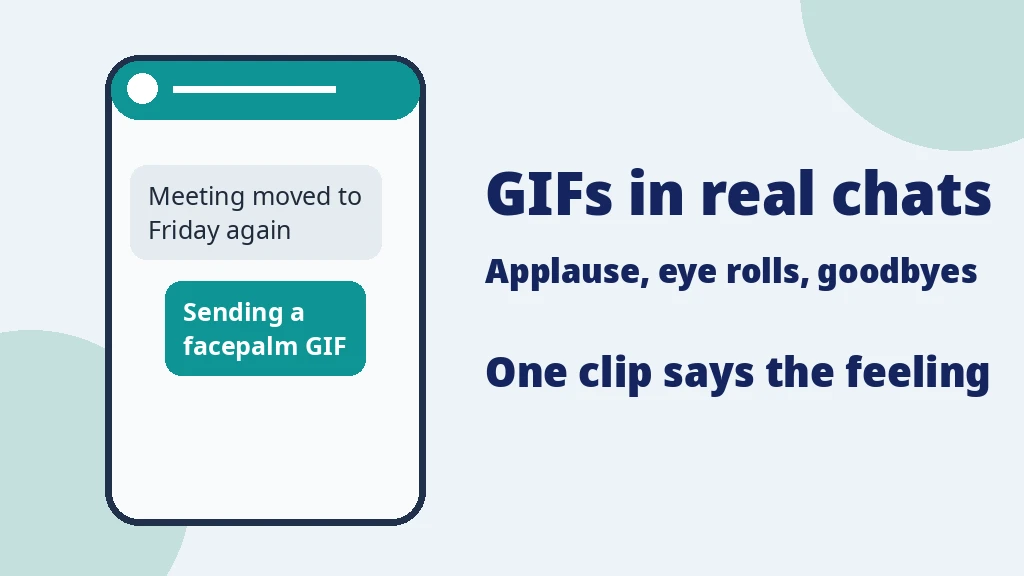
- Group chat: “Meeting moved to Friday, again.”
- You: Send a facepalm GIF.
Meaning: Frustrated disbelief at the repeated delay. The facepalm is the visual version of a sigh.
Example 4:
- Friend: “Guess who just got concert tickets?”
- You: Send a shocked happy GIF.
Meaning: Wow, that is amazing news. The shocked face plus a smile beats a plain “nice” reply.
Example 5:
- Friend: “I am done arguing, goodnight.”
- You: Send a waving goodbye GIF.
Meaning: A light, friendly exit that softens the end of a tense chat. The wave says goodbye without reopening the argument.
GIF vs Similar Formats
GIF is often confused with its neighbours, so a quick comparison helps. A still image shows one moment, a video has sound and a timeline, and a GIF loops silently in between. Stickers are a special GIF use: transparent clips layered over photos and videos, popular on Instagram stories.
| Format | Moves? | Sound? | Best for |
|---|---|---|---|
| GIF | Yes, loops | No | Quick reactions in chats |
| Meme image | No | No | Jokes with text on a photo |
| Video clip | Yes | Yes | Full scenes with dialogue |
| Sticker | Sometimes | No | Decorating stories and photos |
| Emoji | Sometimes | No | Tiny reactions inside a sentence |
Key difference: A GIF is a reaction with a face and timing, while an emoji is a reaction with a symbol. A GIF carries a scene and a joke in one loop. For a words only reaction, here is what SMH means in text.
Pronunciation: The gif pronunciation gif or jif debate has no single winner in everyday use. Inventor Steve Wilhite preferred “jif,” with a soft g, but dictionaries record both, with the hard g “gif” now dominant in common usage. Either pronunciation is understood, so use the one your friends use and do not correct theirs.
How to Reply to a GIF
Replying to a GIF is easier than replying to text, because the clip already set the tone. Match that tone and the conversation flows.
If it is a celebration: answer with words plus a GIF of your own. “Amazing, so happy for you” plus a clapping clip doubles the energy.
If it is a joke: laugh in the same register. A laughing emoji or a second funny GIF keeps the thread playful.
If it is sarcastic: check the relationship before firing back. Between close friends, a sarcastic GIF in return is the game. With a colleague, a plain words reply is safer.
If you do not get the reference: say so honestly. “I do not know that scene, but I get the vibe” is better than pretending, and most senders will happily explain the joke. For a short reply that is words only, here is what FWB means in text and how its tone differs from a playful GIF thread.
When to Use GIFs (and When to Avoid Them)
Good situations:
- Celebrating good news with friends and family
- Reacting to jokes, memes, and plot twists in group chats
- Lightening a long chat thread with a visual punchline
- Ending a tense chat softly with a friendly goodbye clip
Avoid using GIFs when:
- Someone is sharing bad news or a serious problem
- The message is formal, such as a first email to a client
- The chat is a work thread where clips distract from decisions
- You send so many that the conversation becomes clips, not talk
The rule is proportion. One well chosen GIF lands harder than five random ones, and a GIF should add a feeling that words would miss, not replace words entirely.
Common Misunderstandings About GIF
It is not a slang abbreviation like LOL. GIF is an image format that became part of chat culture. It was not invented as texting shorthand, and its expansion is a technical name.
It is not pronounced only one way. Both “gif” and “jif” are documented, with the inventor preferring “jif” and common usage favouring “gif.” Neither is wrong in conversation.
It is not a video with sound. A true GIF has no sound. If a clip plays audio, it is a video file, even if everyone calls it a GIF.
It is not the same as a meme. Memes are usually still images with text. GIFs move and loop. A meme can be a GIF, but most GIFs are reactions, not captioned jokes.
It does not mean the sender is lazy. Sending a GIF instead of typing is a choice about tone, not effort. The clip often communicates more precisely than a sentence would.
Frequently Asked Questions
What does GIF mean in text?
GIF stands for Graphics Interchange Format. In text, it means a short looping animation sent as a reaction, to show emotion, humour, or a punchline without typing a sentence.
What is the full form of GIF?
The full form of GIF is Graphics Interchange Format, a bitmap image format developed at CompuServe and released in 1987, limited to 256 colours per frame.
Is GIF pronounced gif or jif?
Both are documented. Inventor Steve Wilhite preferred “jif,” but dictionaries record both pronunciations, with hard g “gif” now dominant in common usage.
What is a reaction GIF?
A reaction GIF is a short looping clip sent instead of typed words to show a feeling, such as applause, laughter, shock, or an eye roll, usually picked from Giphy or Tenor.
What is the difference between a GIF and a meme?
A meme is usually a still image with text, while a GIF moves and loops without sound. A GIF can be a meme, but most GIFs are reactions rather than captioned jokes.
How do I send a GIF in a text?
Open the chat, tap the GIF or sticker button, search a word for the feeling you want, preview the clip, and send it. If there is no picker, download a GIF from Giphy or Tenor and attach it like a photo.
Related Texting Slang
Keep exploring the dictionary: two exclamation marks, explained with real examples, DM in chats and texts, ERM, FYP in chats and texts, GOAT in chats and texts, gurt, the HBS meaning, in plain words.
Final Thoughts
GIF is one of the rare chat terms with no argument about its meaning. Graphics Interchange Format is the expansion, a short looping silent animation is the object, and a reaction clip is how it lives in chats. It survived because it shows a face, a gesture, and a timing in a single loop.
Use GIFs where they add feeling, pick one that matches the moment, and let words do the serious work. That balance, clips for reactions and sentences for substance, is what makes a GIF thread fun instead of noisy.
The references agree completely. Merriam-Webster defines GIF as a computer file format for digital images, and Wikipedia records its 1987 CompuServe release under Steve Wilhite and its 256 colour limit, the facts behind every reaction clip you send.