
Your friend sends a voice note about weekend plans, and you reply: “Erm… I think I am busy Saturday.”
Nothing in that message is certain. The “erm” buys you time, softens the no, and tells your friend you are thinking, not rejecting. Three letters, and the whole mood of the reply changes.
Here is the short answer: ERM means “errr”, the written form of “um”, a hesitation filler people type while they think. It signals uncertainty, awkwardness, or a pause before an answer, and it is almost always written in lowercase as “erm”, not as capital “ERM”.
In this guide you will see erm in real chats, learn the difference between erm, um, and uh, find out how it sounds on TikTok and Snapchat, and learn when a little hesitation helps and when it hurts.
What Does ERM Mean in Text?
ERM stands for Errr (thinking), the typed version of the sound people make when they pause mid-sentence.
That lead is solid across three layers. CyberDefinitions gives “Errr (thinking)” as its quick answer for ERM, while noting it is a rare term. The top niche guides for “ERM meaning in text” agree exactly, calling erm a hesitation filler meaning “um” or “er”, the digital equivalent of pausing to think before speaking. Cambridge backs the dictionary side, defining erm as the sound people make when they pause in the middle of what they are saying, usually because they are deciding what to say. Reverso agrees too, describing erm as informal, expressing doubt or lack of confidence. Three layers, one answer.
Quick definition: Erm is a written hesitation filler. People type it at the start of a message, or in the middle, to show they are thinking, unsure, embarrassed, or not fully convinced, instead of answering instantly.

One more point matters before anything else: erm is not an abbreviation. It has no full form to expand, because it is simply a sound written down. Anyone promising an “ERM full form” for texting is inventing one. The letters spell the sound, and the sound means “hold on, I am thinking”.
ERM Meaning in Easy Words
Think of erm as the texting version of a thoughtful pause.
In a real conversation, people say “um” or “er” all the time. They do it while choosing words, while dodging an awkward answer, or while deciding whether to agree. Erm puts that same pause into a message:
Erm = “Wait a second, I am thinking about this.”
That pause does social work. A bare “No” can feel blunt. “Erm… no” feels softer, because it shows you considered the question. A bare “Really?” can feel challenging. “Erm, really?” feels curious, because the hesitation shows you are processing, not attacking. The letters are tiny, but the softening is real.
Erm also buys honesty. When someone types “erm” before an answer, they are admitting they do not have a ready reply.
Where Is ERM Used?
Erm shows up wherever people answer in real time and need a beat to think. Common places include:
- Text messages between friends, partners, and family
- WhatsApp chats when a question is tricky or awkward
- Instagram and Twitter comments reacting to surprising posts
- Snapchat chats, where it marks hesitation or slight awkwardness
- TikTok comments, where it marks cringe, doubt, or playful disbelief
The erm meaning in texting is the same across all of these: hesitation, and the erm meaning in chat slang is exactly that hesitation. The erm meaning on Snapchat leans a little more toward awkwardness, the digital equivalent of clearing your throat. The erm meaning on TikTok leans toward reaction on cringe videos and polite disbelief.
Example situations:
- Stalling before answering a tricky question
- Softening a no so it does not sound harsh
- Reacting to something awkward or embarrassing
- Showing doubt about a claim without starting an argument
- Flirting shyly, where hesitation reads as cute rather than cold
Why Do People Use ERM?
It buys thinking time
The honest reason is also the most common. A question arrives, the answer is not ready, and “erm” fills the gap while the brain catches up. It is the typed version of stalling gracefully.
It softens hard messages
Bad news, refusals, and disagreements all land softer after a hesitation. “Erm, I cannot make it” feels kinder than “I cannot make it”, because the pause shows the decision was not casual.
It adds humour and tone
Erm is also a comedy tool. “Erm, WHAT?” after a wild story is funnier than “WHAT?” alone, because the pause acts out the disbelief. On TikTok and in group chats, that performed pause is half the joke.
Real-Life Examples of ERM
Here is how erm actually looks in real chats, with the meaning spelled out each time. These erm hesitation filler examples show the full tone ladder, from soft thinking to open disbelief:
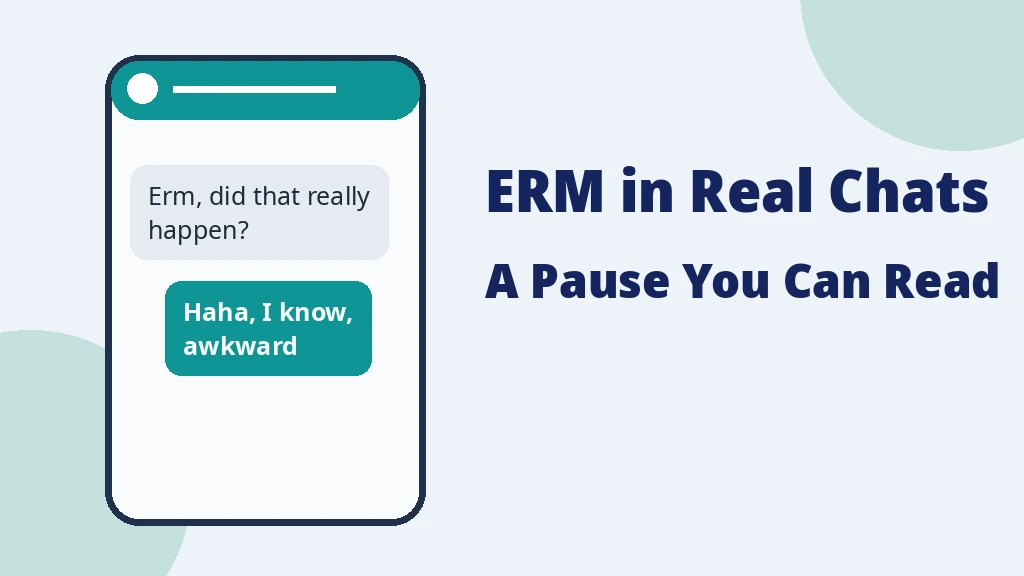
Example 1 (soft hesitation):
- Friend: “Are you free Saturday?”
- You: “Erm… I think I am busy, let me check.”
Meaning: I am not sure yet, give me a moment to think. The trailing dots stretch the pause even further.
Example 2 (awkward admission):
- Friend: “Did you eat the last slice?”
- You: “Erm yeah, that was me, sorry.”
Meaning: Yes, awkwardly, it was me. The erm confesses before the words do.
Example 3 (doubt):
- Friend: “He says he can fix your phone in five minutes.”
- You: “Erm, I doubt that.”
Meaning: I am not convinced. The erm makes the doubt polite instead of confrontational.
Example 4 (disbelief):
- Friend: “She just bought a third car.”
- You: “Ermm WHAT??”
Meaning: Wait, really? The stretched spelling and capitals turn hesitation into comic shock.
Example 5 (shy or flirty hesitation):
- Crush: “So… would you want to go out sometime?”
- You: “Erm… maybe, that could be nice.”
Meaning: I am shy but interested. Here the hesitation is part of the charm, not a rejection.
ERM vs Similar Fillers
Erm has close cousins, and the erm vs um vs uh difference is mostly about geography and spelling, not meaning. British speakers write “erm” and “er”. American speakers write “um” and “uh”. Everyone understands all of them, but the spelling signals where the writer is from.
| Term | Meaning | When to use it |
|---|---|---|
| Erm | Hesitation, thinking, awkwardness | British style chats, casual and written |
| Um | Hesitation while thinking | American style chats, most common |
| Uh | Short pause or correction coming | Quick hesitation before a fix |
| Er | Short hesitation, British style | Brief pause, same family as erm |
| Hmm | Thinking, considering, or doubting | Thoughtful replies and mild doubt |
Key difference: Um and uh are sounds from speech, while erm is the same family written with a British spelling. Hmm leans more toward considering an idea, while erm leans more toward awkwardness or doubt. None of them is an abbreviation, and none of them has a full form. For a short form that ends a chat for the night rather than pausing it, here is what DWU means in text.
ERM Variations You Should Know
Lowercase “erm” vs capital “ERM”. In real chats this is almost always lowercase “erm”. Capital ERM in professional writing means something completely different, which brings us to the big rival sense below. Case and context together tell you which world you are in.
“Ermm” and “errrm” (stretched spellings). Extra letters stretch the pause. “Ermm” reads as longer hesitation or stronger disbelief, and “errrm” reads as theatrical, usually comic. The longer the spelling, the bigger the feeling.
“Erm…” with trailing dots. The dots extend the silence. “Erm…” before bad news softens it. “Erm…” before a joke builds the punchline. Punctuation is part of the meaning here.
ERM enterprise risk management vs texting meaning. The ERM enterprise risk management vs texting meaning split is the one to watch in search results. In business, ERM means Enterprise Risk Management, a framework for handling company risks. In a casual chat, ERM means hesitation. A boardroom report and a friend’s text share the letters and nothing else.
Erm meaning from a girl. Searches for erm meaning from a girl usually reflect tone, not a separate definition. From anyone, erm can sound shy, awkward, doubtful, or flirty depending on the conversation. The sender does not create a new meaning, so read the message, not the profile. For a reaction word that changes meaning with tone in the same way, here is what AWH means in text.
How to Reply to ERM
Your reply depends on what the hesitation was doing: thinking, doubting, confessing, or flirting.
If they are thinking: give them room. “Take your time” or “No rush” is the kindest reply, and it usually produces a better answer.
If they are doubting you: answer the doubt, not the pause. “Fair question, here is why” treats the hesitation as reasonable instead of rude.
If they are confessing something awkward: laugh it off. “Ha, no worries” closes the embarrassment fast.
If they are flirting shyly: match the softness. “That could be nice” keeps the door open without pressure.
If you are the sender: use erm once, then answer. “Erm… I think Saturday works” is natural. “Erm… erm… erm…” reads as evasion, and the reader stops trusting the pause. Learning how to use erm in a text comes down to that balance: one pause shows thought, a string of pauses shows avoidance.
When to Use ERM (and When to Avoid It)
Good situations:
- Softening a refusal or a piece of bad news
- Showing you are thinking before a tricky answer
- Reacting to something awkward, surprising, or funny
- Signalling polite doubt without starting an argument
Avoid using ERM when:
- The message is formal, such as work email or a job application
- You need to sound confident, such as a promise or an apology that must be firm
- The other person needs a clear yes or no right now
- You have already hesitated twice, and another pause looks like stalling
Common Misunderstandings About ERM
It is not an abbreviation. ERM has no full form in texting. It is a sound written down, not initials waiting to be expanded.
It does not mean “I disagree”. Erm can carry doubt, but it can also carry thinking, shyness, or humour. Assuming disagreement from one “erm” overreads the message.
It is not rude by itself. A pause before an answer is usually considerate, not dismissive. It only turns rude when it is used to dodge a question repeatedly.
It is not the same as ignoring someone. Erm is a reply, not silence. It says “I am here and thinking”, which is the opposite of leaving someone on read.
It is not always British. The spelling is British in origin, but the sound and the usage travel everywhere online. Americans write “um” more often, but they read “erm” without any trouble.
Frequently Asked Questions
What does ERM mean in text?
ERM means errr, the written form of um. It is a hesitation filler people type while thinking, or to show uncertainty, awkwardness, or doubt before an answer.
What is the full form of ERM in texting?
ERM has no full form in texting. It is not an abbreviation. It is the sound of hesitation written down, usually spelled in lowercase as erm.
What is the difference between erm, um, and uh?
They mean almost the same thing. Erm and er are the British spellings, while um and uh are the American spellings. Hmm leans more toward considering an idea, while erm leans more toward awkwardness or doubt.
What does erm mean on TikTok and Snapchat?
On Snapchat, erm marks hesitation or slight awkwardness in chats. On TikTok, it also marks cringe reactions and polite disbelief in comments, as a way of saying “I am not entirely convinced” without arguing.
What does erm mean from a girl?
It means the same thing it means from anyone: hesitation, shyness, doubt, or awkwardness, depending on the conversation. There is no separate girls-only definition, so read the message and its mood.
Is erm rude?
Usually not. A single erm before an answer reads as thoughtful or softening. It only feels rude when it is used repeatedly to dodge a question, or when a clear answer was needed right away.
How do you reply when someone sends erm?
Give them room if they are thinking, answer the doubt if they are unsure, and laugh it off if they are confessing something awkward. A simple “Take your time” fits most cases.
Related Texting Slang
Keep exploring the dictionary: HBU in chats and texts, how people actually use FFS, the FINNA meaning, in plain words, FR in chats and texts, JK in chats and texts, when someone texts you RS, SMH in chats and texts.
Final Thoughts
Erm is one of the smallest words in texting and one of the most human. It admits that the writer is thinking, unsure, or a little embarrassed, and that admission makes the reply that follows feel more honest. Use it once to soften a no, to buy a moment of thought, or to react to something awkward, and it does real social work. Use it as a habit, and it starts to sound like stalling. One pause is thoughtful. A string of pauses is avoidance.
The references line up on the meaning. CyberDefinitions defines ERM as errr, thinking, in texting, and Cambridge defines erm as the sound people make when pausing to decide what to say, which matches exactly how it reads in a real chat.
1 thought on “ERM Meaning in Text | What That Little Pause Really Says”