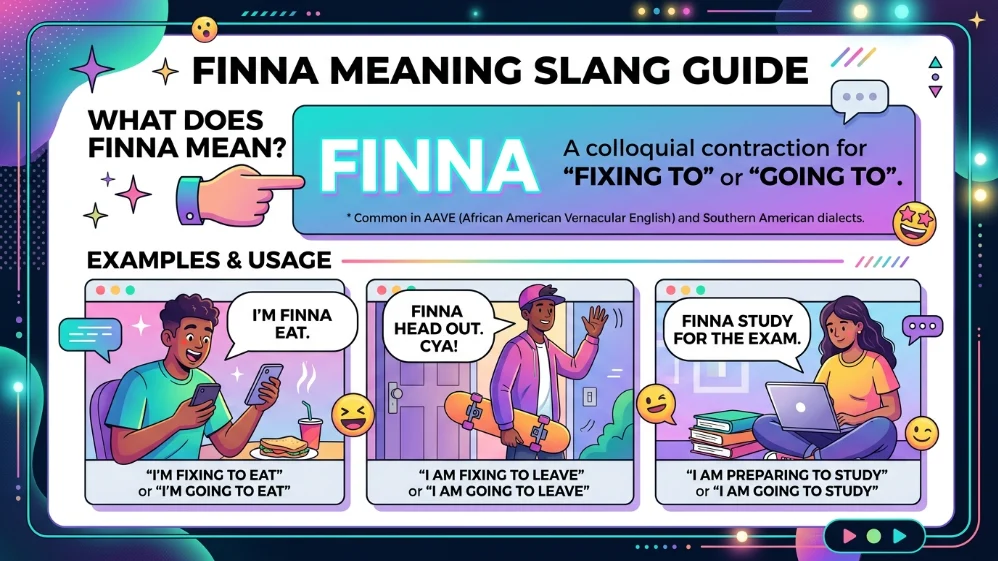
Finna is a slang term that means “fixing to,” “going to,” or “about to.” It is a contraction commonly used in African American Vernacular English (AAVE) and Southern American English to indicate an intention or plan to do something in the near future. For example, “I’m finna eat” means “I’m about to eat.”
If you have spent any time on social media, in group chats, or around younger generations, you have probably come across the word “finna.” It appears in TikTok captions, Snapchat stories, text messages, and everyday conversations. But what exactly does finna mean, where did it come from, and how do you use it correctly?
This guide breaks down everything you need to know about the slang term finna. You will learn its definition, origin, proper usage, platform-specific meanings, and how to respond when someone uses it. Whether you are a parent trying to decode teen slang, a non-native English speaker, or just someone curious about modern language, this article has you covered.
Quick Answer Box
| Aspect | Details |
|---|---|
| Meaning | Fixing to, going to, about to |
| Context | Informal speech, texting, social media |
| Usage | Indicates near-future action or intention |
| Platforms | TikTok, Snapchat, Instagram, WhatsApp, text messages |
| Example | “I’m finna grab some food.” |
| Tone | Casual, conversational, expressive |
What Does Finna Mean in Slang?
Finna is a slang contraction that means “fixing to,” which itself means “going to” or “about to.” When someone says they are “finna” do something, they are expressing an intention or plan to take action in the immediate or near future.
Think of finna as the slang equivalent of “gonna” (going to) but with a slightly more immediate sense of readiness. While “gonna” can refer to actions in the distant future, finna typically refers to something happening soon.
Key Characteristics of Finna
- Indicates imminent action: The speaker is actively preparing or planning to do something
- Always informal: Never used in formal writing or professional settings
- Followed by a verb: Usually appears as “finna [verb]” (e.g., “finna eat,” “finna go”)
- Often used with “I’m”: “I’m finna” is the most common construction
Examples of Finna in Simple Sentences
- “I’m finna leave for work.” → I’m about to leave for work.
- “We finna watch a movie.” → We’re getting ready to watch a movie.
- “You finna get in trouble.” → You’re about to get in trouble.
- “I’m finna grab some food. You want anything?” → I’m about to get food.
- “She finna start her new job next week.”
Origin of Finna: Where Does It Come From?
Understanding the origin of finna provides important context for its proper use and cultural significance.
The “Fixing To” Connection
Finna is a contraction of the phrase “fixing to.” The phrase “fixing to” has been used in Southern American English for centuries to mean “getting ready to” or “about to.” The word “fix” in this context originally meant “to set one’s mind to” something, dating back to the 14th century. By the 18th century, “fixing to” had taken on the meaning of preparing to do something, earning a citation in the Oxford English Dictionary in 1716.
African American Vernacular English (AAVE)
Finna is primarily associated with African American Vernacular English (AAVE), where it developed as a natural contraction of “fixing to.” In AAVE, the pronunciation of “fixing to” compressed over time into “finna,” similar to how “going to” became “gonna.”
Spread Through Pop Culture
From its roots in AAVE and Southern American English, finna spread through:
- Hip-hop and rap music: Featured prominently in song lyrics
- Internet culture: Social media platforms like TikTok, Instagram, and YouTube
- Mainstream slang: Adopted by Gen Z and Millennials across demographics
When Was Finna First Recorded?
The term finna was first recorded in 1985-1990, according to Dictionary.com. However, its root phrase “fixing to” has been in use for much longer.
Finna vs Gonna: What is the Difference?
While finna and gonna are similar, they have important differences:
Example Comparison
- Finna: “I’m finna retire” → implies retirement is happening very soon (like today or this week)
- Gonna: “I’m gonna retire” → could mean today, next year, or in 20 years
How to Use Finna in Everyday Conversation
Grammar Rules
Finna is typically used as a auxiliary verb preceding the base form of an action verb. The most common construction is:
Subject + “finna” + base verb
Examples:
- “I’m finna go.” (Not “I’m finna going”)
- “She finna call.” (Not “She finna calling”)
- “We finna eat.” (Not “We finna eating”)
Common Contexts
Expressing Intent
Making a Decision
Describing Immediate Actions
Playful or Casual Remarks
Emphasizing Determination
Finna on Different Platforms
Finna on TikTok
TikTok has played a major role in popularizing finna among Gen Z. You will commonly see it in:
The term has also appeared in viral TikTok memes, such as the “When the chile is tea but the finna is gag” trend that went viral in early 2025.
Finna on Snapchat
On Snapchat, finna appears frequently in:
- Story captions: “Yooo this lunch finna be fire”
- Private messages between friends
- Snap streaks and casual updates
Users often post snaps with text like “Finna re-live some old memories” when sharing nostalgic content.
Finna on Instagram
Instagram users incorporate finna in:
- Photo captions
- Instagram Stories
- Comments and DMs
- Reels captions
Example: “I might finna post the edit that I made last night on Instagram reels.”
Finna on WhatsApp
In WhatsApp group chats and private messages, finna is used for:
- Making plans: “Finna head to the movies, who’s coming?”
- Quick updates: “Finna eat dinner, brb”
- Expressing intentions: “Finna call you in a bit”
Real-Life Conversation Examples
1: Making Plans with Friends
Alex: “Yo, what you doing later?”
Jordan: “I’m finna go to the mall. You tryna come?”
Alex: “Bet. I’m finna get some new sneakers.”
Jordan: “Aight, I’m finna pick you up in 20.”
2: Texting About Food
Mia: “I’m finna grab some food. You want anything?”
Chris: “Yeah, get me a burger fr.”
Mia: “Got you. I’m finna be back in 15.”
Chris: “No cap? Aight bet.”
3: Group Chat Energy
Tyler: “Y’all finna come to the party tonight?”
Sarah: “I’m finna pull up around 10.”
Marcus: “Same. We finna turn up.”
Tyler: “Say less. I’m finna send the address.”
4: Expressing Frustration (Playful)
Derek: “Bro finna rage quit if he loses again.”
Emma: “LOL he always does that.”
Derek: “Nah fr this time he finna throw his controller.”
5: Making a Decision
Nina: “You finna tell him how you really feel?”
Rebecca: “I don’t know… I’m nervous.”
Nina: “Just do it. You finna feel better after.”
Rebecca: “You right. I’m finna text him right now.”
Related Slang Terms
Understanding finna is easier when you know related terms:
How to Respond When Someone Uses Finna
Appropriate Responses
| Context | Response |
|---|---|
| Friend says “I’m finna go” | “Aight, see you later” or “Bet, text me when you’re back” |
| Friend says “Finna grab food” | “Get me something too” or “Where you going?” |
| Friend says “Finna rage quit” | “LOL don’t do it” or “Fr? It’s not that deep” |
| Friend says “Finna call you” | “Aight, I’ll be here” or “Bet, I’m free” |
Inappropriate Responses (When NOT to Use Finna)
- In job interviews
- In professional emails
- In academic writing
- When speaking to elders who may not understand slang
- In formal presentations
Misinterpretations and Edge Cases
Common Misunderstandings
- Finna is not “going to” in the distant future – It specifically implies near-future action
- Finna is not a noun – It is always used as an auxiliary verb
- Finna is not interchangeable with “gonna” in all contexts – The immediacy matters
Edge Cases
Can finna be used without “I’m”?
Yes. Examples: “We finna go,” “She finna call,” “They finna eat.”
Can finna be used in past tense?
No. Finna is specifically for future or imminent actions.
Is finna always followed by a verb?
Yes. Finna must be followed by an action verb.
Cultural Sensitivity
Because finna originates from AAVE, it is important to use it respectfully. The term has deep cultural roots in African American communities and should not be used in a mocking or appropriative way.
When NOT to Use Finna
While finna is widely used in casual settings, there are times when you should avoid it:
Formal Settings
- Job interviews
- Business meetings
- Academic presentations
- Professional correspondence
Professional Writing
- Emails to clients or superiors
- Reports and proposals
- Resumes and cover letters
Cross-Generational Communication
- When speaking to older individuals who may not understand slang
- In situations where clarity is paramount
When in Doubt
If you are unsure whether finna is appropriate, default to “going to,” “about to,” or “planning to.” These are always acceptable in any context.
Usage Tips for Non-Native English Speakers
If English is not your first language, here are some tips for using finna:
- Understand the meaning first: Finna = about to / going to (near future)
- Listen to native speakers: Pay attention to how they use it in context
- Start with “I’m finna”: This is the most common and safest construction
- Use it informally only: Never use finna in formal writing or speech
- Don’t overuse it: Like any slang, using it too much can sound forced
Practice Sentences for Learners
- “I’m finna go to the store.”
- “She’s finna call me back.”
- “We’re finna watch a movie tonight.”
- “They finna be here soon.”
FAQs About Finna Slang
1. What does finna mean in slang?
Finna means “fixing to,” “going to,” or “about to.” It indicates that someone is planning or preparing to do something in the near future.
2. Is finna the same as gonna?
No. While both mean “going to,” finna implies more immediate action (something happening very soon), while gonna can refer to actions at any future time.
3. Where does finna come from?
Finna comes from African American Vernacular English (AAVE) and is a contraction of the phrase “fixing to,” which has roots in Southern American English.
4. Is finna a real word?
Yes, finna is recognized in dictionaries including Dictionary.com and has been recorded since the late 1980s.
5. How do you use finna in a sentence?
Use finna before a verb to indicate a near-future action. Example: “I’m finna eat” or “She finna call you back.”
6. Can I use finna in a formal setting?
No. Finna is informal slang and should only be used in casual conversations, text messages, and social media.
7. What does “WYFD” mean?
“WYFD” stands for “What You Finna Do?” and is used in text messaging to ask what someone is about to do.
8. Is finna only used by Gen Z?
No. While Gen Z has popularized finna on social media, the term has been used in AAVE and Southern American English for decades.
9. What are some synonyms for finna?
Synonyms include gonna, boutta (about to), fixing to, and planning to.
10. Is finna offensive?
No, finna is not offensive. However, because it originates from AAVE, it should be used respectfully and not in a mocking way.
11. Can finna be used for past actions?
No. Finna is only used for future or imminent actions.
12. What does “finna woke” mean?
Finna woke” is a slang combination meaning “about to become woke” (aware of social issues).
Conclusion
Finna is a versatile and widely used slang term that means “fixing to,” “going to,” or “about to.” Originating from African American Vernacular English and Southern American English, it has become a staple of casual conversation, text messaging, and social media platforms like TikTok, Snapchat, and Instagram.
The key to using finna correctly is understanding its implication of near-future action. Unlike “gonna,” which can refer to any future time, finna specifically indicates that something is about to happen or that the speaker is actively preparing to do something.
While finna is widely accepted in informal settings, it should be avoided in professional, academic, or formal contexts. When in doubt, opt for clearer alternatives like “going to” or “about to”.
Whether you are decoding a teenager’s text message, scrolling through TikTok, or simply trying to understand modern slang, knowing the meaning and proper usage of finna will help you stay connected and communicate effectively in today’s digital world.