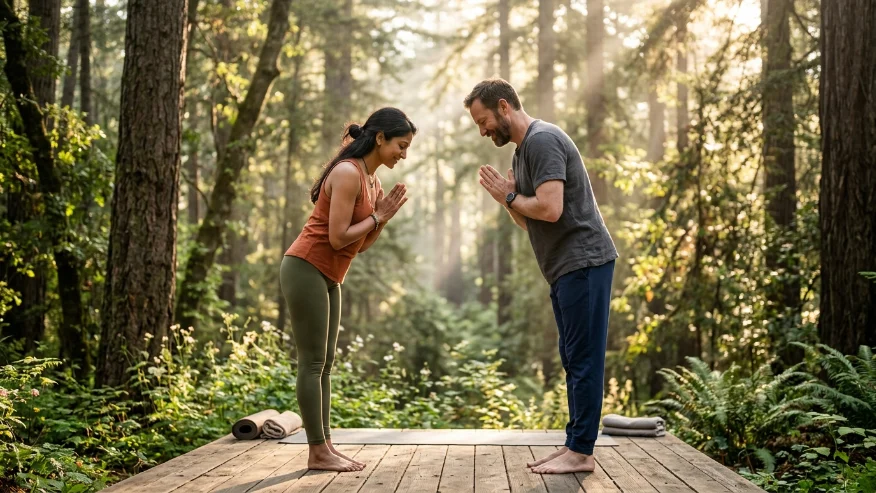
Namaste (pronounced nah-mah-stay) is a traditional Hindu greeting derived from Sanskrit that translates to “I bow to the divine in you.” The word combines “namah” (bow/obeisance) and “te” (to you).
Used widely in India and Nepal, it’s accompanied by a specific hand gesture (anjali mudra) with palms pressed together at the heart center, symbolizing deep respect, spiritual connection, and recognition of the divine spark within every individual.
Have you ever wondered what people really mean when they press their palms together and say “namaste” at the end of a yoga class? This ancient Sanskrit word has traveled far beyond the borders of India, finding its way into wellness studios, social media bios, and casual conversations worldwide.
But the namaste meaning runs far deeper than most people realize. It’s not just a simple greeting or a trendy yoga catchphrase it’s a profound spiritual acknowledgment that carries centuries of cultural significance, philosophical depth, and emotional resonance.
In this comprehensive guide, we’ll explore everything you need to know about the namaste meaning: its origins in ancient Indian texts, its proper usage in different contexts, the spiritual philosophy behind the gesture, and how to use it respectfully.
Whether you’re a yoga practitioner, a traveler to India, or simply curious about this beautiful tradition, this article will give you a complete understanding of what namaste truly means and why it matters.
QUICK ANSWER
| Aspect | Details |
|---|---|
| Meaning | “I bow to the divine in you” |
| Language | Sanskrit |
| Pronunciation | Nah-mah-stay |
| Context | Formal greeting, yoga classes, spiritual settings |
| Usage | India, Nepal, global yoga studios |
| Example | Namaste, welcome to our home” |
| Tone | Respectful, spiritual, formal |
What Does Namaste Mean?
The Literal Translation
At its most basic level, the namaste meaning comes from Sanskrit, one of the oldest languages in the world. The word is formed by combining two root words:
- Namah (नमः) – meaning “bow,” “obeisance,” or “reverential salutation”
- Te (ते) – meaning “to you”
When combined, namaste literally translates to “I bow to you.” However, this simple translation doesn’t fully capture the depth of what the word actually conveys.
The Deeper Spiritual Significance
The true namaste meaning goes far beyond a simple bow. In Hindu philosophy, every living being contains a spark of the divine consciousness known as Atman or Brahman. When you say namaste, you’re essentially saying:
“I recognize and honor the divine presence within you. I bow to the sacred essence that resides in your heart and connects you to the entire universe.”
This isn’t just a casual greeting it’s a profound acknowledgment of spiritual equality and interconnection. You’re recognizing that the same divine spark that exists within you also exists within the person you’re addressing. This understanding of equality and respect is central to Hindu philosophy and the namaste meaning.
The Hand Gesture (Anjali Mudra)
The namaste meaning is closely tied to its accompanying physical gesture. To perform the gesture correctly, you press your palms together at the heart center, fingers pointing upward, and slightly bow your head. This is known as Anjali Mudra or the prayer pose.
Each element of this gesture adds meaning to the namaste meaning:
- Palms together: Represents the union of the left and right sides of the body, the masculine and feminine energies, and the individual soul with the supreme consciousness
- At the heart center: The heart is considered the seat of the divine presence and pure consciousness
- Slight bow: Demonstrates humility and respect
- Closed eyes: Suggests inward focus and spiritual connection
Context & Usage
Traditional Usage in India and Nepal
In India and Nepal, namaste is a common greeting used in various contexts. Understanding the namaste meaning in these cultures helps appreciate its true significance:
- Formal greetings: Used when meeting elders, spiritual teachers, or in formal settings
- Cultural respect: Often used when entering temples, during prayer, or in any context where respect is required
- Everyday interactions: While less common in casual settings between friends, it’s still used in many regions as a polite way to greet both strangers and acquaintances
- Official functions: Used in government ceremonies, formal business meetings, and cultural events
Interestingly, the namaste meaning can vary slightly based on the context. When greeting an elder, it conveys deep respect for their life experience and wisdom. When used in a spiritual context, it carries the full weight of its divine recognition.
Western Adoption and Evolution
The namaste meaning has evolved in Western contexts, particularly in the wellness and yoga communities. Since the 1960s, as yoga traveled from India to the West, the word namaste became increasingly popular. Today, it’s used in a variety of settings:
- Yoga studios: Often used as a closing word at the end of yoga classes, representing gratitude and spiritual connection
- Wellness centers: Used in meditation classes, mindfulness workshops, and other spiritual practice spaces
- Social media: Sometimes used as a hashtag or in profiles to signal interest in spirituality or wellness
- Popular culture: Featured in movies, advertisements, and even merchandise
However, this Western adoption has sometimes led to the word becoming somewhat diluted or commercialized. Many practitioners in India feel that the true namaste meaning has been oversimplified or misrepresented in Western contexts.
The Difference Between “Namaste” and Other Greetings
To fully understand the namaste meaning, it’s helpful to compare it with other common greetings:
| Greeting | Meaning | Context |
|---|---|---|
| Namaste | “I bow to the divine in you” | Formal, respectful, spiritual |
| Namaskar | More formal version of namaste | Very formal, deeper respect |
| Hello/Hi | Neutral greeting | Informal, casual |
| Salaam | “Peace be upon you” | Islamic greeting |
| Pranam | “To prostrate/fall flat” | Extremely respectful |
While namaste is widely used, Namaskar is even more formal and respectful, often used when addressing someone of significantly higher status, a spiritual teacher, or during formal ceremonies.
Real-Life Examples
Example 1: Traditional Indian Greeting
Setting: A grandson visiting his grandmother in Mumbai
Grandson: (With palms together, slight bow) “Namaste Dadi, aap kaise hain?” (Grandmother, how are you?)
Grandmother: (Returning the gesture) “Namaste beta, main theek hoon. Aao, andar aao.” (Namaste, I’m fine. Come, come inside.)
Insight: Here, the namaste meaning extends beyond a simple greeting—it represents deep respect for elders and family bonds.
Example 2: Yoga Class Conclusion
Setting: A yoga studio in New York City, after the final resting pose
Instructor: “Bring your hands together at your heart. Feel the gratitude for this practice and for your beautiful body. Namaste.”
Students: (Returning the gesture) “Namaste.”
Insight: In this Western context, the namaste meaning has been adapted to express gratitude for the practice and for being present.
Example 3: Formal Business Meeting
Setting: A corporate office in Bangalore, India
Executive A: (At the start of the meeting, with a slight bow and palms together) “Namaste. Thank you for your time today.”
Executive B: (Returning the gesture) “Namaste. We’re glad to have this opportunity to collaborate.”
Insight: The namaste meaning in this context combines professional respect with cultural tradition.
Example 4: Temple Visit
Setting: A Hindu temple in Varanasi
Devotee: (Entering the inner sanctum, bowing deeply with palms together) “Namaste, Lord Shiva.”
Insight: When directed toward a deity, the namaste meaning becomes deeply devotional—a complete surrender and recognition of the divine.
Example 5: International Yoga Conference
Setting: An international yoga conference in California
Speaker: “As we come together from different cultures and backgrounds, we honor each other with the same divine light. Namaste, friends.”
Audience: (A chorus of responses) “Namaste.”
Insight: This demonstrates how the namaste meaning can serve as a universal bridge, connecting people across cultural differences through a shared recognition of spiritual equality.
Platform-Specific Meaning
On WhatsApp, the namaste meaning often translates to a simple digital greeting. When someone sends a “🙏” emoji with the word namaste, it conveys respect, formality, or a spiritual acknowledgment.
Common uses on WhatsApp include:
- A polite opening for conversations with Indian friends or colleagues
- A sign-off after a discussion about spiritual topics or yoga
- A respectful response when someone shares significant news
Some might use it jokingly among friends to add a formal touch to an otherwise casual conversation. However, it’s important to remember the traditional namaste meaning when using it in more serious contexts.
Snapchat
Snapchat users have adopted namaste in several creative ways:
- Filters and Lenses: Some filters combine the gesture or the word with colorful effects
- Snap Stories: People might include “Namaste” as a caption when sharing yoga or meditation moments
- Bitmoji: Some users have Bitmojis that use the namaste gesture
Unlike WhatsApp, where the namaste meaning is relatively straightforward, on Snapchat it can range from genuine spiritual expression to playful cultural appreciation.
TikTok
TikTok has given the namaste meaning a new dimension through:
- Yoga videos: Often ending with the word and gesture
- Cultural education: Content creators sharing proper pronunciation and meaning
- Trendy usage: The word sometimes appears in hashtags or captions without deep cultural context
- Soundtracks: Audio samples include the word namaste or spiritual music
The namaste meaning on TikTok can be either very traditional or more commercialized depending on the creator’s intent.
Instagram showcases the namaste meaning in several ways:
- Bio usage: People including “Namaste” in their bios to signal wellness or spiritual interests
- Captions: Yoga, meditation, or travel posts frequently use #namaste or include the word
- Stories: Behind-the-scenes from yoga classes or wellness retreats often feature the gesture
- Reels: Short videos of spiritual practices frequently include the word
The namaste meaning on Instagram represents a blend of authenticity and branding, as many wellness influencers use it as part of their personal branding.
YouTube
On YouTube, the namaste meaning appears in:
- Yoga tutorials: Instruction videos ending with namaste
- Spiritual content: Videos about meditation, mindfulness, or Hinduism
- Travel vlogs: Videos from India often feature the greeting
- Cultural explanations: Dedicated videos explaining the word’s meaning and usage
Given YouTube’s educational aspect, the namaste meaning on this platform tends to be more thoroughly explained and analyzed.
Facebook features the namaste meaning in:
- Group discussions: Especially in yoga, meditation, or spiritual groups
- Event invitations: Particularly for wellness retreats or Indian cultural events
- Personal statuses: People sharing spiritual or yoga-related moments
In Facebook communities, the namaste meaning often carries more traditional weight, as groups can focus on authentic cultural education.
Alternative Meanings
The Divine Connection
One of the most significant alternative aspects of the namaste meaning is the concept of the divine connection. When you say namaste, you’re not just greeting a person but acknowledging the universal consciousness that permeates all existence. This connects to the Sanskrit phrase “Atman is Brahman”—the individual soul is the universal soul.
In this understanding, the namaste meaning serves as a reminder of our essential unity: the person in front of you contains the same divine essence as you, as a spiritual teacher, as a deity. This creates a powerful equalizing effect.
A Gesture of Gratitude
In many contexts, the namaste meaning shifts toward expressing gratitude rather than greeting. At the end of a yoga class, namaste becomes a heartfelt thank you—to the teacher, to fellow practitioners, and to the practice itself.
This gratitude interpretation emphasizes the namaste meaning as:
- Acknowledgment of the positive impact of the practice
- Appreciation for the energy in the room
- Recognition of collective growth and healing
An Expression of Welcome
When used as a greeting, the namaste meaning conveys:
- Hospitality: “You are welcome here”
- Acknowledgement: “I see you and honor you”
- Safety: “I come in peace”
This welcoming aspect of the namaste meaning makes it a powerful tool for creating comfortable, respectful environments.
A Sign of Farewell
Namaste can also be used when parting ways. In this context, the namaste meaning becomes:
- “Thank you for this interaction”
- “May the divine bless you as you go”
- “May we meet again”
Related Terms / NLP Variations
Semantic Variations
The concept behind the namaste meaning has several semantic variations and related terms:
- Namaskar: A more formal version of namaste used in deeper respect contexts
- Pranam: An even more reverent form, often used for deities or highly respected elders
- Vandana: Meaning “praise” or “worship” through words
- Abhivandan: A formal greeting that involves touching the feet of elders
Synonyms in Other Languages
The namaste meaning has echoes in other cultures:
| Language | Word | Meaning |
|---|---|---|
| Thai | Wai | The gesture of pressing palms together in greeting |
| Japanese | Gassho | The gesture of placing palms together in prayer-like greeting |
| Sanskrit | Namaskara | More formal version of namaste |
| Gujarati | Kem cho | “How are you?” (casual greeting) |
Phrases with Similar Intent
Understanding the namaste meaning also involves knowing phrases with similar intentions:
- “I see you” – Acknowledging the other person’s presence and humanity
- “Peace be with you” – A wish for the other’s well-being
- “The light in me honors the light in you” – A direct translation of the namaste meaning in spiritual contexts
Related NLP Entities
The namaste meaning is associated with several concepts:
- Yoga: Often connected with yoga practices
- Hinduism: The religion where the word originated
- Meditation: Used in mindfulness practices
- India: The geographic and cultural origin
- Spirituality: The broader category of practices that use it
- Mudra: The hand gesture that accompanies it
- Chakra: The energy centers, particularly the heart chakra
How to Respond to Namaste
Traditional Responses
When someone greets you with namaste, the appropriate response depends on the context:
IN Traditional Settings:
- Return the gesture with sincerity: Press your palms together and bow slightly
- Simply say “Namaste” back
- For elders: You might add “Pranam” or “Namaskar” to show extra respect
In Yoga Classes:
- Return the gesture and say “Namaste” or simply bow in acknowledgment
- You can also smile in acknowledgment if you’re not comfortable saying the word
Casual Encounters:
- You can respond with a smile and a nod
- Say “Hello” or “Hi” while also acknowledging the gesture
What Not to Do
Understanding the namaste meaning also involves knowing what to avoid:
- Don’t simply ignore the gesture: This shows cultural disrespect
- Don’t dismiss it as “just a yoga thing”: The namaste meaning deserves cultural and spiritual respect
- Don’t use it flippantly: A sincere gesture is more appropriate than a mocking one
- Don’t overcomplicate it: Overthinking can make the simple acknowledgment feel awkward
Cultural Etiquette Tips
- When in India: Always use namaste in formal settings or when greeting elders, and follow the cultural lead of those around you
- In a yoga class: Using namaste at the end of class is common and appreciated
- When in doubt: Following the lead of others is usually the safest approach
Misinterpretations
Common Cultural Appropriation Issues
The spread of the namaste meaning has led to cultural appropriation concerns:
- Commercialization: Using the word simply as a marketing tool without understanding its meaning reduces its spiritual significance
- Casualness: Using it in flippant or casual contexts that ignore the namaste meaning
- Fashion: Using the word purely as a fashion statement or accessory
- Pseudo-spirituality: Using it to appear “spiritual” without actual practice or understanding
Historical Misunderstandings
Many people misunderstand the namaste meaning as:
- Just a greeting without spiritual significance
- Something only for yoga classes
- A casual “hello” or “goodbye”
- Just about the gesture, not the words
Overuse in Wellness Culture
In Western wellness culture, the namaste meaning is often oversimplified to:
- “The light in me honors the light in you” (A translation that, while technically accurate, doesn’t fully convey the depth)
- “I bow to you” (Losing the spiritual element)
- “Hello” or “Goodbye” (Missing the philosophical weight)
Cultural Communication Differences
The namaste meaning can also be misinterpreted across cultures:
- In the West: It may be seen as merely a yoga trend
- In India: The spiritual significance is often more deeply understood
- In other Asian cultures: The gesture may be recognized but not fully understood
- In business contexts: Some may see it as too spiritual for a professional setting
When Not to Use Namaste
Regional Differences
The namaste meaning isn’t appropriate in all regions or situations:
- Southern India: Namaskaram or Vanakkam are often preferred
- Certain religious contexts: Some faiths may have their own greetings
- In casual settings: Friends might simply say “Hi” or “Hello”
Situational Awareness
Consider these situations when the namaste meaning might not be the best choice:
- Very casual encounters: A simple “hi” or a wave might be more appropriate
- Fast-paced business settings: A simple “hello” may be more comfortable
- When it feels forced: Sincerity is crucial for the true namaste meaning
Cultural Sensitivity
- In India: It can be seen as too formal or traditional in modern settings
- Outside India: It may be misunderstood or seen as pretentious if overused
- In the West: Its frequent use can sometimes feel like cultural appropriation
Usage Tips
Authentic Usage
For a genuine understanding of the namaste meaning, keep these tips in mind:
- Use with sincerity: The gesture is meaningless without genuine respect
- Learn proper pronunciation: “Nah-mah-stay” not “Nah-mas-tay”
- Pair with the correct gesture: Palms together, bow slightly
- Use in appropriate contexts: Yoga, spiritual settings, formal greetings
Context-Specific Guidelines
The namaste meaning adapts to different contexts:
- Yoga class: Use at the beginning and/or end of class
- Meeting an Indian elder: Use with deep respect and bow slightly more
- Entering a temple: Use with devotion and humility
- Greeting a spiritual teacher: Use with full sincerity and respect
- Thanking someone: The gesture can express deep gratitude
When to Use Other Greetings
The namaste meaning isn’t always the best choice:
- Casual friends: “Hey” or “What’s up” might be more natural
- Professional settings: “Hello” or a formal handshake may be better
- When you’re not spiritually aligned: Using it without meaning can feel disrespectful
Unspoken Rules
Understanding the namaste meaning includes knowing the unspoken rules:
- Eye contact: Keeping eye contact shows sincerity
- Sincerity over performance: The true namaste meaning is about what’s in your heart
- Respect the elders: A deeper bow for elders shows additional respect
FAQs
Is namaste a religious word?
Yes, namaste originates from Hinduism and has deep spiritual significance. However, it can be used in secular contexts, particularly in yoga and wellness settings, as a sign of respect and gratitude.
What is the literal translation of namaste?
The literal translation from Sanskrit is “I bow to you.” However, the deeper namaste meaning is “I honor the divine in you.”
Why do we say namaste in yoga?
Yoga practitioners often say namaste at the end of a class to show gratitude and respect for the practice and for one another. It’s a way of acknowledging the divine connection between all beings.
Is it okay to say namaste if I’m not Hindu?
Yes, namaste can be used respectfully by anyone as long as you understand and honor its cultural and spiritual significance. Using it with sincerity and genuine respect is important.
What does the namaste gesture mean?
The gesture, which involves pressing palms together at the heart center, represents the union of mind, body, and soul. It’s a physical expression of respect and humility.
Can you say namaste in casual conversation?
Yes, particularly in India, it’s used as a formal greeting. In Western contexts, it’s more commonly used in spiritual or wellness settings.
What is the difference between namaste and namaskar?
Namaskar is a more formal and respectful version of namaste. It may be used for elders, deities, or in very formal occasions.
Why do we press our palms together for namaste?
The gesture symbolizes the unity of the material and spiritual aspects of life, and the namaste meaning of unifying one’s soul with the divine.
How do you respond when someone says namaste?
The most common response is to say namaste back while making the same hand gesture. You can also simply bow slightly in acknowledgment.
Is it cultural appropriation to use namaste?
Using namaste can be cultural appropriation if used flippantly or without understanding its significance. However, using it respectfully and with sincere intention is generally appreciated.
CONCLUSION
The namaste meaning encompasses so much more than a simple greeting. It represents a profound spiritual philosophy that recognizes the divine spark within every being. Originating in ancient Sanskrit, this beautiful word has traveled across time and geography to become a universal symbol of respect, connection, and spiritual awareness.
As we’ve explored throughout this guide, understanding the namaste meaning requires appreciating its cultural roots, proper usage, spiritual significance, and the context in which it’s used. Whether you’re a yoga practitioner, a traveler to India, or someone curious about global traditions, embracing the namaste meaning offers an opportunity to connect more deeply with others and with your own spiritual essence.
Remember that the true namaste meaning lies not just in the word itself, but in the sincerity behind it. When you press your palms together and bow to someone, you’re honoring the divine within them and within yourself. That’s a message that transcends cultural boundaries and speaks to the heart of human connection.
In our increasingly divided world, the namaste meaning offers a simple yet powerful reminder: we are all connected by the same divine spark. So the next time you say namaste, let the word come from a place of genuine respect and spiritual acknowledgment. That’s when its true beauty shines through.










1 thought on “Namaste Meaning: Spiritual Significance & Cultural Usage Guide for 2026”