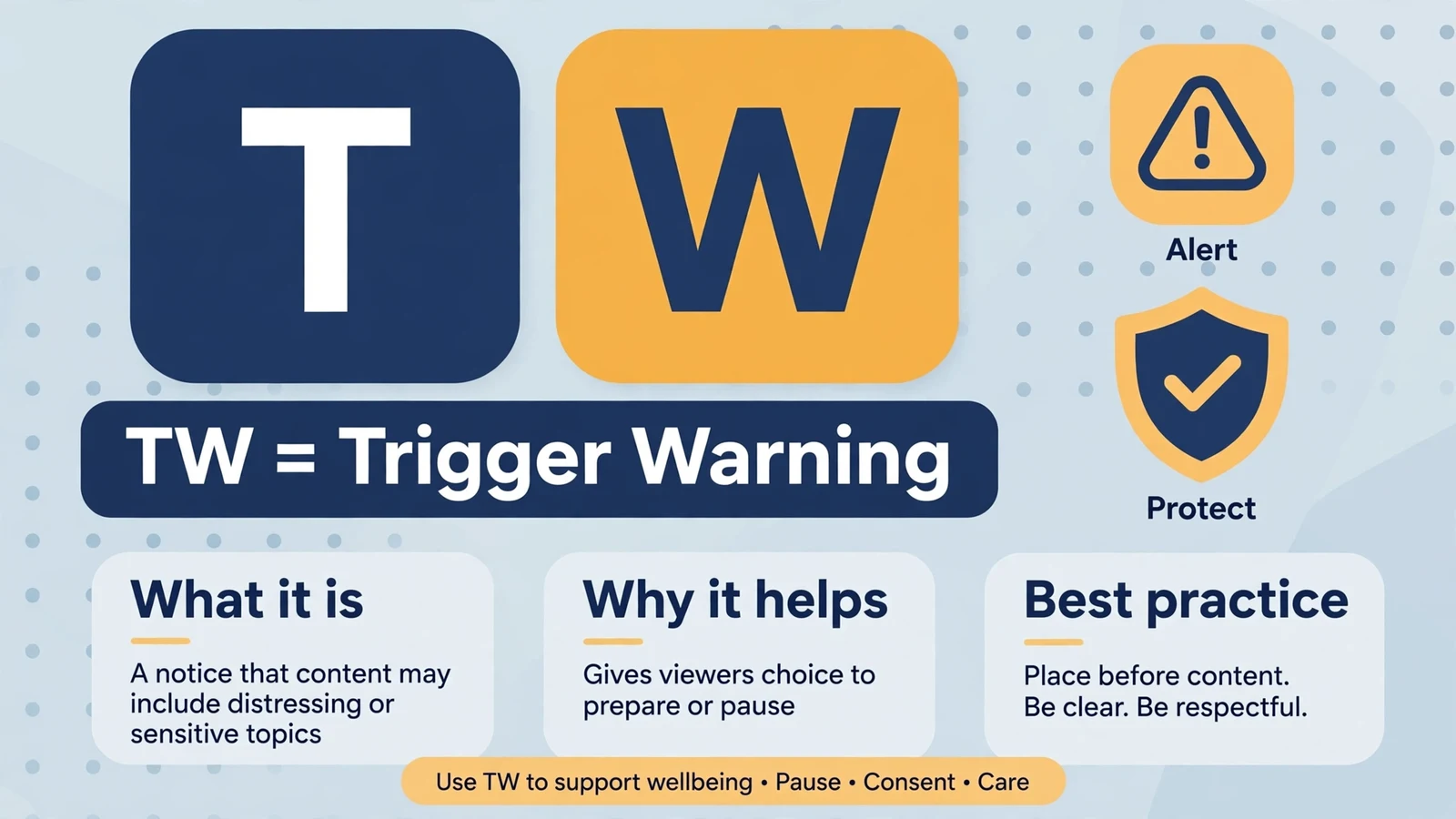
If you have seen “TW:” sitting at the top of a post, caption, or message, here is the quick answer. TW means Trigger Warning. It is a short heads-up placed before content that could upset or distress some readers, so they can choose whether to keep reading, save it for later, or skip it entirely.
Unlike most texting slang, TW is not a joke or a casual shortcut. The tw meaning in text is serious: the writer is flagging heavy material ahead, usually in the format “TW: [topic],” and giving you a fair chance to brace yourself or scroll past. This guide explains what a trigger warning actually does, how to use TW correctly, how it differs from CW, and the other meanings TW can carry in different contexts.
What Does TW Mean in Text?
A trigger warning is a brief label that tells readers the content ahead touches on topics that may cause emotional distress or bring back difficult memories. The idea comes from psychology, where a “trigger” is something that sets off a trauma response, especially for people living with PTSD or recovering from a painful experience. The warning does not remove or censor anything. It simply adds information before the content starts, and information gives people control.
The standard format is simple:
- TW: [specific topic], for example “TW: self-harm” or “TW: graphic violence”
- It goes at the very beginning, before any detail, ideally on its own line
- It names the actual topic, because a bare “TW” with no topic tells the reader nothing useful
Topics that commonly get a TW include violence and graphic injury, abuse of any kind, sexual assault, self-harm, suicide, eating disorders and body image, mental health struggles such as depression and anxiety, death and grief, substance abuse and addiction, and animal cruelty. Some communities also warn for flashing lights or specific phobias in videos.
You will see TW across TikTok captions, Instagram posts, X threads, Reddit posts, Tumblr tags, Discord servers, and group chats. In many mental health and fandom communities it is not just polite, it is an expected rule of posting. Dictionary.com now lists TW as an established abbreviation for trigger warning, which shows how far the term has traveled from its early days in trauma support and feminist forums in the early 2000s, through Tumblr in the early 2010s, and into everyday social media.
How to Use TW Correctly
Using TW well takes about five seconds, and the difference between a helpful warning and a useless one comes down to three habits.
Put it first. The warning only works if it arrives before the content. A TW placed after a graphic description is like a seatbelt handed over after the crash. Put it on the first line, before images, details, or spoilers of the heavy part.
Name the topic. “TW” alone forces readers to guess, and guessing helps nobody. “TW: eating disorders” or “TW: car accident” lets each person judge their own limits. Specificity is the entire point of the label.
Leave a small buffer. Many writers add a line break or a few dots after the warning before the real content begins. On Discord, people often pair the warning with spoiler formatting, hiding the sensitive text behind a tap. That extra beat gives readers a genuine chance to stop.
What about tone? Keep it plain and factual. A TW is a signpost, not a dramatic announcement, and it does not need an apology attached. The warning itself is the courtesy.
TW in Real Conversations
TW shows up in slightly different shapes depending on where you are. These four scenarios cover the most common ones.
1. A Personal Post on Social Media
- Nadia: TW: eating disorders. I want to share something that happened to me this week, because I think it might help someone.
- Commenter: Thanks for the TW. I will read this tonight when I am in a better headspace.
2. A Heads-Up in a DM
- Alice: Sending you that article, but TW: it discusses mental health issues in detail.
- Bob: Thanks for letting me know. I appreciate the warning.
- Alice: Of course. Read it whenever, no rush.
3. A Group Chat Forward
- Sam: Sharing this news story here. tw grief, it is about a local family losing their home.
- Rena: Thanks for flagging it. I will skip this one today.
- Sam: Totally fair.
4. Checking Before You Share
- Mike: I sent you the link to that new documentary.
- Jason: Does it need a TW? I know it covers some heavy crime topics.
- Mike: Yes, definitely. It has a TW for violence right in the intro.
Lowercase “tw” is common in fast chats and captions, and it means exactly the same thing. Capitalization changes nothing here; the topic after it is what matters.
TW vs CW vs CN: What Is the Difference?
TW is often mentioned alongside two close relatives, CW and CN, and they are not interchangeable, even though many people use them loosely. This table keeps them straight, along with two other labels TW gets confused with.
| Label | Full form | What it covers | Where you will see it |
|---|---|---|---|
| TW | Trigger Warning | Specific topics likely to trigger a trauma response, such as abuse, self-harm, or sexual assault | Mental health spaces, social posts, group chats, fandom |
| CW | Content Warning | Any sensitive or mature content, broader than TW: strong language, politics, graphic imagery, spoilers | Tumblr, Mastodon, forums, community posts |
| CN | Content Note | The same job in a neutral, factual tone, without the word “warning” | Academic writing, journalism, professional newsletters, some fanfiction archives |
| NSFW | Not Safe For Work | Explicit or work-inappropriate content, which is a different concern from emotional distress | Everywhere online |
| Spoiler warning | Spoiler | Plot reveals that ruin a story, not distressing real-world topics | Reviews, fandom, entertainment posts |
A simple way to remember it: TW is the narrowest and most serious, CW covers sensitive content in general, and CN is the formal version of the same idea. If a post could genuinely retraumatize someone, TW is the right label. If it is merely mature or uncomfortable, CW usually fits better.
Other Meanings of TW
Trigger Warning dominates texting and social media, but TW is a busy pair of letters, and context can hand it a completely different job. In a gaming Discord, TW likely means the Total War strategy games, or a Team Wipe when a whole squad goes down. In a work chat, “free tw” usually means “this week,” and praise like “great TW” means teamwork. In news, travel, and shipping, TW is the country code for Taiwan. Older posts sometimes used TW for Twitter, though that reading has faded since the platform became X. Fan communities may use it for Twilight, and in jewellery listings it can mean total weight, as in the combined carat weight of stones.
| Meaning | Context | Example |
|---|---|---|
| Trigger Warning | Texts, captions, posts | “TW: violence. This video gets graphic.” |
| Taiwan | News, travel, shipping | “Flying to TW next month for work.” |
| Total War | Gaming | “Anyone playing TW: Warhammer 3 tonight?” |
| Team Wipe | Gaming, PvP matches | “That ambush was a full TW, nobody survived.” |
| This Week | Work and scheduling chats | “I am swamped tw, let us meet next Monday.” |
| Teamwork | Work praise | “Great TW on that project, everyone.” |
The tell is almost always position and company. If TW opens a post and is followed by a colon and a heavy topic, it is a trigger warning. If it sits inside a sentence about flights, games, or deadlines, it is one of the others.
How to Respond When You See a TW
Seeing a TW gives you options, and every one of them is acceptable. That is the whole design.
- Continue reading. If you feel prepared, go ahead. No reply is required.
- Save it for later. A simple “Thanks for the TW, I will come back to this when I am ready” works well.
- Skip it silently. Skipping needs zero explanation. The warning exists precisely so you can walk away without a scene.
- Ask if it is vague. “TW for what?” is a completely fair question, and most posters appreciate being asked.
- Thank the poster. A quick “thanks for the heads-up” reinforces the habit for everyone in the group.
- Suggest one gently if it is missing. “This might be worth a TW for folks in the group” is helpful, not preachy.
What not to do: do not mock the warning, dismiss it as unnecessary, or pressure someone to remove it. You are free to ignore a TW for yourself. You are not the audience it was written for, and that is fine.
Common Mistakes With TW
Writing TW with no topic. A bare “TW” warns about nothing in particular. Always name the subject.
Putting it in the wrong place. A warning after the content, or buried mid-caption, protects nobody. First line, every time.
Using it as a joke. “TW: Mondays” and similar gags exist, but they dilute a label that other people rely on for real protection. Most guides advise against it.
Overusing it. Tagging every mildly sad post turns the label into background noise. Save TW for content that could genuinely distress someone, and real warnings will keep their weight.
Treating it as censorship. A TW bans nothing and hides nothing by default. It adds a label and leaves the choice with the reader.
Using it in formal writing. Bare “TW” is a social media convention. In a work email or report, spell it out: “Content advisory: the following section discusses graphic case details.” You may occasionally see claims online that TW means “Teacher Watching” in school chats. No major slang dictionary or texting guide confirms that meaning, so treat it as an unverified niche claim, not established slang.
Frequently Asked Questions
What does TW stand for in text?
TW stands for Trigger Warning. It is a short label placed before content that could cause emotional distress, such as material about violence, abuse, self-harm, or mental health struggles, so readers can decide whether to continue or skip it.
Is TW the same as CW?
No. TW (Trigger Warning) is narrow and focuses on topics that can trigger a trauma response. CW (Content Warning) is broader and covers any sensitive or mature content, including strong language, politics, or graphic imagery. Many communities use them loosely, but the distinction is real.
What is the difference between TW and NSFW?
NSFW (Not Safe For Work) flags explicit or work-inappropriate content. TW flags content that could cause emotional or psychological distress. A post can carry one, both, or neither, because they warn about different risks.
When should you use a trigger warning?
Use one before sharing content about heavy topics such as violence, abuse, sexual assault, self-harm, suicide, eating disorders, death, or addiction, especially in public posts and group chats. Always name the specific topic after TW, and place the warning before the content.
Can TW mean something other than Trigger Warning?
Yes, in other contexts. TW can mean Taiwan in news and travel, Total War or Team Wipe in gaming, and This Week or Teamwork in work chats. If TW opens a post followed by a colon and a topic, it is a trigger warning.
Is TW appropriate for professional emails?
Not in its bare form. “TW” is a social media and chat convention. In formal emails or reports, spell it out instead, for example: “Content advisory: the following section discusses graphic case details.”
How do you respond to a TW?
You can read on if you feel ready, save the post for later, or skip it without any explanation. Thanking the poster (“thanks for the heads-up”) is always welcome, and if the warning is unclear, asking “TW for what?” is perfectly fine.
Related Texting Slang
Keep exploring the dictionary: DM in chats and texts, FYP in chats and texts, GOAT in chats and texts, SMH in chats and texts, when someone texts you woke, the meaning of yaoi.
Conclusion
TW is two letters doing genuinely kind work. It stands for Trigger Warning, a small label placed before heavy content so readers can prepare, postpone, or pass, with no pressure either way. Use it first, name the topic, and keep it serious, and you are using it exactly right. Just remember that context rules every abbreviation: in a gaming chat or a shipping update, those same letters may mean Total War or Taiwan instead. When TW opens a post with a colon and a topic, though, you can be confident you are looking at a warning, and the choice of what to do next is yours.
Sources: Wikipedia: Trigger Warning, Dictionary.com: Trigger Warning