
You open a message that starts with three letters and then a piece of news: “FYI, the meeting moved to 3 pm.” Do you need to reply? Do anything? Or just know it?
Here is the short answer: FYI means “For Your Information”. It is a short heads-up that shares something you should know, and it usually asks for no action and no reply. Once you know that one rule, almost every FYI message becomes easy to read.
In this guide you will learn what does FYI mean in text, how to use FYI in a text without sounding rude, and why the same three letters can feel helpful in one message and pointed in another.
What Does FYI Mean in Text?
FYI stands for For Your Information.
That lead is unanimous. CyberDefinitions gives For Your Information as its sole texting meaning for FYI. The top niche guides for “FYI meaning in text” agree word for word, describing it as a way to introduce something the sender thinks you should know, with no further action expected. Cambridge, Merriam-Webster, and Wikipedia confirm the same expansion, and no rival texting meaning appears in any of those checks.
Quick definition: FYI means For Your Information. It is used at the start of a message, or on its own before a link or a file, to flag that the information matters but does not demand a decision. The fyi meaning in texting is therefore a label for the message that follows, not a question and not an order.

The history is older than texting. FYI began as a journalist and wire service abbreviation, used to pass along information, and it moved naturally into email, then into instant messaging. That long life is why it feels familiar even to people who rarely use slang: FYI is workplace shorthand that became everyday shorthand, rather than slang that stayed in one age group.
FYI Meaning in Easy Words
Think of FYI as a friendly tap on the shoulder before a fact.
Without FYI, a message like “The meeting moved to 3 pm” can feel abrupt, as if you were supposed to already know. With FYI in front, the same message becomes “Here is something you should know: the meeting moved to 3 pm.” The fact is identical, but the framing changes:
FYI = “Just so you know” in three letters.
It works like other framing words. “Heads up” warns you about something coming. “Quick note” softens a message. FYI does both jobs at once: it says this is worth knowing, and it says you do not have to do anything about it right now. That second part is the part people most often miss, and it explains why FYI messages so often sit unanswered without any offence meant.
The fyi stands for question has only one ordinary answer in texting, and that simplicity is a strength. Unlike many abbreviations in this series, FYI does not hide a second chat meaning. If a message says FYI, the sender is sharing information, and the only question is tone, not definition.
Where Is FYI Used?
FYI shows up wherever information needs to travel fast without a meeting or a long explanation. Common places include:
- Work emails and Slack messages sharing a change, a link, or a file
- WhatsApp and SMS messages passing on a time, a place, or a price change
- Group chats where one update matters to everyone at once
- Discord and gaming chats sharing a patch note, a rule, or a schedule change
- Captions and DMs sharing news, tips, or updates quickly
The fyi meaning in email is the classic use: forwarding a document with FYI signals that the reader should know about it, but no action is expected yet. The fyi meaning on TikTok and the fyi meaning on Instagram follow the same pattern in captions and DMs, as in “FYI, new episode drops tonight”, where the point is fast news, not a request. The platform changes the speed and the audience, not the expansion.
Why Do People Use FYI?
It saves a whole sentence
“I am telling you this because you should know it, but you do not need to do anything” is a long sentence. FYI compresses it into three letters, and every regular reader understands the compression at once.
It sets expectations about replies
A bare fact can feel like a hidden task. FYI removes that pressure by labelling the message as information only. The reader can absorb it, file it, and move on, which is exactly what busy chats need.
It keeps a record without a meeting
Sending an FYI creates a timestamped note that the information was shared. In work chats that matters, because it prevents the later argument about who knew what, and when.
FYI on Social Media, in Captions, and in Tone
FYI has no separate platform expansion, but it does have a platform tone shift, and that shift is documented by several sources. In a helpful message, FYI sounds neutral and kind: a friend sharing a useful update. In a pointed message, the same three letters can sound curt, or even passive-aggressive, especially when the fact is something the reader should already have known.
Just FYI meaning is a good example of that shift. “Just FYI” often softens a message, as in “Just FYI, the shop closes early today”, but it can also sharpen one, as in “Just FYI, I already told you that.” The words after FYI, and the history between sender and reader, decide which tone lands. The abbreviation itself does not carry rudeness, but it does not remove rudeness either.
On TikTok and Instagram, FYI in captions and comments usually leans helpful, because captions share tips, facts, and updates with a wide audience. In a one-to-one DM after an argument, the same FYI can lean pointed. Read the relationship first, then the letters.
Real-Life Examples of FYI
Here are five realistic chats showing FYI in action, with the meaning spelled out each time:
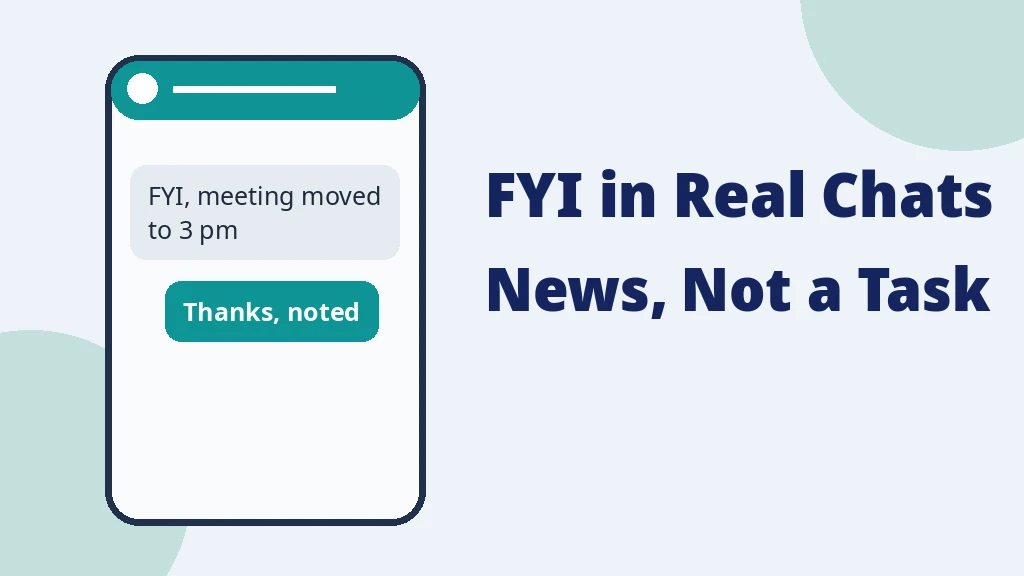
Example 1:
- Colleague: “FYI, the meeting moved to 3 pm.”
- You: “Thanks, noted.”
Meaning: For your information, the meeting time has changed. No action is requested beyond knowing the new time.
Example 2:
- Friend: “FYI, tickets sell out fast for Saturday.”
- You: “Good to know, I will book tonight.”
Meaning: Just so you know, Saturday tickets go quickly. The sender is helping, not ordering you to book.
Example 3:
- Manager: “FYI, here is the new price list, no action needed yet.”
- You: “Got it, thanks.”
Meaning: For your information, here is a document to be aware of. The sender spells out the no-action rule that FYI usually implies.
Example 4:
- Friend: “Just FYI, the shop closes early today.”
- You: “Thanks for the heads-up.”
Meaning: Just so you know, plan around the early closing time. The word “just” softens the note and marks it as helpful.
Example 5:
- Friend: “FYI, I already sent that file yesterday.”
- You: “Sorry, I missed it, thanks.”
Meaning: For your information, the file was already sent. Here the tone is pointed, because the fact corrects the reader, and that tone comes from the sentence, not from FYI alone.
FYI vs FYA Difference
FYI has one close neighbour that causes real confusion in work chats, and the fyi vs fya difference is worth learning once and keeping. FYI shares information. FYA asks for action.
| Term | Meaning | What the reader should do |
|---|---|---|
| FYI | For Your Information | Know it, no action expected |
| FYA | For Your Action | Act on it, reply or complete a task |
| Heads up | A warning or advance note | Be ready for something coming |
| Note | A short record or reminder | Remember it for later |
Key difference: If a message says FYI, silence is usually an acceptable reply. If a message says FYA, silence can look like the task was ignored. Mixing the two up is how files sit unread and deadlines slip, so work chats use the pair deliberately. For a short form that ends a chat for the night rather than sharing news, here is what BRB means in text, and for a private message that often carries FYI-style updates, here is what DM means in text.
When to Use FYI (and When to Avoid It)
Good situations:
- Sharing a change, a link, or a file that the reader should know about
- Updating a group chat where everyone needs the same fact
- Forwarding information in email with no action expected yet
- Adding a helpful note to a caption, a tip, or a quick update
Avoid using FYI when:
- You actually need action, and FYA or a direct request would be clearer
- The fact is sensitive, and a bare FYI would sound cold or dismissive
- The reader already knows the fact, and FYI would sound like a correction
- The message is the first contact with someone, and a full sentence would be warmer
Learning how to use FYI in a text comes down to one check: if you would be happy with no reply, FYI fits. If you need a reply, write the request plainly instead.
Common Misunderstandings About FYI
It does not mean you must reply. FYI usually signals information only. A short thanks is polite, but a full reply is not required.
It is not always rude. Is FYI rude? Usually no. It can sound pointed when the fact corrects someone, but in most messages it is neutral and helpful.
It is not the same as FYA. FYI shares, FYA assigns. Treating them as twins causes missed tasks on one side and needless pressure on the other.
It is not slang for young people only. FYI is used by adults and teenagers alike, in workplaces and in private chats, and it predates modern texting slang by decades.
It is not a technical term in chat. In Internet Standards, FYI is also a subset of the RFC document series, but that is a technical use, not a texting sense, and it should never be read into a chat message.
How to Reply to FYI
Your reply depends on whether the information needs acknowledgement.
If it is a simple update: a short thanks is enough. “Thanks, noted” or “Got it” closes the loop politely.
If you have a question about the fact: ask it directly. “Thanks, does that change anything for tomorrow?” turns information into a useful next step.
If it sounds pointed: do not mirror the tone. A calm “Thanks for letting me know” keeps the chat civil, even when the FYI felt sharp.
If you are the sender: add one line when action might be unclear. “FYI, no action needed” removes all doubt, and it costs only three extra words.
Frequently Asked Questions
What does FYI mean in text?
FYI means For Your Information in text. It introduces something the sender thinks you should know, usually with no action or reply expected.
What does FYI stand for?
FYI stands for For Your Information. It began as a journalist and wire service abbreviation and is now used in emails, chats, and social messages.
Is FYI rude?
FYI is usually not rude. It is neutral and helpful in most messages, but it can sound pointed when the fact corrects the reader or repeats something they already knew.
What is the difference between FYI and FYA?
FYI means For Your Information and asks for no action, while FYA means For Your Action and asks the reader to act, reply, or complete a task. The two should not be swapped.
Do I need to reply to an FYI message?
No, a reply is not usually required. A short thanks or Got it is polite, but FYI messages are designed to be read and filed, not answered in full.
What does just FYI mean?
Just FYI means just so you know. It usually softens a helpful note, as in Just FYI, the shop closes early today, but it can also sharpen a correction depending on the sentence around it.
Related Texting Slang
Keep exploring the dictionary: how people actually use CV, the DRE meaning, in plain words, GB, explained with real examples, what GI means in a text, how people actually use slow startup on Windows.
Final Thoughts
FYI is the easiest abbreviation in this series to use well, because its meaning never changes. It means For Your Information, it shares a fact, and it usually asks for nothing back. The skill is not in decoding it, but in using it kindly: share facts that help, add “no action needed” when the reader might wonder, and save direct requests for the moments when you actually need a reply. Used that way, FYI keeps chats fast without making them cold.
For the dictionary record, Cambridge defines FYI as the written abbreviation for for your information, used when sending someone an announcement or something they should know, and Wikipedia traces FYI from journalist wire use to everyday emails and messages, which explains why it feels familiar across ages and workplaces.
1 thought on “FYI Meaning in Text | Small Note, Big Tone Difference”